










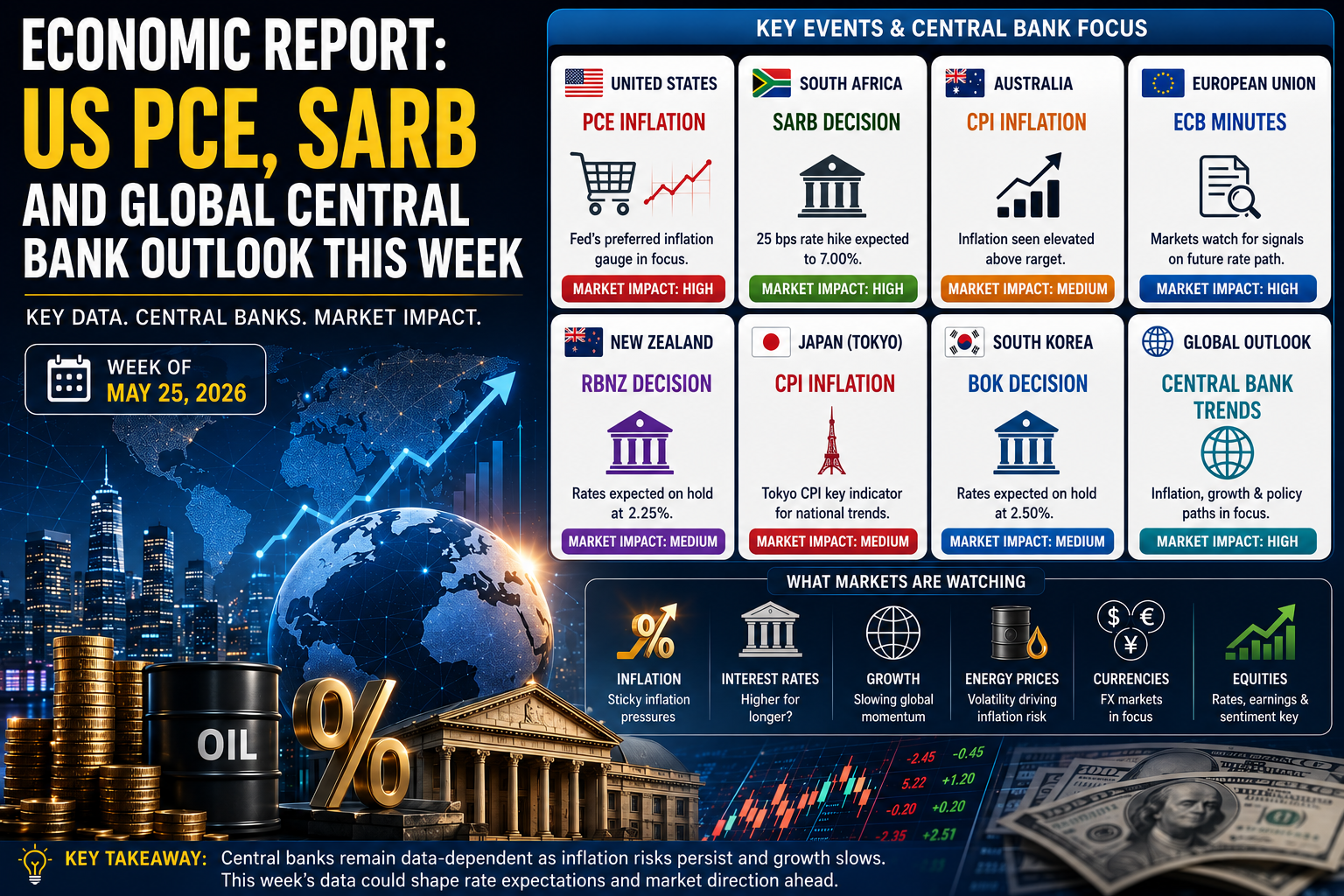
Economic Report Opens With Key Global Market Drivers
Economic report expectations this week are heavily centered on inflation data, central bank decisions and interest rate guidance across several major economies. Investors, policymakers and financial markets are closely monitoring the US PCE inflation report, the SARB interest rate decision, Australian CPI figures, Tokyo CPI data and the latest ECB minutes for signals on the future direction of monetary policy.
The global macroeconomic environment remains sensitive to inflation persistence, energy market volatility and slowing growth momentum. Central banks continue to balance inflation risks against weakening consumer demand and softer labour market conditions. As a result, this week’s economic report could play a major role in shaping expectations for interest rates, currency markets, bond yields and equity performance during the second half of the year.
The primary focus remains the US PCE inflation report, which is the Federal Reserve’s preferred inflation measure. Markets are also watching the SARB closely as South Africa faces renewed inflation pressure from higher energy costs and imported price risks. Meanwhile, policymakers at the ECB, RBNZ and BoK are attempting to navigate increasingly complex economic conditions without disrupting fragile growth trends.
This economic report provides a detailed analysis of the key events scheduled for the week ahead, along with a review of the major economic developments from the previous week.
Why This Economic Report Matters for Global Markets
Global financial markets are entering a critical period where inflation data and central bank communication are driving almost every major asset class. Bond markets remain highly sensitive to inflation surprises, while equity markets continue to adjust to the possibility of interest rates remaining higher for longer.
Several themes are dominating market sentiment:
- Persistent inflation pressures
- Energy price volatility
- Slowing global growth
- Tight labour markets
- Central bank credibility
- Currency market instability
The economic report this week arrives at a time when policymakers are increasingly divided over whether additional tightening is necessary. Some economies continue to experience resilient inflation despite slowing activity, while others are beginning to show clearer signs of economic weakness.
For traders and investors, understanding the direction of monetary policy remains essential because interest rate expectations continue to shape market valuations globally.
US PCE Inflation Takes Centre Stage
Why the US PCE Report Is Important
The US PCE inflation report remains the most important event in this economic report because it directly influences Federal Reserve policy expectations. Unlike CPI, the Personal Consumption Expenditures index reflects changing consumer behaviour and carries a lower weighting for energy prices.
Markets are expecting another firm inflation reading after both CPI and PPI data surprised to the upside earlier in the month. Analysts now believe that core PCE inflation could print between 0.3% and 0.4% month-on-month.
A stronger reading would reinforce concerns that inflation remains too sticky for the Federal Reserve to begin easing policy anytime soon.
Oxford Economics forecasts:
- Headline PCE at 3.8% year-on-year
- Core PCE at 3.3% year-on-year
These projections represent some of the hottest inflation readings seen since 2022.

Federal Reserve Outlook Following US PCE
Federal Reserve officials have recently adopted a more cautious and hawkish tone. The latest FOMC minutes showed growing support for maintaining restrictive policy settings for longer.
Several factors are contributing to inflation risks:
- Rising energy prices
- Strong labour market conditions
- AI-related infrastructure demand
- Geopolitical tensions
- Elevated consumer spending
The economic report suggests that if US PCE inflation remains elevated, markets could begin pricing in additional Federal Reserve tightening later in the year.
Currently, markets still expect rates to remain elevated through year-end despite earlier expectations for policy easing.
SARB Policy Decision in Focus
SARB Expected to Raise Rates
The SARB policy announcement is another major highlight in this economic report. Expectations currently point to a 25 basis point interest rate increase, which would take the repo rate to 7%.
7%−6.75%=0.25%7\%-6.75\%=0.25\%7%−6.75%=0.25%
South African inflation pressures have accelerated recently, largely due to higher energy prices and imported inflation risks.
Headline inflation surged sharply:
- Previous reading: 3.1%
- Latest reading: 4.0%
The latest inflation figure now sits at the upper end of the SARB’s target range.
Why SARB Remains Cautious
SARB Governor Lesetja Kganyago has repeatedly emphasized the importance of monitoring incoming inflation data carefully before determining future policy decisions.
The South African Reserve Bank faces several competing challenges:
- Higher fuel prices
- Weak domestic growth
- Currency volatility
- Global inflation pressures
- Slowing consumer demand
Despite concerns over growth, inflation stability remains the SARB’s primary objective. Policymakers are attempting to preserve credibility while preventing inflation expectations from becoming unanchored.
This economic report suggests the SARB is likely to maintain a data-dependent approach in the coming months.
RBNZ Policy Announcement and New Zealand Inflation Risks
RBNZ Expected to Hold Rates
The Reserve Bank of New Zealand is widely expected to keep its Official Cash Rate unchanged at 2.25%.
OCR=2.25%OCR=2.25\%OCR=2.25%
Most economists believe policymakers will pause for a third consecutive meeting, although inflation concerns remain elevated.
The RBNZ has recently maintained a hawkish tone despite holding rates steady. Officials continue to warn that inflation expectations must remain anchored around the 2% midpoint target.
Inflation Remains a Concern in New Zealand
Recent New Zealand economic data has produced mixed signals:
- Unemployment unexpectedly declined
- Inflation moved above target
- Wage growth remains elevated
- Sectoral inflation softened slightly
Although policymakers discussed a potential hike at the previous meeting, officials indicated they were not close to raising rates immediately.
Still, markets remain alert to the possibility of future tightening later in the year.
Australian CPI and RBA Expectations
Australian Inflation Remains Elevated
Australian CPI data is expected to remain elevated, reinforcing concerns that inflation may stay above target longer than expected.
The previous inflation reading came in at 4.6% year-on-year, and markets are watching closely for signs of persistence.
CPIAustralia=4.6% y/yCPI_{Australia}=4.6\%\ y/yCPIAustralia=4.6% y/y
The Reserve Bank of Australia has consistently warned about the risk of inflation expectations becoming de-anchored.
Labour Market Weakness Changes the Outlook
Recent Australian employment data surprised negatively:
- Employment declined
- Unemployment increased
- Participation rates softened
These developments have reduced expectations for immediate rate hikes. Markets now see a pause as the most likely outcome at the next RBA meeting.
However, inflation risks remain elevated due to:
- Energy costs
- Supply chain pressures
- Sticky services inflation
This economic report indicates that the RBA remains in a difficult position as it balances slowing growth against persistent inflation.
ECB Minutes Could Shift European Market Expectations
ECB Debate Around Further Tightening
The ECB minutes will provide important insight into how policymakers view inflation and growth risks across the euro area.
Although rates were left unchanged at the previous meeting, President Christine Lagarde confirmed that a rate hike was discussed internally.
The minutes are expected to reveal:
- How many members supported tighter policy
- Concerns about inflation persistence
- Views on growth deterioration
- Debate around future guidance
Markets increasingly believe the ECB could move toward tighter monetary conditions if inflation remains elevated.
Eurozone Growth Remains Weak
Recent PMI data across Europe has been disappointing:
- Services activity weakened
- Manufacturing momentum slowed
- France showed particularly weak demand
- Germany remains fragile
This creates a difficult policy environment for the ECB because inflation remains elevated while growth deteriorates.
The economic report highlights the growing risk of stagflation-like conditions within the eurozone economy.
BoK Faces Policy Challenges Amid Global Uncertainty
Bank of Korea Expected to Hold Rates
The Bank of Korea is expected to maintain its Base Rate at 2.50%.
Base Rate=2.50%Base\ Rate=2.50\%Base Rate=2.50%
Officials remain cautious due to:
- Middle East tensions
- Currency volatility
- Trade uncertainty
- Weak external demand
The new governor’s comments will be closely monitored for any shift in policy direction.
Korean Inflation and Financial Stability Risks
Some analysts believe the Bank of Korea could eventually tighten policy again if inflation pressures intensify.
Concerns include:
- Excessive household debt
- Financial imbalances
- Currency depreciation
- Imported inflation
At the same time, policymakers remain concerned about growth risks linked to weaker global demand.
This economic report suggests the BoK is likely to remain patient for now while maintaining flexibility.

Tokyo CPI and Japanese Inflation Trends
Tokyo CPI Seen Remaining Soft
Tokyo CPI data remains important because it acts as a leading indicator for national inflation trends in Japan.
Current expectations suggest:
- Core CPI around 1.5% to 1.7%
- Core-core CPI near 2%
Tokyo CPI≈1.5%−1.7%Tokyo\ CPI\approx1.5\%-1.7\%Tokyo CPI≈1.5%−1.7%
Inflation momentum in Japan has cooled in recent months due to government subsidies and softer food price inflation.
Bank of Japan Still Monitoring Wage Growth
Despite softer inflation readings, the Bank of Japan remains focused on:
- Wage growth
- Services inflation
- Domestic demand
- Labour market tightness
A stronger-than-expected Tokyo CPI print could increase expectations for additional BoJ tightening later this year.
However, softer inflation data would likely support the central bank’s cautious approach.
Week In Review: Key Economic Developments
FOMC Minutes Reinforced Hawkish Bias
The latest FOMC minutes reinforced the Federal Reserve’s increasingly hawkish stance.
Officials expressed concern about:
- Persistent inflation
- Energy market shocks
- Trade disruptions
- Inflation expectations
Several policymakers suggested additional tightening may become necessary if inflation remains elevated.
This shift has contributed to:
- Higher Treasury yields
- Stronger US dollar demand
- Reduced expectations for rate cuts
Australian Labour Market Softened
Australia’s employment report surprised markets negatively.
Key figures included:
- Falling employment
- Rising unemployment
- Lower participation rates
This data reduced expectations for immediate RBA tightening while weakening the Australian dollar.
Still, inflation concerns remain unresolved.
Japanese Inflation Missed Expectations
Japan’s inflation figures came in softer than expected across all major measures.
Headline inflation slowed while core inflation also moderated.
Government subsidies helped suppress:
- Fuel prices
- Education costs
- Household inflation pressures
This has complicated the Bank of Japan’s normalization strategy.
UK Data Pointed to Economic Weakness
Several UK data releases pointed toward slowing economic activity:
- Weak retail sales
- Softer PMIs
- Rising unemployment
- Declining vacancies
At the same time, inflation pressures remain elevated due to energy prices.
This creates a difficult challenge for the Bank of England.
How Financial Markets Could React
Bond Markets
Bond yields remain highly sensitive to inflation surprises.
A stronger US PCE reading could:
- Push Treasury yields higher
- Increase expectations for tighter policy
- Pressure global bond markets
Meanwhile, weaker inflation data could support risk assets.
Currency Markets
The US dollar remains supported by:
- Higher US yields
- Hawkish Federal Reserve expectations
- Safe-haven demand
The South African rand may remain volatile around the SARB decision.
Meanwhile:
- AUD remains sensitive to CPI data
- JPY depends heavily on inflation outcomes
- EUR reacts to ECB guidance
Equity Markets
Equity markets continue to struggle with:
- Higher interest rates
- Slowing growth
- Inflation uncertainty
Technology stocks remain particularly sensitive to bond yield movements.
Investors are increasingly focused on whether central banks can achieve a soft landing without triggering deeper economic weakness.
What Traders and Investors Should Monitor
This economic report highlights several major themes traders should monitor closely:
Key Inflation Indicators
- US PCE
- Australian CPI
- Tokyo CPI
Central Bank Decisions
- SARB
- RBNZ
- BoK
Policy Guidance
- ECB minutes
- Federal Reserve commentary
- Inflation expectations
Market Risks
- Energy prices
- Geopolitical tensions
- Currency volatility
- Slowing global growth
Longer-Term Global Economic Outlook
The broader global outlook remains uncertain.
Central banks are attempting to control inflation without causing severe economic slowdowns. However, inflation remains more persistent than many policymakers expected earlier in the cycle.
Several longer-term risks remain:
- Elevated debt levels
- Geopolitical instability
- Structural inflation pressures
- Slower productivity growth
- Weak global trade momentum
At the same time, labour markets in many advanced economies remain relatively resilient.
This combination continues to complicate policymaking globally.

Frequently Asked Questions
What is the US PCE report?
The US PCE report measures inflation based on consumer spending and is the Federal Reserve’s preferred inflation indicator.
Why is the SARB decision important?
The SARB decision influences South African borrowing costs, inflation expectations, the rand and broader financial market conditions.
What is the ECB minutes report?
ECB minutes provide detailed insight into policy discussions among European Central Bank officials.
Why does Tokyo CPI matter?
Tokyo CPI acts as an early indicator of national inflation trends in Japan.
What are markets expecting from the RBNZ?
Markets expect the RBNZ to hold rates steady while maintaining a hawkish tone.
Why is inflation still a concern globally?
Inflation remains elevated due to energy costs, labour market tightness and supply-side pressures.
Conclusion
This economic report highlights one of the most important weeks for global macroeconomic markets in recent months. The US PCE inflation report, SARB decision, ECB minutes and several major inflation releases could significantly influence expectations for global monetary policy.
Markets remain highly sensitive to inflation surprises as investors attempt to determine whether central banks will maintain restrictive policy settings for longer than previously expected.
The Federal Reserve continues to focus heavily on inflation persistence, while the SARB faces renewed pressure from higher energy costs and inflation risks. Meanwhile, policymakers across Europe, Asia and Oceania continue balancing inflation control against weakening growth momentum.
For traders and investors, this week’s economic report provides critical insight into the evolving global interest rate environment and the direction of financial markets during the months ahead.