









Nvidia delivered another strong quarter during the latest earnings season, reporting financial results that once again exceeded Wall Street expectations. The company posted higher-than-expected revenue, stronger earnings per share, and continued momentum across its data centre business as global demand for artificial intelligence infrastructure remained elevated.
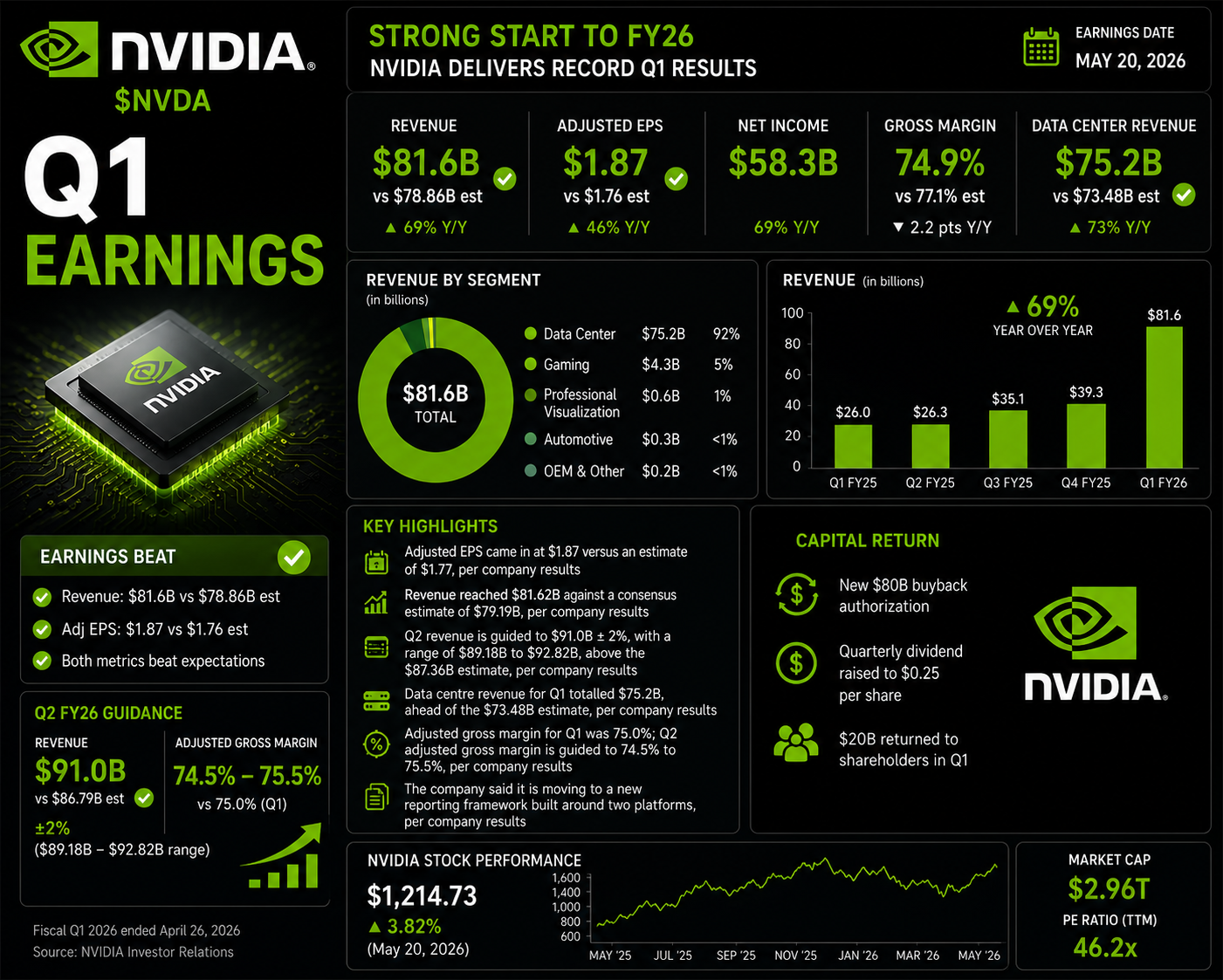
The latest Nvidia earnings report showed that the company continues to benefit from the rapid expansion of AI-related spending by hyperscalers, enterprise customers, and cloud computing providers. Revenue for the quarter reached $81.62B, while adjusted earnings per share came in above analyst forecasts at $1.87. More importantly for investors, Nvidia also issued stronger-than-expected guidance for the next quarter, signalling that AI infrastructure demand continues to accelerate rather than slow.
The results further reinforced Nvidia’s dominant position within the semiconductor industry. While concerns around competition, export restrictions, and valuation continue to remain part of the broader discussion surrounding AI-related companies, Nvidia’s latest numbers demonstrated that demand for high-performance computing chips continues to outpace supply in several key markets.
Nvidia Earnings Overview
Nvidia’s quarterly report reflected strong operational execution across nearly every major financial metric. Revenue growth remained robust, profitability stayed elevated, and forward guidance pointed to another quarter of expansion.
Key Quarterly Figures
| Metric | Reported | Estimate |
|---|---|---|
| Revenue | $81.62B | $79.19B |
| Adjusted EPS | $1.87 | $1.77 |
| Data Centre Revenue | $75.2B | $73.48B |
| Q2 Revenue Guidance | $91B | $87.36B |
| Adjusted Gross Margin | 75.0% | 74.6% Expected |
The quarter highlighted how deeply Nvidia has become tied to the ongoing global AI buildout. The company’s data centre division continued to represent the overwhelming majority of overall revenue growth as businesses increasingly invest in advanced computing infrastructure capable of supporting large-scale AI models and cloud services.
Data Centre Revenue Continues to Drive Nvidia Growth
The most important takeaway from the latest Nvidia earnings report was the continued strength of the company’s data centre business. Revenue within the segment reached $75.2B during the quarter, once again surpassing analyst expectations.
That figure alone demonstrates how critical AI infrastructure spending has become for both Nvidia and the broader technology sector. Data centre sales now account for the vast majority of Nvidia’s total revenue, reflecting sustained demand from hyperscale cloud providers and enterprise customers racing to expand their AI capabilities.
Why Data Centre Demand Remains Strong
Several factors continue to support elevated spending across AI infrastructure markets:
- Rapid adoption of generative AI applications
- Increased enterprise investment in machine learning
- Expansion of cloud computing capacity
- Demand for advanced GPU acceleration
- Ongoing development of large language models
- AI integration across multiple industries
Nvidia remains at the centre of this transition because its GPU architecture has effectively become the standard for AI training and inference workloads. Companies building AI systems continue to rely heavily on Nvidia hardware due to the ecosystem surrounding its software stack, developer tools, and computing performance.
The latest results suggest that customers are still willing to spend aggressively despite concerns about broader macroeconomic conditions and elevated capital expenditure levels.

AI Infrastructure Spending Remains in Full Expansion Mode
One of the biggest themes throughout this earnings season has been the continued growth in AI-related capital expenditure. Nvidia’s results provided perhaps the clearest evidence yet that spending on artificial intelligence infrastructure remains a top priority for large technology companies.
Major cloud providers continue allocating billions of dollars toward AI server expansion, networking upgrades, and high-performance computing systems. Nvidia’s chips remain central to these investments.
Hyperscalers Continue to Increase AI Spending
Large cloud companies continue competing aggressively to expand their AI capabilities. This competition has created an environment where demand for Nvidia hardware remains exceptionally strong.
Key areas driving spending include:
| AI Infrastructure Driver | Impact on Nvidia |
|---|---|
| Cloud AI Services | Increased GPU demand |
| Enterprise AI Adoption | Expansion of inference workloads |
| Generative AI Platforms | Higher compute requirements |
| AI Data Centres | Larger hardware deployments |
| AI Research Development | Continuous training demand |
The scale of this spending has become one of the defining themes across global technology markets. Nvidia’s results indicate that this trend is not slowing down.
Nvidia’s Q2 Guidance Exceeded Expectations
Forward guidance often matters more than headline quarterly results, and Nvidia’s outlook for the next quarter significantly exceeded Wall Street estimates.
The company projected Q2 revenue of approximately $91B, plus or minus 2%, compared with consensus forecasts closer to $87.36B.
That guidance range suggested continued momentum across the AI infrastructure market and reinforced confidence in ongoing demand trends.
What Nvidia’s Guidance Signals
Nvidia’s guidance matters because it provides insight into broader industry conditions.
The strong outlook suggests:
- AI spending remains elevated
- Enterprise demand continues growing
- Cloud providers are still expanding infrastructure
- Nvidia maintains strong pricing power
- Supply chain constraints remain manageable
- Customer order pipelines remain healthy
Markets typically look to Nvidia as a leading indicator for AI demand trends. Strong guidance therefore carries implications well beyond the semiconductor industry itself.
Gross Margins Remain Exceptionally Strong
Another major positive from the quarter was Nvidia’s ability to maintain extremely high profit margins despite growing competition within the semiconductor industry.
Adjusted gross margin came in at 75.0%, while guidance for the following quarter remained within a similarly strong range.
Why Margins Matter
Strong margins demonstrate several important advantages:
- Pricing power remains intact
- Customers continue prioritising Nvidia products
- Supply constraints have not significantly pressured profitability
- AI chips continue commanding premium valuations
Maintaining margins above 70% at Nvidia’s scale remains remarkable within the semiconductor sector.
Many investors closely monitor margin performance because it reflects both competitive positioning and operational efficiency. Nvidia’s ability to sustain these levels suggests demand remains significantly stronger than supply across much of the AI hardware market.
Nvidia Announces Major Shareholder Returns
Beyond operational performance, Nvidia also announced significant shareholder-friendly capital allocation measures.
Dividend Increase
The company raised its quarterly cash dividend to $0.25 per share from $0.01 previously.
That increase represented a substantial shift in Nvidia’s capital return strategy and reflected growing confidence in long-term cash generation.
$80B Share Buyback Authorisation
Nvidia also authorised an additional $80B share repurchase programme.
Large buyback programmes typically signal management confidence regarding future growth and profitability. They also provide ongoing support for shareholder returns over time.
The Broader Impact on Earnings Season
Nvidia’s quarterly report arrived during a period where investors remain heavily focused on AI-related spending trends across the technology sector.
The company’s results may influence sentiment across several areas:
- Semiconductor stocks
- Cloud computing providers
- AI software companies
- Data centre operators
- Enterprise technology firms
Because Nvidia sits at the centre of the AI infrastructure ecosystem, its earnings often shape broader market expectations for the entire sector.
Competition Within the AI Semiconductor Market
Despite Nvidia’s strong position, competition within the AI semiconductor market continues increasing.
Several companies are attempting to challenge Nvidia’s dominance, including:
- AMD
- Intel
- Custom AI accelerator providers
- Internal hyperscaler chip projects
However, Nvidia currently maintains significant advantages across software integration, ecosystem development, and overall market adoption.
Why Nvidia Maintains Its Lead

Nvidia’s competitive advantages include:
| Competitive Advantage | Explanation |
|---|---|
| CUDA Software Ecosystem | Widely adopted developer platform |
| GPU Performance | Strong AI training capability |
| Market Leadership | Established enterprise relationships |
| AI Infrastructure Integration | Broad hardware compatibility |
| Developer Adoption | Large ecosystem support |
These factors continue making it difficult for competitors to significantly erode Nvidia’s market position in the near term.
Geopolitical Risks Remain a Key Factor
While the quarter was clearly strong, investors continue monitoring geopolitical risks that could affect Nvidia’s long-term growth outlook.
Export Restrictions
US export restrictions on advanced AI chips remain one of the biggest uncertainties facing Nvidia.
These restrictions could potentially impact:
- China-related revenue
- International expansion
- Supply chain flexibility
- Long-term market access
However, Nvidia has continued adapting product offerings to comply with evolving regulatory frameworks.
Investor Sentiment Toward Nvidia Remains Strong
Investor sentiment surrounding Nvidia remains closely tied to broader enthusiasm around artificial intelligence.
The latest earnings report reinforced several key themes:
- AI spending remains robust
- Infrastructure demand continues growing
- Nvidia retains dominant market positioning
- Profitability remains exceptionally strong
Despite valuation concerns, many investors continue viewing Nvidia as one of the primary beneficiaries of long-term AI adoption trends.
Nvidia’s Role in the Future of Artificial Intelligence
Nvidia has evolved far beyond its origins as a gaming-focused graphics company.
Today, the company effectively serves as critical infrastructure for the modern AI economy.
Its chips now power:
- Large language models
- Cloud AI systems
- Enterprise AI applications
- Autonomous systems
- Scientific computing
- Advanced robotics
This transformation has fundamentally changed how investors evaluate Nvidia’s long-term growth potential.
Wall Street Reaction to Nvidia Earnings
Analysts broadly viewed the latest Nvidia earnings report positively.
Several factors drove strong market reactions:
- Revenue beat expectations
- Strong guidance
- Continued data centre growth
- Stable margins
- Increased shareholder returns
The results helped reinforce confidence that AI infrastructure investment remains one of the strongest growth themes across global markets.
What Investors Will Watch Next
Going forward, investors will likely focus on several major factors:
Key Areas to Monitor
- AI infrastructure demand trends
- Competitive pressures
- Gross margin sustainability
- Supply chain developments
- Export regulations
- Enterprise AI adoption rates
- Cloud spending levels
Each of these areas could significantly influence Nvidia’s future growth trajectory.
Conclusion
Nvidia delivered another impressive quarter as AI infrastructure spending continued supporting strong growth across its business. Revenue exceeded expectations, earnings surpassed forecasts, and forward guidance reinforced confidence in ongoing demand trends.
The company’s data centre segment once again served as the primary growth engine, highlighting Nvidia’s central role within the global artificial intelligence ecosystem. Strong margins, increased shareholder returns, and optimistic guidance further strengthened the broader investment case surrounding the company.
While risks around competition, regulation, and valuation remain important considerations, the latest results suggest Nvidia continues benefiting from one of the most significant technology investment cycles in recent history.
As the current earnings season continues, Nvidia’s results will likely remain a key reference point for investors attempting to assess the sustainability of AI-related growth across global markets.
FAQs
Why were Nvidia earnings important this quarter?
Nvidia earnings were closely watched because the company is viewed as a leading indicator for global AI infrastructure spending trends.
What drove Nvidia’s revenue growth?
The majority of Nvidia’s growth came from its data centre business, which benefited from strong AI-related demand.
How much was Nvidia’s data centre revenue?
Nvidia reported data centre revenue of $75.2B during the quarter.
Did Nvidia beat analyst expectations?
Yes. Nvidia exceeded both revenue and earnings per share estimates.
What was Nvidia’s Q2 guidance?
Nvidia guided Q2 revenue to approximately $91B, above Wall Street expectations.