




Executive Summary
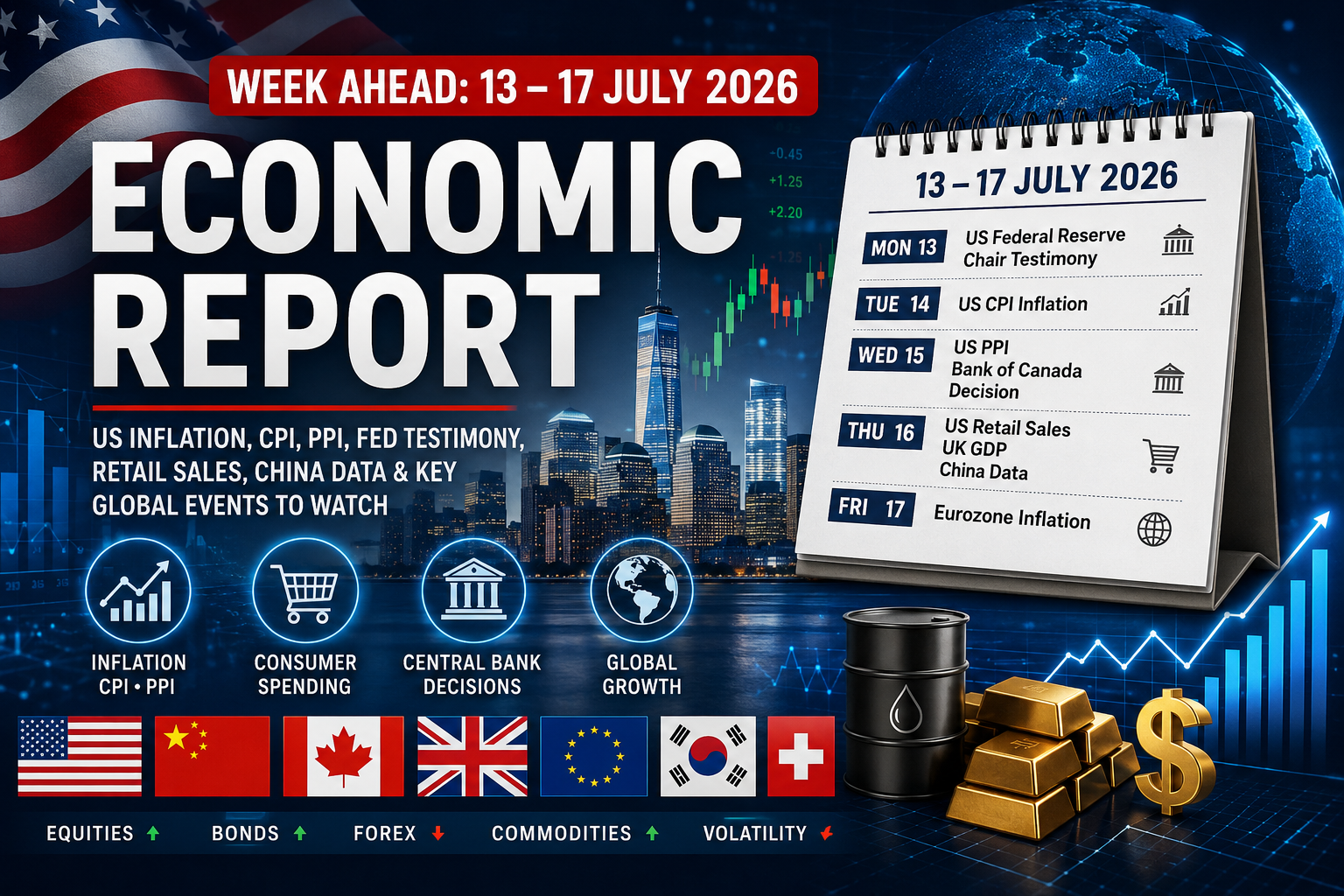
Economic Report analysis for the week of 13–17 July 2026 arrives at a pivotal moment for global financial markets. Investors are entering one of the busiest weeks on the economic calendar, with a concentration of high-impact releases that will help determine expectations for inflation, economic growth, interest rates, and monetary policy during the second half of the year.
The United States will remain the primary focus, with June Consumer Price Index (CPI) and Producer Price Index (PPI) reports expected to provide the clearest indication yet of whether inflation continues its gradual moderation or proves more persistent beneath the surface. These releases will be closely followed by June retail sales, offering valuable insight into the strength of the American consumer—the single largest driver of US economic activity.
Adding to the significance of the week, Federal Reserve Chair Kevin Warsh will deliver his first semi-annual testimony before Congress since assuming office. Investors will be listening carefully for any changes in tone regarding inflation, interest rates, balance sheet policy, and the Federal Reserve’s broader outlook for the US economy.
Outside the United States, attention will shift to the Bank of Canada, Chinese trade and activity data, UK Gross Domestic Product (GDP), the Bank of Korea policy decision, Eurozone inflation, and several important manufacturing and industrial production releases.
Rather than evaluating each release in isolation, markets will assess how the week’s data collectively shapes the outlook for monetary policy and global economic growth. The interaction between inflation, consumer demand, labour market resilience, and central bank communication is likely to determine investor sentiment well beyond July.
Key Takeaways
Before diving into the week’s calendar, here are the most important themes investors should monitor:
- US CPI inflation is expected to slow on lower energy prices, while core inflation remains elevated.
- PPI data will indicate whether producer costs continue easing or remain a future inflation risk.
- Federal Reserve Chair Kevin Warsh’s testimony may influence expectations for interest rates during the remainder of 2026.
- US retail sales will provide another important assessment of consumer resilience despite elevated borrowing costs.
- China’s latest economic indicators will offer insight into domestic demand and the effectiveness of policy support.
- The Bank of Canada is widely expected to leave interest rates unchanged while maintaining a cautious policy stance.
- UK GDP, Eurozone inflation, and several central bank updates will provide additional context regarding the global economic outlook.
Week at a Glance
| Day | Key Events | Importance | Primary Market Focus |
|---|---|---|---|
| Monday | OPEC Monthly Oil Market Report, US Budget Statement | Medium | Energy markets, fiscal position |
| Tuesday | Fed Chair Warsh Testimony, US CPI, China Trade Data | Very High | Inflation, monetary policy |
| Wednesday | Bank of Canada Decision, US PPI, Fed Beige Book, China Activity Data | Very High | Producer inflation, central banks |
| Thursday | US Retail Sales, UK GDP, Bank of Korea Decision | Very High | Consumer demand, economic growth |
| Friday | Eurozone CPI, US Industrial Production, Consumer Sentiment | High | Manufacturing and confidence |
Why This Week’s Economic Report Matters
Every trading week brings new economic releases, but not every week reshapes market expectations.
The period between 13 and 17 July 2026 stands out because it combines multiple first-tier indicators capable of influencing financial markets simultaneously. Inflation data, consumer spending, central bank communication, and international growth figures will all arrive within just five trading sessions.
For investors, this concentration of releases provides an unusually comprehensive view of the global economy.
Instead of relying on one indicator, markets will evaluate whether the data supports three key conclusions:
- Is inflation continuing to move toward central bank targets?
- Is economic growth slowing or remaining resilient despite higher interest rates?
- Are central banks likely to keep policy unchanged, tighten further, or begin preparing for future easing?
The answers to these questions will influence asset prices across equities, government bonds, currencies, and commodities.
More importantly, they will shape expectations ahead of the Federal Reserve’s preferred inflation measure, the Personal Consumption Expenditures (PCE) Price Index, due later this month.
Top Market Events to Watch
While dozens of economic reports will be released throughout the week, a handful are expected to carry the greatest influence over market sentiment.
1. US Consumer Price Index (CPI)
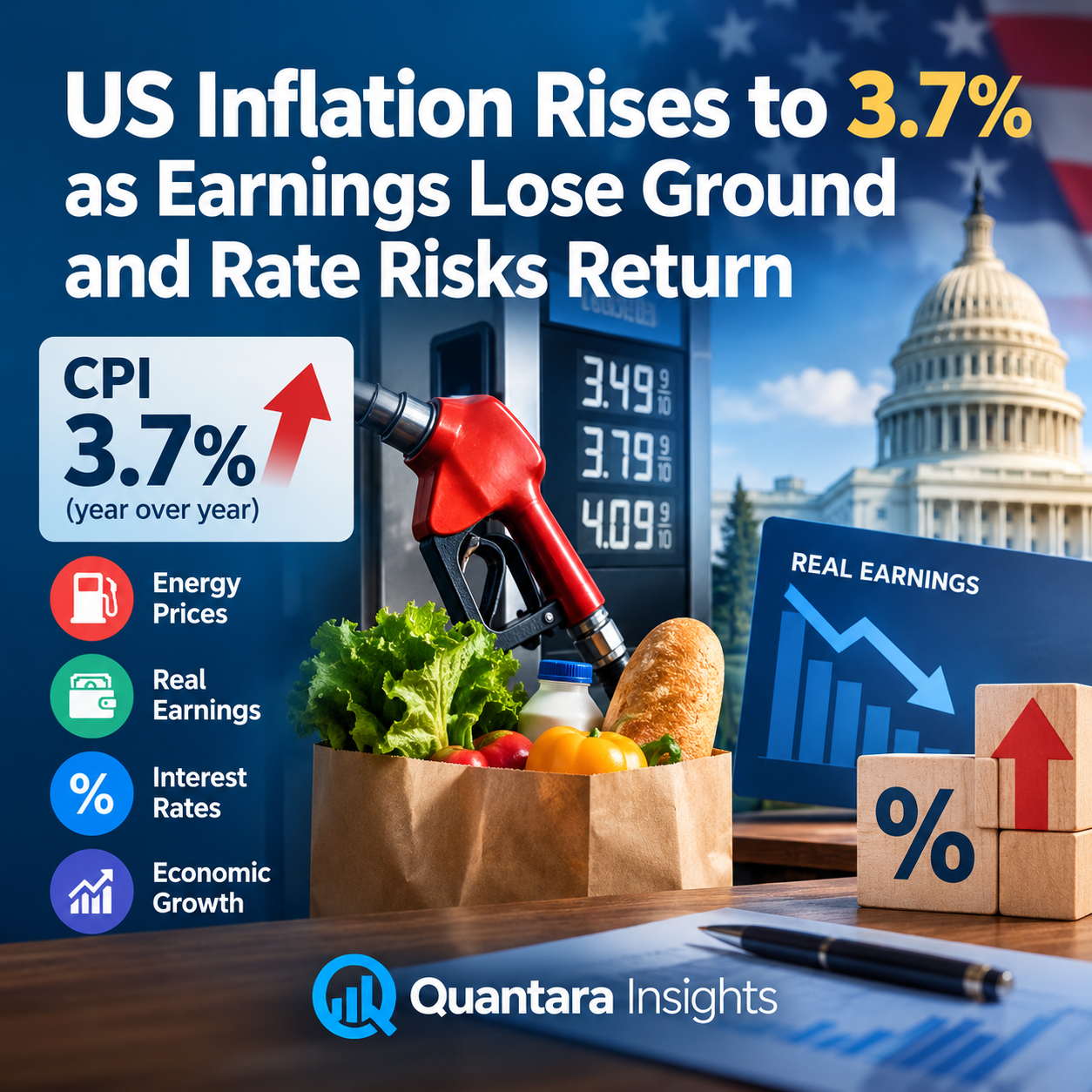
The June CPI report remains the week’s most anticipated release. Markets expect headline inflation to soften, largely because lower oil prices reduced energy costs during June. However, investors will pay much closer attention to core inflation, which excludes volatile food and energy prices and provides a better measure of underlying price pressures.
2. Federal Reserve Chair Kevin Warsh’s Testimony
Congressional testimony from a Federal Reserve Chair often moves markets because it provides policymakers with an opportunity to explain how they interpret recent economic developments. Investors will be looking for any indication that the Fed’s outlook has changed following June’s meeting.
3. Producer Price Index (PPI)
Producer inflation frequently provides an early indication of future consumer inflation. Businesses experiencing higher production costs often pass those costs to consumers over time, making PPI an important leading indicator.
4. Retail Sales
Consumer spending accounts for roughly two-thirds of US economic activity. A resilient consumer continues supporting economic growth, while weaker retail sales could indicate that higher borrowing costs are beginning to slow household demand.
5. China’s Economic Data
Trade figures, retail sales, industrial production and GDP estimates will offer a broad assessment of China’s recovery. These releases remain particularly important for commodity markets and countries closely linked to Chinese demand.
The Global Macro Backdrop
The economic environment entering mid-July differs considerably from the conditions seen earlier in the year.
Inflation has moderated from previous highs across many advanced economies, but progress has become increasingly uneven. Headline inflation has benefited from lower energy prices, while underlying services inflation remains more persistent.
At the same time, labour markets continue displaying surprising resilience.
Despite elevated interest rates, unemployment rates across several major economies remain historically low, wage growth has remained positive, and household spending has generally exceeded expectations.
This combination has complicated the task facing central banks.
On one hand, easing inflation reduces the urgency for additional policy tightening.
On the other, resilient demand raises concerns that inflation could remain above target for longer than anticipated.
As a result, policymakers have increasingly adopted a data-dependent approach, avoiding firm commitments regarding future interest rate decisions.
This week’s releases therefore assume greater importance because they will either reinforce or challenge the current economic narrative.

Economic Report Focus: Inflation Remains the Dominant Theme
Although growth indicators and central bank meetings are important, inflation continues to dominate financial market decision-making.
Why?
Because inflation ultimately influences almost every other major economic variable.
Persistent inflation affects:
- Interest rates
- Consumer spending
- Business investment
- Corporate profitability
- Government borrowing costs
- Currency valuations
- Equity market valuations
For central banks, inflation remains the foundation upon which monetary policy decisions are built.
Even if economic growth slows modestly, policymakers are unlikely to ease policy prematurely if inflation remains well above target.
Consequently, this week’s CPI and PPI reports will likely set the tone not only for the coming trading week but also for expectations heading into the Federal Reserve’s next policy meeting.
What Investors Should Watch Before the Data Is Released
Ahead of each major release, markets will continue monitoring several underlying developments that could influence expectations.
These include:
- Energy price movements following recent OPEC+ production decisions.
- Treasury yield movements as investors reassess interest rate expectations.
- US Dollar performance against major currencies.
- Commodity prices, particularly oil and industrial metals.
- Equity market positioning ahead of inflation data.
- Market-implied probabilities for future Federal Reserve decisions.
Changes in these indicators before Tuesday’s CPI release may provide early insight into investor expectations and positioning.
US Inflation: Why the June CPI Report Could Shape Market Expectations
The June Consumer Price Index (CPI) report is expected to be the defining release in this week’s Economic Report, providing investors with the latest assessment of inflation across the United States. While inflation has moderated significantly from the highs experienced in previous years, the Federal Reserve has repeatedly stated that the final stage of returning inflation to its long-term target is likely to prove the most challenging.
That perspective places enormous importance on every monthly CPI release.
Markets are no longer asking whether inflation is falling—they are asking how quickly, how broadly, and whether the improvement is sustainable.
June’s figures arrive after a month marked by easing oil prices, resilient consumer spending and continued labour market strength. Together, these factors create a complex inflation picture that is unlikely to be captured by a single headline number.
CPI Consensus Expectations
| Inflation Measure | Forecast | Previous | Market Interpretation |
|---|---|---|---|
| Headline CPI (MoM) | -0.1% | +0.5% | Lower energy prices expected to reduce overall inflation |
| Core CPI (MoM) | +0.3% | +0.2% | Underlying inflation remains firm |
| Core CPI (YoY) | 2.9% | 2.9% | Progress toward target has slowed |
At first glance, a decline in headline inflation appears encouraging. However, investors understand that the expected improvement is largely driven by lower fuel prices rather than a broad easing in price pressures across the economy.
For that reason, Core CPI will likely receive far greater attention than the headline figure.
Understanding Headline vs Core Inflation
One of the most common misconceptions among newer investors is assuming that headline inflation tells the complete story.
In reality, economists spend considerably more time analysing core inflation because it removes two of the most volatile components of the inflation basket:
- Food
- Energy
These categories can fluctuate sharply due to weather, geopolitical events or changes in global commodity markets. While consumers certainly feel the impact of higher fuel or grocery prices, these short-term movements do not always reflect underlying inflationary trends.
Core inflation attempts to answer a different question:
Are prices continuing to rise across the broader economy, even after temporary factors are removed?
That is why central banks place greater emphasis on core measures when determining interest rate policy.
If headline inflation falls while core inflation remains stubbornly high, policymakers may conclude that underlying inflation pressures have not yet been fully contained.
Where Inflation Is Expected to Ease
Several categories are expected to contribute to lower headline inflation during June.
Energy Prices
The most significant contribution should come from lower oil prices.
Following the easing of geopolitical tensions in the Middle East and improved expectations regarding global supply, crude oil prices declined during June, reducing gasoline and transportation costs.
Lower energy prices generally affect inflation in several ways:
- Reduced fuel costs for consumers.
- Lower transportation expenses for businesses.
- Cheaper logistics and distribution.
- Reduced production costs across manufacturing.
These benefits often take several months to filter through the broader economy, meaning June may represent only the beginning of a wider disinflationary trend if energy markets remain stable.
Transportation Costs
Lower fuel prices should also ease transportation-related inflation.
Airfares, freight costs and shipping expenses all tend to respond to changes in energy prices, although the timing varies across industries.
Should transportation inflation moderate meaningfully, markets would view this as evidence that lower commodity prices are beginning to influence broader consumer prices.
Where Inflation May Remain Sticky
While energy prices are expected to provide relief, several categories continue posing inflation risks.
Housing and Shelter
Housing remains one of the largest components within the CPI basket.
Although rental inflation has slowed compared with previous years, shelter costs continue rising at a pace above the Federal Reserve’s long-term inflation objective.
Because housing prices adjust gradually, this component often delays broader improvements in inflation.
Services Inflation
Services inflation also remains closely watched.
Unlike goods inflation, which often responds relatively quickly to supply chain improvements, services inflation is heavily influenced by wages.
With labour markets remaining resilient and unemployment relatively low, wage growth continues supporting demand for services ranging from healthcare and hospitality to insurance and financial services.
This is one reason why policymakers continue emphasising patience despite improvements in headline inflation.
Insurance and Healthcare
Insurance premiums and healthcare costs have remained persistent contributors to underlying inflation throughout much of the past year.
Although these categories rarely generate headlines, they play an important role in determining whether inflation returns sustainably toward target.
What Would Surprise Markets?
Financial markets rarely react to economic data based solely on whether inflation rises or falls.
Instead, markets compare the actual result against expectations.
Below are several potential scenarios.
| Scenario | Likely Market Reaction |
|---|---|
| Inflation below expectations | Lower Treasury yields, weaker US Dollar, stronger equities |
| Inflation broadly in line | Limited reaction, focus shifts to Warsh testimony |
| Inflation above expectations | Higher bond yields, stronger Dollar, equity volatility |
| Core inflation significantly higher | Markets may price additional Fed tightening |
This is why even relatively small deviations from consensus forecasts can generate substantial market volatility.
How the Federal Reserve Will Interpret CPI
The Federal Reserve is unlikely to react to one inflation report in isolation.
Instead, policymakers will evaluate June’s data alongside several additional indicators:
- Labour market conditions.
- Wage growth.
- Consumer spending.
- Producer inflation.
- Inflation expectations.
- Financial conditions.
Collectively, these indicators determine whether inflation is continuing to move toward the Federal Reserve’s objective or whether additional policy restraint may eventually become necessary.
Investors should therefore avoid placing excessive emphasis on a single monthly figure.
The broader trend remains far more important than one data point.
Federal Reserve Chair Kevin Warsh: Markets Await His First Congressional Testimony
While Tuesday’s CPI report may dominate headlines, Federal Reserve Chair Kevin Warsh’s testimony before Congress could prove equally influential.
Congressional testimony differs from a scheduled policy meeting because policymakers face direct questioning from legislators regarding inflation, employment, financial stability and the broader economic outlook.
These exchanges frequently reveal nuances that are absent from formal policy statements.
For investors, this makes congressional testimony one of the most valuable communication events on the Federal Reserve calendar.
A New Chair, A New Communication Style
Kevin Warsh assumed leadership of the Federal Reserve during a period of unusual policy uncertainty.
Inflation has declined considerably from previous peaks, yet remains above target.
Economic growth continues exceeding expectations.
Labour markets remain resilient.
Meanwhile, geopolitical developments continue influencing energy markets and global supply chains.
Rather than inheriting an economy facing one dominant challenge, Warsh begins his tenure balancing several competing priorities simultaneously.
His communication style has therefore become an important focus for investors.
Unlike some previous Federal Reserve Chairs who relied extensively on forward guidance, Warsh has consistently argued that excessive guidance can reduce policy flexibility and encourage markets to focus too heavily on future commitments rather than incoming data.
This philosophy suggests markets should expect fewer explicit promises and greater emphasis on economic evidence.
Key Topics Markets Will Be Listening For
Although the testimony will cover a broad range of issues, several themes are expected to dominate investor attention.
Interest Rates
Will the current policy rate remain appropriate if inflation stabilises above target?
Inflation
Does the Federal Reserve believe recent progress is sufficient, or do policymakers remain concerned about underlying price pressures?
Balance Sheet Policy
Will balance sheet normalisation continue at its current pace?
Artificial Intelligence and Economic Analysis
Warsh has previously discussed the potential for emerging technologies to improve economic forecasting and policy analysis.
Markets may seek additional insight into how technological innovation could influence future Federal Reserve research and decision-making.
Policy Reviews
The recently established external policy review groups represent one of the more significant governance developments at the Federal Reserve in recent years.
Investors may receive further information regarding the objectives and expected timeline for these reviews.
Why Testimony Can Move Markets
History shows that congressional testimony can influence markets even without major policy announcements.
Sometimes it is not what the Chair says, but how it is said.
Small changes in language regarding inflation risks, labour market strength or financial conditions frequently alter investor expectations regarding future policy.
As a result, markets will carefully compare Warsh’s testimony with the tone adopted during the June Federal Open Market Committee meeting.
Any noticeable shift could influence interest rate expectations well before the next policy decision.
US Producer Price Index (PPI): Measuring Inflation Before It Reaches Consumers
Following Tuesday’s CPI release, attention will quickly turn to Wednesday’s Producer Price Index (PPI). While CPI measures the prices consumers pay for goods and services, PPI focuses on prices received by domestic producers, making it an important indicator of inflation earlier in the supply chain.
Within this Economic Report, PPI deserves close attention because it often provides early signals about whether businesses are facing increasing cost pressures that could eventually be passed on to consumers.
Although the relationship between producer prices and consumer prices is not always immediate, sustained increases in production costs frequently influence future inflation trends.
June PPI Expectations
| Producer Price Measure | Forecast | Previous |
|---|---|---|
| Headline PPI (MoM) | +0.2% | +1.1% |
| Core PPI (MoM) | +0.4% | +0.4% |
The anticipated slowdown in headline producer inflation largely reflects lower energy prices throughout June. However, the expected stability in the core measure suggests that businesses continue to experience underlying pricing pressures outside the energy sector.
For policymakers, this distinction is significant. Falling energy costs can reduce headline inflation relatively quickly, but persistent increases in underlying production costs may indicate that broader inflation risks have not fully disappeared.
Why Producer Inflation Matters
Businesses rarely absorb higher costs indefinitely.
When input costs increase—whether due to wages, raw materials, transportation or financing—companies generally have three options:
- Accept lower profit margins.
- Improve productivity and efficiency.
- Pass higher costs on to consumers.
The chosen response often depends on market conditions.
In highly competitive industries, businesses may absorb some cost increases to protect market share. In sectors with stronger pricing power, however, companies are often able to pass those costs directly to customers.
This process explains why economists frequently describe PPI as a leading indicator of consumer inflation.
A sustained increase in producer prices does not guarantee higher CPI, but it does increase the likelihood that consumer prices will rise over time if businesses begin transferring costs to households.
What Investors Should Watch in the PPI Report
Professional investors rarely focus only on the headline number.
Instead, they examine whether inflation pressures are broadening across multiple industries or becoming concentrated in only a handful of categories.
Key areas include:
- Manufacturing input costs.
- Transportation and logistics.
- Energy-related industries.
- Wholesale trade.
- Business services.
If inflation moderates across a wide range of sectors, confidence in the broader disinflation narrative increases.
If only energy prices decline while most other categories continue rising, markets may become more cautious regarding the inflation outlook.
How PPI Influences the Federal Reserve’s Preferred Inflation Measure
Another reason the PPI report receives significant attention is its relationship with the Personal Consumption Expenditures (PCE) Price Index, the Federal Reserve’s preferred measure of inflation.
Several components of the PPI report feed directly into PCE calculations, making Wednesday’s release particularly valuable for economists updating forecasts ahead of the official PCE report later in the month.
Current projections continue suggesting that inflation remains above the Federal Reserve’s long-term objective, even though the pace of price increases has moderated compared with previous years.
As a result, the June PPI release will play an important role in shaping expectations for both monetary policy and future inflation forecasts.
US Retail Sales: A Crucial Test of Consumer Strength
Thursday’s Retail Sales report will shift market attention from inflation to demand.
While inflation measures how quickly prices are changing, retail sales reveal whether consumers continue spending despite higher borrowing costs and elevated prices.
For this reason, retail sales remain one of the most closely watched indicators in every monthly economic calendar.
Consumer spending accounts for approximately two-thirds of US Gross Domestic Product (GDP). When households continue spending confidently, businesses typically maintain production, employment and investment. Conversely, a sustained slowdown in spending often signals weakening economic momentum.
Consensus Expectations
| Retail Sales Measure | Forecast | Previous |
|---|---|---|
| Headline Retail Sales (MoM) | +0.3% | +0.9% |
| Core Retail Sales (MoM) | -0.1% | +0.8% |
The expected moderation follows a particularly strong performance in May.
However, several private-sector indicators suggest that consumer activity remained healthier than the consensus forecast implies.
Why the American Consumer Continues to Surprise
Throughout 2026, one of the most notable features of the US economy has been the resilience of household spending.
Despite elevated interest rates, consumers have continued supporting economic growth through steady purchases of goods and services.
Several factors explain this resilience.
Labour Market Stability
Employment conditions remain relatively strong.
Although hiring has slowed compared with earlier stages of the economic expansion, unemployment remains historically low, supporting household income and consumer confidence.
Wage Growth
Real wage growth has gradually improved as inflation has moderated.
While wage gains vary across industries, many households continue experiencing income growth that supports discretionary spending.
Lower Energy Costs
Declining gasoline prices effectively increase disposable income.
Money previously allocated toward fuel expenses becomes available for restaurants, entertainment, travel and retail purchases.
This indirect effect can meaningfully influence consumer spending over time.
Prime Day and Consumer Behaviour
June also included one of the year’s largest retail events: Amazon Prime Day.
Preliminary industry data indicated that online sales increased significantly compared with the same period a year earlier, supported by widespread promotional discounts.
However, average transaction values declined.
Rather than signalling weakness, this suggests consumers remain highly selective.
Today’s shoppers continue spending, but they increasingly prioritise value, compare prices and take advantage of promotional events.
This behaviour reflects a consumer that remains financially engaged while exercising greater budget discipline.
Retail Sales and Inflation: An Important Relationship
Retail sales do not influence markets solely because they measure consumer demand.
They also help investors understand inflation.
Strong demand allows businesses greater flexibility to maintain pricing power.
Weak demand often encourages retailers to discount products, reducing inflationary pressure.
For this reason, economists evaluate retail sales alongside CPI and PPI rather than independently.
Together, these reports answer three important questions:
- Are prices still rising?
- Are consumers continuing to spend?
- Are businesses able to pass higher costs to customers?
The answers provide a clearer picture of the overall economy than any single report alone.
Connecting the Dots: CPI, PPI and Retail Sales
Professional investors rarely react to one economic indicator in isolation.
Instead, they build a broader narrative from multiple data releases.
The relationship between CPI, PPI and Retail Sales illustrates this approach.
| Economic Indicator | Primary Question Answered |
|---|---|
| CPI | What are consumers paying? |
| PPI | What are businesses paying? |
| Retail Sales | Are consumers still spending? |
Viewed together, these indicators help determine whether inflation pressures are easing without significantly damaging consumer demand.
For example:
- Falling CPI combined with stable retail sales would suggest inflation is moderating while economic growth remains intact.
- Rising PPI followed by stronger CPI may indicate businesses are successfully passing higher costs to consumers.
- Weak retail sales combined with easing inflation could suggest higher interest rates are beginning to slow economic activity.
This integrated approach is one reason institutional investors often wait until several key reports have been released before significantly adjusting portfolio positioning.
What This Means for the Federal Reserve
The Federal Reserve’s challenge remains balancing two competing objectives:
- Restoring inflation to its long-term target.
- Maintaining a healthy labour market and sustainable economic growth.
If inflation continues easing while consumer spending remains resilient, policymakers may become increasingly confident that current policy settings are appropriate.
However, if inflation remains persistent despite strong consumer demand, discussions regarding additional policy tightening could re-emerge.
Conversely, if both inflation and spending weaken sharply, attention may gradually shift toward when policy easing becomes appropriate.
At present, the most likely outcome remains one of cautious patience. Policymakers have consistently emphasised that future decisions will depend on incoming data rather than a predetermined policy path.
This week’s releases therefore carry significance not because they will determine policy on their own, but because they will either reinforce or challenge the Federal Reserve’s current assessment of the economy.
China’s Economic Data: A Global Growth Barometer
While US inflation will dominate market attention, China’s economic releases could prove equally important for investors focused on global growth, commodity demand and international trade.
As the world’s second-largest economy and one of the largest consumers of raw materials, China’s economic performance influences everything from industrial metals and energy prices to multinational corporate earnings and regional currency movements.
This week’s Economic Report therefore extends well beyond the United States. Investors will receive a comprehensive update on China’s economic conditions through several key releases, including:
- Balance of Trade
- Retail Sales
- Industrial Production
- Fixed Asset Investment
- Money Supply (M2)
- Second-quarter GDP estimates
Together, these reports will provide a broad assessment of whether recent policy support measures are beginning to strengthen domestic demand or whether the recovery continues to lose momentum.

Trade Data: Exports Remain the Bright Spot
China’s June trade figures will be released before the broader activity data and are expected to show continued strength in exports, although growth is likely to moderate compared with previous months.
Chinese manufacturers have remained competitive across many international markets despite softer global demand, helping offset weakness within the domestic economy.
Several factors continue supporting exports:
- Competitive manufacturing capacity
- Stable global demand for technology products
- Diversified export markets
- Government support for industrial production
However, economists expect the pace of export growth to cool as international demand gradually normalises.
Imports will receive equal attention because they often provide an early indication of domestic demand. Stronger imports generally suggest improving consumer and business confidence, while weaker import growth can indicate softer domestic spending and investment.
Retail Sales: Can Chinese Consumers Drive the Recovery?
Retail sales remain one of the most closely watched indicators in China’s monthly economic calendar because they provide insight into household confidence and domestic consumption.
Unlike previous recoveries that relied heavily on exports and infrastructure spending, policymakers have repeatedly emphasised the importance of strengthening domestic demand as a more sustainable source of economic growth.
Consensus expectations point to a modest improvement in retail activity during June.
While this would represent progress compared with previous months, spending is still expected to remain below levels typically associated with a strong consumer-led expansion.
Several factors continue weighing on household confidence:
Property Market Weakness
China’s property sector remains under pressure, affecting household wealth and consumer sentiment.
Although authorities have introduced measures to stabilise the housing market, activity remains well below previous peaks.
Cautious Consumer Behaviour
Many households continue prioritising savings over discretionary spending.
This more conservative approach reflects ongoing uncertainty regarding employment prospects, property values and future economic conditions.
Youth Employment
Youth employment remains another structural challenge.
Although conditions have improved compared with earlier periods, employment opportunities for younger workers continue influencing consumer confidence and spending patterns.
Industrial Production: Manufacturing Continues to Provide Support
Industrial production has generally remained more resilient than consumer spending.
Manufacturing output continues benefiting from export demand and targeted government support, even as domestic demand remains subdued.
Economists expect industrial production to remain broadly stable during June.
Should manufacturing activity exceed expectations, markets may interpret this as evidence that China’s industrial sector continues adapting successfully to changing global demand conditions.
However, investors will also examine whether stronger production reflects genuine improvement in domestic activity or continued reliance on exports.
The distinction is important because long-term economic sustainability depends increasingly on stronger household consumption rather than export-led growth alone.
GDP Outlook: Growth Faces Headwinds
Second-quarter GDP estimates are expected to show that China’s economy continues expanding but at a slower pace than earlier in the year.
Recent indicators suggest that while manufacturing remains relatively stable, domestic demand has yet to recover convincingly.
Several headwinds continue affecting growth:
| Challenge | Potential Economic Impact |
|---|---|
| Weak consumer confidence | Softer household spending |
| Property market adjustment | Reduced investment activity |
| External trade uncertainty | Slower export growth |
| Local government debt | Constrained infrastructure spending |
| Global demand moderation | Reduced manufacturing momentum |
Despite these challenges, policymakers continue signalling their willingness to provide targeted support where necessary.
Rather than implementing broad-based stimulus, authorities have generally preferred measures aimed at improving credit availability, supporting businesses and encouraging investment.
Why China’s Data Matters to Global Markets
China’s economic performance extends well beyond its domestic economy.
A stronger-than-expected recovery would likely support:
- Commodity prices
- Mining companies
- Asian equity markets
- Emerging market currencies
- Global manufacturing activity
Conversely, weaker data could reinforce concerns regarding slower global growth, reducing demand expectations for industrial commodities and weighing on export-oriented economies.
For investors, China’s releases therefore represent more than regional data points—they provide important signals regarding the health of the global economy.
Bank of Canada: Expected to Hold Rates Steady
The Bank of Canada (BoC) will announce its latest policy decision on Wednesday.
Financial markets overwhelmingly expect policymakers to leave the overnight lending rate unchanged at 2.25%, extending the current pause in the tightening cycle.
The decision itself is unlikely to surprise markets.
Instead, attention will focus on Governor Tiff Macklem’s assessment of inflation risks, economic growth and future policy flexibility.
A Delicate Balancing Act
Canada’s recent economic data has delivered mixed signals.
Inflation accelerated modestly during May, while retail sales disappointed expectations.
At the same time, GDP growth proved stronger than forecast, employment remained relatively resilient and producer price pressures eased.
These conflicting trends explain why policymakers continue favouring a cautious, data-dependent approach.
The Bank appears comfortable maintaining current policy settings while evaluating whether recent inflation increases prove temporary or more persistent.
Trade Policy Adds Another Layer of Uncertainty
Domestic economic conditions are not the only consideration for Canadian policymakers.
The ongoing review of the United States-Mexico-Canada Agreement (USMCA) continues creating uncertainty for businesses engaged in cross-border trade.
Although negotiations have shifted toward a rolling review process rather than a single renewal deadline, exporters remain cautious regarding future policy developments.
The Bank of Canada therefore faces both domestic inflation risks and external trade uncertainty simultaneously.
What Markets Will Watch
Beyond the rate decision, investors will focus on several key questions:
- Has the Bank’s inflation outlook changed?
- Does the Governing Council believe current policy remains sufficiently restrictive?
- How concerned are policymakers about global growth?
- What impact could future trade developments have on Canada’s economy?
The tone of the accompanying statement may prove more influential than the interest rate decision itself.
UK GDP: Measuring the Strength of Britain’s Recovery
Thursday’s release of UK Gross Domestic Product for May will provide another important update on European economic momentum.
Following April’s modest contraction, economists broadly expect growth to stabilise.
Business surveys throughout the second quarter have painted a mixed picture.
While services activity continues expanding, manufacturing remains subdued and business investment has softened amid ongoing uncertainty.
Several sectors, including healthcare and public administration, may provide temporary support to overall GDP.
However, weaker private-sector activity continues limiting stronger economic expansion.
Why UK GDP Matters
For the Bank of England, economic growth has become increasingly important alongside inflation.
Although inflation remains above target, policymakers must also consider whether restrictive monetary policy is beginning to weigh more heavily on economic activity.
A stronger-than-expected GDP report could reinforce expectations that policy rates remain elevated.
Conversely, weaker growth would strengthen arguments for a more cautious policy approach should inflation continue easing during the second half of the year.
Other Global Central Bank Developments
Bank of Korea
The Bank of Korea faces a different policy challenge.
Inflation has increased in recent months while the Korean Won has weakened significantly against the US Dollar.
A weaker currency raises import costs and can contribute to higher inflation, making policy decisions increasingly complex.
Markets will closely examine whether policymakers believe further tightening may eventually become necessary.
Swiss National Bank
The Swiss National Bank will publish the minutes from its latest policy meeting.
Although no immediate policy changes are expected, investors will look for additional commentary regarding inflation expectations, exchange rate developments and the Bank’s willingness to intervene in currency markets if required.
Eurozone Inflation
Friday’s final Eurozone CPI figures will conclude another busy week.
While revisions are generally limited, confirmation of inflation trends remains important for European Central Bank policy expectations.
Any unexpected revisions could influence European bond markets, the euro and expectations surrounding future ECB decisions.
Global Perspective: Why This Week Matters Beyond Individual Data Releases
One of the defining characteristics of the current economic environment is the increasing divergence among major economies.
While inflation has moderated across many regions, the pace of improvement varies considerably.
Some central banks remain primarily focused on reducing inflation.
Others have begun paying greater attention to slowing economic growth.
Meanwhile, several emerging markets continue balancing inflation pressures against currency volatility and external trade risks.
This divergence means that investors can no longer rely on a single global narrative.
Instead, they must evaluate each economy according to its own inflation dynamics, growth outlook and policy framework.
The combination of US inflation data, Chinese activity indicators, Canadian monetary policy, UK GDP and European inflation figures makes this one of the most internationally significant weeks of the quarter.
Rather than offering isolated snapshots, these releases collectively provide a comprehensive assessment of the global economic landscape heading into the second half of 2026.
Week in Review: Setting the Stage for the Week Ahead
Before analysing the upcoming economic calendar, it is important to understand the developments that shaped current market expectations. The previous week’s data provided investors with a mixed picture of the global economy—one that reinforced resilience in some areas while highlighting ongoing inflation and growth risks in others.
Rather than fundamentally changing the market narrative, the latest releases confirmed that the global economy continues transitioning toward a slower but more balanced phase of expansion.
OPEC+ Continues Gradual Supply Increases
One of the week’s most significant developments came from OPEC+, which announced another modest production increase as part of its ongoing strategy to gradually unwind previous supply cuts.
The decision reflected growing confidence that oil markets can absorb additional supply without triggering significant price instability.
For inflation, this development is particularly important.
Lower and more stable energy prices reduce transportation, manufacturing and logistics costs throughout the global economy. These effects are rarely immediate, but they gradually filter through supply chains before influencing consumer prices.
Should energy markets remain relatively stable during the third quarter, central banks may gain additional confidence that headline inflation will continue moderating.
US Services Sector Continues Expanding
The latest ISM Services PMI remained firmly in expansion territory, although growth moderated slightly compared with the previous month.
The report highlighted several encouraging trends:
- Business activity remained positive.
- New orders continued expanding.
- Employment returned to growth.
- Backlogs increased.
- Price pressures eased modestly.
Taken together, these indicators suggest that the largest segment of the US economy continues performing relatively well despite elevated borrowing costs.
The improvement in employment was particularly encouraging, indicating that businesses remain willing to hire even as economic growth gradually normalises.
Federal Reserve Minutes Reinforce a Data-Driven Approach
Minutes from the latest Federal Open Market Committee meeting confirmed that policymakers remain divided regarding the inflation outlook.
Some officials expressed concern that inflation could remain above target for longer than anticipated, while others argued that previous policy tightening continues working its way through the economy.
Importantly, the minutes did not reveal a committee committed to additional tightening.
Instead, they reinforced the view that future decisions will depend heavily on incoming economic data.
This makes this week’s CPI, PPI and Retail Sales reports even more influential.
Global Inflation Trends Remain Uneven
Outside the United States, inflation developments continued highlighting the differing challenges facing major economies.
While some countries experienced further moderation in price pressures, others continued dealing with inflation driven by services, wages or currency weakness.
This divergence explains why central banks are increasingly following different policy paths despite sharing similar inflation objectives.
For investors, this reinforces the importance of analysing each economy individually rather than assuming a uniform global trend.

Market Outlook
This week’s economic calendar has the potential to influence expectations across virtually every major asset class.
Although markets have become more accustomed to inflation data over recent years, the concentration of high-impact releases means volatility could increase throughout the week.
Below is an overview of how different markets may respond.
Equity Markets
Stock markets continue balancing optimism regarding moderating inflation against concerns that interest rates may remain elevated for longer than previously expected.
Technology and growth sectors generally benefit from lower inflation and declining bond yields, while financial companies often perform better in an environment of higher interest rates.
Should this week’s data indicate easing inflation alongside resilient consumer demand, equities may find additional support.
Conversely, stronger-than-expected inflation could place renewed pressure on valuation-sensitive sectors.
Government Bonds
Bond markets are likely to respond most directly to the inflation reports.
A softer CPI or PPI reading would generally support lower Treasury yields as investors reduce expectations for future policy tightening.
Higher-than-expected inflation could push yields higher, particularly at the short end of the curve, reflecting expectations that interest rates remain restrictive for longer.
Foreign Exchange
Currency markets remain highly sensitive to changing interest rate expectations.
The US Dollar could strengthen if inflation surprises to the upside or if Federal Reserve Chair Kevin Warsh adopts a more hawkish tone during congressional testimony.
At the same time, domestic economic releases in Canada, the United Kingdom and South Korea may generate increased volatility in their respective currencies.
Commodities
Commodity markets remain influenced by both inflation expectations and global growth prospects.
Oil prices will continue responding to OPEC+ policy decisions, geopolitical developments and expectations regarding global demand.
Industrial metals remain closely linked to China’s economic performance, making this week’s activity data particularly important for commodity investors.
Three Potential Market Scenarios
Professional investors often evaluate multiple outcomes rather than relying on a single forecast. The following scenarios illustrate how different combinations of data could influence market sentiment.
Bullish Scenario
- Headline and core CPI come in below expectations.
- PPI confirms easing producer cost pressures.
- Retail Sales remain positive without indicating overheating demand.
- Kevin Warsh reinforces a balanced, data-dependent policy approach.
- Chinese activity data show gradual improvement.
Likely Market Reaction
- Equity markets strengthen.
- Treasury yields decline.
- The US Dollar softens modestly.
- Risk appetite improves across global markets.
Base Case Scenario
- Inflation broadly matches consensus forecasts.
- Consumer spending moderates but remains resilient.
- Central banks maintain a cautious, data-dependent stance.
- Chinese growth remains stable but subdued.
Likely Market Reaction
- Limited market volatility.
- Stable bond yields.
- Moderate currency movements.
- Investors continue focusing on future economic releases.
Bearish Scenario
- Core CPI exceeds expectations.
- PPI indicates renewed producer price pressures.
- Retail Sales remain exceptionally strong, reinforcing inflation concerns.
- Federal Reserve communication becomes more hawkish.
Likely Market Reaction
- Treasury yields rise.
- The US Dollar strengthens.
- Equity markets experience increased volatility.
- Expectations for further monetary tightening increase.
Historical Perspective: Why This Week Could Matter
History shows that weeks combining inflation data, central bank communication and consumer spending reports often produce some of the largest market movements of the quarter.
Inflation releases frequently reshape interest rate expectations.
Retail Sales provide confirmation regarding economic momentum.
Congressional testimony offers insight into how policymakers interpret recent developments.
When these events occur within the same week, investors gain a more complete understanding of the economic landscape than would normally be possible from individual reports alone.
This is precisely why the week of 13–17 July 2026 deserves close attention.
Key Takeaways
- US CPI will remain the week’s most closely watched release.
- Core inflation will likely matter more than headline inflation.
- PPI will help determine whether producer cost pressures continue easing.
- Retail Sales will provide an important measure of consumer resilience.
- Kevin Warsh’s testimony may clarify the Federal Reserve’s policy outlook.
- China’s activity data will influence expectations for global growth.
- The Bank of Canada is expected to maintain its current policy rate.
- UK GDP and Eurozone inflation will provide additional insight into international economic momentum.
- Markets remain highly data-dependent as investors assess inflation, growth and monetary policy simultaneously.
Frequently Asked Questions
1. What is the most important event this week?
The US Consumer Price Index (CPI) is expected to have the greatest impact because it directly influences inflation expectations and Federal Reserve policy.
2. Why is Core CPI more important than Headline CPI?
Core CPI excludes food and energy prices, providing a clearer picture of underlying inflation trends that are more relevant for monetary policy decisions.
3. Why should investors monitor PPI?
PPI measures inflation at the producer level and often provides early insight into future consumer price pressures.
4. Why are Retail Sales closely watched?
Consumer spending represents the largest component of the US economy. Strong retail sales generally support economic growth.
5. What will investors watch during Kevin Warsh’s testimony?
Markets will focus on inflation, interest rates, balance sheet policy and any changes in the Federal Reserve’s economic outlook.
6. Why does China’s economic data matter globally?
China is a major driver of global trade and commodity demand. Changes in Chinese growth often influence international financial markets.
7. Why is the Bank of Canada expected to leave rates unchanged?
Recent Canadian data has been mixed, allowing policymakers to maintain a cautious wait-and-see approach while monitoring inflation and growth.
8. How do lower oil prices affect inflation?
Lower energy costs reduce transportation and production expenses, which can gradually contribute to lower consumer inflation.
9. What is the Federal Reserve’s preferred inflation measure?
The Personal Consumption Expenditures (PCE) Price Index is generally considered the Fed’s preferred measure of inflation.
10. What should investors focus on this week?
Rather than reacting to one report, investors should evaluate inflation, consumer spending and central bank communication together to assess the broader macroeconomic outlook.
Final Thoughts
This Economic Report highlights one of the most consequential weeks on the July economic calendar. A concentrated schedule of inflation reports, central bank communication and growth indicators will provide investors with valuable insight into the direction of the global economy during the second half of 2026.
Although US CPI will dominate headlines, it should not be viewed in isolation. Producer inflation, consumer spending, China’s economic performance and central bank commentary all contribute to a broader narrative regarding inflation persistence, economic resilience and future monetary policy.
For investors, the challenge is not simply interpreting one data release but understanding how multiple indicators interact. Markets increasingly respond to the overall balance between inflation and growth rather than individual headlines.
As always, maintaining a disciplined, data-driven approach remains the most effective strategy during weeks characterised by elevated economic uncertainty.