




Table of Contents
- Earnings Season Highlights Strong AI Investment Across Big Tech
- Alphabet Delivers One of the Strongest Earnings Reports of the Quarter
- Google Cloud Continues to Be Alphabet’s Fastest Growing Business
- Advertising Remains Alphabet’s Financial Foundation
- Gemini AI Continues Scaling at an Impressive Pace
- Capital Spending Continues Rising as Alphabet Expands AI Infrastructure
- Investors Continue Rewarding Alphabet’s Balanced Growth Strategy
- Alphabet Sets an Early Benchmark for the Rest of Big Tech
- Tesla Navigates Margin Pressure While Expanding Its Long-Term AI Strategy
- Revenue Growth Offsets Weaker Profitability
- Automotive Revenue Continues to Drive Overall Performance
- Free Cash Flow Provides an Encouraging Surprise
- Full Self-Driving Adoption Continues Expanding
- Robotaxi Expansion Signals Tesla’s Autonomous Ambitions
- Cybercab and Optimus Continue Advancing
- Energy Storage Remains an Important Growth Opportunity
- Manufacturing Expansion Supports Long-Term Growth
- Margin Pressure Remains Tesla’s Largest Near-Term Challenge
- Tesla Continues Building a Broader Technology Ecosystem
- IBM Reinforces Its Enterprise AI Strategy
- IBM Reinforces Its Enterprise AI Strategy During Earnings Season
- IBM Raises Its Full-Year Revenue Outlook
- Software Continues to Drive IBM’s Growth
- Consulting Business Demonstrates Stability
- Infrastructure Performance Reflects Product Cycles
- IBM Expands Investment in Artificial Intelligence
- Quantum Computing Remains a Long-Term Priority
- Productivity Improvements Continue Supporting Profitability
- Comparing Alphabet, Tesla and IBM During Earnings Season
- Artificial Intelligence Remains the Defining Investment Theme
- Cloud Computing Continues Delivering Strong Growth
- Investor Outlook Following Earnings Season
- Key Takeaways
- Frequently Asked Questions
- What was the biggest surprise during this Earnings Season?
- Why is Google Cloud important for Alphabet?
- Why did Tesla miss earnings expectations?
- What is driving Tesla’s long-term strategy?
- Why is IBM focusing on enterprise AI?
- Why are technology companies increasing capital expenditure?
- Will AI continue driving future earnings?
- Which company reported the strongest quarter?
- Conclusion
Earnings Season Highlights Strong AI Investment Across Big Tech
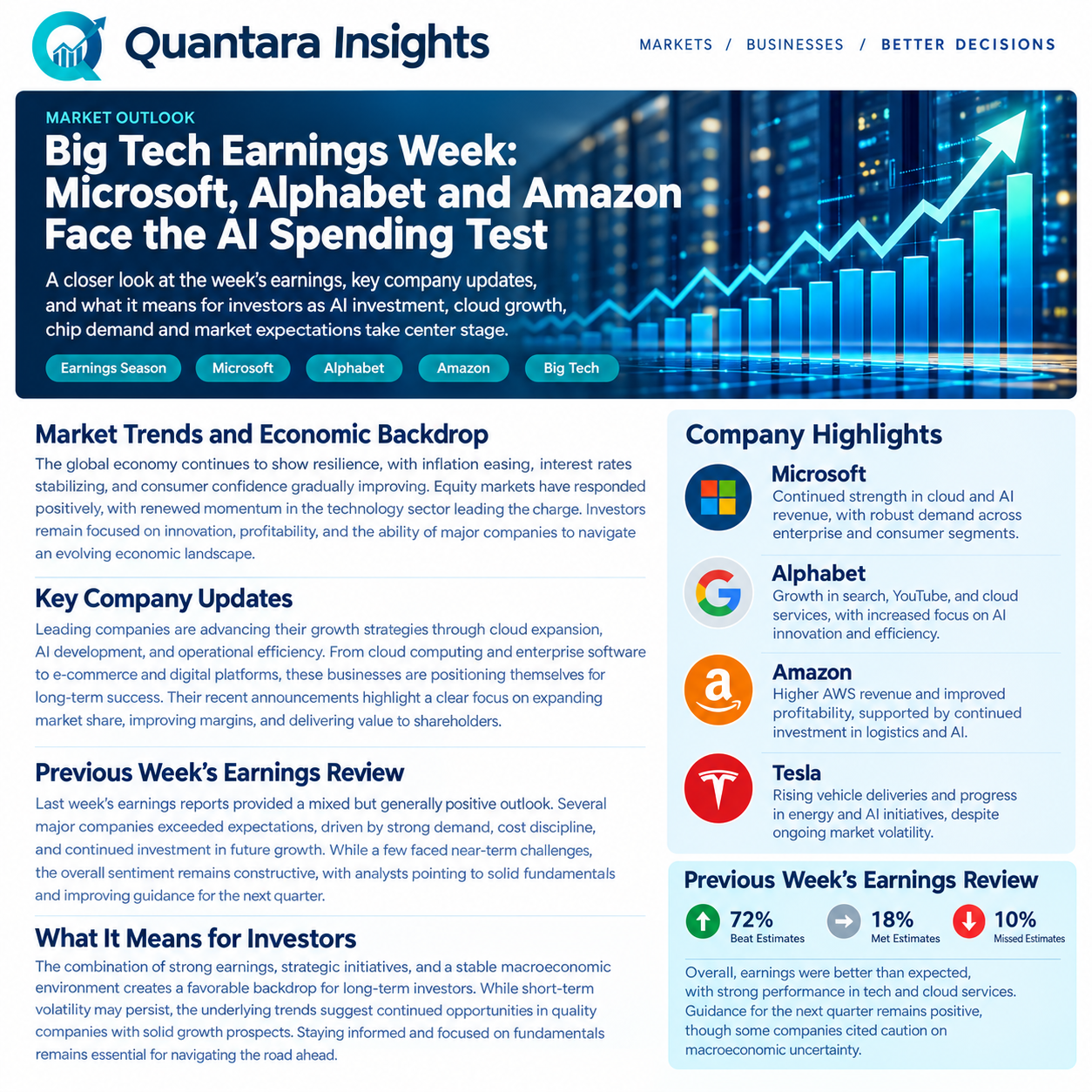
Earnings Season has once again reinforced that artificial intelligence, cloud computing and enterprise software remain the dominant themes shaping the world’s largest technology companies. The latest quarterly results from Alphabet, Tesla and IBM demonstrate that while each company faces different operational challenges, they all continue investing heavily in AI infrastructure, software development and long-term innovation.
This Earnings Season showed Alphabet delivering one of the strongest quarters among the major technology companies, supported by accelerating Google Cloud revenue, resilient advertising growth and rapid adoption of its Gemini AI platform. Tesla reported mixed results, exceeding revenue expectations but facing continued pressure on vehicle margins as it balances profitability with investments in autonomous driving, robotics and energy storage. IBM presented a different picture, emphasizing enterprise AI adoption, software expansion and productivity improvements while reaffirming its long-term growth strategy.
Collectively, these results provide investors with valuable insight into how Big Tech earnings are evolving during a period where capital spending on artificial intelligence continues to accelerate. Rather than slowing investment despite higher infrastructure costs, technology leaders are increasingly demonstrating that AI spending is beginning to translate into measurable revenue growth, stronger customer adoption and expanding commercial opportunities.
While every company reported different financial outcomes, the broader message from this Earnings Season remains consistent. Artificial intelligence is no longer viewed simply as a future growth opportunity. Instead, it is becoming a significant contributor to current financial performance, helping shape investor expectations for the remainder of the year.
Alphabet Delivers One of the Strongest Earnings Reports of the Quarter
Among the major technology companies reporting during this Earnings Season, Alphabet produced one of the most convincing sets of financial results, comfortably surpassing Wall Street expectations across nearly every major performance metric.
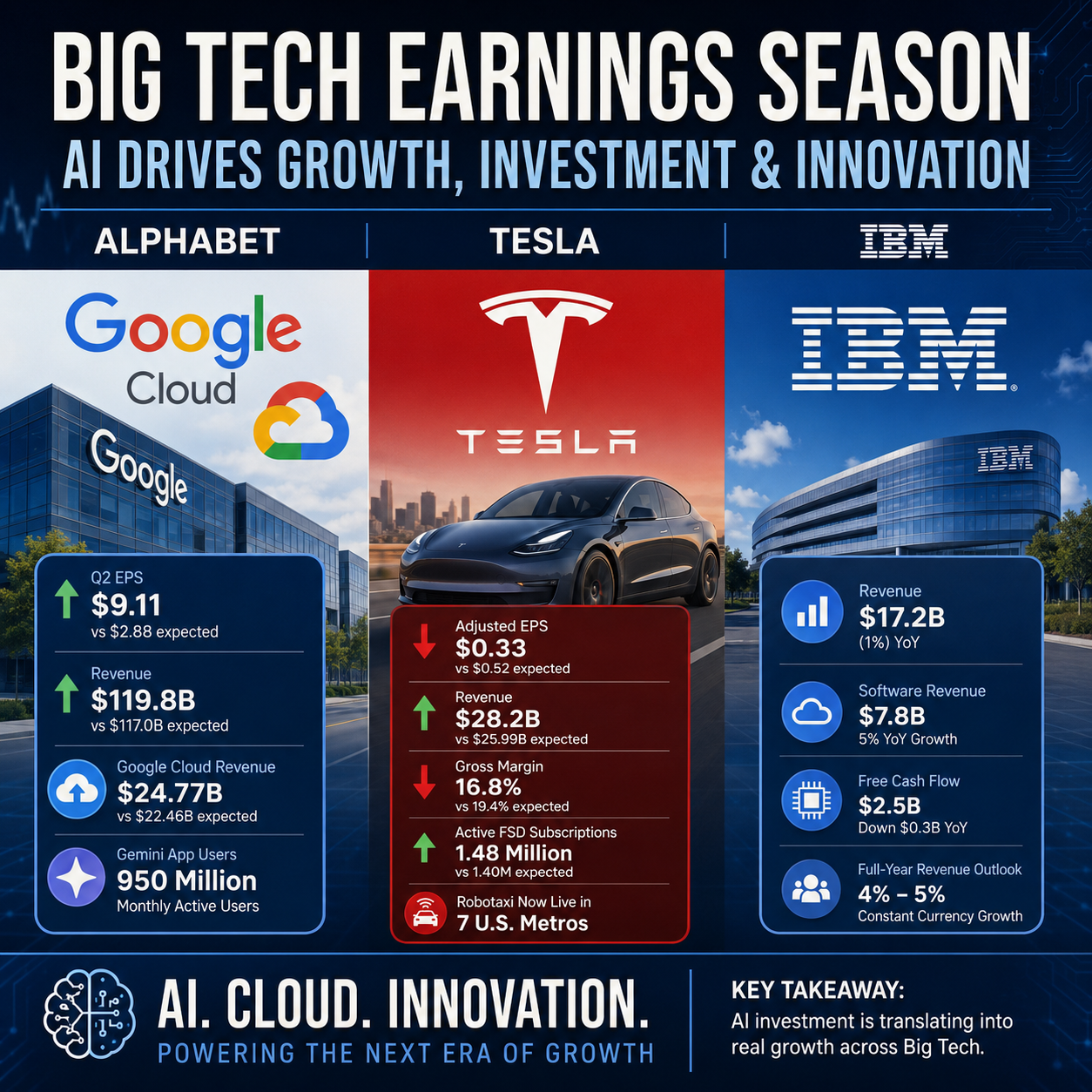
The company reported second-quarter earnings per share of $9.11, substantially above analyst expectations of $2.88, while quarterly revenue reached $119.8 billion, exceeding forecasts of $117.0 billion. The magnitude of the earnings beat reflected broad-based strength throughout Alphabet’s business rather than dependence on a single division.
Operating income reached $40.77 billion, slightly ahead of consensus estimates, while revenue excluding traffic acquisition costs also exceeded expectations. These figures demonstrate that Alphabet continues generating substantial profitability even as it increases spending on next-generation AI infrastructure.
For investors following Alphabet earnings, the results reinforced confidence that the company is successfully balancing growth investments with financial discipline. Although capital expenditure increased during the quarter, management’s continued willingness to invest reflects confidence that future demand for AI services will justify these higher infrastructure costs.
Unlike previous years when investors questioned whether AI spending would translate into commercial returns, this Earnings Season suggests Alphabet is beginning to demonstrate measurable financial benefits from those investments.
Google Cloud Continues to Be Alphabet’s Fastest Growing Business
One of the most closely watched segments throughout this Earnings Season was Google Cloud, and Alphabet once again exceeded expectations.
Google Cloud generated $24.77 billion in quarterly revenue, significantly outperforming analyst estimates of $22.46 billion. The division has increasingly become one of Alphabet’s most important growth engines, benefiting from strong enterprise demand for cloud infrastructure, cybersecurity solutions and artificial intelligence services.
Cloud computing has become central to Alphabet’s long-term strategy. As businesses expand their use of AI models, demand for computing capacity continues rising. This trend places Google Cloud in direct competition with other major cloud providers while allowing Alphabet to monetize the rapid adoption of AI across multiple industries.
Management highlighted growing customer interest in its security offerings, particularly its new Gemini 3.5 Flash cybersecurity capabilities. The company described the platform as delivering frontier-level AI performance while maintaining cost efficiency, an increasingly important consideration for enterprise customers deploying AI at scale.
The strength of Google Cloud during this Earnings Season also addresses one of the market’s largest concerns surrounding Alphabet. Investors have questioned whether elevated capital expenditure would pressure future profitability. Instead, accelerating cloud revenue suggests that infrastructure investments are beginning to generate meaningful commercial returns.
Advertising Remains Alphabet’s Financial Foundation
Although artificial intelligence dominated investor discussions throughout this Earnings Season, Alphabet’s advertising business continued providing the majority of the company’s financial strength.
Advertising revenue increased to $81.63 billion, slightly exceeding analyst expectations. Google Search remained highly resilient despite increasing competition from AI-powered search platforms and generative AI applications entering the market.
Search and Other revenue remained broadly in line with forecasts, illustrating that Alphabet’s core search ecosystem continues maintaining exceptional scale despite changing consumer behaviour.
YouTube also delivered another positive quarter, generating advertising revenue of $11.06 billion, ahead of consensus estimates.
These results reinforce an important takeaway from this Earnings Season. While investors often focus on emerging AI products, Alphabet’s advertising ecosystem continues generating extraordinary cash flow that helps finance future investments in artificial intelligence, cloud infrastructure and next-generation computing.
Rather than replacing Google’s traditional business model, AI increasingly appears to be strengthening it by improving search quality, expanding user engagement and creating additional monetization opportunities.

Gemini AI Continues Scaling at an Impressive Pace
Perhaps the most important announcement from Alphabet during this Earnings Season was the continued expansion of its Gemini AI platform.
The company disclosed that Gemini now serves 950 million monthly active users, highlighting the extraordinary pace at which its consumer AI ecosystem continues expanding.
Reaching nearly one billion monthly users places Gemini among the world’s largest artificial intelligence platforms and demonstrates Alphabet’s ability to leverage its existing products—including Search, Android, Gmail and Workspace—to accelerate AI adoption.
Unlike many standalone AI companies that must acquire users independently, Alphabet benefits from integrating Gemini directly into services already used by billions of people every day.
This competitive advantage significantly lowers customer acquisition costs while allowing Alphabet to rapidly introduce new AI capabilities across multiple products simultaneously.
For investors monitoring Big Tech earnings, Gemini’s continued expansion illustrates how artificial intelligence is moving beyond experimental technology toward becoming a mainstream consumer product.
As usage continues increasing, Alphabet gains additional opportunities to monetize AI through premium subscriptions, enterprise services, productivity tools and advertising enhancements.
Capital Spending Continues Rising as Alphabet Expands AI Infrastructure
One area receiving close attention throughout this Earnings Season was Alphabet’s capital expenditure.
The company reported quarterly capital expenditure of $44.92 billion, slightly above analyst expectations.
Although rising infrastructure spending may concern investors focused on short-term profitability, management continues emphasizing that these investments are necessary to support future AI demand.
Building advanced AI systems requires substantial investments in data centres, graphics processing units, networking equipment and cloud infrastructure.
Rather than reducing investment to protect near-term margins, Alphabet appears committed to maintaining leadership in artificial intelligence even if that requires elevated spending today.
This strategy mirrors broader trends across the technology sector. Microsoft, Meta, Amazon and other industry leaders have similarly announced large-scale infrastructure investments designed to support increasingly sophisticated AI workloads.
During this Earnings Season, Alphabet demonstrated that these investments are already beginning to produce measurable financial returns through stronger cloud growth and increasing AI adoption.
Investors Continue Rewarding Alphabet’s Balanced Growth Strategy
One reason Alphabet’s quarterly report stood out during this Earnings Season is that the company achieved growth across multiple business segments simultaneously.
Cloud revenue accelerated.
Advertising remained resilient.
Operating income expanded.
AI adoption continued increasing.
Cash generation remained strong despite higher infrastructure spending.
This balanced performance reduces dependence on any single revenue source while giving management greater flexibility to continue investing in future technologies.
Rather than relying solely on advertising, Alphabet is steadily evolving into a diversified technology company spanning cloud computing, artificial intelligence, enterprise software, cybersecurity, consumer applications and digital media.
For institutional investors, this diversification provides greater confidence that Alphabet can continue generating sustainable earnings growth even as technology markets evolve.
The company’s latest quarterly performance suggests management is successfully navigating one of the largest transitions in modern computing, positioning Alphabet to remain one of the dominant beneficiaries of artificial intelligence over the coming years.
Alphabet Sets an Early Benchmark for the Rest of Big Tech
As this Earnings Season progresses, Alphabet has effectively established a benchmark against which other major technology companies will inevitably be compared.
The company’s ability to exceed expectations across earnings, revenue, cloud computing and artificial intelligence demonstrates that disciplined investment in AI infrastructure can coexist with strong financial performance.
Importantly, Alphabet also showed that large-scale AI spending does not necessarily require sacrificing profitability. Instead, management presented evidence that investments made over the past several years are beginning to generate tangible commercial returns.
For the broader technology sector, this sends an encouraging message. Investors increasingly want proof that billions of dollars being invested in artificial intelligence will translate into sustainable revenue growth rather than simply higher operating costs.
Alphabet’s latest quarter provides one of the clearest examples yet that AI commercialization is accelerating.
Tesla Navigates Margin Pressure While Expanding Its Long-Term AI Strategy
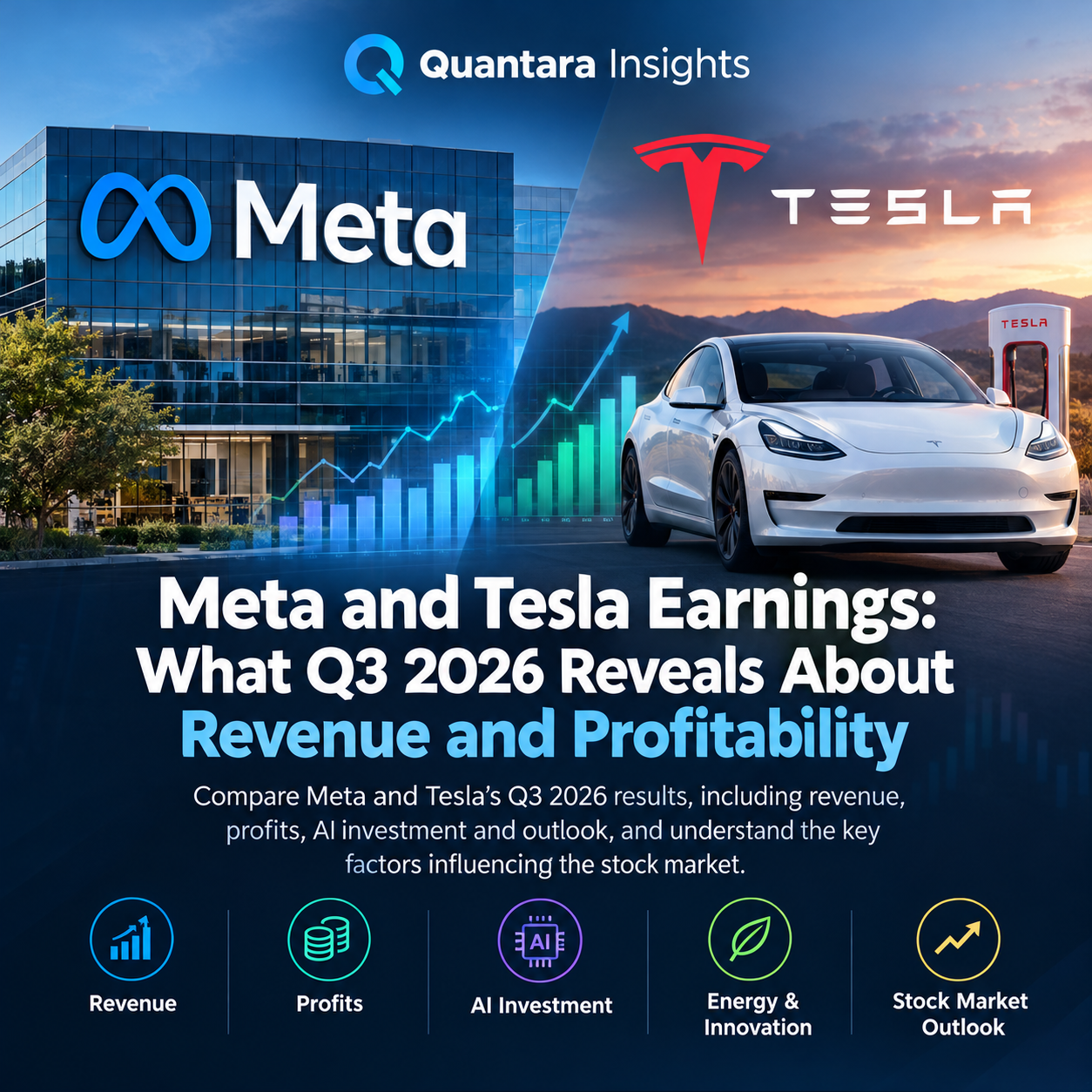
While Alphabet delivered one of the strongest reports of the Earnings Season, Tesla presented investors with a more nuanced picture. The electric vehicle manufacturer exceeded revenue expectations and reported stronger-than-anticipated free cash flow, yet profitability remained under pressure as vehicle margins continued to narrow.
For investors, Tesla’s latest results reinforced a familiar theme. The company’s financial performance increasingly reflects two distinct businesses operating simultaneously. On one side is its mature automotive division, where pricing competition and manufacturing costs continue to weigh on profitability. On the other is a rapidly expanding portfolio of autonomous driving, robotics, artificial intelligence and energy technologies that management believes will define Tesla’s next stage of growth.
This contrast has become increasingly important during the current Earnings Season, as investors attempt to determine whether Tesla should continue to be valued primarily as an automotive manufacturer or as a diversified artificial intelligence and technology company.
Revenue Growth Offsets Weaker Profitability
Tesla reported adjusted earnings per share of $0.33, falling short of analyst expectations of $0.52. While the earnings miss disappointed investors, total revenue reached $28.2 billion, comfortably exceeding forecasts of $25.99 billion.
The divergence between revenue growth and profitability highlights one of Tesla’s biggest challenges.
Vehicle deliveries remain substantial, services revenue continues expanding, and newer business lines are contributing a larger share of overall sales. However, pricing pressure across the global electric vehicle market has compressed automotive margins, reducing earnings despite higher overall revenue.
Gross margin declined to 16.8%, significantly below the expected 19.4%, becoming one of the most closely watched figures in Tesla’s quarterly report.
During this Earnings Season, margin performance has become a key metric for investors evaluating the financial health of large manufacturers. In Tesla’s case, lower margins reflect continued price adjustments, increasing production costs and ongoing investments designed to support future technologies rather than maximize short-term profitability.
Automotive Revenue Continues to Drive Overall Performance
Tesla’s automotive division generated $20.52 billion in quarterly revenue, outperforming analyst expectations of $18.68 billion.
Despite ongoing competitive pressures, vehicle sales remain the company’s largest source of revenue and continue providing the financial foundation needed to support investments across robotics, autonomous driving and artificial intelligence.
Although margin compression remains a concern, the stronger-than-expected automotive revenue demonstrates that consumer demand for Tesla vehicles remains relatively resilient despite changing market conditions.
Investors following this Earnings Season recognize that Tesla has deliberately prioritized market share and technological leadership over maximizing vehicle margins. While this strategy has pressured profitability in recent quarters, management continues emphasizing long-term platform expansion rather than short-term earnings optimization.
Free Cash Flow Provides an Encouraging Surprise
One of the brighter aspects of Tesla’s quarterly report came from cash flow.
Free cash flow was negative $1.09 billion, considerably better than analyst expectations of negative $3.64 billion.
Although cash generation remained below zero, the substantially smaller shortfall suggests Tesla continues managing capital expenditures more effectively than many analysts anticipated.
Cash flow remains one of the most important financial indicators during this Earnings Season, particularly as technology companies continue spending aggressively on artificial intelligence infrastructure, manufacturing expansion and research.
Tesla’s improved cash position provides additional flexibility to continue funding large-scale projects without significantly increasing financial risk.
Full Self-Driving Adoption Continues Expanding
Artificial intelligence remains central to Tesla’s long-term strategy.
The company reported 1.48 million active Full Self-Driving (FSD) subscriptions, exceeding analyst expectations of 1.40 million.
Subscription growth reflects increasing customer adoption of Tesla’s advanced driver assistance technology and provides investors with another example of recurring software revenue becoming a larger component of the company’s business model.
Unlike traditional vehicle manufacturers that depend almost entirely on one-time vehicle sales, Tesla continues building recurring revenue streams through software subscriptions and connected vehicle services.
This transition has become one of the defining themes of the current Earnings Season, with technology companies increasingly generating higher-margin software income alongside traditional hardware businesses.
As regulatory approvals expand across additional markets, Full Self-Driving subscriptions could become an increasingly meaningful contributor to Tesla’s long-term financial performance.
Robotaxi Expansion Signals Tesla’s Autonomous Ambitions
One of the most closely followed operational updates during this Earnings Season was Tesla’s Robotaxi rollout.
The company confirmed that Robotaxi services are now operating across seven major metropolitan areas in the United States, representing continued progress toward broader autonomous transportation deployment.
Management indicated that markets where Full Self-Driving technology has received regulatory approval are experiencing increased customer interest in Tesla vehicles.
While Robotaxi operations remain in their early stages, the expansion demonstrates that Tesla continues executing its long-term autonomous mobility strategy despite ongoing questions surrounding vehicle profitability.
For investors, Robotaxi represents far more than a transportation service.
If autonomous driving achieves widespread regulatory approval, Tesla could eventually generate recurring transportation revenue alongside vehicle manufacturing, fundamentally changing how analysts evaluate the company’s long-term earnings potential.
Although commercial scaling will require additional regulatory progress and technological refinement, Robotaxi remains one of Tesla’s most significant strategic initiatives.
Cybercab and Optimus Continue Advancing
Tesla also provided important updates regarding several next-generation manufacturing programs.
Production of the Cybercab has officially begun at Gigafactory Texas, representing another milestone in Tesla’s autonomous transportation strategy.
Meanwhile, first-generation production lines for the Optimus humanoid robot are currently being installed ahead of planned production during 2026.
These initiatives demonstrate Tesla’s continued commitment to expanding well beyond conventional vehicle manufacturing.
While neither Cybercab nor Optimus currently contributes meaningful revenue, both projects illustrate management’s belief that robotics and artificial intelligence represent substantial long-term commercial opportunities.
Throughout this Earnings Season, investors have increasingly focused on these emerging technologies because they could eventually diversify Tesla’s revenue sources beyond automobiles.
Energy Storage Remains an Important Growth Opportunity
Tesla’s energy generation and storage business reported quarterly revenue of $3.14 billion, below analyst expectations of $3.77 billion.
Although the segment underperformed consensus forecasts, management emphasized that the business has returned to growth.
Energy storage continues becoming an increasingly important part of Tesla’s overall strategy.
As electricity demand rises due to artificial intelligence, cloud computing and electrification, battery storage solutions are expected to play an increasingly important role in supporting modern power grids.
The company also confirmed that its Texas Megafactory is nearing completion, with production expected later this year.
Future expansion of Megapack manufacturing could strengthen Tesla’s position within global energy infrastructure while reducing dependence on vehicle sales.

Manufacturing Expansion Supports Long-Term Growth
Tesla continues investing heavily in manufacturing capacity despite near-term profitability pressures.
Construction and equipment procurement continue for the company’s semiconductor fabrication facility in Austin, while the Nevada factory remains on schedule for Tesla Semi production later this year.
Management also confirmed that Megapack 3 remains scheduled for production during 2026.
These manufacturing projects reflect Tesla’s broader strategy of controlling critical technologies internally wherever possible.
Unlike many competitors that depend heavily on third-party suppliers, Tesla continues investing across semiconductor production, battery manufacturing, robotics and autonomous driving infrastructure.
During this Earnings Season, investors have generally rewarded companies demonstrating long-term investment discipline despite uncertain macroeconomic conditions.
Tesla’s manufacturing roadmap reflects management’s confidence that demand for AI-enabled transportation, robotics and energy infrastructure will continue expanding throughout the decade.
Margin Pressure Remains Tesla’s Largest Near-Term Challenge
Despite encouraging progress across several strategic initiatives, profitability remains Tesla’s primary concern.
Gross margin compression continues reflecting intense competition within the electric vehicle market, ongoing pricing adjustments and elevated production costs.
Investors will likely continue monitoring this metric closely during upcoming quarters.
Unlike Alphabet, whose advertising business generates exceptionally high operating margins, Tesla operates within a capital-intensive manufacturing environment where pricing decisions have a much greater impact on earnings.
As a result, improvements in autonomous driving, software subscriptions and robotics may take time before they meaningfully offset pressure within the core automotive business.
This balance between present profitability and future growth has become one of the defining narratives surrounding Tesla during this Earnings Season.
Tesla Continues Building a Broader Technology Ecosystem
Although quarterly profitability disappointed relative to expectations, Tesla’s broader strategic direction remains unchanged.
The company continues expanding autonomous driving, robotics, battery technology, semiconductor manufacturing and artificial intelligence while strengthening recurring software revenue through Full Self-Driving subscriptions.
These initiatives increasingly position Tesla as more than simply an electric vehicle manufacturer.
Instead, management continues pursuing an integrated technology ecosystem spanning transportation, automation, robotics, software and renewable energy.
For long-term investors, this broader vision remains central to Tesla’s valuation.
Whether these investments ultimately justify continued elevated capital spending will remain one of the most closely watched questions throughout future Earnings Season reports.
IBM Reinforces Its Enterprise AI Strategy
While Alphabet demonstrated consumer AI leadership and Tesla emphasized autonomous technology, IBM approached this Earnings Season from a different perspective.
Rather than competing in consumer applications or electric vehicles, IBM continues positioning itself as one of the leading providers of enterprise artificial intelligence, hybrid cloud infrastructure and mission-critical software for large organizations.
The company’s second-quarter results reflected steady operational execution while highlighting management’s confidence that enterprise AI adoption remains in its early stages.
IBM also reaffirmed that productivity improvements driven by artificial intelligence and automation are expected to support stronger revenue growth and improved profitability over the coming years.
IBM Reinforces Its Enterprise AI Strategy During Earnings Season
IBM entered this Earnings Season with a very different investment narrative compared with Alphabet and Tesla. While Alphabet continues to dominate consumer AI and cloud services and Tesla remains focused on autonomous driving and robotics, IBM has concentrated its strategy on helping businesses deploy artificial intelligence securely and efficiently across enterprise environments.
The company’s latest quarterly results reflected that strategy. Although overall revenue growth remained modest, IBM demonstrated continued resilience in its higher-growth software portfolio while reaffirming its long-term outlook for revenue expansion and free cash flow.
Chief Executive Officer Arvind Krishna emphasized that businesses are still in the early stages of adopting artificial intelligence at scale. According to management, demand continues to shift from AI experimentation toward enterprise-wide deployment, creating opportunities across software, consulting and infrastructure.
For investors following IBM earnings during this Earnings Season, the message was clear: IBM intends to capitalize on enterprise AI adoption rather than compete directly in the consumer AI race.
IBM Raises Its Full-Year Revenue Outlook
One of the most encouraging developments from IBM’s report was management’s decision to improve its revenue expectations for the remainder of the year.
The company now expects constant currency revenue growth of between four and five percent for the full year while maintaining expectations that free cash flow will increase by approximately $1 billion compared with the previous year.
Although these projections may appear conservative relative to faster-growing technology companies, they represent continued confidence in IBM’s ability to generate sustainable growth despite an uncertain macroeconomic environment.
Raising guidance during an Earnings Season characterized by cautious corporate spending sends an important signal to investors. Management clearly believes demand for enterprise AI, hybrid cloud solutions and automation remains strong enough to support additional growth throughout the second half of the year.
Software Continues to Drive IBM’s Growth
IBM’s software division remained the strongest contributor to overall performance during the quarter.
Software revenue increased to $7.8 billion, representing 5% year-over-year growth.
Within that segment, several high-growth businesses delivered particularly encouraging results.
Red Hat, which sits within IBM’s Hybrid Cloud portfolio, expanded by 11%, continuing to benefit from strong enterprise demand for cloud-native infrastructure and application modernization.
The Data segment increased by 19%, reflecting rising demand for data management platforms supporting artificial intelligence deployment.
Automation also continued growing, reinforcing IBM’s strategy of helping organizations improve productivity through AI-powered software.
These results demonstrate why software remains central to IBM’s long-term growth strategy.
Unlike hardware businesses that often experience cyclical demand, enterprise software generates recurring revenue while creating opportunities for long-term customer relationships.
Throughout this Earnings Season, investors have increasingly rewarded companies capable of generating stable subscription-based revenue, making IBM’s software performance particularly significant.
Consulting Business Demonstrates Stability
IBM’s consulting division generated $5.3 billion in quarterly revenue.
Although reported revenue remained broadly flat year over year, constant currency growth remained positive.
The consulting business continues playing an important role within IBM’s overall strategy because it enables the company to help clients design, implement and optimize artificial intelligence solutions.
As more businesses transition from AI experimentation toward full-scale deployment, consulting services become increasingly valuable.
Organizations often require assistance integrating AI systems into existing technology infrastructure, improving cybersecurity and managing operational transformation.
IBM’s global consulting operation positions the company to benefit from these long-term trends as enterprise AI adoption continues accelerating.
Infrastructure Performance Reflects Product Cycles
IBM’s infrastructure business generated $3.8 billion in quarterly revenue.
Overall infrastructure revenue declined during the quarter, largely reflecting expected product cycle dynamics.
However, one particularly encouraging development came from Distributed Infrastructure, which grew by 37%, offsetting weakness elsewhere within the segment.
Management also highlighted record growth in Power systems and storage products, resulting in an order backlog approaching $500 million.
This suggests enterprise customers continue investing heavily in computing infrastructure capable of supporting increasingly complex artificial intelligence workloads.
As organizations deploy larger AI models across their operations, demand for high-performance computing infrastructure is expected to remain an important long-term growth driver.
IBM Expands Investment in Artificial Intelligence
One of the most significant announcements during IBM’s report involved continued investment in AI innovation.
Management highlighted strong performance across its watsonx platform while also discussing investments in new security technologies, automation tools and open-source software.
IBM introduced Lightwell, a new platform designed to address open-source software vulnerabilities.
Within its first two weeks of availability, the platform reportedly generated more than 7,500 security patches, demonstrating strong early adoption.
Cybersecurity continues becoming increasingly important as organizations deploy larger AI systems across enterprise environments.
IBM’s emphasis on secure AI deployment differentiates its strategy from companies focused primarily on consumer-facing applications.
Quantum Computing Remains a Long-Term Priority
Beyond artificial intelligence, IBM reaffirmed its commitment to quantum computing.
Management announced plans to invest more than $10 billion in quantum technologies over the next five years while remaining on schedule to deliver what it expects will be the world’s first large-scale fault-tolerant quantum computer by 2029.
Although quantum computing remains several years from widespread commercial adoption, IBM continues positioning itself as one of the industry’s leading innovators.
For long-term investors, these investments illustrate management’s willingness to allocate capital toward technologies that could become significant competitive advantages over the coming decade.
Productivity Improvements Continue Supporting Profitability
Another recurring theme throughout IBM’s quarterly report involved productivity.
The company continues applying artificial intelligence internally across software development, supply chain management and sales operations.
Management believes these efficiency improvements will help expand profit margins while creating additional capacity for future investment.
This reflects an increasingly common trend across Big Tech earnings.
Rather than simply selling AI products, technology companies are increasingly using artificial intelligence internally to improve operational performance.
IBM expects these initiatives to support stronger profitability throughout future reporting periods.
Comparing Alphabet, Tesla and IBM During Earnings Season
Although Alphabet, Tesla and IBM operate within different industries, several common themes emerged throughout this Earnings Season.
First, every company continues increasing investment in artificial intelligence despite elevated infrastructure costs.
Second, cloud computing remains one of the fastest-growing technology markets.
Third, management teams increasingly view AI not as an experimental technology but as a commercial platform capable of generating measurable financial returns.

However, the companies also demonstrated important differences.
Alphabet produced the strongest overall financial performance, combining robust advertising revenue with exceptional cloud growth and accelerating Gemini adoption.
Tesla delivered stronger-than-expected revenue but continued facing pressure on profitability as vehicle margins remained under pressure despite expanding autonomous driving initiatives.
IBM emphasized operational stability, recurring software revenue and enterprise AI adoption while maintaining disciplined financial guidance.
These differences illustrate why investors should evaluate each company based on its unique strategic priorities rather than expecting identical financial outcomes.
Artificial Intelligence Remains the Defining Investment Theme
Perhaps the single biggest takeaway from this Earnings Season is that artificial intelligence continues reshaping every major technology company.
Alphabet is integrating AI throughout Search, Cloud and Workspace.
Tesla is applying AI to autonomous driving, robotics and manufacturing.
IBM is helping enterprises deploy AI securely across global business operations.
Although their approaches differ, each company views artificial intelligence as central to long-term growth.
This alignment suggests AI investment is unlikely to slow in the near future despite concerns surrounding capital expenditure.
Instead, management teams increasingly believe current investments will generate meaningful financial returns over the coming years.
Cloud Computing Continues Delivering Strong Growth
Another consistent theme throughout this Earnings Season involves cloud computing.
Google Cloud exceeded expectations.
IBM’s Hybrid Cloud business continued expanding through Red Hat.
Tesla relies increasingly on cloud infrastructure to support autonomous driving development and connected vehicle services.
As organizations continue digitizing operations, cloud computing remains one of the technology sector’s strongest structural growth opportunities.
Artificial intelligence only reinforces this trend by increasing demand for computing capacity, networking infrastructure and enterprise software.
Investor Outlook Following Earnings Season
Looking ahead, investors will continue monitoring several important themes.
The first is whether AI investments continue translating into measurable revenue growth.
The second involves capital expenditure.
Although technology companies continue spending aggressively on infrastructure, investors increasingly expect evidence that these investments generate attractive long-term returns.
Another important focus will be profitability.
Alphabet demonstrated that AI investment can coexist with strong earnings.
Tesla continues working to balance long-term expansion against near-term margin pressure.
IBM remains focused on improving productivity while maintaining disciplined financial management.
These factors will likely dominate investor discussions during the remainder of the year.
Key Takeaways
This Earnings Season highlighted several important conclusions for investors:
- Alphabet delivered one of the strongest earnings reports among major technology companies.
- Google Cloud continues emerging as one of Alphabet’s most important growth drivers.
- Gemini’s expanding user base demonstrates rapid consumer AI adoption.
- Tesla exceeded revenue expectations but continues managing margin pressure.
- Full Self-Driving subscriptions and Robotaxi expansion remain central to Tesla’s long-term strategy.
- IBM reaffirmed confidence in enterprise AI, hybrid cloud and software growth.
- Artificial intelligence continues driving investment decisions across the technology sector.
- Capital expenditure remains elevated as companies expand AI infrastructure.
- Cloud computing continues supporting long-term revenue growth across multiple industries.
- Investors remain focused on balancing innovation with profitability.
Frequently Asked Questions
What was the biggest surprise during this Earnings Season?
Alphabet’s significant earnings beat and stronger-than-expected Google Cloud revenue represented one of the largest positive surprises among major technology companies.
Why is Google Cloud important for Alphabet?
Google Cloud provides a rapidly growing source of recurring enterprise revenue while helping monetize Alphabet’s investments in artificial intelligence.
Why did Tesla miss earnings expectations?
Tesla reported lower-than-expected earnings primarily because gross margins remained below analyst forecasts despite stronger overall revenue.
What is driving Tesla’s long-term strategy?
Tesla continues investing heavily in autonomous driving, robotics, artificial intelligence, battery storage and recurring software subscriptions.
Why is IBM focusing on enterprise AI?
IBM believes businesses are entering the next phase of AI adoption, requiring secure software, consulting and hybrid cloud infrastructure.
Why are technology companies increasing capital expenditure?
Artificial intelligence requires significant investment in data centres, processors, networking equipment and cloud infrastructure to support future demand.
Will AI continue driving future earnings?
Current results suggest AI is increasingly contributing to commercial revenue, although investors will continue monitoring profitability and return on investment.
Which company reported the strongest quarter?
Among the companies covered, Alphabet delivered the broadest earnings beat across revenue, cloud computing, advertising and artificial intelligence.
Conclusion
This Earnings Season demonstrated that the largest technology companies remain firmly committed to investing in artificial intelligence despite an environment of elevated infrastructure spending and continued macroeconomic uncertainty.
Alphabet delivered an outstanding quarter, showing that AI investment is already translating into stronger cloud growth and resilient advertising performance. Tesla continued advancing its long-term technology roadmap through autonomous driving, robotics and energy infrastructure, even as vehicle margins remained under pressure. IBM reinforced its position as a leader in enterprise AI by expanding its software portfolio, improving productivity and maintaining confidence in long-term growth.
Taken together, these results reinforce an increasingly important investment theme. Artificial intelligence is no longer simply a future opportunity—it is becoming an essential driver of revenue growth, product innovation and competitive positioning across the global technology sector.
As future Earnings Season reports unfold, investors will remain focused on whether AI investments continue generating sustainable financial returns while supporting long-term profitability and shareholder value.