










Economic Report
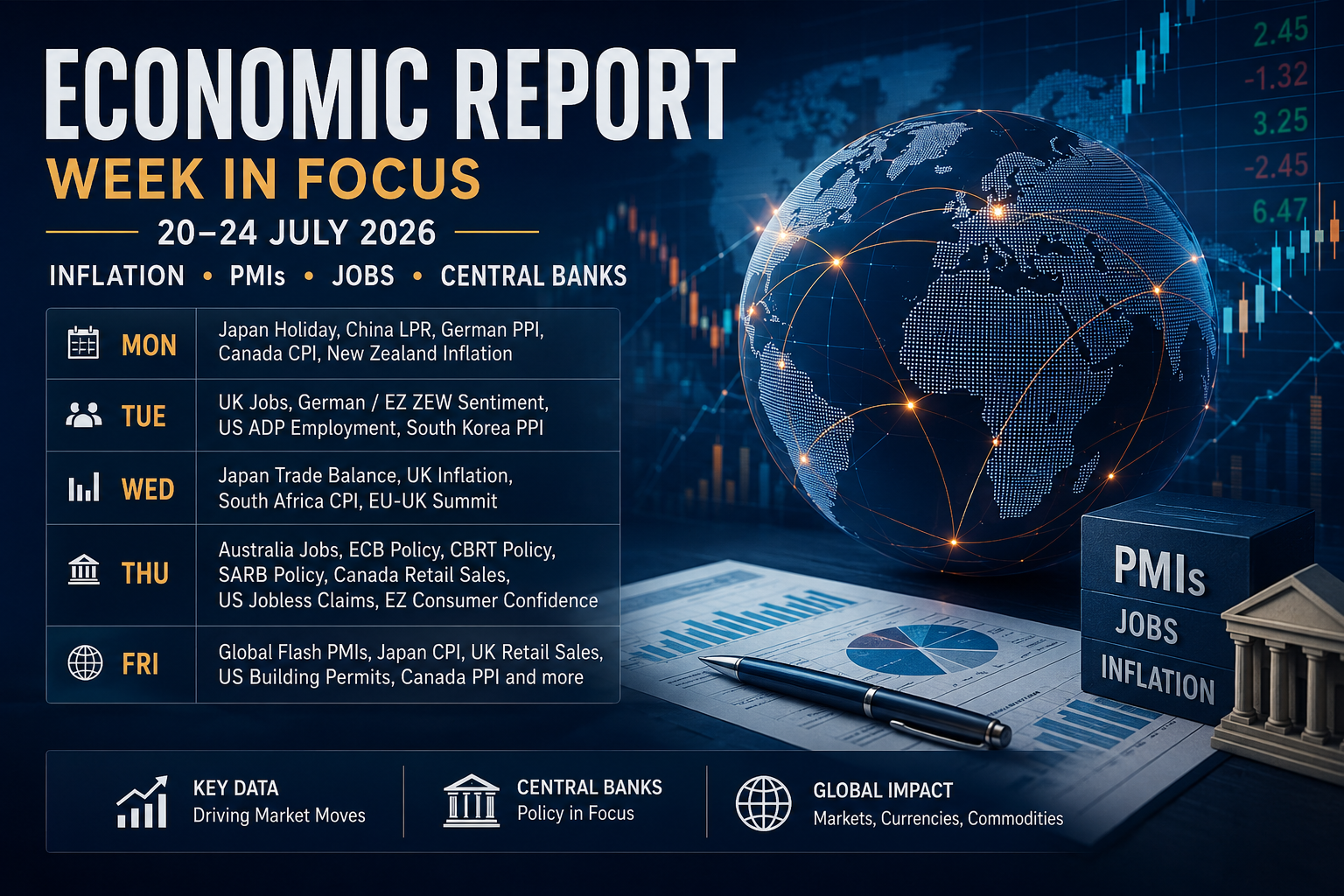
The Economic Report for the week of 20–24 July 2026 highlights one of the busiest periods on the global macroeconomic calendar this month. Investors will closely monitor inflation releases across Japan, the United Kingdom, Canada and New Zealand, while labour market reports from Australia and the UK, the European Central Bank’s July policy decision, and the first Global Flash PMIs for July provide fresh insight into economic momentum during the third quarter.
Although many major central banks have recently shifted toward a more data-dependent policy stance, incoming economic releases continue to shape expectations surrounding future interest-rate decisions. Inflation remains above target in several developed economies, labour markets continue to show signs of gradual moderation rather than abrupt deterioration, and business activity surveys are expected to offer the clearest indication yet of how higher borrowing costs and renewed geopolitical uncertainty are influencing corporate sentiment.
For financial markets, this week’s calendar offers a broad assessment of global economic conditions. Currency markets, sovereign bond yields, equity indices and commodity prices are all likely to respond as investors evaluate whether inflation pressures continue to ease, whether employment conditions remain resilient and whether business confidence is improving or weakening across major economies.
The Economic Report also arrives against a backdrop of elevated geopolitical uncertainty, fluctuating energy prices and diverging monetary policy expectations among the world’s leading central banks. While recent inflation readings have generally moderated from earlier peaks, policymakers remain cautious about declaring victory over inflation. At the same time, slowing growth indicators have increased the importance of every major economic release.
Why This Week Matters
Several of the week’s scheduled releases have the potential to reshape expectations for monetary policy during the second half of 2026.
Inflation reports from Canada, New Zealand, the United Kingdom and Japan will provide updated evidence regarding the pace of price growth across developed economies. Meanwhile, employment data from both Australia and the United Kingdom will offer further insight into labour market resilience as businesses continue adjusting to higher financing costs.
The European Central Bank is widely expected to leave interest rates unchanged, but investors will focus less on the decision itself and more on President Christine Lagarde’s guidance regarding September and the remainder of 2026.
Friday’s Global Flash Purchasing Managers’ Index (PMI) surveys may ultimately become the week’s most influential releases. Because PMIs are among the earliest indicators available each month, they frequently provide investors with the first comprehensive snapshot of business conditions across manufacturing and services sectors.
Collectively, these releases should help determine whether global growth continues to stabilise or whether economic momentum is beginning to soften further.
Monday: Inflation Data Opens the Week
Monday’s calendar begins with several important inflation releases while Asian markets also monitor China’s latest lending rate decision.
Chinese Loan Prime Rates
The People’s Bank of China is widely expected to leave both the one-year and five-year Loan Prime Rates unchanged.
The one-year benchmark is expected to remain at 3.00%, while the five-year rate is anticipated to stay at 3.50%. Policymakers continue to favour targeted liquidity operations over broad interest-rate adjustments as they attempt to support economic growth without encouraging excessive financial leverage.
China’s recent economic data has delivered mixed signals. Although second-quarter GDP growth slowed from earlier levels, industrial production, retail sales and trade data exceeded expectations, reducing immediate pressure for additional monetary easing.
As a result, markets will focus less on Monday’s rate decision and more on any accompanying signals regarding future policy flexibility.
Canadian Inflation Report
Canada publishes June consumer inflation figures on Monday, providing an important update ahead of future Bank of Canada policy meetings.
Headline inflation is expected to moderate following recent declines in energy prices earlier in June. However, geopolitical developments and the subsequent recovery in oil prices continue to complicate the inflation outlook.
Investors will pay particular attention to core inflation measures, which remain a more reliable indicator of underlying domestic price pressures than volatile energy components.
Should inflation ease broadly across both headline and core measures, expectations for further policy tightening could continue to diminish. Conversely, any renewed acceleration in underlying inflation would likely reinforce expectations that restrictive monetary policy may need to remain in place for longer.
New Zealand Inflation
New Zealand also releases second-quarter inflation data.
Annual inflation is expected to accelerate, reflecting higher fuel and energy costs experienced during the quarter. However, policymakers will likely distinguish between temporary energy-driven price increases and broader underlying inflation trends.
For the Reserve Bank of New Zealand, persistent core inflation remains considerably more important than headline movements caused by external commodity prices.
Markets currently continue to price meaningful probability of additional policy tightening later this year should inflation remain stubbornly above target.
German Producer Prices
Germany’s Producer Price Index provides an early indication of pipeline inflation pressures within Europe’s largest economy.
Producer prices often lead consumer inflation trends by several months, making the report an important indicator for both European policymakers and financial markets.
Recent declines in energy costs had previously helped reduce producer price inflation, although renewed increases in oil markets have introduced additional uncertainty.
Tuesday: Labour Markets Return to Centre Stage
Tuesday’s calendar shifts attention toward employment conditions and investor confidence.
United Kingdom Jobs Report
The UK labour market remains one of the Bank of England’s most closely monitored indicators.
Although employment has generally remained resilient throughout 2026, vacancies have gradually declined while businesses have become increasingly selective regarding new hiring.
The unemployment rate is expected to edge modestly higher, reflecting a gradual cooling rather than a sharp deterioration in labour market conditions.
Average earnings will receive particularly close scrutiny, as wage growth remains one of the principal drivers of domestic services inflation.
Should wage pressures remain elevated despite softer employment growth, the Bank of England may continue maintaining a cautious policy stance.

German and Eurozone ZEW Economic Sentiment
Investor confidence across Germany and the broader Eurozone will also be assessed through July’s ZEW Economic Sentiment surveys.
These forward-looking indicators measure expectations among financial market professionals regarding future economic conditions.
Recent improvements in manufacturing activity have supported sentiment modestly, although geopolitical uncertainty and higher energy prices continue limiting optimism across Europe.
Markets will assess whether investor expectations continue recovering or whether recent external developments have interrupted improving confidence.
United States ADP Employment Report
Although not always a precise predictor of official payroll data, the ADP employment report remains an important measure of private-sector hiring momentum.
Following several months of moderating employment growth, investors will examine whether businesses continue expanding payrolls despite elevated borrowing costs and slowing economic activity.
Particular attention will focus on sector composition, as hiring trends increasingly differ across industries.
Wednesday: Inflation Takes Centre Stage
Wednesday marks one of the most important sessions in this week’s Economic Report, with inflation releases from the United Kingdom and South Africa accompanied by Japanese trade data and the Eurogroup EU–UK summit. These releases will provide further clarity on the inflation outlook across several major economies while helping investors refine expectations for upcoming monetary policy decisions.
United Kingdom Inflation Report
The UK Consumer Price Index (CPI) will be among the week’s most closely watched releases.
Following several months of gradual moderation, headline inflation is expected to ease further during June, supported by lower energy prices earlier in the month. However, recent increases in crude oil prices and renewed geopolitical tensions have introduced fresh uncertainty into the inflation outlook, meaning investors will pay close attention not only to the headline figure but also to the underlying components.
For the Bank of England, services inflation and wage-driven price pressures remain considerably more important than temporary fluctuations in energy costs. While lower fuel prices can reduce headline inflation in the short term, policymakers continue to monitor whether broader inflationary pressures are becoming embedded throughout the economy.
A softer-than-expected inflation reading would reinforce expectations that the Bank of England can comfortably maintain its current policy stance over the coming months. Conversely, any upside surprise—particularly in core inflation—could revive expectations that interest rates may need to remain restrictive for longer.
Currency markets are likely to react immediately following the release, with gilt yields and sterling particularly sensitive to any deviation from consensus expectations.
South African Inflation
South Africa also releases June inflation data one day before the South African Reserve Bank announces its latest monetary policy decision.
Inflation is expected to remain above the central bank’s preferred target range, largely reflecting higher fuel costs and imported inflation pressures resulting from elevated energy prices.
While headline inflation has accelerated modestly, policymakers continue to distinguish between temporary energy-related price increases and broader domestic inflation dynamics. The Monetary Policy Committee has consistently emphasised that second-round inflation effects remain limited, reducing the urgency for aggressive policy tightening.
Nevertheless, any upside surprise could influence market expectations ahead of Thursday’s interest-rate decision.
Investors across emerging markets will monitor both the inflation release and subsequent policy announcement for clues regarding the SARB’s policy trajectory during the second half of the year.
Japanese Trade Balance
Japan’s June trade balance provides another important insight into the country’s economic performance.
Export growth has remained relatively resilient despite slowing global demand, supported by continued strength in technology-related shipments and improving regional trade activity.
Imports, meanwhile, remain heavily influenced by energy prices. As crude oil prices have recovered in recent weeks, import costs may begin placing additional pressure on Japan’s trade position.
Although the trade balance rarely moves markets independently, it contributes valuable context ahead of Friday’s Japanese inflation figures and the Bank of Japan’s upcoming policy meeting.
Eurogroup EU–UK Summit
European policymakers will also meet during the Eurogroup EU–UK summit.
Although the meeting is not expected to produce immediate policy changes, investors will monitor discussions surrounding trade cooperation, investment, financial regulation and broader economic coordination.
Any announcements regarding cross-border investment, financial services or economic cooperation could influence market sentiment across European assets.
Thursday: Central Banks Dominate the Economic Calendar
Thursday represents the busiest session of the week and forms the centrepiece of this Economic Report.
Several central banks announce policy decisions while Australia publishes employment data, Canada releases retail sales and the United States reports weekly jobless claims.
Australian Jobs Report
Australia’s labour market remains one of the Reserve Bank of Australia’s most important policy indicators.
Employment growth is expected to moderate compared with previous months, reflecting a gradual cooling in hiring rather than widespread labour market weakness.
The unemployment rate is forecast to remain broadly stable, suggesting that labour market conditions continue to support household consumption despite higher borrowing costs.
Investors will focus on three key components:
- Employment growth
- Unemployment rate
- Labour force participation
A stronger-than-expected employment report would likely support the Australian dollar by reducing expectations for future monetary easing.
Conversely, weaker employment growth combined with rising unemployment could strengthen the argument that labour market conditions are gradually softening as higher interest rates continue working through the economy.
European Central Bank Policy Decision
The European Central Bank’s July meeting represents one of the week’s most significant events.
Market participants overwhelmingly expect policymakers to leave interest rates unchanged following recent improvements in inflation dynamics and modest signs that euro area economic activity is stabilising.
While the decision itself is largely anticipated, President Christine Lagarde’s press conference will likely generate considerably greater market attention.
Investors will assess several important themes.
Inflation Outlook
Headline inflation has moderated considerably compared with earlier peaks, while underlying price pressures have also eased gradually.
The ECB continues to emphasise that policy decisions will remain entirely dependent on incoming economic data rather than predetermined policy paths.
Economic Growth
Recent PMI surveys suggest the euro area economy has stabilised following a prolonged slowdown, although growth remains modest by historical standards.
Consumer demand continues to recover slowly while manufacturing activity has shown tentative signs of improvement.
September Guidance
Markets continue to debate whether additional policy tightening could still occur later this year.
Accordingly, investors will scrutinise every aspect of President Lagarde’s communication for any indication regarding September’s meeting.
If policymakers maintain a balanced and data-dependent tone, market volatility may remain limited.
However, any shift toward a more hawkish or dovish stance could trigger significant movements across European bond yields, the euro and regional equity markets.
Turkish Central Bank Decision
The Central Bank of the Republic of Türkiye also announces its latest interest-rate decision.
Analysts remain divided between expectations for unchanged policy and a modest rate adjustment.
Inflation has moderated gradually in recent months but remains significantly above the central bank’s longer-term objectives.
Policymakers continue balancing inflation risks against financial stability considerations while monitoring exchange-rate developments closely.
South African Reserve Bank Decision
The South African Reserve Bank concludes its latest Monetary Policy Committee meeting on Thursday afternoon.
Consensus expectations generally favour unchanged policy, although the decision remains finely balanced following recent increases in inflation expectations.
The committee will likely emphasise several themes:
- Inflation expectations remain elevated.
- Future decisions will remain data dependent.
- Energy prices continue influencing inflation.
- Second-round inflation effects remain limited.
- Maintaining price stability remains the primary objective.
Regardless of the decision itself, investors will carefully examine Governor Lesetja Kganyago’s accompanying statement for updated guidance regarding future meetings.
Canadian Retail Sales
Canada’s retail sales report provides an important measure of consumer spending.
Household consumption has remained relatively resilient despite restrictive monetary policy and elevated borrowing costs.
A stronger retail sales report would indicate continued consumer resilience and could influence expectations regarding future Bank of Canada policy.
Weak spending, however, would reinforce evidence that higher interest rates are gradually slowing domestic demand.
United States Weekly Jobless Claims
Although released every week, initial jobless claims remain one of the most timely indicators of US labour market conditions.
Markets will assess whether layoffs continue remaining historically low or whether signs of broader labour market softening are beginning to emerge.
Persistent strength in employment continues supporting consumer spending and overall economic growth.
However, a sustained increase in jobless claims would suggest labour market conditions are gradually becoming less robust.
Friday: Global Flash PMIs Close the Week
Friday concludes the week’s Economic Report with one of the most influential data releases available each month—the Global Flash Purchasing Managers’ Index (PMIs).
PMIs frequently shape market sentiment because they provide one of the earliest comprehensive assessments of current business conditions.
Unlike many economic indicators released with significant delays, PMI surveys capture business activity almost in real time.
For investors, they often serve as an early signal regarding economic growth, employment intentions, inflation pressures and corporate confidence.
Why PMIs Matter
Purchasing Managers’ Index surveys measure activity across manufacturing and services sectors.
Readings above 50 generally indicate expansion.
Readings below 50 indicate contraction.
Because PMIs are released before most official economic statistics, they frequently influence financial markets more rapidly than GDP or industrial production data.
Markets will compare July’s surveys against June’s results to determine whether global economic momentum is strengthening or slowing.
Particular attention will focus on:
- New orders
- Employment
- Input costs
- Output prices
- Business expectations
- Export demand
Collectively, these components provide an early indication of inflation trends, labour market conditions and overall economic momentum heading into the third quarter.
Japanese Consumer Price Index (CPI)
Japan concludes the week’s major inflation calendar with the release of its June Consumer Price Index, an important indicator ahead of the Bank of Japan’s next monetary policy meeting.
Headline inflation is expected to edge higher, while core inflation is also forecast to increase modestly. Although both measures remain below the peaks experienced during the previous inflation cycle, they continue to attract considerable attention given the Bank of Japan’s gradual shift away from ultra-accommodative monetary policy.
Unlike many Western economies, Japan continues to balance moderate inflation against a long history of subdued price growth. As a result, policymakers are less concerned about temporary increases in energy prices than whether underlying domestic inflation is becoming more sustainable through stronger wage growth and consumer demand.
One of the key themes investors will monitor is whether food inflation continues to moderate after several months of elevated pricing. At the same time, renewed strength in global crude oil prices could begin feeding into transportation, utilities and production costs during the second half of the year.
Should inflation surprise to the upside, markets may modestly increase expectations that the Bank of Japan could gradually normalise policy over coming quarters. However, any policy adjustment is still expected to remain cautious and highly data dependent.
Currency markets are likely to respond immediately following the release, particularly if inflation deviates materially from consensus expectations. Government bond yields may also react as investors reassess the timing of any future policy normalisation.
United Kingdom Retail Sales
The United Kingdom closes its domestic data calendar with June Retail Sales.
Retail spending remains one of the clearest indicators of household confidence and consumer resilience, particularly during periods of elevated borrowing costs and persistent inflation.
Recent months have produced mixed results as consumers continue adjusting to higher mortgage costs, elevated living expenses and slower wage growth after inflation.
Market participants will focus on whether consumers maintained spending momentum despite ongoing economic uncertainty.
Several factors will influence the report:
- Consumer confidence
- Real wage growth
- Fuel prices
- Seasonal spending patterns
- Interest-rate sensitivity
A stronger retail sales report would reinforce the view that household demand remains relatively resilient despite restrictive monetary policy.
Conversely, weaker-than-expected spending would suggest that higher interest rates continue weighing on discretionary consumption, potentially reducing future inflationary pressures.
Retail sales are particularly important because household consumption accounts for a significant proportion of overall economic activity.
The Bank of England will therefore assess the report alongside labour market data and inflation releases when evaluating future monetary policy.
United States Building Permits
Although not always among the highest-profile releases, US Building Permits remain an important forward-looking indicator of residential investment and construction activity.
Building permits often provide an early indication of future housing supply, construction employment and broader investment trends.
Housing remains one of the sectors most directly affected by higher interest rates, making permit activity an important gauge of how restrictive monetary policy is influencing the real economy.
Should permits continue expanding, it would suggest that builders remain relatively optimistic regarding future housing demand despite elevated financing costs.
A weaker report, however, could indicate that tighter financial conditions continue discouraging new residential development.
Investors will also compare building permits with recent housing starts and existing home sales data to assess the broader health of the US property market.
Canadian Producer Price Index

Canada’s Producer Price Index concludes an important week of domestic inflation data.
While Monday’s CPI report measures prices paid by consumers, Producer Price Index data measures price changes received by manufacturers before goods reach consumers.
As such, Producer Price Index data frequently serves as an early indicator of future inflation trends.
Manufacturing input costs remain heavily influenced by energy prices, commodity markets and exchange-rate movements.
If producer prices continue moderating, markets may conclude that pipeline inflation pressures remain contained despite recent increases in crude oil prices.
However, stronger-than-expected producer inflation could indicate renewed pricing pressures that may eventually pass through to consumers.
The Bank of Canada will evaluate Producer Price Index trends alongside consumer inflation when assessing future policy decisions.
Market Implications
The week’s Economic Report contains several releases capable of influencing financial markets across multiple asset classes.
Rather than reacting to individual data points in isolation, investors will evaluate the combined message emerging from inflation, employment, business activity and central bank communication.
Foreign Exchange Markets
Currency markets are expected to remain particularly sensitive throughout the week.
The British pound will likely respond to inflation and employment data, while the euro’s direction may depend primarily on the European Central Bank’s policy communication and Friday’s Flash PMIs.
The Australian dollar will react to employment data, with stronger labour market figures supporting expectations that domestic economic conditions remain resilient.
The Canadian dollar faces a busy calendar, including inflation, retail sales and producer price data, all of which could influence expectations surrounding future Bank of Canada policy.
Meanwhile, the Japanese yen may experience increased volatility following Friday’s inflation release, particularly if the data alters expectations regarding future Bank of Japan policy.
Overall, currency markets are likely to remain driven by relative interest-rate expectations rather than absolute economic performance.
Fixed Income Markets
Government bond markets will carefully assess whether incoming data supports the view that inflation continues gradually moving toward central bank targets.
Should inflation moderate while employment remains resilient, bond markets may continue pricing stable policy rates across most developed economies.
However, stronger inflation combined with robust labour market data could lead investors to push expectations for future rate reductions further into the future.
Yield curves across major sovereign markets will therefore remain highly responsive to economic surprises throughout the week.
Particular attention will focus on:
- US Treasury yields
- German Bunds
- UK Gilts
- Australian Government Bonds
- Canadian Government Bonds
- Japanese Government Bonds
Equity Markets
Global equity markets generally favour an environment characterised by moderating inflation, resilient employment and improving business activity.
Should this week’s data broadly support that combination, equity sentiment could remain constructive.
However, investors will also monitor whether higher energy prices begin affecting corporate margins and business confidence.
The Financial sector may respond primarily to central bank communication.
Consumer-related companies will closely track retail sales and labour market developments.
Industrial companies may react more directly to Flash PMI surveys, which provide valuable insight into manufacturing activity and new orders.
Technology shares will continue responding to broader interest-rate expectations rather than individual economic releases.
Commodity Markets
Commodity markets remain heavily influenced by geopolitical developments and global growth expectations.
Energy prices continue representing one of the largest sources of inflation uncertainty for central banks worldwide.
Should Flash PMIs indicate stronger manufacturing activity, industrial commodities could receive additional support.
Conversely, weaker business surveys may reinforce concerns regarding slower global demand.
Gold prices will likely remain sensitive to movements in bond yields and monetary policy expectations rather than inflation alone.
Investor Outlook
From an investment perspective, this week’s calendar represents one of the most comprehensive assessments of global economic conditions available during July.
Rather than focusing on individual releases independently, investors should evaluate whether the overall direction of incoming data remains consistent with three broader themes.
Inflation
Are inflation pressures continuing to moderate across developed economies without generating renewed price acceleration?
Labour Markets
Do employment conditions remain sufficiently resilient to support household consumption while gradually easing wage-driven inflation?
Business Activity
Are July’s Flash PMIs confirming stabilising economic momentum, or are businesses becoming increasingly cautious amid higher financing costs and geopolitical uncertainty?
The answers to these questions will help determine market expectations heading into August and provide valuable context ahead of the next round of central bank meetings.
Overall, this Economic Report suggests financial markets are entering a period where incremental changes in macroeconomic data may prove more influential than dramatic policy announcements.
As inflation gradually approaches target levels and interest rates stabilise across many developed economies, investors are increasingly shifting attention toward economic momentum, corporate confidence and labour market resilience.
Frequently Asked Questions
What is the most important event in this week’s Economic Report?
The European Central Bank policy announcement and Friday’s Global Flash PMIs are expected to be the week’s most market-moving events because they provide updated guidance on monetary policy and business activity.
Why are inflation reports important for investors?
Inflation influences central bank interest-rate decisions, government bond yields, currency valuations and equity market expectations. Persistent inflation may keep monetary policy restrictive for longer.
Why do PMIs receive so much market attention?
Purchasing Managers’ Index surveys are among the earliest monthly indicators available and provide timely insight into manufacturing activity, services demand, employment and business confidence.
Why are employment reports closely monitored?
Labour market conditions influence consumer spending, wage growth and inflation. Strong employment generally supports economic growth, while weaker employment may signal slowing activity.
What will investors watch at the ECB meeting?
Markets will focus on the policy statement, inflation outlook, economic growth assessment and President Christine Lagarde’s guidance regarding future meetings.
Why is Australian employment data significant?
Employment remains one of the Reserve Bank of Australia’s primary indicators when assessing domestic economic strength and future monetary policy.
How does Canadian inflation affect markets?
Canadian inflation influences expectations regarding future Bank of Canada interest-rate decisions and may affect both bond yields and the Canadian dollar.
Why do building permits matter?
Building permits provide an early indication of future construction activity, housing investment and broader economic momentum.
How should investors interpret multiple economic releases during the same week?
Individual releases should be viewed collectively rather than independently. The overall trend across inflation, employment and business activity generally provides a more reliable assessment of economic conditions.
What does this Economic Report suggest for markets?
The overall calendar suggests investors will remain focused on inflation trends, labour market resilience and business activity as they assess the outlook for monetary policy and global economic growth.

Conclusion
This Economic Report outlines one of the most significant macroeconomic calendars of July, with inflation, employment, central bank decisions and Flash PMI surveys providing a comprehensive assessment of the global economy.
The combination of inflation reports from several major economies, labour market updates, multiple central bank meetings and business activity surveys offers investors a detailed view of economic momentum entering the second half of 2026.
While financial markets continue to anticipate a broadly data-dependent policy environment, the interaction between inflation, employment and business activity will remain the primary driver of interest-rate expectations across developed economies.
Rather than focusing on a single headline event, investors should evaluate the week’s releases collectively. Consistency across inflation, labour market resilience and improving business sentiment would reinforce expectations of continued economic stabilisation. Conversely, renewed inflationary pressures or signs of weakening activity could prompt markets to reassess policy expectations during the months ahead.
As always, this week’s economic calendar is likely to influence currencies, sovereign bond markets, equities and commodities, making it an important period for institutional investors, portfolio managers and market participants worldwide.