






Table of Contents
- Executive Summary
- A Week Dominated by Central Banks and Inflation Data
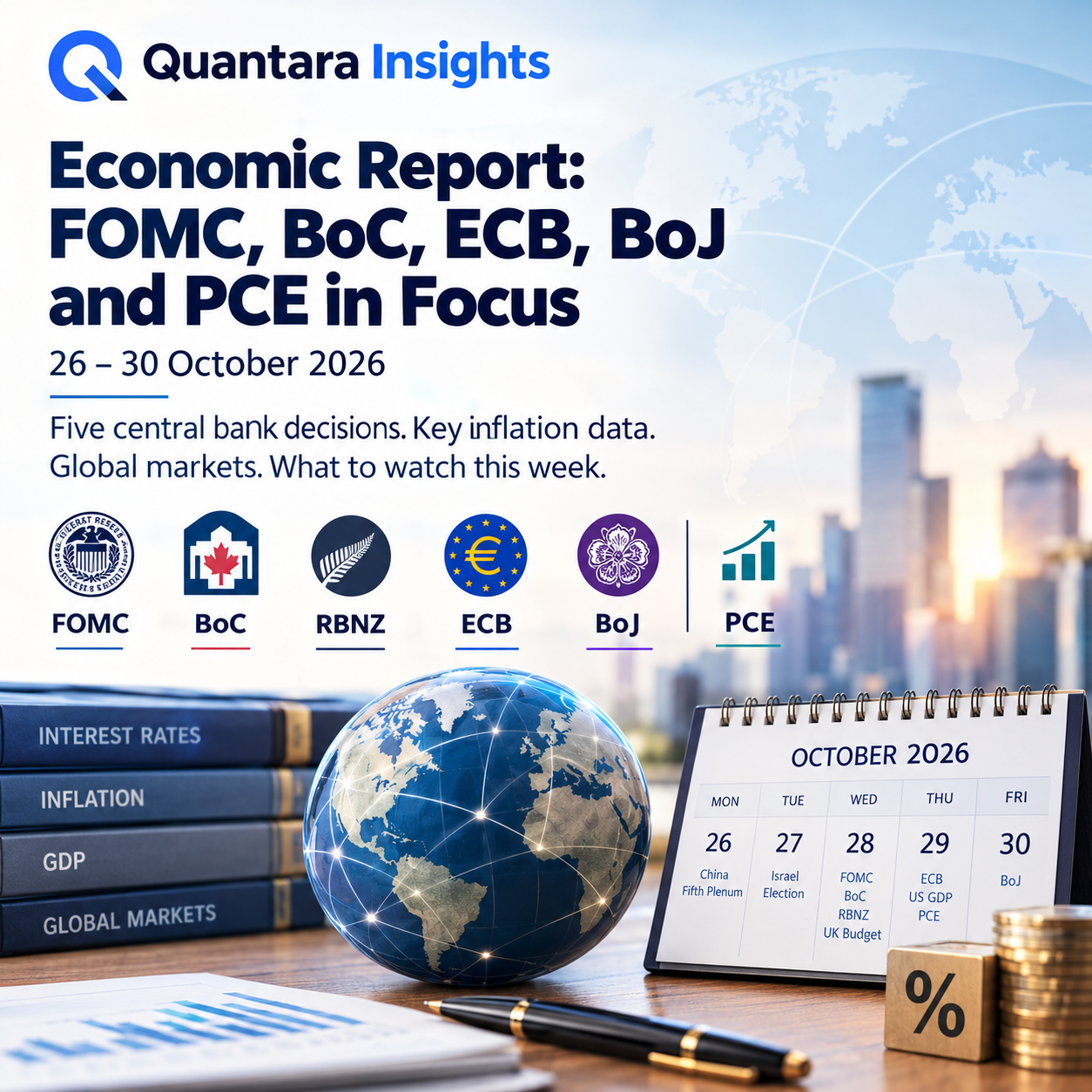
- Key Events at a Glance
- Why This Economic Report Matters
- FOMC Meeting Expected to Deliver a Hawkish Hold
- What Investors Will Watch During the FOMC Press Conference
- Interest Rates Continue to Drive Every Major Asset Class
- US PCE Inflation Report: The Federal Reserve’s Preferred Inflation Gauge
- US GDP: Measuring the Economy’s Momentum
- Bank of England: Inflation Still Complicates Policy
- Bank of Japan: Gradual Normalization Continues
- European Central Bank: Watching Inflation and Growth
- China’s Politburo Meeting: Policy Direction Under the Spotlight
- Chinese PMI Data: A Window into Manufacturing Activity
- Australian Inflation: Another Important Test for Global Monetary Policy
- Inflation Remains the Defining Theme of 2026
- How Interest Rates Continue to Shape Financial Markets
- Energy Prices Remain a Key Wild Card
- What Institutional Investors Will Be Watching
- Economic Report Outlook: Connecting the Data
- Week Ahead Market Outlook: What Investors Should Watch
- Key Risks to Monitor
- What Could Move Markets the Most?
- Final Thoughts
Executive Summary
Economic Report analysis takes center stage this week as investors prepare for one of the most important stretches of the summer trading calendar. The upcoming FOMC policy decision, the release of the Federal Reserve’s preferred inflation measure through the PCE report, advance US GDP figures, and several major central bank meetings are expected to shape expectations for interest rates well into the second half of the year.
Financial markets enter the week balancing resilient economic growth against persistent inflation pressures, while geopolitical developments continue to influence commodity prices and broader market sentiment. Although many major central banks are expected to leave policy settings unchanged, investors will closely examine official statements, updated forecasts, and press conferences for any indication that policymakers are preparing to adjust interest rates in the coming months.
The United States remains the primary focus, with the Federal Reserve expected to maintain its current policy stance while emphasizing a data-dependent approach. However, markets will also monitor decisions from the Bank of England, Bank of Japan, and several other major central banks, alongside key inflation releases from Europe and Asia that could influence global monetary policy expectations.
This Economic Report examines every major event scheduled for the week, explains why each release matters, evaluates potential market reactions, and highlights the broader macroeconomic themes investors should watch across equities, bonds, currencies, and commodities.
A Week Dominated by Central Banks and Inflation Data
The upcoming week represents one of the busiest periods on the global economic calendar. Nearly every major financial market will be influenced by policy announcements, inflation readings, economic growth figures, and forward guidance from central bankers.
Unlike weeks dominated by a single event, this calendar presents investors with multiple catalysts that could reinforce—or contradict—each other. The interaction between inflation data, labor market conditions, economic growth, and central bank messaging will determine how markets price the future path of interest rates.
Several recurring themes continue to dominate the macroeconomic landscape:
- Persistent inflation despite slower headline readings
- Central banks maintaining restrictive policy settings
- Moderating but positive economic growth
- Elevated geopolitical uncertainty
- Energy price volatility
- Ongoing questions surrounding future interest rates
Each of these factors feeds directly into investor expectations for monetary policy, making this week’s Economic Report particularly significant for portfolio positioning.
Key Events at a Glance
| Event | Region | Why It Matters |
|---|---|---|
| FOMC Policy Decision | United States | Future path of interest rates |
| US PCE Inflation | United States | Fed’s preferred inflation gauge |
| Advance US GDP | United States | Measures economic momentum |
| Bank of England Meeting | United Kingdom | Inflation and policy outlook |
| Bank of Japan Meeting | Japan | Future tightening expectations |
| Eurozone CPI | Euro Area | ECB inflation outlook |
| Eurozone GDP | Euro Area | Regional growth assessment |
| Australian CPI | Australia | RBA policy expectations |
| Tokyo CPI | Japan | Inflation leading indicator |
| China PMI | China | Manufacturing and economic activity |
Collectively, these releases provide one of the most comprehensive snapshots of the global economy available during the quarter.
Why This Economic Report Matters
Markets have become increasingly sensitive to incoming economic data because many central banks are approaching critical policy decisions.
Rather than committing to a predetermined path for interest rates, policymakers have repeatedly emphasized that each meeting will depend on the latest economic information. As a result, every inflation report, employment release, and GDP estimate carries greater significance than during periods of stable monetary policy.

This week’s Economic Report combines nearly every major macroeconomic indicator investors monitor:
- Inflation
- Economic growth
- Manufacturing activity
- Consumer demand
- Central bank guidance
- Global monetary policy
Viewed together, these reports will help determine whether policymakers remain comfortable keeping interest rates unchanged or whether renewed inflation risks warrant additional tightening later this year.
FOMC Meeting Expected to Deliver a Hawkish Hold
The centerpiece of this week’s Economic Report is undoubtedly the Federal Open Market Committee meeting.
Consensus expectations strongly favor leaving policy rates unchanged, reflecting recent moderation in inflation alongside signs that the labor market has gradually cooled.
However, investors should not mistake an unchanged rate decision for a dovish shift.
Instead, policymakers are expected to reinforce three important messages.
Inflation Remains Above Target
Although recent inflation reports have shown improvement, price growth continues to exceed the Federal Reserve’s long-term objective.
Officials remain concerned that inflation could become entrenched if financial conditions ease prematurely.
For this reason, the Committee is expected to emphasize patience rather than declare victory over inflation.
Economic Growth Remains Positive
Another reason the FOMC is expected to remain cautious is the resilience of the broader economy.
Consumer spending continues to support activity, business investment remains relatively healthy, and employment conditions, while moderating, have not weakened enough to justify easier monetary policy.
The combination of stable growth and elevated inflation allows policymakers additional flexibility to maintain current interest rates while evaluating future data.
Geopolitical Risks Complicate Monetary Policy
Recent geopolitical developments have introduced another layer of uncertainty.
Higher energy prices resulting from renewed tensions can temporarily increase inflation while simultaneously weighing on economic growth.
This creates a difficult balancing act for central banks.
If policymakers respond too aggressively to temporary energy-driven inflation, they risk unnecessarily slowing the broader economy.
Conversely, ignoring sustained price pressures could undermine inflation expectations.
The Federal Reserve is therefore expected to stress that future decisions regarding interest rates will remain entirely dependent on incoming economic data.
What Investors Will Watch During the FOMC Press Conference
While the policy statement itself is important, markets often react more significantly to comments made during the Chair’s press conference.
Investors will closely monitor responses to questions regarding:
- Inflation progress
- Labor market conditions
- Future interest rates
- Tariff-related inflation risks
- Energy prices
- Consumer spending
- Housing inflation
- Financial conditions
- Business investment
- Timing of future policy adjustments
Even subtle changes in language can influence Treasury yields, equity markets, and currency valuations.
As a result, this portion of the Economic Report could prove more influential than the formal rate announcement itself.
Interest Rates Continue to Drive Every Major Asset Class
Perhaps no single variable has become more important for financial markets than interest rates.
Higher borrowing costs influence virtually every area of the economy, including:
- Mortgage activity
- Housing demand
- Consumer spending
- Corporate borrowing
- Capital investment
- Equity valuations
- Government bond yields
- Currency markets
- Commodity prices
Because interest rates affect future cash flows and financing costs, even small adjustments in expectations can trigger meaningful market movements.
This week’s combination of the FOMC, inflation reports, and growth data therefore has implications extending far beyond the bond market.
Equity investors, commodity traders, foreign exchange participants, and institutional asset managers will all use this Economic Report to reassess their outlook for monetary policy during the remainder of the year.
US PCE Inflation Report: The Federal Reserve’s Preferred Inflation Gauge
Following the FOMC announcement, attention will quickly shift to one of the week’s most influential data releases: the Personal Consumption Expenditures (PCE) Price Index.
For policymakers, PCE carries greater significance than the Consumer Price Index (CPI) because it provides a broader measure of inflation across the U.S. economy and better reflects changing consumer behavior. As the Federal Reserve’s preferred inflation gauge, the report will play a critical role in shaping expectations for future interest rates.
This Economic Report views the upcoming PCE release as one of the defining events of the week. Even if the Federal Reserve leaves policy unchanged, stronger or weaker inflation data could immediately influence market expectations for future policy meetings.
Why PCE Matters More Than CPI
Many investors focus on the monthly CPI report because it often receives greater media attention. However, Federal Reserve officials consistently emphasize PCE when evaluating inflation trends.
Several characteristics make PCE particularly valuable:
- It includes a broader range of consumer expenditures.
- Spending weights adjust as consumer behavior changes.
- Healthcare expenditures receive more comprehensive treatment.
- The index generally provides a more stable measure of underlying inflation.
For these reasons, every Economic Report covering U.S. monetary policy should closely examine PCE, as it frequently carries greater weight in policy discussions than headline CPI.
Market Expectations for the PCE Report
Consensus forecasts suggest another modest easing in annual inflation, although the pace of improvement remains gradual.
Several components are expected to influence the report:
Lower Energy Prices
Earlier declines in gasoline and fuel prices are likely to provide some downward pressure on headline inflation. Since energy prices represent a smaller share of the PCE basket than the CPI basket, the impact may be somewhat muted but still meaningful.
Sticky Core Inflation
Core inflation—which excludes food and energy—is expected to remain considerably more resilient.
Several categories continue to warrant close attention:
- Services inflation
- Housing-related costs
- Healthcare expenditures
- Technology products
- Financial services
These areas have demonstrated greater persistence, reinforcing the Federal Reserve’s cautious approach toward future interest rates.
Goods Inflation
Recent improvements in supply chains have reduced pricing pressure for many goods categories. However, higher semiconductor costs and select imported products continue to create isolated areas of upward inflation pressure.
The overall result is likely to be another mixed inflation report—one showing gradual progress but not enough to declare victory over inflation.
How Markets Could React
The PCE release has the potential to move virtually every major asset class.
If inflation comes in below expectations, investors may conclude that the Federal Reserve has additional flexibility to maintain current interest rates or potentially ease policy later in the year.
Conversely, stronger-than-expected inflation would reinforce the view that policymakers must remain restrictive for longer.
Potential market reactions include:
| Stronger PCE | Weaker PCE |
|---|---|
| Higher Treasury yields | Lower Treasury yields |
| Stronger U.S. dollar | Softer U.S. dollar |
| Pressure on growth stocks | Support for equities |
| Higher rate expectations | Lower rate expectations |
Because inflation remains the central driver of monetary policy, the PCE report represents one of the most important components of this week’s Economic Report.
US GDP: Measuring the Economy’s Momentum
Another major highlight of this Economic Report is the advance estimate of second-quarter US GDP.
Gross Domestic Product remains the broadest measure of economic activity and provides investors with a comprehensive assessment of the nation’s economic health.
Although growth has moderated from the exceptionally strong pace experienced previously, the U.S. economy continues to demonstrate resilience despite elevated interest rates.
What’s Driving GDP Growth?
Several sectors continue to support economic expansion.
Consumer Spending
Household consumption remains the largest contributor to economic activity.
Although higher borrowing costs have slowed discretionary purchases in some areas, consumer spending has remained relatively healthy thanks to continued employment growth and stable household incomes.
Business Investment
Corporate investment has remained surprisingly resilient.
Technology spending, artificial intelligence infrastructure, manufacturing expansion, and productivity-enhancing investments continue supporting overall growth despite higher financing costs.
Government Spending
Public sector investment continues contributing positively, particularly in infrastructure and defense-related expenditures.
These programs have partially offset slower activity in interest-rate-sensitive sectors such as residential housing.
Net Exports
Trade remains a headwind.
Higher imports and softer global demand continue weighing on overall GDP growth, although the magnitude of this drag varies from quarter to quarter.
Why GDP Matters for Interest Rates
Economic growth directly influences monetary policy.
If the economy continues expanding at a healthy pace while inflation remains elevated, policymakers have less incentive to reduce interest rates.
Conversely, a meaningful slowdown in US GDP could strengthen arguments for a less restrictive policy stance if inflation also continues moderating.
For that reason, investors should evaluate the GDP report alongside the PCE inflation data rather than in isolation.
Together, these reports provide one of the clearest pictures of the current U.S. economic environment.
Bank of England: Inflation Still Complicates Policy
While the United States dominates this week’s calendar, the United Kingdom will also receive significant attention.
The Bank of England is widely expected to leave policy unchanged, but inflation continues presenting a difficult challenge for policymakers.
Unlike many previous tightening cycles, inflation has proven more persistent across several sectors of the British economy.
Although headline inflation has moderated, underlying price pressures remain elevated.
This creates a policy dilemma.
Maintaining restrictive interest rates risks slowing economic growth.
Lowering borrowing costs too early risks allowing inflation to accelerate again.
As a result, most economists expect the Bank of England to maintain a cautious, data-dependent approach.
What Investors Should Watch
Markets will focus on several key areas:
- Voting split among Monetary Policy Committee members
- Updated inflation projections
- Economic growth forecasts
- Wage growth commentary
- Energy price assessment
- Future guidance regarding interest rates
Any indication that policymakers are becoming more concerned about inflation could influence expectations for future rate decisions.
Bank of Japan: Gradual Normalization Continues
The Bank of Japan enters this meeting after recently raising policy rates to levels not seen in decades.
Although another increase appears unlikely this week, investors remain focused on the longer-term outlook.
Japan’s economy continues experiencing moderate growth, while inflation has become more durable than during previous years.
The central bank now faces the challenge of normalizing policy without disrupting financial markets.
Inflation in Japan
Recent inflation trends suggest price growth is becoming more broadly distributed throughout the economy.
Key developments include:
- Higher wage growth
- Improving domestic demand
- Stronger corporate pricing power
- Moderately higher consumer inflation
Although inflation remains below levels seen in many Western economies, policymakers increasingly believe extraordinary monetary accommodation is no longer necessary.
Why the BoJ Matters Globally
Changes in Japanese monetary policy often influence global bond markets.
Japanese institutional investors represent some of the world’s largest buyers of international fixed-income assets.
If domestic yields continue rising, some capital could gradually shift back into Japan, affecting global bond demand and financial conditions.
Accordingly, the Bank of Japan remains an important component of this week’s Economic Report, even if no immediate policy change is expected.
European Central Bank: Watching Inflation and Growth
The Eurozone also faces a delicate balancing act.
Economic growth remains subdued, while inflation risks have not disappeared completely.
This week’s releases—including Eurozone GDP and consumer inflation—will provide important insights into whether policymakers can continue holding interest rates steady or whether renewed inflation pressures may require additional action.
Recent surveys suggest manufacturing activity has stabilized, while services continue expanding modestly.
However, geopolitical uncertainty and energy prices remain significant upside risks for inflation.
ECB officials continue emphasizing a meeting-by-meeting approach, making every major data release particularly important.
Investors will therefore closely monitor:
- Eurozone GDP
- Consumer inflation
- Energy prices
- Manufacturing activity
- Services sector performance
- Labor market conditions
Together, these indicators will shape expectations for future European monetary policy and provide additional context for global investors assessing the outlook for interest rates.
China’s Politburo Meeting: Policy Direction Under the Spotlight
Beyond the United States, this Economic Report identifies China as one of the week’s most important macroeconomic stories. Although the timing of the Politburo meeting is traditionally not announced in advance, investors will closely monitor any policy signals that emerge from Beijing.
China remains the world’s second-largest economy, and any shift in fiscal policy, infrastructure spending, housing support, or industrial investment can have significant implications for global markets. Commodity exporters, multinational corporations, and emerging market economies all have a vested interest in China’s economic trajectory.
The first half of the year has produced mixed results. While industrial production and export-related sectors have shown resilience, domestic demand and consumer confidence remain uneven. The property sector also continues to weigh on broader economic activity despite targeted policy support.
What Investors Want to Hear
Markets are looking for evidence that Chinese policymakers remain committed to supporting sustainable growth without relying on broad-based stimulus measures.
Areas of particular interest include:
- Additional fiscal spending
- Support for domestic consumption
- Measures to stabilize the property sector
- Infrastructure investment
- High-tech manufacturing initiatives
- Financial system stability
- Credit availability for businesses
Any announcements in these areas could influence commodity prices, Asian equity markets, and global risk sentiment.
Chinese PMI Data: A Window into Manufacturing Activity
Later in the week, China will publish its latest Purchasing Managers’ Index (PMI) reports.
PMIs provide one of the earliest monthly indicators of economic activity and are closely monitored by investors for signs of accelerating or slowing growth.
A reading above 50 generally indicates expansion, while a reading below 50 suggests contraction.
Manufacturing PMI
Manufacturing activity has remained relatively resilient despite softer global demand. Continued investment in advanced manufacturing, artificial intelligence infrastructure, and export-oriented industries has helped offset weakness elsewhere in the economy.
However, investors will also be watching for signs that domestic demand is beginning to strengthen, as sustainable long-term growth depends increasingly on household consumption rather than exports alone.
Non-Manufacturing PMI
The services sector remains another critical indicator.
Stronger services activity would suggest improving consumer confidence and broader economic recovery, while weaker readings could reinforce concerns about slowing domestic demand.
For commodity markets, a stronger-than-expected PMI report could support industrial metals, energy demand expectations, and broader market sentiment.
Australian Inflation: Another Important Test for Global Monetary Policy
Australia also contributes significantly to this week’s Economic Report through the release of second-quarter Consumer Price Index (CPI) data.
Inflation remains the Reserve Bank of Australia’s primary policy concern, and investors will examine whether recent price pressures continue to justify restrictive interest rates.
Several factors are expected to influence the report:
- Energy prices
- Housing construction costs
- Services inflation
- Food prices
- Transportation expenses
Recent labor market strength has reinforced expectations that inflation could remain elevated for longer than previously anticipated.
If inflation surprises to the upside, markets may increase expectations for additional policy tightening from the Reserve Bank of Australia.
Inflation Remains the Defining Theme of 2026
One message consistently emerges throughout this Economic Report: inflation remains the central issue confronting policymakers around the world.
Although headline inflation has generally moderated from its peak, underlying price pressures remain more persistent than many economists expected.
Several structural factors continue contributing to inflation:
Energy Markets
Geopolitical tensions have increased volatility in crude oil markets, creating renewed uncertainty for inflation forecasts.
Higher energy prices affect transportation, manufacturing, logistics, agriculture, and consumer spending, making them one of the most closely watched variables in the global economy.
Labor Markets
Employment conditions remain relatively healthy across many advanced economies.
Strong labor markets support household spending but can also contribute to wage-driven inflation if productivity growth fails to keep pace.
Services Inflation
Unlike goods inflation, services inflation has proven particularly difficult to reduce.
Housing, healthcare, insurance, hospitality, and professional services continue recording stronger price growth than policymakers would prefer.
These persistent pressures explain why many central banks remain reluctant to signal imminent reductions in interest rates.
How Interest Rates Continue to Shape Financial Markets
The importance of interest rates extends well beyond central bank meetings.
Changes in borrowing costs influence nearly every major financial asset.
Equity Markets
Growth-oriented companies typically experience greater sensitivity to rising interest rates, as higher discount rates reduce the present value of future earnings.
Conversely, sectors such as financial services may benefit from higher rates through improved lending margins.
Investors should therefore monitor sector-specific reactions rather than focusing solely on broad market indices.
Bond Markets
Government bond yields respond almost immediately to changes in monetary policy expectations.
If investors anticipate higher interest rates, bond yields generally move upward while bond prices decline.
Should inflation moderate more rapidly than expected, yields may fall as markets begin pricing a less restrictive policy outlook.
Currency Markets
Interest rate differentials remain one of the primary drivers of foreign exchange movements.
Currencies associated with relatively higher yields often attract international capital, strengthening exchange rates.
Accordingly, this week’s FOMC, Bank of England, and Bank of Japan meetings all have the potential to influence major currency pairs.
Commodity Markets
Commodity prices respond to both economic growth expectations and monetary policy.
Higher interest rates can strengthen the U.S. dollar, making commodities more expensive for international buyers.

At the same time, stronger economic growth can increase demand for industrial metals and energy products.
This interaction makes commodity markets particularly sensitive to both inflation data and GDP releases.
Energy Prices Remain a Key Wild Card
One of the most important risks highlighted throughout this Economic Report is continued volatility in energy markets.
Oil prices influence nearly every component of the global economy.
Higher fuel costs increase transportation expenses, manufacturing costs, airline operating expenses, agricultural production costs, and household energy bills.
These effects eventually feed into broader inflation measures, complicating central bank decision-making.
While policymakers generally prefer to look through temporary energy shocks, sustained increases can influence inflation expectations and wage negotiations.
As a result, investors should continue monitoring developments in energy markets alongside traditional economic indicators.
What Institutional Investors Will Be Watching
Professional investors rarely focus on a single economic release in isolation.
Instead, they evaluate how multiple reports interact to shape the broader macroeconomic narrative.
During the coming week, institutional investors will likely ask several critical questions:
- Is inflation continuing to moderate?
- Does economic growth remain resilient?
- Are labor markets beginning to weaken?
- Will central banks maintain restrictive interest rates for longer?
- Are energy prices creating renewed inflation risks?
- Is global growth becoming more synchronized?
The answers to these questions will help determine asset allocation decisions across equities, fixed income, currencies, and alternative investments.
Economic Report Outlook: Connecting the Data
While each economic release provides valuable information independently, the true importance of this week’s calendar lies in how the data fits together.
For example:
- A softer PCE report combined with weaker US GDP could reinforce expectations that inflation is easing alongside moderating growth.
- Strong GDP coupled with elevated inflation could strengthen the case for maintaining restrictive interest rates.
- Stable inflation and resilient labor markets may encourage policymakers to remain patient while monitoring future developments.
- Unexpected geopolitical events could quickly alter inflation expectations regardless of economic data.
Because financial markets continuously reassess these relationships, investors should avoid interpreting any single report in isolation.
Instead, this Economic Report encourages readers to view the week’s releases as interconnected pieces of a broader macroeconomic puzzle.
Week Ahead Market Outlook: What Investors Should Watch
This Economic Report highlights one of the most important weeks on the macroeconomic calendar, with multiple events likely to influence financial markets simultaneously. While each release is significant on its own, the combined impact of the FOMC, PCE, US GDP, and several global central bank meetings will provide investors with a clearer understanding of the economic outlook heading into the next phase of the year.
The Federal Reserve remains the primary focus, but the broader narrative extends well beyond the United States. Inflation trends in Europe, monetary policy decisions in the United Kingdom and Japan, manufacturing activity in China, and inflation data from Australia all contribute to the evolving picture of global economic conditions.
Investors should pay particular attention to whether the week’s data reinforces three major themes:
- Inflation is continuing to moderate without a significant deterioration in economic growth.
- Central banks remain committed to maintaining restrictive interest rates until inflation returns closer to target.
- Economic growth is slowing gradually rather than entering a sharp contraction.
If these themes remain intact, markets may continue to favor a cautious but constructive outlook. However, meaningful surprises in inflation, growth, or central bank communication could quickly alter expectations across equities, bonds, currencies, and commodities.
Key Risks to Monitor
Although the economic calendar provides a roadmap for the week, several external factors could influence market sentiment beyond scheduled data releases.
Geopolitical Developments
Ongoing geopolitical tensions continue to present a risk to global financial markets. Any escalation affecting energy production, international trade, or supply chains could place renewed upward pressure on inflation and complicate central bank policy decisions.
Energy Prices
Oil and natural gas prices remain critical variables. Sustained increases could delay progress on inflation and strengthen expectations that interest rates will remain elevated for longer.
Inflation Persistence
While headline inflation has eased in many economies, core inflation remains more resilient. Sticky price pressures in housing, services, and labor-intensive industries continue to present challenges for policymakers.
Financial Conditions
Markets will also monitor credit conditions, corporate financing costs, and consumer borrowing. Higher financing costs have gradually tightened financial conditions, but resilient employment and consumer spending have helped offset some of these headwinds.
What Could Move Markets the Most?
Although the week is packed with important events, several releases are likely to have the greatest influence on investor sentiment.
1. FOMC Policy Decision
The Federal Reserve’s statement and press conference will provide valuable insight into how policymakers assess inflation, economic growth, and future interest rates.
2. PCE Inflation Report
As the Federal Reserve’s preferred inflation gauge, the PCE report could significantly influence expectations for future monetary policy.
3. US GDP
The advance estimate of US GDP will offer a timely assessment of the economy’s underlying momentum and help determine whether higher interest rates are materially slowing growth.
4. Bank of England Meeting
Investors will evaluate whether persistent inflation in the United Kingdom increases the likelihood of further policy tightening later this year.
5. Bank of Japan Decision
Although no immediate policy change is widely expected, any adjustment in the Bank of Japan’s guidance could have broader implications for global bond markets and currency valuations.
Final Thoughts
This Economic Report underscores the importance of analyzing economic releases as part of a broader macroeconomic framework rather than focusing on individual data points.
The interaction between inflation, employment, consumer spending, business investment, and monetary policy will continue to shape financial markets over the coming months. While the immediate outlook suggests that most major central banks will leave policy unchanged, investors should remain attentive to evolving guidance regarding future interest rates.
The FOMC, PCE, and US GDP releases collectively provide one of the most comprehensive snapshots of the U.S. economy available during the quarter. Combined with inflation data and central bank decisions from other major economies, this week’s calendar offers valuable insight into the direction of global monetary policy and economic growth.
For investors, traders, and market participants, maintaining a disciplined focus on the broader macroeconomic picture will remain essential as financial markets continue responding to changing inflation dynamics, evolving policy expectations, and geopolitical developments.
Frequently Asked Questions

1. What is included in this Economic Report?
This Economic Report covers the week’s most important macroeconomic events, including the FOMC meeting, PCE inflation data, US GDP, central bank decisions, inflation reports, manufacturing surveys, and other market-moving releases.
2. Why is the FOMC meeting important?
The FOMC determines U.S. monetary policy and sets the federal funds rate. Its decisions and forward guidance influence borrowing costs, bond yields, equity markets, and the U.S. dollar.
3. Why does the Federal Reserve prefer the PCE inflation measure?
The PCE Price Index provides a broader measure of consumer inflation than CPI and adjusts for changes in consumer spending patterns, making it the Federal Reserve’s preferred inflation indicator.
4. How do interest rates affect financial markets?
Changes in interest rates influence borrowing costs, consumer spending, corporate investment, bond prices, stock valuations, exchange rates, and overall economic activity.
5. Why is US GDP closely monitored?
US GDP measures the total value of goods and services produced in the economy. It provides a comprehensive assessment of economic growth and helps investors evaluate the strength of overall economic activity.
6. Why are central bank meetings important?
Central banks influence inflation, employment, financial stability, and economic growth through monetary policy. Their statements often shape market expectations for future interest rates.
7. How do energy prices affect inflation?
Higher energy prices increase transportation, manufacturing, and production costs, which can eventually lead to higher consumer prices across many sectors of the economy.
8. What should investors monitor after this week’s data?
Investors should continue monitoring inflation trends, labor market conditions, consumer spending, business investment, central bank communications, and geopolitical developments.
9. How do global central banks influence markets?
Policy decisions by the Federal Reserve, Bank of England, Bank of Japan, and European Central Bank influence global capital flows, currency markets, bond yields, and investor sentiment.
10. What is the biggest takeaway from this week’s Economic Report?
The week’s combination of the FOMC, PCE, US GDP, and major global central bank meetings will provide a clearer picture of inflation, economic growth, and the likely direction of future interest rates.