




Introduction
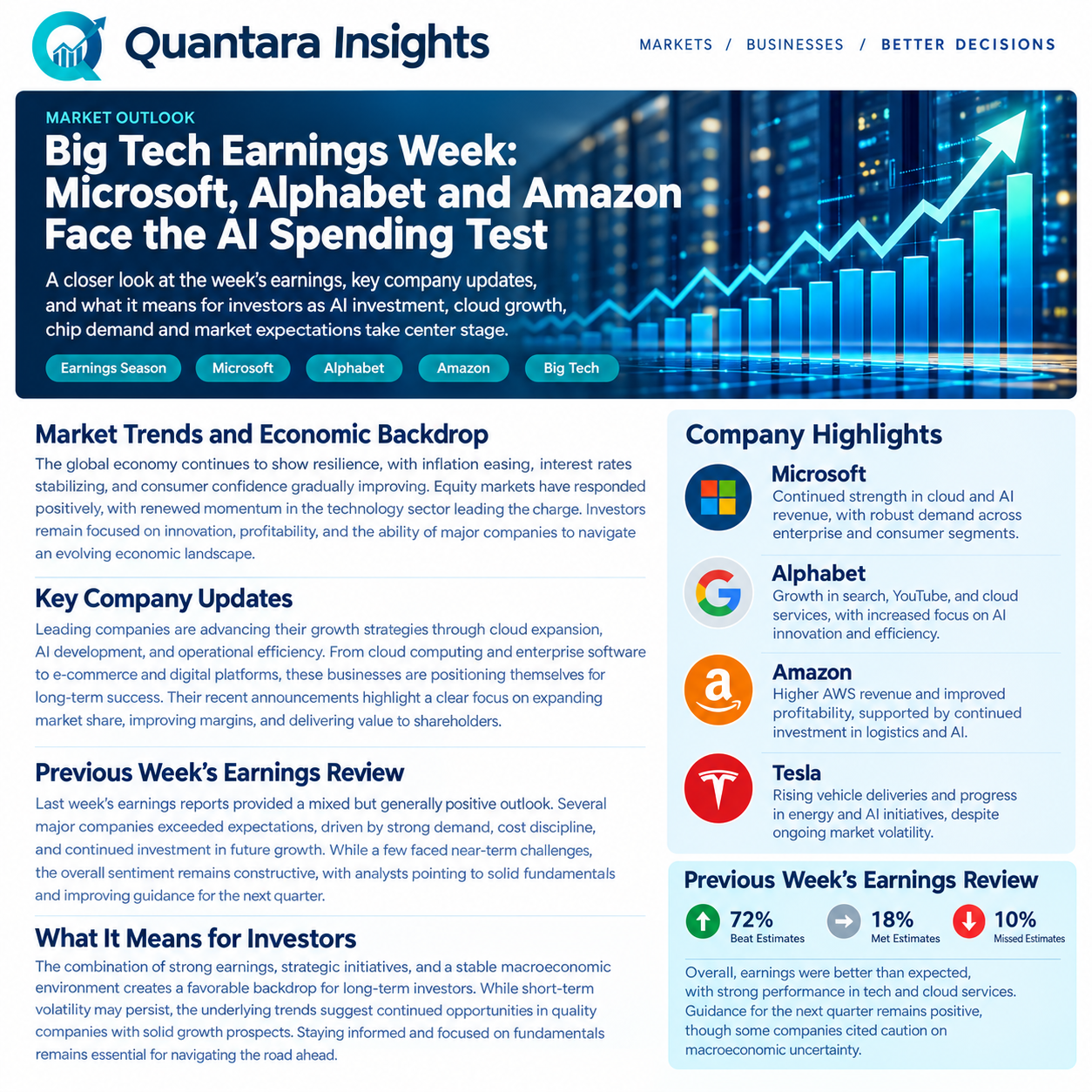
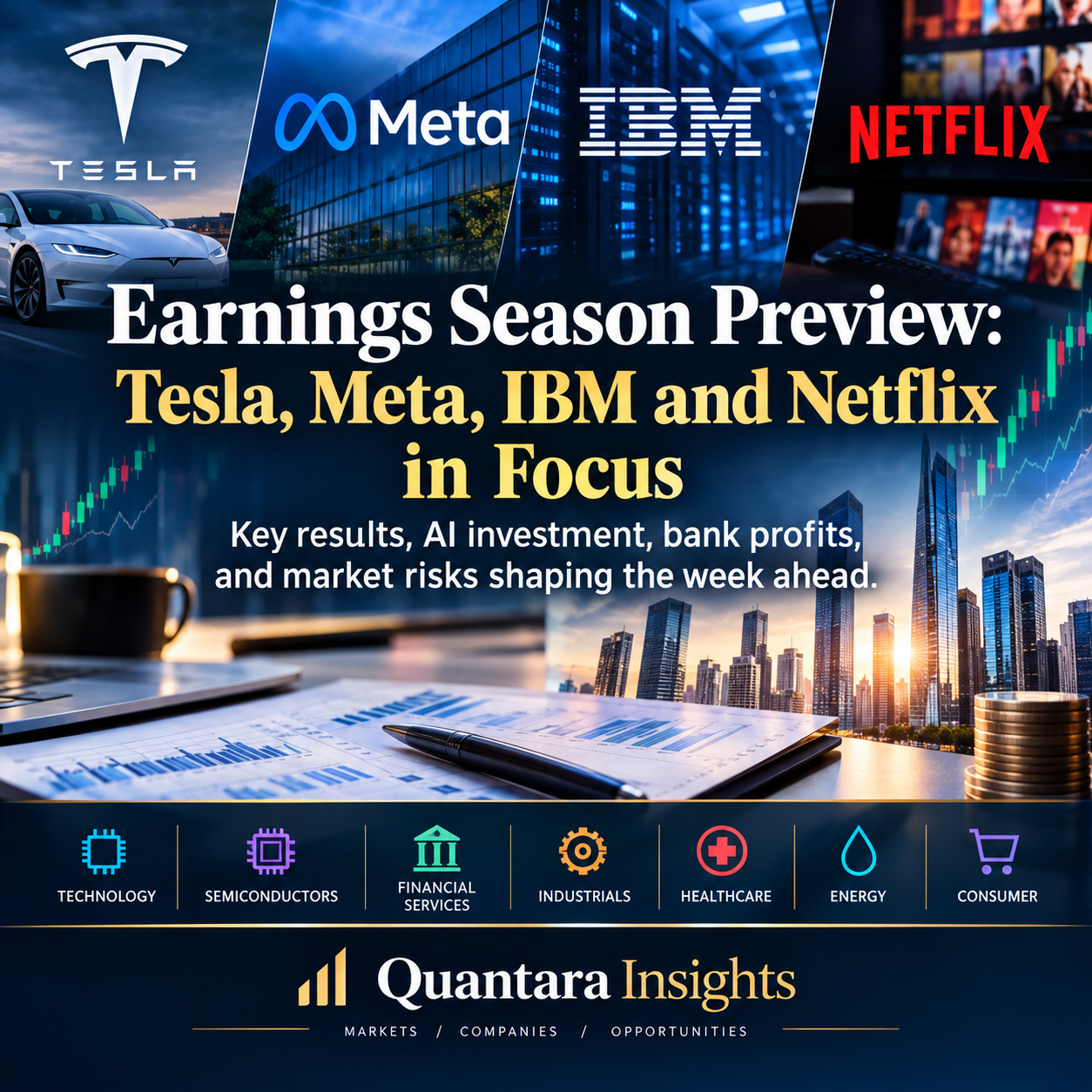
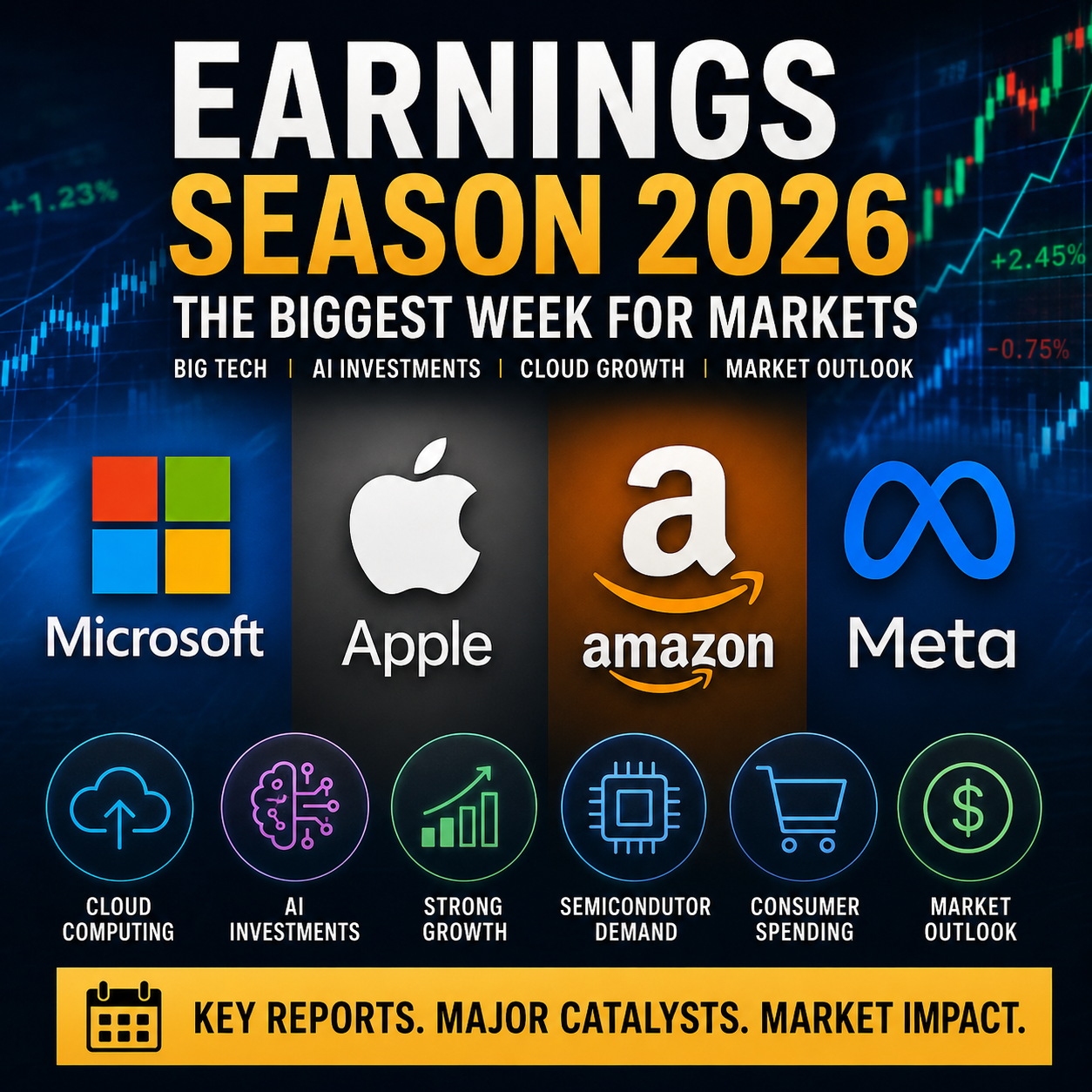
Earnings Season begins one of its busiest and most influential weeks of the year as investors prepare for a wave of corporate results that could shape market direction through the remainder of 2026. Four of the world’s largest companies—Microsoft, Meta Platforms, Apple and Amazon—headline a reporting calendar packed with market-moving announcements, while dozens of industry leaders across healthcare, financial services, semiconductors, industrials, consumer products and energy will also release quarterly results.
This week’s Earnings Season arrives at an important moment for investors. Equity markets remain near record territory despite elevated valuations, corporate investment in artificial intelligence continues at an unprecedented pace, and management teams are balancing aggressive capital spending against shareholder expectations for sustained earnings growth. Every conference call will be scrutinized not only for quarterly results but also for commentary surrounding enterprise technology demand, cloud computing, advertising trends, consumer spending, tariff impacts and capital allocation.
Unlike previous reporting periods that focused primarily on whether companies could exceed earnings expectations, this Earnings Season is expected to revolve around one central question: are the hundreds of billions of dollars being invested in artificial intelligence beginning to generate sustainable financial returns?
That question places Microsoft, Amazon, Meta and Apple firmly in the spotlight.
Cloud infrastructure providers continue to invest heavily in next-generation data centers. Semiconductor demand remains exceptionally strong. Enterprise software spending has accelerated, while digital advertising continues to recover. At the same time, investors are becoming increasingly selective, rewarding companies that demonstrate disciplined execution while penalizing those unable to convert investment into expanding margins and accelerating cash flow.
Beyond technology, investors will also receive important updates from Boeing, Visa, Mastercard, Coca-Cola, Qualcomm, Lam Research, Exxon Mobil, Chevron, Bristol Myers Squibb, Humana, Ferrari and many others. Together, these reports will provide one of the clearest pictures yet of corporate America heading into the second half of the year.
For portfolio managers, traders and long-term investors alike, this Earnings Season represents one of the most important weeks on the financial calendar.
Why This Earnings Season Matters
Several powerful themes are converging simultaneously.
Artificial intelligence investment continues to dominate executive discussions. Cloud providers are racing to expand capacity while enterprise customers accelerate adoption of AI applications. Semiconductor manufacturers continue benefiting from unprecedented infrastructure demand, although investors are increasingly asking whether today’s spending levels remain sustainable.
Consumer spending remains another major focus.
Companies including Apple, Amazon, Visa, Mastercard and Coca-Cola offer valuable insight into household demand across multiple income groups. Their commentary frequently provides an early indication of broader economic trends.
Corporate capital expenditures also remain under the microscope.
Many technology companies are spending record amounts on servers, networking equipment, memory chips and data centers. While investors generally support long-term AI investment, expectations have become exceptionally high. Management teams must increasingly demonstrate that elevated spending will eventually translate into stronger earnings and free cash flow.
This Earnings Season may therefore become less about headline earnings per share and more about guidance, margin outlooks and capital allocation discipline.
Key Themes Investors Should Watch
Several recurring themes are expected to dominate conference calls throughout the week.
Artificial Intelligence Spending
Investors will closely monitor updates regarding AI infrastructure spending, enterprise adoption, software monetization and cloud demand.
Capital Expenditures
Technology companies continue investing at historic levels. Markets will evaluate whether spending plans remain justified relative to expected revenue growth.
Cloud Computing
Microsoft Azure and Amazon Web Services remain among the most important businesses in global technology. Their growth rates often influence broader software and semiconductor valuations.
Consumer Demand
Apple, Amazon and several consumer-focused companies will provide valuable insight into discretionary spending and purchasing behavior.
Corporate Guidance
Forward guidance frequently matters more than historical results. Investors will closely examine management expectations for the remainder of 2026.
Microsoft Earnings Preview: AI Leadership Faces Higher Expectations
Microsoft enters this Earnings Season as arguably the most closely watched company in global equity markets.
Wall Street expects another quarter of double-digit revenue growth, supported primarily by continued strength in Azure cloud services, enterprise software subscriptions and expanding artificial intelligence offerings.
The company’s AI strategy continues to reshape investor expectations.
Azure has emerged as one of the primary beneficiaries of enterprise AI adoption, while Microsoft 365 Copilot continues attracting corporate customers seeking productivity enhancements powered by generative artificial intelligence. Demand for cloud infrastructure remains robust, and enterprise technology budgets have generally remained resilient despite broader macroeconomic uncertainty.
Microsoft’s long-term investment thesis remains intact.
Businesses continue migrating workloads to Azure, enterprise customers increasingly adopt AI-enabled software tools and recurring subscription revenue provides exceptional earnings visibility.
However, this Earnings Season also introduces several important questions.
Capital expenditures have accelerated dramatically as Microsoft expands global data center capacity. Investors generally support these investments but increasingly expect measurable financial returns.
Higher infrastructure spending has pressured free cash flow and cloud operating margins.
Management must convince investors that today’s elevated capital expenditures represent temporary investments supporting future profitability rather than permanently lower margins.
Analysts will also focus on Azure growth.
Any acceleration beyond current expectations would likely reinforce confidence in enterprise AI adoption, while slower growth could trigger broader concerns regarding technology valuations across the sector.
Investors will additionally monitor updates surrounding Microsoft’s partnership strategy, enterprise software demand, commercial bookings and long-term AI monetization opportunities.
Although consensus expectations remain constructive, Microsoft enters this Earnings Season facing one of its highest expectation levels in years.
When expectations become elevated, even strong quarterly performance may prove insufficient unless accompanied by optimistic forward guidance.
What Investors Should Watch
- Azure cloud growth
- AI subscription adoption
- Copilot enterprise expansion
- Commercial bookings
- Capital expenditure outlook
- Free cash flow trends
- Gross margin performance
- Fiscal 2027 guidance
Overall, Microsoft remains one of the most influential reports of the week and may significantly impact broader technology sentiment.
Meta Earnings Preview: Artificial Intelligence Meets Advertising Strength
Meta Platforms enters this Earnings Season following several quarters of exceptional financial performance driven by advertising recovery and accelerating artificial intelligence deployment.
Digital advertising remains the company’s primary earnings engine.

Improvements in advertising pricing, user engagement and AI-powered recommendation algorithms have contributed to stronger revenue growth across Facebook, Instagram and related platforms.
Artificial intelligence is becoming increasingly central to Meta’s long-term strategy.
Rather than positioning AI solely as a future opportunity, management has begun integrating AI throughout advertising systems, content recommendations, business messaging and consumer-facing applications.
These initiatives have improved user engagement while enhancing advertising efficiency.
Investors now expect Meta to demonstrate continued monetization progress.
However, substantial investment remains necessary.
Capital expenditures continue increasing as Meta expands data center infrastructure, purchases advanced computing hardware and develops next-generation AI models.
While revenue growth has remained impressive, investors increasingly want evidence that these investments can produce durable earnings expansion rather than simply larger operating expenses.
Another area of focus involves Reality Labs.
Although virtual and augmented reality remain relatively small contributors to total revenue, investors continue evaluating losses associated with these initiatives alongside broader AI spending commitments.
Advertising demand also deserves close attention.
Corporate marketing budgets have generally improved throughout the year, but management commentary regarding retail spending, small business advertising and international demand could influence expectations for the broader digital advertising industry.
Key Questions
Investors will primarily evaluate:
- Advertising revenue growth
- AI monetization progress
- User engagement metrics
- Capital spending outlook
- Operating margins
- Free cash flow
- Regulatory developments
- Forward guidance
Meta has consistently surprised investors over recent years by improving profitability while continuing aggressive investment.
Whether that balance continues during this Earnings Season may determine the stock’s direction following results.
Earnings Season: Apple, Amazon and the AI Infrastructure Trade
Apple Earnings Preview: Premium Demand Meets Margin Discipline
Apple enters this Earnings Season with momentum following a strong run in its share price and improving investor confidence. Unlike several technology peers that remain heavily dependent on enterprise spending, Apple offers investors exposure to consumer demand, premium hardware, services revenue and an increasingly important artificial intelligence ecosystem.
Wall Street expects another quarter of healthy revenue growth supported by strong iPhone demand, continued expansion of Services and resilient international sales. Investors will closely examine whether Apple can sustain that momentum while protecting profitability amid higher component costs.
The biggest question this Earnings Season centers on margins rather than revenue.
Demand across Apple’s product portfolio appears solid, particularly following the latest iPhone cycle. Services revenue continues to deliver recurring, high-margin cash flow, while Mac and iPad sales have stabilized after several volatile years.
However, component pricing remains an important variable.
Memory costs have risen across the semiconductor industry as AI infrastructure demand competes for supply. Those higher costs could pressure gross margins unless offset through pricing, product mix improvements or operating efficiencies.
Management commentary regarding future pricing strategy will therefore receive significant attention.
Another closely watched topic will be Apple’s artificial intelligence roadmap.
Although Apple has historically taken a measured approach to new technologies, investors increasingly expect AI functionality to become a larger part of the ecosystem. Software enhancements, on-device processing and deeper integration across hardware could strengthen customer retention while supporting future upgrade cycles.
Leadership transition also remains part of the investment narrative.
Markets generally favor stability, and investors will look for reassurance that strategic priorities—including capital allocation, product development and long-term innovation—remain unchanged.
Apple’s Services business continues to be one of Wall Street’s favorite metrics.
Recurring revenue from subscriptions, digital services and ecosystem engagement provides greater earnings stability than hardware sales alone. Continued expansion would reinforce confidence in Apple’s long-term financial profile.
Key Metrics to Watch
During this Earnings Season, investors should focus on:
- iPhone revenue growth
- Services revenue
- Gross margins
- China sales trends
- AI product strategy
- Memory cost commentary
- Capital return plans
- Forward guidance
Apple typically experiences relatively modest post-earnings volatility compared with many technology companies. Nevertheless, elevated expectations mean guidance will likely carry greater weight than quarterly earnings alone.
Amazon Earnings Preview: Growth Versus Capital Investment
Amazon enters this Earnings Season balancing exceptional operational momentum against one of the largest capital investment programs in corporate America.
The company’s business has become increasingly diversified.
E-commerce remains foundational, but Amazon Web Services (AWS), advertising, logistics and subscription services now contribute meaningfully to earnings growth and cash generation.
Among those businesses, AWS remains the centerpiece.
Cloud infrastructure demand continues accelerating as enterprises deploy artificial intelligence applications requiring enormous computing capacity. Organizations across industries continue migrating workloads to AWS while increasing spending on AI-related services.
That trend has translated into improving revenue growth and expanding customer commitments.
Backlog remains historically strong, reflecting sustained enterprise demand for cloud computing.
This Earnings Season, investors will evaluate whether AWS can maintain that momentum while preserving industry-leading profitability.
Advertising also deserves attention.
Amazon’s advertising platform has quietly become one of the fastest-growing segments within the company, benefiting from high-margin digital advertising integrated directly into the shopping ecosystem.
Growth in this business provides valuable diversification beyond retail.
However, Amazon’s aggressive investment strategy remains the primary discussion point.
Capital expenditures continue reaching record levels as management builds data centers, expands AI infrastructure and strengthens logistics capabilities.
Although these investments support long-term competitive advantages, they also reduce near-term free cash flow.
Investors generally remain supportive provided spending produces measurable growth.
Should management indicate additional acceleration in capital expenditures without corresponding revenue expectations, market reactions could become more cautious.
Consumer spending trends will also be important.
Retail sales, Prime membership engagement and marketplace activity provide useful insight into broader economic conditions heading into the second half of the year.
What Investors Should Monitor
Key areas during this Earnings Season include:
- AWS revenue growth
- Cloud operating margins
- Advertising growth
- Free cash flow
- Capital expenditures
- Retail demand
- AI infrastructure investment
- Second-half guidance
Amazon remains one of the week’s most influential earnings reports because its results reflect both enterprise technology demand and global consumer spending.
Semiconductor Earnings: AI Infrastructure Remains the Dominant Theme
While Microsoft, Apple, Meta and Amazon dominate headlines, this Earnings Season may ultimately be defined by semiconductor companies supplying the infrastructure behind artificial intelligence.
Demand remains exceptionally strong across multiple categories.
Cloud providers continue ordering advanced processors, networking equipment, storage systems and memory components to support expanding AI workloads.
This environment has benefited several industry leaders.
Qualcomm: Beyond Smartphones
Qualcomm enters this Earnings Season with investors looking beyond traditional smartphone demand.
Although handset sales remain important, Qualcomm has steadily diversified into automotive technology, edge computing and artificial intelligence.
AI-enabled personal computers, connected vehicles and industrial applications represent long-term growth opportunities.
Management commentary regarding these businesses may prove as important as quarterly financial results.
Investors will also monitor licensing revenue, chipset demand and international smartphone trends.
Lam Research: Measuring Semiconductor Capital Spending
Few companies provide a clearer picture of semiconductor manufacturing activity than Lam Research.
Equipment orders often serve as an early indicator of industry investment.
This Earnings Season, investors will evaluate whether chip manufacturers continue expanding production capacity to satisfy AI demand.
Strong order growth would reinforce confidence across the semiconductor supply chain.
Conversely, signs of slowing capital investment could influence expectations throughout the technology sector.
Seagate Technology: Storage Demand Continues to Expand
Artificial intelligence applications generate enormous volumes of data.
That trend has created renewed demand for enterprise storage solutions, benefiting companies such as Seagate.
Following several quarters of improving profitability, Seagate enters this Earnings Season with investors expecting continued margin expansion and healthy enterprise demand.
Large cloud providers continue deploying high-capacity storage solutions to support AI infrastructure.
Management commentary regarding long-term customer commitments, pricing and manufacturing capacity will receive close attention.
Investors will also monitor free cash flow, gross margins and future production plans.
Applied Digital: Waiting for the Next Growth Catalyst
Applied Digital remains one of the more closely watched infrastructure companies within the AI ecosystem.
The company’s investment thesis depends largely upon expanding data center capacity and securing additional long-term customer agreements.
During this Earnings Season, investors will evaluate progress toward new leasing agreements while monitoring operating profitability.
Although recent operational improvements have been encouraging, additional contract announcements remain critical to sustaining investor confidence.
Capital allocation, financing strategy and customer demand will all influence market reaction.
Bloom Energy: Powering Artificial Intelligence
The rapid expansion of artificial intelligence has created an equally important discussion surrounding electricity demand.
Data centers require enormous amounts of reliable power.
Bloom Energy has emerged as one of several companies positioned to benefit from that structural trend.
This Earnings Season, management is expected to provide updates regarding project execution, manufacturing capacity and customer demand.
Investors will also examine whether recent guidance remains achievable given accelerating infrastructure development.
As more hyperscale data centers come online, dependable power generation continues becoming an increasingly valuable competitive advantage.
AI Infrastructure Remains the Market’s Biggest Long-Term Theme
A defining characteristic of this Earnings Season is the scale of corporate investment supporting artificial intelligence.
Technology companies are no longer discussing future AI opportunities—they are actively deploying capital.
Across the industry, management teams continue investing billions of dollars in:
- Data centers
- Advanced processors
- Networking infrastructure
- High-capacity storage
- Memory technologies
- Energy infrastructure
- Enterprise software
- AI-enabled cloud services
These investments represent one of the largest technology spending cycles in decades.
For investors, however, the focus has shifted.
Markets increasingly expect measurable financial returns rather than ambitious long-term promises.
Companies capable of demonstrating accelerating revenue, expanding margins and disciplined capital allocation are likely to remain market leaders.
Those unable to justify elevated spending may face increasing valuation pressure despite strong top-line growth.
This dynamic will remain one of the defining themes throughout this Earnings Season and could shape investor sentiment well into 2027.
Earnings Season Broadens: Financials, Healthcare, Industrials and Energy Take Center Stage
While Big Tech will dominate market headlines, this Earnings Season extends well beyond Microsoft, Apple, Amazon and Meta. Several companies across financial services, healthcare, industrials and energy are scheduled to report results that will provide valuable insight into the broader U.S. economy.
Consumer spending, credit quality, travel demand, healthcare utilization, industrial activity and commodity markets will all be represented during one of the busiest reporting weeks of the quarter.
Visa: Consumer Spending Remains in Focus
Visa enters this Earnings Season as one of the clearest indicators of global consumer activity.
Unlike retailers that measure product demand directly, Visa benefits from payment volume across nearly every segment of the economy. As a result, its earnings frequently provide an early read on discretionary spending, travel activity and cross-border commerce.
Investors will focus on:
- Total payment volume
- Cross-border transaction growth
- Commercial payment activity
- International spending
- Operating margins
- Share repurchases
- Management guidance
A healthy report from Visa would reinforce confidence that consumer spending remains resilient despite higher interest rates and persistent inflation pressures in several regions.
Mastercard: Another Window Into Global Consumption
Mastercard reports later in the week and offers investors another valuable perspective on worldwide spending trends.
Although its business model closely resembles Visa’s, Mastercard often provides additional commentary regarding international travel, commercial payments and cross-border transactions.
During this Earnings Season, investors will compare both payment networks for consistency in consumer behavior.
Strong transaction growth would suggest household spending remains healthy, supporting retailers, airlines, hotels and leisure companies heading into the second half of the year.
PayPal: Progress on the Turnaround Strategy
PayPal remains one of the more closely watched financial technology companies this Earnings Season.
Following leadership changes and ongoing restructuring efforts, investors continue evaluating whether management’s turnaround strategy is producing measurable improvements.
The company has made progress in several areas.
Venmo continues expanding.
Buy Now, Pay Later remains a growing business.
Enterprise payment solutions have shown resilience.
However, traditional branded checkout continues facing intense competition across digital commerce.
Markets will closely evaluate whether newer business segments can offset slower growth in PayPal’s legacy operations.
Key metrics include:
- Total payment volume
- Active account growth
- Venmo engagement
- Operating margins
- Expense reductions
- Earnings guidance
Investors will also look for updates regarding long-term profitability targets and strategic priorities.
SoFi Technologies: Strong Growth Faces Higher Expectations
SoFi enters this Earnings Season with one of the fastest revenue growth profiles among financial technology companies.
Membership growth has remained impressive.
Loan originations continue expanding.
Financial services products have diversified beyond traditional lending.
Despite these positives, investor expectations have increased significantly.
Markets will evaluate whether management can maintain strong revenue growth while improving profitability.
Particular attention will focus on:
- New member additions
- Loan growth
- Deposit balances
- Technology platform performance
- Credit quality
- Full-year guidance
Management commentary regarding interest rates and consumer borrowing demand will also be important.
Boeing: Production Stability Under the Microscope
Boeing’s report will be one of the most closely followed industrial earnings announcements this Earnings Season.
Commercial aircraft demand remains robust, supported by global airline fleet modernization and international travel recovery.
However, investors remain focused on production execution, regulatory oversight and cash generation.
Conference call discussions will likely center on:
- Aircraft deliveries
- Production schedules
- Supply chain improvements
- Free cash flow
- Defense operations
- Order backlog
Any updates regarding manufacturing stability could influence sentiment across the broader aerospace sector.
Coca-Cola: Measuring Global Consumer Demand
Coca-Cola provides investors with one of the broadest snapshots of global consumer activity.
Its diversified geographic footprint allows management to discuss spending patterns across developed and emerging markets.
This Earnings Season, investors will monitor:
- Organic revenue growth
- Pricing trends
- Unit case volume
- International demand
- Currency impacts
- Margin performance
Stable results would reinforce the defensive characteristics that have historically attracted long-term investors during periods of economic uncertainty.
Healthcare Earnings: A Critical Week for the Sector
Healthcare companies reporting this week include Boston Scientific, Bristol Myers Squibb, Humana and AbbVie.
Together, these companies provide insight into medical device demand, pharmaceutical sales, healthcare utilization and insurance trends.
Boston Scientific: Recovery in Focus
Boston Scientific enters this Earnings Season following a challenging period marked by reduced guidance and operational headwinds.
Investors will closely evaluate whether recent execution issues have begun to stabilize.
Areas receiving particular attention include:
- Medical device sales
- Procedure volumes
- Gross margins
- Product launches
- Full-year guidance
Markets will also look for evidence that recent investments can restore stronger growth over the coming quarters.
Bristol Myers Squibb: Pharmaceutical Pipeline Remains Key
For Bristol Myers Squibb, investors remain focused on long-term product development as much as current earnings.
Patent expirations continue shaping the pharmaceutical industry, making pipeline execution increasingly important.
Conference call discussions are expected to include:
- Key drug performance
- Research and development
- Clinical trial updates
- Capital allocation
- Revenue outlook
A strong pipeline remains essential for sustaining future earnings growth.
Humana: Medicare Advantage in the Spotlight
Humana continues operating within a rapidly evolving healthcare reimbursement environment.
During this Earnings Season, investors will evaluate:
- Medicare Advantage enrollment
- Medical cost trends
- Profit margins
- Membership growth
- Regulatory developments
Healthcare utilization remains an important variable affecting profitability across managed care organizations.
AbbVie: Diversification Beyond Flagship Products
AbbVie continues expanding beyond its traditional blockbuster therapies.
Investors will monitor growth across newer treatments while evaluating management’s long-term strategy for replacing revenue from mature products.

Important metrics include:
- Immunology sales
- Oncology performance
- Neuroscience portfolio
- Research pipeline
- Earnings guidance
Strong execution would reinforce confidence in AbbVie’s diversified pharmaceutical portfolio.
Energy Earnings: Oil Majors Face a Different Environment
Energy companies reporting this week include Exxon Mobil and Chevron.
Unlike technology companies investing primarily in artificial intelligence, integrated energy producers remain influenced by commodity prices, refining margins and capital discipline.
Exxon Mobil: Cash Flow and Capital Allocation
Exxon Mobil enters this Earnings Season with investors focused on:
- Oil production
- Natural gas volumes
- Refining margins
- Free cash flow
- Share repurchases
- Capital expenditures
Management’s ability to balance shareholder returns with long-term investment remains a central investment theme.
Chevron: Production Growth Remains the Priority
Chevron’s report will provide another important assessment of global energy markets.
Investors will evaluate:
- Upstream production
- International operations
- Capital spending
- Cash generation
- Dividend sustainability
Commodity prices remain an important variable, but operational execution continues separating industry leaders from competitors.
Ferrari: Luxury Demand Continues to Impress
Ferrari remains one of the most consistently profitable luxury manufacturers globally.
Its results often provide insight into spending among high-net-worth consumers rather than the broader economy.
This Earnings Season, investors will monitor:
- Vehicle deliveries
- Average selling prices
- Order backlog
- Operating margins
- Production outlook
Ferrari’s disciplined production strategy has historically supported premium pricing and exceptional profitability.
Broader Market Themes Emerging This Earnings Season
Beyond individual company reports, several macro themes continue developing across corporate America.
Artificial Intelligence Investment
Nearly every major technology company continues increasing AI-related spending.
Investors now expect evidence that those investments are producing measurable financial returns.
Margin Discipline
Companies capable of protecting operating margins despite elevated investment are receiving premium valuations.
Consumer Resilience
Results from Visa, Mastercard, Amazon, Apple and Coca-Cola will collectively provide one of the clearest pictures of household spending.
Capital Allocation
Management teams continue balancing shareholder returns through dividends and buybacks against aggressive investment in future growth.
Forward Guidance
Perhaps most importantly, markets will continue rewarding companies that confidently raise guidance while penalizing even modest signs of caution.
These themes will likely define not only this Earnings Season but also investor sentiment heading into the final months of 2026.
Weekly Earnings Calendar: The Most Anticipated Releases for the Week Beginning Monday, July 27, 2026
This Earnings Season features one of the busiest reporting calendars of the quarter, with major companies representing nearly every sector of the U.S. economy. While the spotlight will remain firmly on Big Tech, results from financials, industrials, healthcare, consumer staples and energy companies will provide a comprehensive picture of corporate performance and economic conditions.
Below is the reporting schedule investors should monitor throughout the week.
| Day | Before Market Open | After Market Close |
|---|---|---|
| Monday | AstraZeneca, Baker Hughes | No major household-name reports |
| Tuesday | PayPal, Boeing, Coca-Cola, UPS, Corning | Visa |
| Wednesday | SoFi, Boston Scientific, ADP, Procter & Gamble, Humana | Microsoft, Meta Platforms, ARM Holdings, Qualcomm, Lam Research, Chipotle, Robinhood |
| Thursday | Bristol Myers Squibb, Cigna, Mastercard, Valero, Stellantis, Ferrari | Apple, Amazon |
| Friday | Exxon Mobil, Chevron, AbbVie, Moderna, Colgate-Palmolive | No major scheduled reports |
The concentration of reports during Wednesday and Thursday makes the middle of the week particularly important. Investors should expect elevated trading volumes, increased market volatility and rapid sector rotation as earnings results and management commentary are released.
Institutional Investors Will Focus on Guidance More Than Headlines
One of the defining characteristics of this Earnings Season is the exceptionally high level of investor expectations.
Many of the largest technology companies have delivered multiple consecutive quarters of earnings beats, revenue acceleration and optimistic outlooks. Consequently, markets have already priced in considerable optimism.
Institutional investors are increasingly less concerned with whether companies exceed quarterly consensus estimates by a few cents per share. Instead, attention has shifted toward longer-term execution.
Conference calls will likely prove more influential than headline earnings releases.
Portfolio managers will be listening for commentary regarding:
- Enterprise technology demand
- AI monetization
- Capital spending plans
- Hiring trends
- Pricing power
- Gross margin expectations
- Supply chain conditions
- International demand
- Tariff exposure
- Cash flow generation
Even companies reporting strong quarterly numbers may experience share-price weakness if management adopts a more cautious tone regarding the second half of the year.
Conversely, businesses providing confident guidance could outperform despite relatively modest quarterly earnings beats.
Artificial Intelligence Spending Remains the Market’s Defining Narrative
Artificial intelligence continues to dominate discussions across corporate America.
Unlike previous reporting periods, where AI represented a promising future opportunity, this Earnings Season reflects a market transitioning from experimentation toward commercialization.
Microsoft continues expanding Azure infrastructure.
Amazon is investing aggressively across AWS.
Meta is integrating artificial intelligence into advertising, content recommendations and productivity tools.
Apple is gradually embedding AI throughout its ecosystem.
Semiconductor manufacturers continue operating near capacity as hyperscale cloud providers increase infrastructure spending.
The investment cycle remains extraordinary in scale.
Collectively, leading technology companies are committing hundreds of billions of dollars toward:
- Advanced computing hardware
- GPU infrastructure
- High-performance networking
- Memory technologies
- Enterprise AI software
- Data center expansion
- Renewable and conventional energy solutions
- Cloud computing capacity
While investors generally support these initiatives, expectations have evolved.
Markets now require measurable evidence that today’s investments will translate into stronger revenue growth, higher operating margins and expanding free cash flow over the coming years.
That transition from investment to execution may become the defining storyline of this Earnings Season.
Consumer Spending Remains an Important Market Indicator
Technology companies may dominate headlines, but consumer-related earnings remain equally important for assessing overall economic conditions.
Results from Apple, Amazon, Visa, Mastercard, Coca-Cola and Procter & Gamble collectively offer insight into several key areas:
- Household spending patterns
- Consumer confidence
- Pricing power
- Travel demand
- Luxury purchases
- International consumption
- Small business activity
Thus far, consumer spending has remained relatively resilient despite higher borrowing costs.
Whether that resilience continues will become clearer as management teams discuss demand trends across different income levels and geographic markets.
Investors will also evaluate whether consumers continue favoring premium brands or are increasingly shifting toward value-oriented purchases.
These observations frequently influence expectations for retailers, travel companies, restaurants and discretionary consumer businesses throughout the remainder of the year.
Energy Markets Could Influence Inflation Expectations
Although technology dominates this Earnings Season, investors should not overlook the energy sector.
Results from Exxon Mobil and Chevron will provide valuable insight into:
- Global oil demand
- Refining profitability
- Production trends
- Capital investment
- Shareholder returns
Energy prices remain an important component of inflation expectations.
Management commentary regarding supply conditions, production discipline and capital expenditures could influence broader macroeconomic sentiment beyond the energy sector itself.
Strong cash generation would reinforce the financial strength of integrated energy producers while supporting continued dividend growth and share repurchase programs.
Risks That Could Shape Market Performance
Despite generally constructive expectations entering this Earnings Season, several risks deserve close attention.
Elevated Valuations
Many large-cap technology stocks continue trading near historically rich valuation multiples.
Even strong earnings may not satisfy investors if future guidance falls short of elevated expectations.
Margin Compression
Artificial intelligence infrastructure remains expensive.
Higher depreciation, increased energy consumption and ongoing hardware investment could pressure operating margins across the technology sector.
Capital Spending Fatigue
Investors have largely embraced aggressive capital investment.
However, patience is not unlimited.
Should management teams continue increasing capital expenditures without demonstrating corresponding revenue growth, markets could begin reassessing valuation premiums assigned to AI leaders.
Consumer Demand
Although spending has remained relatively healthy, any signs of slowing demand across retail, travel or discretionary categories would quickly become a market concern.
Consumer-facing companies reporting this week will therefore receive considerable attention.
Geopolitical and Trade Developments
International operations remain important for nearly every multinational company reporting this week.

Executives may address evolving trade policies, regional demand, supply chain diversification and foreign exchange impacts during conference calls.
These factors could influence guidance for the second half of 2026.
What Could Move Markets the Most?
Several reports stand out as having the greatest potential to influence broader market sentiment.
Microsoft
Azure growth, enterprise AI adoption and capital expenditure guidance could significantly affect software, cloud computing and semiconductor stocks.
Apple
Consumer demand, Services growth and gross margin commentary remain the primary focus.
Amazon
AWS performance and AI infrastructure investment continue shaping expectations across cloud computing.
Meta Platforms
Advertising trends, AI monetization and operating expense guidance remain key catalysts.
Visa and Mastercard
Both companies provide valuable insight into consumer spending and global economic activity.
Exxon Mobil and Chevron
Their outlooks may influence expectations surrounding energy markets, inflation and capital allocation.
Collectively, these companies represent a substantial portion of major equity indexes, making their earnings particularly important for institutional investors.
Market Outlook for the Week
Entering the week, investor sentiment remains broadly constructive.
Corporate earnings expectations continue improving, artificial intelligence investment remains robust and economic activity has generally exceeded earlier forecasts.
Nevertheless, this Earnings Season may represent a transition point.
Markets have rewarded ambitious investment strategies throughout much of the AI expansion.
Going forward, investors appear increasingly focused on execution, profitability and sustainable cash generation.
Companies capable of combining revenue growth with disciplined expense management are likely to remain market leaders.
Those unable to demonstrate meaningful returns on aggressive capital investment could face greater scrutiny from institutional investors.
By the end of the week, investors should have a significantly clearer understanding of:
- Enterprise technology demand
- Consumer spending trends
- Artificial intelligence adoption
- Corporate investment plans
- Profit margin outlooks
- Second-half earnings expectations
Those themes will likely influence equity markets well beyond this reporting period and help establish the investment landscape for the remainder of 2026.
Frequently Asked Questions
1. Why is this Earnings Season so important?
This Earnings Season is one of the most significant reporting periods of 2026 because four of the world’s largest companies—Microsoft, Apple, Amazon and Meta—are reporting results during the same week. Their earnings and forward guidance will influence not only their own share prices but also broader market sentiment across technology, cloud computing, semiconductors and artificial intelligence.
2. Which companies are expected to have the biggest impact on the market?
Microsoft, Apple, Amazon and Meta are expected to have the greatest influence due to their size and weighting in major stock indexes. Additional reports from Visa, Mastercard, Boeing, Qualcomm, Lam Research, Exxon Mobil and Chevron could also affect sector performance and overall market direction.
3. What will investors focus on besides earnings per share?
While earnings per share remain important, investors are expected to pay greater attention to:
- Revenue growth
- Forward guidance
- Artificial intelligence investment
- Cloud computing demand
- Capital expenditures
- Gross margins
- Free cash flow
- Share repurchase programs
- Management commentary on the second half of 2026
These factors often have a greater impact on share prices than quarterly earnings alone.
4. Why are AI investments receiving so much attention?
Artificial intelligence has become the largest corporate investment theme in decades.
Microsoft, Amazon, Meta and other technology companies are investing billions of dollars in data centers, advanced processors and cloud infrastructure. Investors now want evidence that these investments are generating sustainable revenue growth and long-term profitability.
5. Why are Microsoft and Amazon particularly important this week?
Microsoft and Amazon operate the two largest cloud computing platforms—Azure and Amazon Web Services (AWS).
Their results provide insight into enterprise technology spending, AI adoption and demand for cloud infrastructure. Strong performance from either company could positively influence software, semiconductor and infrastructure stocks across the broader market.
6. What should investors watch in Apple’s earnings report?
Apple’s report will likely focus on:
- iPhone demand
- Services revenue
- Gross margins
- China sales
- Artificial intelligence initiatives
- Pricing strategy
- Capital returns
- Management guidance
Services growth and margin performance may be particularly important during this Earnings Season.
7. Why are Visa and Mastercard important during Earnings Season?
Visa and Mastercard process billions of payment transactions worldwide, making them valuable indicators of consumer spending and economic activity.
Strong transaction growth generally reflects healthy consumer demand, while weaker trends may signal slowing economic momentum.
8. Which sectors could outperform after Earnings Season?
Performance will depend largely on guidance rather than historical results.
Technology, semiconductors, cloud computing, digital advertising and AI infrastructure companies could continue outperforming if management teams demonstrate accelerating revenue growth and disciplined capital investment.
Healthcare, financials and energy may also benefit if earnings exceed expectations and outlooks improve.
9. Could market volatility increase this week?
Yes.
Because several of the market’s largest companies are reporting within a short period, daily market volatility may increase as investors react to earnings announcements, conference calls and revised guidance.
Options markets are already implying above-average price movements for many technology leaders.
10. What is the biggest takeaway entering this Earnings Season?
The primary question is no longer whether companies can beat quarterly estimates.
Instead, investors want confirmation that heavy investment in artificial intelligence, cloud infrastructure and enterprise technology is translating into sustainable earnings growth, improving profitability and stronger long-term cash flow.
Those companies that successfully demonstrate both growth and financial discipline are likely to remain market leaders.
Conclusion
Earnings Season arrives at a pivotal moment for financial markets.
Technology leaders continue investing at unprecedented levels to expand artificial intelligence capabilities, enterprise customers are accelerating cloud adoption, and investors are increasingly demanding proof that these investments will generate durable financial returns. At the same time, reports from financial institutions, healthcare companies, industrial manufacturers and energy producers will provide a broader assessment of corporate America and the health of the global economy.
Microsoft, Apple, Amazon and Meta will understandably command the greatest attention, but they represent only part of a reporting calendar that spans nearly every major sector. Results from Visa and Mastercard will help gauge consumer spending, while Qualcomm, Lam Research and other semiconductor companies will reveal whether demand for AI infrastructure remains as strong as recent trends suggest. Energy producers, healthcare leaders and industrial companies will complete a comprehensive picture of business conditions entering the second half of 2026.
More important than the headline earnings numbers will be management commentary. Investors will closely analyze guidance, capital spending plans, margin expectations and free cash flow generation to determine whether current valuations remain justified.
As this Earnings Season unfolds, the market’s attention will remain focused on execution rather than promises. Companies that combine sustainable revenue growth with disciplined capital allocation and improving profitability are likely to distinguish themselves in an environment where expectations are already exceptionally high.
For investors, this week’s earnings reports should provide valuable insight into the trajectory of artificial intelligence investment, consumer demand, corporate confidence and the broader market outlook for the remainder of 2026.