









Table of Contents
- Week Ahead: 2–6 November 2026
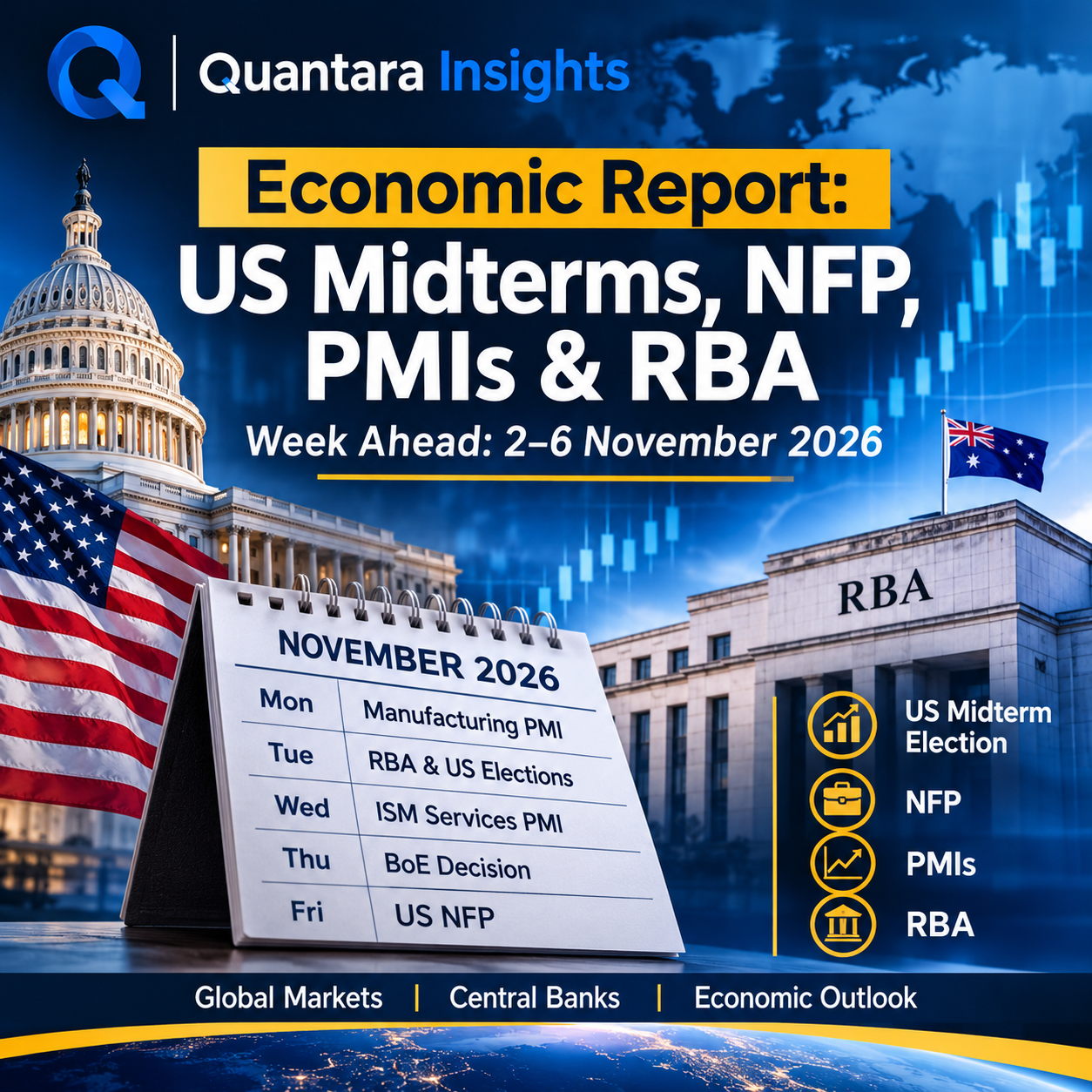
- Economic Calendar: 2–6 November 2026
- Week Ahead: Major Economic Events and Market Analysis
- Chinese NPC Standing Committee (Monday–Friday)
- US ISM Manufacturing PMI (Monday)
- RBA Policy Announcement (Tuesday)
- US Midterm Elections (Tuesday)
- Swiss CPI (Tuesday)
- Riksbank Policy Announcement (Wednesday)
- US Treasury Quarterly Refunding Announcement (Wednesday)
- US ISM Services PMI (Wednesday)
- Eurozone Flash CPI (Wednesday)
- Bank of England Policy Announcement (Thursday)
- Norges Bank Policy Announcement (Thursday)
- Banxico Policy Announcement (Thursday)
- US Nonfarm Payrolls (NFP) — Friday
- Canadian Employment Report (Friday)
- Week in Review: Key Economic and Central Bank Developments
- Chinese Fifth Plenum Review
- Israeli Legislative Election Review
- Federal Reserve Policy Announcement Review
- Bank of Canada Policy Announcement Review
- Reserve Bank of New Zealand Policy Announcement Review
- UK Autumn Budget Review
- Australian CPI Review
- European Central Bank Policy Announcement Review
- US GDP Review
- US PCE Inflation Review
- Japanese Tokyo CPI Review
- Bank of Japan Policy Announcement Review
- Key Takeaways: Economic Report for 2–6 November 2026
- 1. Inflation remains central to monetary policy
- 2. The US labour market remains a key Federal Reserve consideration
- 3. US political developments may influence the broader economic outlook
- 4. Economic activity remains comparatively resilient
- 5. Central bank communication will remain important
- Overall Economic Outlook
Week Ahead: 2–6 November 2026
Economic Report — Global financial markets enter the first full week of November with a concentrated calendar of economic releases, central bank policy decisions, and political developments. The US Midterm Election, October Nonfarm Payrolls (NFP), US manufacturing and services PMIs, and the Reserve Bank of Australia’s (RBA) policy announcement are among the principal events likely to influence market expectations.
The week also features policy decisions from the Bank of England (BoE), Riksbank, Norges Bank, National Bank of Poland, Banco Central do Brasil, and Banco de México. Meanwhile, preliminary Eurozone inflation, the US Treasury’s Quarterly Refunding Announcement, and employment data from Canada and New Zealand will provide additional insight into the global economic outlook.
The economic calendar arrives against a backdrop of persistent inflation concerns, elevated energy prices, and uncertainty surrounding the direction of monetary policy. Recent central bank communications have generally emphasised the importance of maintaining restrictive policy where inflation remains above target, although the growth outlook and labour market conditions continue to complicate the policy debate.
For financial markets, the interaction between inflation, employment, economic growth, and central bank guidance will remain central. The US Midterm Election adds another dimension, particularly as the composition of Congress may influence fiscal policy, regulation, and the broader economic policy environment.
The week’s data will also be assessed against the latest developments in global trade, energy markets, and geopolitical conditions. These factors continue to affect inflation expectations, business confidence, and the outlook for economic activity.
This Economic Report examines the principal events scheduled for 2–6 November 2026, alongside a review of the major developments from the previous week.
Economic Calendar: 2–6 November 2026
The following calendar highlights the principal scheduled economic releases and policy announcements.
| Day | Major economic events |
|---|---|
| Monday, 2 November | Global Manufacturing Final PMIs, US ISM Manufacturing PMI, Chinese NPC Standing Committee |
| Tuesday, 3 November | RBA Policy Announcement, US Midterm Elections, Swiss CPI, US JOLTS |
| Wednesday, 4 November | Riksbank, US Treasury Refunding, Eurozone Flash CPI, US ADP, US ISM Services PMI |
| Thursday, 5 November | BoE Policy Announcement, Norges Bank, Banxico, Canadian Federal Budget |
| Friday, 6 November | US NFP, Canadian Employment Report, US University of Michigan Consumer Sentiment |
The calendar also includes the National Bank of Poland, Banco Central do Brasil, Czech National Bank, Bank of Japan minutes, New Zealand employment data, and several European industrial and retail releases.
The US employment report is scheduled for Friday, while the RBA decision and US Midterm Elections are expected to dominate attention on Tuesday.
Week Ahead: Major Economic Events and Market Analysis
Chinese NPC Standing Committee (Monday–Friday)
The 25th session of the 14th National People’s Congress (NPC) Standing Committee is scheduled to take place from 2–6 November.
The draft agenda includes ten legislative bills and eight oversight reports. Market attention is likely to remain focused on the possibility of additional fiscal policy measures, particularly given the ongoing importance of government support for economic activity.
At present, the draft agenda does not include specific fiscal items, including potential changes to the debt quota. Consequently, any unexpected addition of fiscal measures would represent a notable development.
The absence of new fiscal initiatives would not necessarily signal a change in the broader policy direction. However, investors will continue to assess whether Chinese authorities are preparing additional measures to support domestic demand, industrial activity, and economic confidence.
China’s policy environment remains relevant for global markets through its influence on commodity demand, regional trade, industrial supply chains, and broader emerging-market sentiment.
The NPC Standing Committee’s proceedings will therefore be monitored for indications of changes to the fiscal policy outlook.
US ISM Manufacturing PMI (Monday)
The US ISM Manufacturing PMI is expected to rise modestly to 54.7 in October from 54.5 in September.
The forecast points to continued expansion in manufacturing activity, although the details of the report will be important in assessing the strength and sustainability of the improvement.
S&P Global’s preliminary manufacturing PMI increased to 56.0 in October from 55.9 in September. This represented a 53-month high and the strongest improvement in operating conditions since May 2022.
However, the manufacturing output index declined to 55.8 from 56.2, marking a two-month low.
The underlying survey details showed that production and new orders growth slowed but remained elevated. Export orders increased for the first time since June 2025, while backlogs of work accumulated at a faster pace.
Input inventories rose at their quickest rate in four months. Supplier delivery times also lengthened, reaching their highest level since July 2022.
Respondents cited material shortages, low stock levels, and shipping or import delays as contributing factors.
Manufacturing prices and employment
Price pressures remained an important component of the manufacturing survey.
Manufacturers reported higher costs associated with oil-based inputs, energy, fuel, freight, steel, aluminium, and copper. Some respondents attributed these increases to tariffs and supply shortages.
Factory selling-price inflation accelerated to its fastest pace since July 2022.
Employment conditions were comparatively firm, with factory payrolls increasing at their fastest pace since March 2012.
S&P Global also reported an improvement in manufacturing confidence, with sentiment returning approximately to its long-run average. Manufacturers were more optimistic than service providers.
The ISM Manufacturing PMI will therefore provide an important assessment of whether the improvement in activity is accompanied by stronger orders, employment, and pricing pressures.
A stronger-than-expected reading could reinforce concerns about persistent inflation, particularly if the prices-paid and employment components remain elevated.
Conversely, a weaker report could indicate that the manufacturing sector is losing momentum despite the recent improvement in survey conditions.
RBA Policy Announcement (Tuesday)
The Reserve Bank of Australia is scheduled to announce its latest monetary policy decision on Tuesday, alongside the November Statement on Monetary Policy.
Market expectations currently favour another 25-basis-point increase in the Cash Rate Target to 4.85%.
The supplied market pricing indicates approximately a 79% probability of a rate increase, compared with around a 21% probability of the cash rate remaining at 4.60%.
The RBA increased rates by 25 basis points to 4.60% at its September meeting, marking its fourth rate increase this year.
The decision was unanimous, and the accompanying statement maintained a hawkish tone. The Board noted that inflation remained elevated and that some of the upside risks identified in August were materialising.
The RBA reiterated that it would take whatever action it considered necessary to return inflation sustainably to target, including further increases in the Cash Rate Target if required.
The central bank also highlighted the widening conflict in the Middle East, higher global energy prices, and stronger-than-anticipated Australian inflation outcomes.
Inflation remains the principal policy consideration
At the subsequent press conference, Governor Michele Bullock adopted a comparatively measured tone.
Although she acknowledged that inflationary pressures could persist for longer than expected and that further rate increases remained possible, she also suggested that additional tightening might not be necessary if inflation declined.
The Governor expressed hope that the four rate increases already delivered would prove sufficiently restrictive to slow inflation.
However, subsequent inflation data have strengthened the case for further policy tightening.
Australian monthly CPI for September and quarterly CPI for Q3 both increased, with the readings matching or exceeding market expectations.
Governor Bullock’s recent comments have also remained hawkish. She acknowledged that higher interest rates could be challenging for households but emphasised that elevated inflation could not be allowed to persist.
She also noted that oil and related prices had increased sharply and were likely to contribute materially to inflation.
The Governor indicated that inflation was likely to exceed the RBA’s August base-case forecast, with upside risks materialising and price pressures remaining too high.
What markets will watch
The decision itself will be important, but the accompanying statement and Governor Bullock’s press conference may provide additional insight into the likely direction of policy.
Investors will assess:
- The Board’s interpretation of recent inflation data.
- The extent to which higher energy prices are affecting the inflation outlook.
- Whether further rate increases remain likely.
- The RBA’s assessment of domestic demand and household spending.
- The updated forecasts contained in the Statement on Monetary Policy.
A further rate increase would reinforce the RBA’s restrictive policy stance. However, the central bank’s guidance will remain important in determining whether markets anticipate additional tightening beyond November.
US Midterm Elections (Tuesday)
The US Midterm Elections are scheduled for 3 November and represent one of the week’s most significant political developments.
Voters will decide the composition of the House of Representatives, a portion of the Senate, and several gubernatorial races.

Midterm elections take place two years into a presidential term and are often interpreted as a referendum on the administration’s handling of the economy, inflation, and other domestic issues.
The outcome may influence fiscal policy, regulatory priorities, and the legislative environment for the remainder of the presidential term.
Congressional control
All 435 House seats are up for election, while 35 Senate seats are being contested.
Of the Senate seats up for election, 22 are currently held by Republicans and 13 by Democrats.
The supplied election briefing indicates that several key Senate races are concentrated in Republican-held seats, including Alaska, Iowa, Kansas, Maine, Ohio, Texas, and North Carolina.
The Senate contest remains closely watched, while expectations have increasingly favoured a Democratic victory in the House.
Prediction-market pricing cited in the supplied briefing suggests a greater probability of a Democratic congressional sweep, although the final outcome remains uncertain.
The principal scenarios include:
- Democratic control of both chambers.
- A Democratic House and Republican Senate.
- Republican control of both chambers.
The political implications of each outcome will depend on the balance of power and the extent to which the administration can advance its legislative agenda.
Economic and market implications
The election may have implications for several areas of economic policy.
Fiscal policy remains a principal consideration, particularly in relation to government spending, taxation, and the federal deficit.
The composition of Congress may also influence regulation affecting technology, data centres, financial services, healthcare, and energy.
Investors will also consider the potential implications for Treasury borrowing requirements and the broader fiscal outlook.
The election’s market impact may depend not only on the final result but also on how quickly the outcome becomes clear.
A decisive result could reduce uncertainty surrounding the legislative environment, while a closely contested outcome may prolong uncertainty.
The US Midterm Election will therefore be monitored alongside economic data and central bank decisions, rather than in isolation.
Swiss CPI (Tuesday)
Swiss inflation will be another important release on Tuesday.
September’s inflation data were broadly stable, although underlying trends showed contrasting developments across energy, holidays, rentals, and other consumer activities.
Higher energy prices may be contributing to inflationary pressures, while households appear to be limiting expenditure in other areas.
This dynamic may indicate a trade-off in consumer spending, with elevated energy costs reducing the scope for discretionary expenditure.
The Swiss National Bank’s forecasts indicate that inflation could average 1.2% year-on-year in Q4, compared with 0.7% in Q3.
Although this would represent an increase, inflation would remain within the SNB’s 0–2% target range if the pressures remain largely concentrated in energy.
The principal consideration for the SNB will be whether higher energy prices begin to generate broader second-round inflation effects.
A sustained increase in wages, services prices, or inflation expectations could complicate the outlook.
However, if the inflation increase remains concentrated in energy, the case for additional tightening may remain limited.
Riksbank Policy Announcement (Wednesday)
The Riksbank is expected to raise its policy rate by 25 basis points to 2.00%, following its decision to hold at 1.75% in September.
At the September meeting, the central bank indicated that rate increases were expected to begin later in the year if the economic outlook remained unchanged.
The rate path implied a Q4 average of 1.85% and a Q1 2027 average of 2.07%.
The Riksbank also indicated that it would raise rates more quickly if inflation showed signs of a larger and more persistent increase.
Following the meeting, several major Nordic banks called for a November rate increase.
Governor Erik Thedéen has subsequently indicated that there are strong reasons to raise the policy rate in the near term. Deputy Governor Per Jansson also highlighted the increasing risk of higher energy prices feeding into broader inflation.
Recent economic data
September CPIF inflation increased to 1.5% year-on-year from 0.7%, in line with expectations.
However, CPIF excluding energy was softer at 0.5%, compared with an expectation of 0.7%.
Economic activity has been comparatively firm, with preliminary Q3 GDP increasing 0.4% quarter-on-quarter, above the 0.3% forecast.
October consumer inflation expectations also increased to 7.7% from 6.3%.
However, unemployment remains elevated at 8.6%.
The Riksbank’s decision will therefore reflect the interaction between rising inflation expectations, higher energy prices, and the broader economic outlook.
US Treasury Quarterly Refunding Announcement (Wednesday)
The US Treasury’s Quarterly Refunding Announcement is scheduled for Wednesday, following the release of quarterly financing estimates on Monday.
The announcement will provide an update on Treasury borrowing requirements and the composition of government debt issuance.
In Q3, the Treasury projected borrowing of USD 739 billion in privately held net marketable debt, assuming an end-September cash balance of USD 950 billion.
This was USD 68 billion higher than the initial projection.
The preliminary Q4 guidance projected borrowing of USD 628 billion, assuming an end-December cash balance of USD 850 billion.
The updated estimate will be important in assessing the Treasury’s financing requirements and the potential implications for the government bond market.
Treasury issuance and auction sizes
Investors will focus on whether the Treasury makes any changes to its longstanding guidance that it anticipates maintaining nominal coupon and floating-rate note auction sizes for at least the next several quarters.
Any adjustment to this guidance could influence expectations for Treasury supply across different maturities.
Buyback operations will also remain in focus.
In August, the Treasury increased the size of its long-end liquidity-support buybacks from September 9 to at least USD 4 billion per operation, compared with a previous maximum of USD 4 billion.
The Treasury has subsequently conducted multiple operations with maximum sizes of USD 6 billion in both the 10–20-year and 20–30-year sectors.
The August announcement indicated that further information on future buyback sizes would be provided at the quarterly refunding.
The Primary Dealer Questionnaire also sought feedback on the buyback programme, including potential changes to improve its effectiveness.
Treasury Inflation-Protected Securities
Treasury Inflation-Protected Securities (TIPS) issuance will also be monitored.
Barclays expects no changes to issuance sizes, forecasting the November 10-year reopening at USD 19 billion, the December 5-year reopening at USD 24 billion, and the January 10-year reopening at USD 21 billion.
The announcement may influence Treasury yields, particularly if the updated borrowing estimates or issuance guidance differ from market expectations.
The implications for yields will also depend on the interaction between Treasury supply, inflation expectations, and the Federal Reserve’s policy outlook.
US ISM Services PMI (Wednesday)
The US ISM Services PMI is expected to ease to 54.7 in October from 54.9 in September.
Although the forecast indicates a modest slowdown, the index would remain consistent with expansion in the services sector.
S&P Global’s preliminary services business activity index declined to 57.9 in October from 58.8 in September, marking a two-month low.
However, the rate of expansion remained among the strongest recorded over the past five years.
The composite output index also eased to 57.6 from 58.4, although it continued to indicate a substantial increase in activity.
Demand, employment, and prices
The underlying survey details showed that demand strengthened.
Services new business growth increased to its strongest level since March 2022, while services exports recorded their largest rise since July 2023.
Backlogs of work accumulated at a faster pace.
Employment growth was comparatively resilient. Although service-sector payroll gains were below September’s level, they remained the third-largest increase in more than four years.
Price pressures also remained elevated.
Service providers reported higher wage rates, utility costs, insurance expenses, and energy-related inputs.
Services selling-price inflation increased to its fastest pace since August 2022.
The survey also indicated that business optimism had weakened. Service providers remained concerned about the cost of living, borrowing costs, and political uncertainty.
The ISM Services PMI will therefore provide an important assessment of whether the US economy continues to expand at a pace consistent with persistent inflationary pressures.
A stronger-than-expected report, particularly if accompanied by higher prices paid and employment readings, could reinforce expectations for restrictive monetary policy.
Conversely, a weaker report could indicate that higher borrowing costs are beginning to affect activity.
Eurozone Flash CPI (Wednesday)
Eurozone inflation will be another key release during the week.
September’s final HICP confirmed headline inflation at 3.8% year-on-year, compared with 3.2% previously.
Core inflation increased to 2.5% from 2.4%, while services inflation rose to 3.2% from 3.0%.
Monthly prices increased 0.6%.
Energy prices have been the principal driver of the increase, reflecting the impact of the Middle East conflict and higher global energy benchmarks.
National preliminary readings have been mixed.
French HICP increased to 3.8% year-on-year, above the 3.6% forecast and previous reading of 3.4%.
Italian HICP rose to 5.6%, compared with an expectation of 4.6% and previous reading of 4.2%.
Spanish HICP was broadly in line with expectations at 4.9%, compared with 5.0% previously, while German inflation also moderated.
The European Central Bank’s Q4 Survey of Professional Forecasters revised higher its headline and core inflation expectations for 2026 and 2027.
Implications for the ECB
The inflation report will be assessed in the context of the ECB’s recent policy discussions.
Higher energy prices may increase headline inflation, but the central bank will remain focused on whether the increase spreads to wages, services prices, and broader inflation expectations.
The growth outlook will also remain important.
Higher borrowing costs and tighter financial conditions could weigh on economic activity, potentially limiting the scope for additional tightening.
The preliminary CPI release may therefore influence expectations for the ECB’s next policy decision, particularly if the data show a broader increase in underlying inflation.
Bank of England Policy Announcement (Thursday)
The Bank of England is expected to begin a tightening cycle with a 25-basis-point rate increase.
The decision will be accompanied by the Monetary Policy Report, providing an updated assessment of inflation, economic activity, and the outlook for monetary policy.
The vote split will be an important consideration.
Investors will assess whether the more dovish members of the Monetary Policy Committee support the increase or whether divisions remain significant.
The statement, forecasts, and press conference will also be scrutinised for indications of the likely magnitude and duration of the tightening cycle.
Growth and financial conditions
The UK economic outlook remains complicated by inflationary pressures and tighter domestic and global financial conditions.
The Bank of England will need to assess the extent to which higher borrowing costs are affecting household spending, business investment, and economic activity.
The tightening cycle may also depend on the persistence of inflation.
A stronger inflation outlook could justify further increases, while weaker growth and deteriorating labour market conditions could limit the scope for additional tightening.
The November meeting will therefore be important not only for the immediate policy decision but also for the Bank’s assessment of the likely policy path.
Investors will pay particular attention to any indication of when the BoE could return to a holding position and, subsequently, whether an easing bias could emerge.
Norges Bank Policy Announcement (Thursday)
Norges Bank is expected to leave its policy rate unchanged at 4.50%, following a 25-basis-point increase in September.
The September decision marked the central bank’s second rate increase this year.
Governor Ida Wolden Bache indicated that rates would likely need to remain elevated for some time and that the Committee was prepared to raise them further if required by the inflation outlook.
The rate path showed the policy rate remaining close to current levels for a period before declining somewhat.
Inflation was not expected to return to the 2% target until 2029.
Nordea estimated that the rate path implied approximately a 40% probability of another increase over the following six months, with no cuts forecast before 2028.
Recent economic developments
September CPI-ATE inflation was unchanged at 3.0% year-on-year, slightly below the 3.1% expectation.
Headline CPI increased 3.4%, compared with an expectation of 3.6%.
Labour market conditions also weakened, with LFS unemployment rising to 5.0% from 4.5%.
The November meeting will not be accompanied by a Monetary Policy Report.
Consequently, the statement and accompanying communication will be particularly important in assessing whether the Committee maintains its tightening bias.
Banxico Policy Announcement (Thursday)
Banco de México is scheduled to announce its latest policy decision on Thursday.
At its previous meeting, Banxico left rates unchanged at 6.50%, as expected, in a unanimous decision.
However, the central bank adjusted its guidance, indicating that future decisions would consider the ongoing disinflation process and the expected behaviour of its determinants.
These include exchange-rate pass-through to consumer prices, economic slack, and inflation expectations.
The previous guidance had indicated that the Governing Board considered it appropriate to maintain the reference rate at its current level.
Economic activity and inflation
Stronger retail sales and industrial production have prompted Pantheon Macroeconomics to raise its Q3 GDP growth forecast.
However, weak employment and subdued confidence could limit momentum heading into 2027.
Persistent services inflation also remains a consideration.
Pantheon expects Banxico to leave rates unchanged until Q3 2027.
The central bank’s decision will therefore be assessed in the context of inflation persistence, domestic economic activity, and the broader monetary policy outlook.
US Nonfarm Payrolls (NFP) — Friday
The US October employment report is scheduled for Friday and represents one of the week’s most important economic releases.
Consensus expectations point to an increase of 55,000 in nonfarm payrolls, compared with 29,000 in September.
The unemployment rate is expected to remain unchanged at 4.2%.
Average hourly earnings are forecast to increase 0.3% month-on-month, compared with 0.1% previously.
The annual rate is expected to ease to 2.9% from 3.0%.
The NFP report will provide an important assessment of the US labour market following the Federal Reserve’s recent policy decision.
Payroll forecasts and uncertainty
Barclays forecasts a slightly weaker increase of 50,000 in both headline and private payrolls, while expecting government employment to remain broadly flat.
The bank estimates that, barring revisions, the three-month average would increase to 71,000.
This would remain above its estimate of the breakeven pace, which is around zero.
However, Barclays highlights significant uncertainty surrounding the employment outlook.
Its models, which generally rely on weekly jobless claims data, point to stronger gains.
Alternative indicators suggest more modest hiring.
Seasonal adjustment factors also remain an important source of uncertainty.
The divergence between the payroll and household surveys will therefore remain an important consideration.
Unemployment and wage growth
Barclays expects the unemployment rate to decline by 0.1 percentage point to 4.1%.
The bank argues that September’s increase in labour force participation, which contributed to the unemployment rate rising to 4.175% from 4.141%, is unlikely to persist.
It also notes that weekly initial jobless claims have not increased since the September Bureau of Labor Statistics reference week.
However, the October report may not resolve the divergence between the payroll and household surveys.
Wage growth will also be important.
A stronger-than-expected increase in average hourly earnings could reinforce concerns about services inflation and the persistence of domestic price pressures.
Conversely, softer wage growth could provide additional evidence that labour market conditions are moderating.
NFP and Federal Reserve policy expectations
The NFP report will be assessed alongside the unemployment rate, average hourly earnings, labour force participation, and revisions to previous payroll figures.
A stronger report could support expectations for restrictive monetary policy, particularly if wage growth remains elevated.
However, the market reaction will depend on the composition of the data.
Strong employment growth accompanied by moderating wages may be interpreted differently from strong employment growth combined with accelerating wage inflation.
A weaker report could reinforce concerns about labour market deterioration, although the implications for monetary policy would depend on whether the weakness appears temporary or persistent.
The NFP release will therefore remain a key determinant of expectations for the Federal Reserve’s December policy decision and the broader US economic outlook.
Canadian Employment Report (Friday)
The Canadian employment report may influence expectations for further Bank of Canada rate increases following its recent decision to tighten policy.
The BoC’s latest increase was primarily driven by inflation concerns.
The central bank made limited reference to the labour market, noting that unemployment had remained around 6.5% for several months.
It also acknowledged that a broad range of indicators continued to point to excess supply in the economy.
The BoC’s growth projections were stronger than those in its July Monetary Policy Report, although inflation was expected to average 3% in 2027, approximately one percentage point above the July projection.

The central bank indicated that further increases could be necessary, while emphasising that the Governing Council would proceed carefully.
Employment and monetary policy
The principal arguments for the recent increase included higher energy prices, the expectation that they would persist, and building cost pressures.
The arguments for holding rates included the concentration of inflation in energy and energy-intensive services, remaining economic slack, and the potential impact of new US tariffs on growth.
The neutral rate estimate remained at 2.25–3.25%, leaving the current policy rate near the midpoint.
Governor Tiff Macklem indicated that rates were not sufficiently restrictive to prevent economic growth and that inflation was becoming less likely to remain well contained.
Markets currently expect the employment report to provide additional insight into the extent of labour market resilience.
A stronger report could make further tightening easier to justify, particularly if employment conditions improve alongside persistent inflation.
However, recent employment data have been weak.
September employment declined by 68,000, while the unemployment rate increased to 6.5%.
This followed a decline of 42,000 in August.
The employment report will therefore be important in assessing whether the labour market is stabilising or continuing to deteriorate.
Week in Review: Key Economic and Central Bank Developments
The previous week was characterised by a series of central bank decisions, inflation releases, and economic growth data.
The Federal Reserve and Bank of Canada maintained a restrictive policy outlook, while the Reserve Bank of New Zealand surprised markets by holding rates unchanged.
The European Central Bank’s latest communication also suggested that further tightening remained possible, although the growth outlook and financial conditions continued to limit the scope for additional action.
Chinese Fifth Plenum Review
The Chinese Communist Party’s fifth plenary session concluded on 29 October in Beijing.
President Xi Jinping delivered a work report on behalf of the Politburo.
As expected, the session focused primarily on governance and discipline rather than the economy.
No significant immediate market-relevant developments were reported.
The absence of new economic measures suggests that investors will continue to monitor subsequent policy announcements for indications of additional fiscal support or changes to the broader economic strategy.
Israeli Legislative Election Review
The Israeli legislative election produced an inconclusive result, with neither bloc securing the 61 seats required for a Knesset majority.
The Central Elections Committee’s final count showed Netanyahu’s bloc winning 53 seats, Eisenkot’s bloc 48, and the Arab-led parties a record 19 seats.
Likud remained the largest party with 27 seats, ahead of Eisenkot’s Yashar with 21.
Israel’s Channel 14 reported that President Isaac Herzog was pushing for a Netanyahu-led government for two years in exchange for Netanyahu’s resignation at the end of the term and a full pardon in his trial.
The report was subsequently denied.
From a geopolitical perspective, a change in government is unlikely to materially soften Israel’s stance on Iran.
The election outcome therefore leaves political uncertainty elevated, with the broader geopolitical environment continuing to influence energy markets and regional risk sentiment.
Federal Reserve Policy Announcement Review
The Federal Reserve held rates at 3.75–4.00%, as expected.
Governors Lisa Cook and Beth Hammack dissented in favour of a 25-basis-point increase, with Cook’s dissent representing a particular surprise.
The statement was largely unchanged but added that further information would help determine the policy stance required to return inflation to the 2% target in a timely manner.
The Fed also upgraded its assessment of economic growth from “solid” to “strong”.
Powell’s economic assessment
In the post-meeting press conference, Federal Reserve Chair Jerome Powell said the US economy was strong and pointing in the right direction.
He indicated that Q3 GDP was likely running above 3%, while business investment was increasing at a double-digit pace.
Powell also said the Fed was tightening financial conditions and was not uncomfortable with that development.
He emphasised that the central bank remained committed to returning inflation to its 2% target.
The Chair noted that the FOMC would continue to meet eight times per year.
However, one meeting in 2027 and two meetings in 2028 would be devoted to broader strategy discussions without interest rate votes.
This would leave seven meetings with rate votes in 2027 and six in 2028.
Market expectations for further tightening
Goldman Sachs Asset Management’s fixed-income chief investment officer Kay Haigh indicated that the Fed’s pause in raising rates could be short-lived.
She expected a resumption of rate increases in December.
The firm noted that September’s strong CPI reading indicated that upside inflation risks remained.
Another increase in energy prices or further strong economic data could bring additional tightening into consideration next year.
Treasury Secretary Scott Bessent also said that further Fed rate increases would not necessarily represent policy mistakes.
However, he urged policymakers to consider the possibility that energy-driven inflation could prove transitory.
He also noted that bond markets had already tightened financial conditions.
The Fed’s latest decision therefore leaves monetary policy restrictive, with inflation and employment data likely to remain central to the next policy assessment.
Bank of Canada Policy Announcement Review
The Bank of Canada increased rates by 25 basis points, as expected.
The decision was intended to reduce the risk of second-round inflation effects from higher energy prices and prevent inflation expectations from becoming unanchored.
The central bank pointed to higher inflation and economic growth projections than those contained in its July Monetary Policy Report.
However, the Governing Council indicated that further increases would be approached carefully given the uncertainty surrounding the economic outlook.
The principal arguments supporting the rate increase included higher energy prices, expectations that they would persist, and building cost pressures.
The arguments for holding rates included the concentration of inflation in energy and energy-intensive services, continued economic slack, and the potential impact of new US tariffs on growth.
The neutral rate estimate remained at 2.25–3.25%, leaving the current policy rate near the midpoint.
In the press conference, Governor Macklem said rates were low enough not to restrain economic growth and that inflation was becoming less likely to remain well contained.
Money markets subsequently priced in approximately 13.3 basis points of further tightening by year-end.
The decision highlights the BoC’s concern about inflation persistence, although the broader economic outlook remains uncertain.
Reserve Bank of New Zealand Policy Announcement Review
The Reserve Bank of New Zealand surprised markets by holding the Official Cash Rate at 2.75%, against expectations for a 25-basis-point increase to 3.00%.
Money markets had priced in approximately a 93% probability of a rate increase.
The decision was narrow, with a 4–3 vote.
Breman, Hansen, Gai, and Williams voted to hold, while Conway, Gourley, and Silk favoured an increase.
Members agreed on the inflation outlook but differed over the weight assigned to various risks and the timing of the policy response.
The Committee indicated that tighter policy would likely be required, although the decision remained dependent on the economic outlook.
The minutes also highlighted the risk of inflation becoming entrenched.
The New Zealand Dollar declined following the announcement.
December policy expectations
Governor Breman subsequently indicated that the OCR would likely increase further at upcoming meetings and that the probability of a December increase was high.
However, MPC member Hansen later described the likelihood of a December move as approximately 50-50.
Westpac, which had expected an increase, now forecasts a data-dependent move to 3.00% in December and a peak OCR of 4.00% in September 2027.
The bank cautioned that a December increase was not guaranteed and would depend on fuel prices, inflation expectations, and second-round pricing pressures.
The next decision is scheduled for 9 December.
UK Autumn Budget Review
The UK Autumn Budget alleviated some of the concerns that had developed ahead of the announcement.
However, several economic and political challenges remain, including welfare-related reviews, the 2027 spending review, the expected initial Bank of England rate increase, the EU–UK summit, and ongoing cost-of-living pressures.
Speculation surrounding a potential early election also remains.
Chancellor Rachel Healey announced several measures intended to support households and, to some extent, businesses in the current economic environment.
To fund these measures, the Chancellor increased the bank surcharge, although by less than had been anticipated.
The resulting fiscal headroom was approximately GBP 14.5 billion, broadly in line with consensus expectations.
The Debt Management Office adjusted its allocation away from the long end, which was supportive of Gilts.
The Office for Budget Responsibility’s full release and subsequent scrutiny weighed modestly on Gilts at the time.
Overall, the market reaction was positive.
Australian CPI Review
Australian inflation increased more than expected in September.
Headline CPI rose to 4.3% year-on-year, compared with an expectation of 4.2% and previous reading of 4.0%.
Monthly inflation increased 0.8%, compared with an expectation of 0.7%.
Quarterly headline inflation was broadly in line with expectations, with Q3 CPI increasing 1.3% quarter-on-quarter and 3.9% year-on-year.
However, the RBA’s preferred quarterly trimmed mean increased 1.0% quarter-on-quarter, compared with 0.8% previously.
This was above the RBA’s August forecast of 0.8%.
The annual trimmed mean increased to 3.7%, compared with an expectation of 3.6%.
The monthly trimmed mean was in line with expectations at 3.6% year-on-year, compared with a revised previous reading of 3.5%.
Energy and services inflation
Transport inflation increased to 8.7% year-on-year.
Westpac noted that automotive fuel prices rose 9.4% month-on-month.
Services inflation also accelerated to 4.1% from 3.7%.
The inflation report reinforced expectations that the RBA could raise rates again at its 3 November meeting.
The central bank’s decision will therefore be assessed against a backdrop of stronger-than-expected inflation and continued concerns about the persistence of domestic price pressures.
European Central Bank Policy Announcement Review
The European Central Bank’s October meeting was characterised by a mixed but comparatively hawkish assessment of the inflation outlook.
President Christine Lagarde indicated that a December rate increase remained possible.
However, the growth outlook and tightening of financial conditions continued to limit the scope for further action.
France remained a particular focus given concerns about the fiscal outlook and financial conditions.
Lagarde indicated that the ECB had tools available to address market stress, including the Transmission Protection Instrument, but avoided specific comments on the French situation.
The initial market reaction was modestly dovish, as forward guidance was not adjusted and the central bank did not identify significant second-round inflation effects.
However, Lagarde subsequently generated a more hawkish reaction.
She described wage pressures as moderate and highlighted upward pressures in the early stages of the pricing chain.
The principal market reaction came after she indicated that a debate had taken place over whether to increase rates and that the situation could have warranted a move.
Following the meeting, Reuters sources indicated that ECB policymakers saw a December rate increase followed by a pause.
New ECB staff estimates also suggested that higher bond yields could reduce growth by a cumulative 100 basis points and inflation by 90 basis points in 2027–28 relative to the September baseline.
The ECB’s policy outlook therefore remains dependent on the interaction between inflation persistence, economic growth, and financial conditions.
US GDP Review
The advance Q3 GDP report showed that the US economy expanded at an annualised rate of 3.4%, above the 3.2% forecast and previous reading of 2.2%.
The figure was also marginally above the Atlanta Fed GDPNow tracker of 3.3%.
Real consumer spending increased 3.8%, matching the Q2 pace.
The PCE price index increased 2.1%, significantly below the 3.4% forecast and previous reading of 5.0%.
Core PCE prices increased 2.5%, above the 2.4% forecast but below the previous reading of 3.3%.
Components of economic growth
The increase in investment primarily reflected gains in private inventory investment and equipment.
Consumer spending increased across both goods and services.
The rise in government spending was more than accounted for by federal government spending, led by nondefense consumption expenditures.
The decline in exports primarily reflected a decrease in goods, led by petroleum and related products.
Capital goods excluding automotive accounted for the largest contribution to imports.

The report reinforced the Federal Reserve’s assessment of a comparatively strong economy.
Chair Powell acknowledged that Q3 GDP was likely running above 3% and that business investment was increasing at a double-digit pace.
The Fed also upgraded its assessment of economic growth in its statement from “solid” to “strong”.
Looking ahead, the Atlanta Fed’s initial GDPNow estimate for Q4 stands at 3.2%.
US PCE Inflation Review
The US September Personal Consumption Expenditures report was broadly in line with expectations.
Core PCE prices increased 0.3% month-on-month and 3.1% year-on-year, both as expected.
Headline PCE prices increased 0.5% month-on-month and 3.6% year-on-year, also in line with expectations.
Personal spending increased 0.5%, below the expected 0.6% and down from 0.9% previously.
Personal income increased 0.2%, compared with an expectation of 0.3% and previous reading of 0.3%.
Real personal spending was flat month-on-month after increasing 0.5% in August.
Underlying inflation pressures
The report highlighted continued pressure in core services prices excluding housing.
Core PCE services prices excluding housing increased 0.37% month-on-month, lifting the 12-month rate to 3.6%.
This matched the highest reading since 2024.
Core goods prices were also firm, increasing 0.20% month-on-month.
Core goods prices had been falling year-on-year in 2024 but were now increasing approximately 2%.
If this trend continues, the Federal Reserve may require additional services disinflation to achieve its 2% inflation target.
Pantheon Macroeconomics expects core PCE inflation to peak at 3.3% year-on-year in December, compared with 3.1% in September.
The consultancy expects retailers to pass higher producer prices on to consumers.
However, slower consumer demand is likely to limit the extent to which services firms can increase prices beyond cost-related adjustments next year.
Pantheon continues to expect core PCE inflation to decline materially in 2027, reaching approximately 2.5% by year-end.
It argues that this progress, alongside increasing labour market risks, should discourage the FOMC from tightening further after a potential final 25-basis-point increase in December.
The consultancy subsequently expects the Fed to begin easing policy from mid-2027.
Japanese Tokyo CPI Review
Tokyo inflation was mixed in October.
Headline CPI accelerated to 2.8% year-on-year from 2.7%, although the reading was below expectations of 3.3%.
Core CPI, which excludes fresh food, was in line with expectations at 2.6%, compared with 2.7% previously.
The measure excluding food and energy slowed to 2.4%, below the 2.7% forecast and previous reading of 2.7%.
The figures were released on the same day as the Bank of Japan’s policy decision.
The data therefore provided an additional assessment of inflation trends ahead of the central bank’s latest policy guidance.
Bank of Japan Policy Announcement Review
The Bank of Japan maintained its policy rate at 1.25%, as expected, in an 8–1 vote.
Board member Takata dissented in favour of an increase to 1.50%.
Takata argued that the situation had entered a new phase in which the Bank needed to accelerate the process of bringing rates closer to neutral.
The BoJ indicated that underlying inflation had reached levels consistent with its price target.
It also stated that risks to prices were skewed to the upside, while reiterating that it would continue raising rates in response to economic and price developments.
ETF sales and inflation forecasts
The BoJ accelerated its ETF sales to approximately JPY 860 billion annually on a book-value basis from January.
This shortened the disposal period to approximately 43 years from around 112 years.
In its Outlook Report, the BoJ raised its FY2027 core inflation forecast to 2.6% from 2.4%.
The FY2026 forecast remained at 2.5%, while the FY2028 forecast remained at 2.0%.
At the press conference, Governor Kazuo Ueda said all members agreed that underlying inflation had reached 2%.
However, he cautioned that it was too early to declare the inflation target achieved.
Ueda added that the Bank would assess risks at every meeting, including December, and could not commit to raising rates at fixed intervals.
The BoJ’s policy outlook therefore remains dependent on the persistence of inflation and the broader economic environment.
Key Takeaways: Economic Report for 2–6 November 2026
The coming week brings together several important developments that could influence global financial markets.
The US Midterm Election, NFP report, PMIs, and RBA policy decision are likely to remain the principal areas of focus, although the BoE, Eurozone CPI, Treasury Refunding Announcement, and other central bank decisions will also contribute to the broader economic outlook.
1. Inflation remains central to monetary policy
Recent inflation data have reinforced concerns about persistent price pressures in several major economies.
Higher energy prices, stronger services inflation, and the possibility of second-round effects remain important considerations for central banks.
The RBA, BoE, and Riksbank are expected to maintain or reinforce restrictive policy settings, while the ECB and Norges Bank will continue to assess the balance between inflation and economic growth.
2. The US labour market remains a key Federal Reserve consideration
The October NFP report will provide an important assessment of employment conditions.
Payroll growth, unemployment, wage inflation, and revisions to previous data will influence expectations for the Federal Reserve’s December meeting.
The interaction between employment and inflation will remain particularly important, given the Fed’s dual mandate.
3. US political developments may influence the broader economic outlook
The US Midterm Election could affect expectations for fiscal policy, regulation, and government spending.
The outcome may also influence market sentiment, particularly if control of Congress changes.
However, the economic implications will depend on the final composition of Congress and the extent to which the administration can advance its legislative priorities.
4. Economic activity remains comparatively resilient
Recent US GDP and PMI data indicate that economic activity remains firm.
However, the underlying details suggest that inflationary pressures have not fully subsided.
The coming week’s manufacturing and services PMIs will provide an additional assessment of business activity, employment, and pricing pressures.
5. Central bank communication will remain important
The RBA, BoE, Riksbank, Norges Bank, and other central banks will provide additional insight into the likely direction of monetary policy.
Markets will focus not only on the immediate decisions but also on the accompanying statements, forecasts, and press conferences.
The extent to which policymakers remain concerned about inflation will be particularly important in determining expectations for future interest rate decisions.
Overall Economic Outlook
The week of 2–6 November 2026 represents a significant period for global financial markets.
The concentration of central bank decisions, employment data, inflation releases, and political developments creates a broad range of potential market catalysts.
The US Midterm Election and NFP report are likely to dominate attention, while the RBA and BoE decisions may provide important signals for monetary policy in Australia and the United Kingdom.
The ISM PMIs and Eurozone CPI will also contribute to the assessment of global economic activity and inflation.
For market participants, the principal consideration will remain the interaction between inflation, economic growth, employment, and central bank policy.
The extent to which incoming data reinforce or challenge current expectations will be important in determining the broader market outlook.
Editorial Note: This Economic Report has been prepared for informational and educational purposes only. The analysis reflects economic data, market expectations, forecasts, and commentary available at the time of publication. Forecasts and market pricing are subject to change as new information becomes available.
This article does not constitute financial, investment, trading, tax, or legal advice. It should not be interpreted as a recommendation to buy, sell, or hold any financial instrument. Financial markets involve risk, and past performance is not indicative of future results.
Readers should conduct their own research and consider their individual financial circumstances, objectives, and risk tolerance before making investment or trading decisions. Where appropriate, readers should seek advice from a qualified financial professional.