






Table of Contents
- Earnings Season: A Critical Test for Big Tech, AI Investment and Corporate Profits
- Why Earnings Season Matters for the Broader Market
- Netflix Earnings: Streaming Growth, Advertising and Content Investment
- Tesla Earnings: Vehicle Demand, Margins and Artificial Intelligence
- Meta Earnings: Digital Advertising Growth Meets Rising AI Costs
- IBM Earnings: Enterprise AI, Hybrid Cloud and Software Growth
- Semiconductor Earnings: TSMC, ASML and Lam Research
- Bank Earnings: Lending Income, Trading Activity and Credit Quality
- Healthcare Earnings: UnitedHealth, Johnson & Johnson and Intuitive Surgical
- Industrial Earnings: Aerospace, Defense and Manufacturing
- General Motors and the Automotive Transition
- Cleveland-Cliffs: Steel Demand and Cost Management
- Bloom Energy: Data Centers and Power Infrastructure
- Consumer Companies, Airlines and Utilities: Uneven Demand
- What Investors Should Watch as Earnings Season Progresses
- Reported Earnings Versus Market Expectations
- Revenue Growth and Operating Margins
- Free Cash Flow and Capital Expenditure
- Management Guidance and Forward Expectations
- Options Volatility and Market Positioning
- Three Potential Market Scenarios
- Conclusion: Earnings Quality Will Matter as Much as Growth
Earnings Season: A Critical Test for Big Tech, AI Investment and Corporate Profits
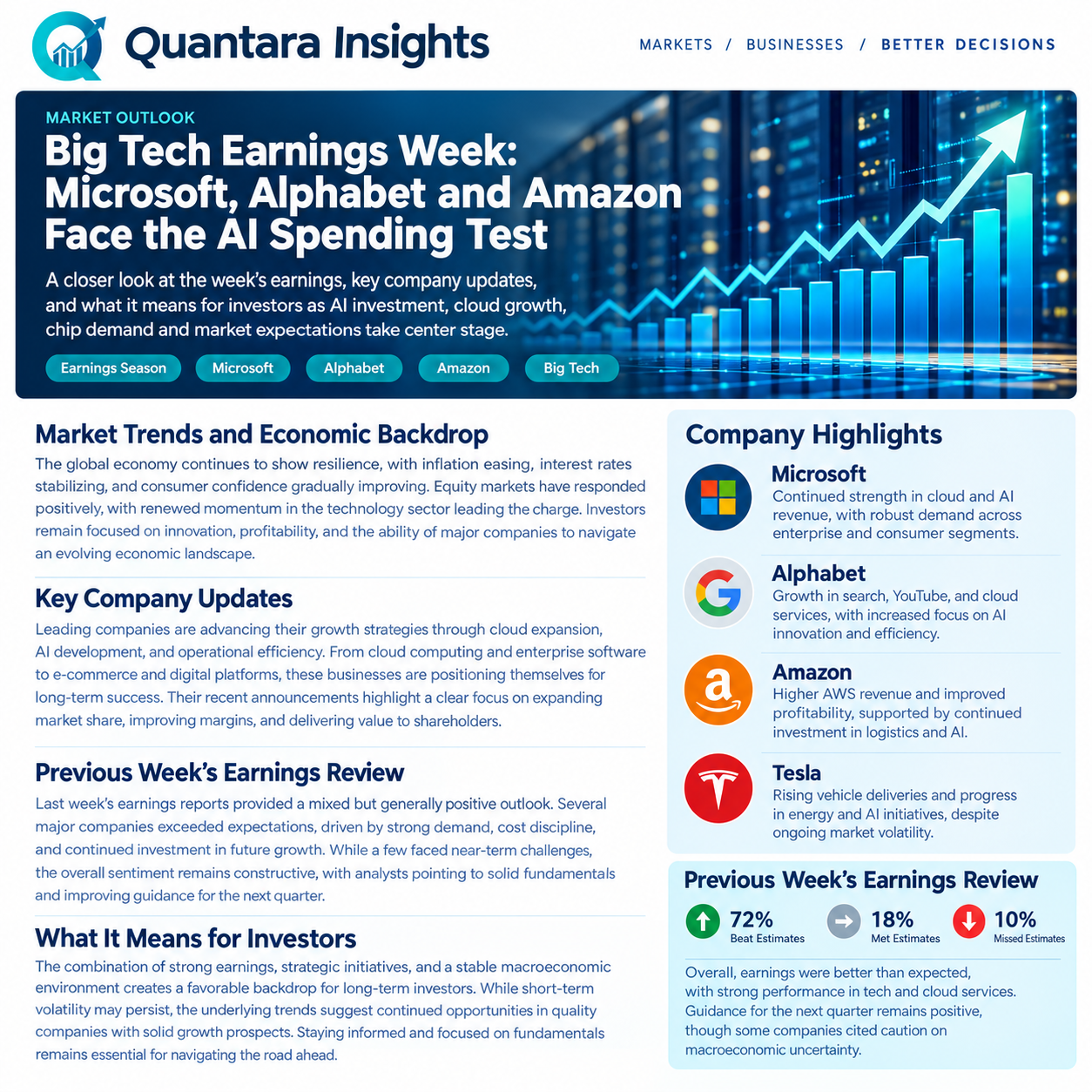
Earnings Season is entering an important phase as investors prepare to assess results from some of the world’s most influential technology companies, alongside financial institutions, industrial businesses, healthcare providers, and consumer-focused corporations. The reporting period offers a valuable opportunity to evaluate whether revenue growth, artificial intelligence investment, and corporate spending are translating into sustainable profits.
The week of October 19–23, 2026, places several major companies in the spotlight. Netflix is scheduled to report on Tuesday, October 20, while Tesla, Meta Platforms, and IBM are expected to release their results on Wednesday, October 21. Their announcements will provide fresh information about streaming demand, electric-vehicle profitability, digital advertising, enterprise technology, and the financial commitments required to compete in an increasingly AI-driven economy.
However, these companies represent only part of the wider market picture. Semiconductor manufacturers are responding to substantial demand for advanced computing infrastructure, banks are navigating changing interest-rate conditions, and industrial businesses are balancing improving demand against operating costs and economic uncertainty.
Results from major banks and semiconductor companies reported during the preceding week have already provided important context. Investors are assessing not only whether companies meet expectations, but also whether management teams can maintain growth without allowing expenses, capital requirements, or financial risks to undermine profitability.
The central issue is straightforward: Are companies generating enough sustainable earnings to justify their investment plans and market valuations?
That question will shape the response to several important reports. Strong revenue growth may support confidence, but investors could remain cautious if margins deteriorate or management offers a less optimistic outlook. Conversely, companies delivering disciplined spending, resilient cash flow, and credible guidance may attract attention even when headline growth is moderate.
This analysis examines the principal companies and sectors influencing the current reporting period, the financial indicators worth monitoring, and the potential implications for the broader stock market.
Why Earnings Season Matters for the Broader Market
Corporate earnings provide one of the clearest ways to assess the underlying condition of the economy and the businesses operating within it. Share prices can respond to interest-rate expectations, investor sentiment, geopolitical developments, and speculative positioning, but company results help establish whether the financial performance behind those prices is improving.
During the current reporting period, several themes deserve particular attention.
First, revenue growth remains important, particularly for businesses benefiting from artificial intelligence, digital advertising, cloud computing, and infrastructure investment. However, revenue alone does not establish whether a company is becoming more profitable.
Second, investors are examining operating margins and free cash flow more closely. Businesses investing heavily in data centers, manufacturing capacity, automation, and new products may experience rising revenue while facing pressure on near-term profitability.
Third, management guidance can be just as important as reported results. A company that exceeds quarterly estimates but lowers its outlook may receive a less favorable market response than a company reporting moderate growth while maintaining a credible long-term plan.
Finally, sector performance remains uneven. Technology and semiconductor companies are benefiting from structural investment trends, while banks, insurers, industrial businesses, and consumer companies face different combinations of demand, financing, and cost pressures.
The result is a reporting period in which investors must evaluate individual companies rather than assuming that strong performance in one part of the economy will extend to every sector.
Netflix Earnings: Streaming Growth, Advertising and Content Investment
Netflix is scheduled to report its quarterly results after the market closes on Tuesday, October 20, 2026. The company remains one of the most closely watched businesses in the streaming industry, with investors evaluating subscription revenue, advertising monetization, content spending, and the sustainability of its growth.
The supplied analyst consensus estimates call for earnings of approximately $0.82 per share and revenue of about $12.87 billion. These figures represent expectations ahead of the announcement, not confirmed results. The market’s response will depend on how actual performance compares with those estimates and what management communicates about future quarters.
Revenue Growth and the Streaming Business Model
Netflix has spent years developing a global subscription business supported by original programming, licensed content, and an expanding collection of entertainment formats. Its scale provides advantages in distribution, customer data, and content monetization, but it also requires significant investment in programming that must attract and retain viewers.
Revenue growth is therefore only one part of the assessment. Investors also need to consider subscription pricing, customer retention, advertising revenue, and the cost of producing and acquiring content.
A strong quarterly result could indicate that Netflix is continuing to convert its audience into revenue while maintaining effective control over operating expenses. However, a weaker margin could suggest that content investment, marketing, or other operating costs are increasing faster than the company’s income.
The important distinction is between growth that creates lasting economic value and growth that requires continually rising expenditure.
Advertising and New Revenue Opportunities
Advertising represents an important opportunity for Netflix to diversify its revenue streams. An advertising-supported subscription tier allows the company to monetize viewing activity beyond subscription fees alone.
The commercial potential depends on several factors, including the number of advertising-supported viewers, the effectiveness of advertising placements, advertiser demand, and the company’s ability to deliver measurable results for brands.

Netflix can also explore additional monetization opportunities through international partnerships, live programming, gaming, and other entertainment formats. These initiatives may increase engagement and broaden the company’s relationship with its audience.
Nevertheless, new business lines should be evaluated according to their financial contribution. Expanding into additional formats may support long-term growth, but it can also increase production, technology, and operating expenses before meaningful revenue develops.
Investors will therefore be looking for evidence that Netflix’s broader strategy is improving monetization without weakening its underlying subscription business.
Content Costs and Production Efficiency
Content spending remains one of Netflix’s most important financial considerations. Original programming helps differentiate the service, but the company must continually invest in new releases to maintain engagement across different countries and audience groups.
Artificial intelligence could help streamline selected production processes, support localization, and improve certain elements of content development. Such tools may create opportunities to control costs or shorten production timelines.
However, technology does not eliminate the creative, contractual, and operational costs associated with producing successful entertainment. The financial benefit will depend on whether efficiency gains become visible in operating margins and cash generation.
Investors should also consider the timing of content spending. Costs may occur well before a programme generates its full commercial benefit, making individual quarters difficult to interpret without examining broader trends.
What to Watch in Netflix’s Results
The most important indicators include revenue growth, operating profitability, advertising monetization, and management’s outlook for future performance.
Investors should pay attention to whether the company can maintain growth while controlling its content commitments. Changes in engagement, pricing strategy, and the performance of newer revenue streams may also provide useful information about its long-term prospects.
The overall question is whether Netflix can continue expanding its global entertainment business while generating sufficient cash to support content investment and shareholder returns.
A strong result would support confidence in its business model, but sustained performance will depend on the company’s ability to balance audience growth, programming quality, and financial discipline.
Tesla Earnings: Vehicle Demand, Margins and Artificial Intelligence
Tesla is expected to report its third-quarter results after the market closes on Wednesday, October 21, 2026. The announcement will attract attention because the company’s valuation reflects not only electric-vehicle manufacturing but also expectations surrounding autonomous driving, robotics, energy storage, and artificial intelligence.
The supplied analyst consensus estimates call for earnings of approximately $0.44 per share on revenue of about $27.79 billion. These figures should be treated as pre-report estimates, with the final assessment depending on actual results and updated guidance.
Tesla’s challenge is to demonstrate that its investment in future technologies can coexist with a financially sustainable automotive business.
Vehicle Deliveries and Revenue Quality
Vehicle deliveries remain a central indicator of Tesla’s operating performance. Higher deliveries can support revenue, improve factory utilization, and spread fixed costs across a larger number of vehicles.
However, delivery growth does not automatically translate into stronger earnings. Selling prices, incentives, manufacturing costs, geographic mix, and the relative contribution of different models all influence profitability.
Investors will therefore want to understand the relationship between unit sales and automotive margins. If Tesla delivers more vehicles but generates less profit per vehicle, the financial benefit may be smaller than the headline delivery figure suggests.
Competitive conditions also matter. Electric-vehicle manufacturers face changing consumer preferences, pricing pressure, evolving regulations, and competition from established automakers and newer manufacturers.
Tesla’s ability to maintain a compelling product offering while controlling costs will remain central to its financial performance.
Automotive Margins and Cost Management
Automotive profitability is one of the most important areas to monitor in the upcoming report. Lower selling prices or increased incentives can support demand but reduce the amount of revenue retained as profit.
Manufacturing efficiency, battery costs, logistics, warranty expenses, and factory utilization also affect margins. A company can improve production volumes without achieving a corresponding improvement in profitability if costs rise at a similar pace.
Investors should examine whether any changes in margins reflect temporary factors or more persistent pricing and competitive pressures.
The distinction is important because a temporary disruption may be manageable, whereas sustained margin compression could require a reassessment of the company’s long-term earnings potential.
Robotaxis, Full Self-Driving and Robotics
Tesla’s autonomous-driving ambitions represent a significant potential source of future value. If the company can develop commercially viable autonomous services, it could expand beyond selling vehicles into software, transportation, and mobility services.
However, these opportunities remain dependent on technological progress, safety performance, regulation, customer adoption, and the economics of operating autonomous vehicles.
Progress should therefore be assessed against measurable milestones rather than broad statements about future potential. Investors need to understand how quickly new services can expand, what costs they require, and whether they can generate meaningful revenue.
The Optimus robotics programme and Tesla’s AI computing investments also offer potential long-term opportunities. Yet their financial contribution must be distinguished from the company’s current automotive earnings.
These projects may require substantial spending before their commercial value becomes clear. Their long-term prospects do not remove the need for discipline in the existing business.
Capital Expenditure, Debt and Free Cash Flow
Capital spending is particularly important for Tesla because the company is investing in manufacturing capacity, computing infrastructure, energy products, autonomous driving, and robotics.
Such investments may strengthen its competitive position, but they also place demands on cash flow. Free cash flow measures the cash remaining after capital expenditure and provides an indication of how much flexibility a business has to fund new projects, repay debt, or return capital to shareholders.
If capital expenditure increases faster than operating cash flow, Tesla may need additional financing or a larger cash reserve to support its plans.
That does not automatically indicate financial weakness. Growth companies frequently invest ahead of future revenue. The key question is whether the expected returns justify the financial commitments.
Investors should monitor the scale of planned expenditure, liquidity, debt obligations, and management’s explanation of how current spending is expected to produce future returns.
What Tesla’s Results Could Reveal
The most important signals will be automotive margins, delivery trends, operating expenses, free cash flow, and updated investment plans.
Progress in autonomous driving and robotics may also influence market sentiment, but these developments should be evaluated separately from current earnings performance.
Tesla’s investment case ultimately depends on whether its existing businesses can support its longer-term ambitions without creating unsustainable financial pressure.
Meta Earnings: Digital Advertising Growth Meets Rising AI Costs
Meta Platforms is scheduled to report its quarterly results after the market closes on Wednesday, October 21, 2026. Investors will focus on the company’s advertising business, the commercial benefits of artificial intelligence, and the substantial investment required to develop its computing infrastructure.
The supplied consensus estimates call for earnings of approximately $6.54 per share and revenue of about $63.18 billion. These are pre-report expectations rather than confirmed results.
Meta presents an important test of the relationship between AI investment and financial performance. Its advertising business can generate substantial revenue, but the company must demonstrate that higher infrastructure spending can support future growth without permanently weakening profitability.
Advertising Remains the Core Financial Engine
Meta’s advertising business benefits from a large user base, extensive engagement data, and a collection of platforms that connect businesses with consumers.
Advertising performance depends on the number of users, time spent on the platforms, the number and quality of advertisements displayed, and the prices advertisers are willing to pay.
Artificial intelligence can improve several parts of this process. Better recommendation systems may increase engagement, while improved ad targeting can help advertisers reach relevant audiences and measure campaign performance.
These improvements can strengthen Meta’s commercial position when they produce measurable increases in advertiser returns.
However, investors should distinguish between technology improvements and their financial consequences. Better engagement is valuable, but the impact on revenue and profit depends on how effectively the company monetizes that activity.
AI Products and Business Opportunities
Meta is developing AI capabilities across its consumer platforms, business tools, and connected devices. These investments could create new revenue streams and improve the productivity of existing services.
Business-focused AI tools may help companies automate customer interactions, improve advertising campaigns, and manage routine communication. Connected devices and smart glasses could also provide additional ways for Meta to reach users.
The opportunity is significant, but commercial adoption takes time. New products must attract customers, provide useful functionality, and generate enough revenue to justify their development and operating costs.
Investors should look for evidence of adoption, repeat usage, monetization, and measurable improvements in existing businesses.
Capital Expenditure and Operating Margins
Meta’s investment in data centers, advanced computing equipment, and AI infrastructure is a major financial consideration.
Building and operating this infrastructure requires substantial capital expenditure. The costs can affect cash flow immediately, while the expected benefits may emerge over several years.
Operating margins are therefore an important indicator. If revenue continues to grow but operating expenses increase even faster, profitability may weaken despite strong commercial demand.
Free cash flow provides another perspective. A decline in free cash flow may reflect an intentional investment cycle rather than deterioration in the core business, but investors still need to assess the scale, duration, and expected return of that investment.

Management’s explanation of future spending commitments will be especially important. Investors need to understand whether the company expects its investments to produce higher revenue, improve efficiency, or establish new sources of long-term profit.
The Importance of Financial Discipline
Meta’s challenge is not simply to spend enough to remain competitive in AI. It must also allocate capital effectively.
Large technology companies face pressure to develop infrastructure before future demand becomes fully visible. Investing too cautiously can limit growth, while excessive spending can reduce financial flexibility.
A disciplined strategy should establish clear priorities, measurable operating objectives, and a credible relationship between expenditure and expected returns.
The upcoming report should help investors assess whether Meta is balancing these priorities effectively.
What to Watch in Meta’s Results
Key indicators include advertising revenue, operating margins, expense growth, capital expenditure, and free cash flow.
Investors should also examine management’s forward guidance and any changes to its investment plans.
The central question is whether Meta’s AI investments are strengthening its advertising business and creating commercially viable opportunities quickly enough to support the financial resources committed to them.
IBM Earnings: Enterprise AI, Hybrid Cloud and Software Growth
IBM is expected to report its quarterly results after the market closes on Wednesday, October 21, 2026. Its performance offers a different perspective on AI adoption from that of consumer-facing technology companies.
While Meta and Tesla are investing heavily in infrastructure and new consumer services, IBM focuses on enterprise software, hybrid cloud, consulting, infrastructure, and technology services for large organizations.
The supplied consensus estimates call for earnings of approximately $2.88 per share on revenue of about $16.84 billion. These figures represent expectations ahead of the announcement.
Enterprise Technology Spending
IBM operates in a market where customers often make large purchasing decisions over extended periods. Enterprise technology projects may involve complex contracts, implementation schedules, regulatory requirements, and budget approvals.
Consequently, the timing of contracts can influence quarterly revenue even when underlying demand remains relatively stable.
Investors should assess whether delayed transactions are converting into completed business and whether the company’s major operating segments are generating consistent growth.
A single quarter may not fully reflect the health of IBM’s customer relationships, but repeated delays or weaker contract activity could indicate pressure on enterprise spending.
Hybrid Cloud and Red Hat
Hybrid cloud technology allows businesses to operate applications and data across different computing environments, including private infrastructure and public cloud platforms.
IBM’s software strategy, including Red Hat, is positioned around helping organizations manage complex systems while maintaining flexibility, security, and control.
Demand for hybrid cloud services can be supported by modernization projects, data management requirements, and the need to integrate new AI applications with existing systems.
Investors should monitor software revenue growth, recurring income, customer retention, and the company’s ability to turn its technology portfolio into sustainable profitability.
AI Consulting and Commercial Adoption
Many businesses are interested in AI but face practical challenges when deploying it. These include data quality, cybersecurity, regulatory compliance, integration costs, and the need to demonstrate measurable productivity improvements.
IBM’s consulting operations can help customers address these challenges. However, the commercial opportunity depends on whether companies move from experimentation into funded projects and ongoing implementation.
A growing pipeline is encouraging, but completed contracts, recognized revenue, and cash collection provide stronger evidence of commercial progress.
Investors should distinguish between broad interest in AI and the financial contribution of AI-related services.
Infrastructure and Financial Performance
IBM’s infrastructure business also plays a role in its results. Demand can vary according to customer purchasing cycles, equipment availability, and investment decisions.
Changes in infrastructure revenue should be evaluated alongside software performance and consulting demand rather than viewed in isolation.
Cash flow remains important because it supports dividends, debt management, acquisitions, and investment in new capabilities.
Investors should monitor the company’s operating performance, guidance, and explanations of any changes in customer demand or contract timing.
What IBM’s Report Could Signal
IBM’s results may help clarify whether enterprise technology spending is remaining resilient and whether businesses are beginning to generate more tangible returns from AI adoption.
The key indicators are software growth, consulting activity, infrastructure demand, margins, and free cash flow.
IBM does not need to deliver the same growth rate as a rapidly expanding consumer technology company to demonstrate financial progress. Its performance should be judged against its business model, strategic priorities, and ability to generate durable cash flow.
Semiconductor Earnings: TSMC, ASML and Lam Research
Semiconductor companies occupy a central position in the AI investment cycle. Advanced computing systems require increasingly sophisticated chips, manufacturing equipment, memory, and packaging technologies.
That creates opportunities for companies throughout the semiconductor supply chain. However, the sector also faces significant capital requirements, geopolitical risks, supply constraints, and cyclical changes in demand.
The latest results and outlooks from Taiwan Semiconductor Manufacturing Company, ASML, and Lam Research offer different perspectives on the industry’s position.
TSMC: Advanced Chip Demand and Manufacturing Capacity
TSMC has benefited from demand for advanced semiconductors used in AI computing, smartphones, and other electronic devices. Its manufacturing capabilities make it an important supplier to major technology companies.
Its third-quarter results were reported during the preceding week, with revenue and profit growth reflecting strong demand for advanced chips.
The next stage of the investment story depends on whether TSMC can expand capacity while maintaining attractive returns.
Building advanced semiconductor facilities requires substantial capital, specialized equipment, highly trained employees, and careful execution. New facilities can take years to reach efficient production levels.
Investors must therefore balance demand growth against the financial costs of expansion.
Gross margins are particularly important because new manufacturing processes and international production facilities can increase costs before reaching full efficiency.
A company can experience exceptional demand while facing temporary pressure on margins as it builds the capacity required to serve customers.
TSMC’s outlook should be assessed through demand for advanced chips, production yields, capital expenditure, and the pace at which new technologies contribute to revenue.
ASML: Equipment Demand and Production Constraints
ASML supplies highly specialized lithography systems used in advanced semiconductor manufacturing.
Its equipment is essential to the production of many cutting-edge chips, placing the company in a strategically important position within the semiconductor supply chain.
Demand for advanced manufacturing technology may increase as chipmakers expand capacity and develop smaller, more sophisticated processes.
However, strong customer demand does not guarantee that equipment can be delivered immediately. Manufacturing complex systems requires specialized components, engineering expertise, and extensive testing.
Capacity expansion is therefore a critical issue.
Investors should assess order backlogs, delivery schedules, customer investment plans, and the company’s ability to increase output without undermining product quality or profitability.
Export restrictions and geopolitical developments can also influence demand and the geographic distribution of sales.
ASML’s long-term opportunity remains closely connected to semiconductor technology requirements, but its financial performance will depend on execution and customer investment decisions.
Lam Research: Memory and Advanced Manufacturing Equipment
Lam Research supplies equipment used in semiconductor manufacturing, including processes required for memory and advanced logic chips.
Its performance is influenced by customer spending on new production capacity, technology transitions, and equipment upgrades.
Demand from AI-related applications can support investment in memory and advanced computing systems. However, the semiconductor equipment market remains cyclical, and customers may change their spending plans as industry conditions evolve.
Investors should examine revenue growth, gross margins, order trends, and management guidance.
Regional demand also matters. Changes in customer investment and trade restrictions can affect the company’s sales mix and growth outlook.
What Semiconductor Results Say About AI Investment
The semiconductor supply chain provides an important test of whether AI investment is translating into actual demand for computing infrastructure.
Strong equipment orders and advanced-chip sales suggest that customers are continuing to build capacity. However, these figures do not automatically establish how quickly the infrastructure will generate profitable AI services.
The financial relationship between chipmakers, cloud providers, and AI developers is complex. Capital spending by one company becomes revenue for another, but the ultimate economic benefit depends on the revenue generated by the systems being built.
Investors should therefore assess both sides of the equation: the growth of semiconductor demand and the ability of customers to earn adequate returns on their computing investments.
Bank Earnings: Lending Income, Trading Activity and Credit Quality
Major banks reported results during the preceding week, providing an early indication of how financial institutions are responding to interest-rate conditions, consumer activity, and changing capital-markets demand.
The results showed that strong performance in one business line does not necessarily translate into uniform improvement across the entire organization.
Banks generate revenue from lending, deposits, credit cards, investment banking, trading, asset management, and other financial services. Each area responds differently to economic conditions.
JPMorgan Chase: Interest Income and Market Activity
JPMorgan Chase operates across consumer banking, commercial lending, investment banking, trading, and asset management.
Higher interest rates can support lending income under certain conditions, particularly when loan yields rise faster than the cost of deposits. However, the relationship is not automatic.
Banks must compete for deposits, manage funding costs, and monitor the credit quality of borrowers. If deposit costs rise quickly or loan demand weakens, higher rates may not produce the expected improvement in profitability.
JPMorgan’s reported results should be evaluated across its major business lines rather than through a single earnings figure.
Consumer spending, new account growth, investment-banking activity, trading revenue, expenses, and credit provisions all provide useful information.

Management’s guidance is also important. Expectations for future net interest income can influence how investors assess the bank’s earnings capacity, while changes in credit reserves may indicate how management views potential economic risks.
The broader lesson is that lending income can remain resilient even as trading and dealmaking become less supportive.
Bank of America: Regulation, Deposits and Operating Costs
Bank of America faces many of the same industry-wide challenges, including deposit competition, funding costs, lending demand, and credit quality.
Regulatory expenses can add another layer of complexity. Settlements, compliance requirements, and investments in risk-management systems can affect profitability even when core banking operations remain stable.
Investors should distinguish between unusual expenses and recurring operating costs.
A one-time settlement may have a limited long-term effect, whereas persistently higher compliance costs could change the bank’s underlying expense structure.
Deposit trends also deserve attention. A strong deposit base can provide a stable funding source, but maintaining customer relationships may become more expensive when alternative savings products offer attractive yields.
The bank’s results should therefore be assessed through net interest income, expenses, deposit costs, credit provisions, and capital strength.
Goldman Sachs and Morgan Stanley: Trading and Wealth Management
Goldman Sachs and Morgan Stanley provide useful examples of how investment banking, trading, and wealth management can respond differently to the same market environment.
Trading revenue may benefit from increased market activity and volatility, but results can vary significantly from one quarter to another.
Investment banking depends on mergers and acquisitions, equity issuance, debt markets, and client confidence. When valuations become uncertain or financing conditions deteriorate, companies may postpone transactions.
Wealth management can offer a more recurring revenue base through advisory fees and assets under management. However, market declines may reduce asset values, while lower client activity can affect transaction-related income.
Investors should assess the composition of earnings rather than focusing solely on the headline total.
Strong wealth-management results may provide stability when dealmaking slows, while elevated credit provisions or weaker trading activity may offset some of that benefit.
Citigroup and Wells Fargo: Profitability and Execution
Citigroup’s performance can be evaluated through its profitability targets, operating efficiency, risk management, and progress in simplifying its business.
Wells Fargo provides another perspective on consumer banking, commercial lending, deposit trends, and cost discipline.
For both institutions, investors should monitor credit quality, expense growth, lending activity, and capital allocation.
Differences in business structure and strategic priorities can produce different results even when banks face similar economic conditions.
The most useful comparison is not simply which bank reports the highest earnings. It is which institution demonstrates the strongest combination of sustainable profitability, controlled risk, and effective execution.
What Bank Results Reveal About the Economy
Bank results offer a window into consumer and business financial conditions.
Credit-card spending can provide information about household demand, while loan growth may indicate whether businesses and consumers are willing to borrow.
Credit provisions and delinquency trends help investors assess whether financial pressure is increasing.
At the same time, strong lending income may coexist with slower investment banking or weaker trading activity.
The sector’s outlook therefore depends on the interaction between interest rates, funding costs, economic growth, and credit quality.
Investors should avoid treating higher interest rates as uniformly positive for banks. The impact depends on each institution’s balance sheet, customer base, and mix of revenue sources.
Healthcare Earnings: UnitedHealth, Johnson & Johnson and Intuitive Surgical
Healthcare businesses have different demand drivers from technology and financial companies. Insurance costs, drug development, medical procedures, regulatory decisions, and reimbursement conditions can influence results independently of the wider economic cycle.
The sector’s recent reports illustrate the importance of examining operational details rather than relying solely on headline revenue.
UnitedHealth: Profit Recovery and Medical Costs
UnitedHealth’s performance depends on insurance operations, healthcare services, membership trends, and the cost of providing medical care.
Medical-cost ratios are particularly important because they indicate how much of insurance revenue is used to pay medical claims.
An improving ratio can support profitability, provided that the change is sustainable and does not simply reflect temporary timing differences.
Membership changes also require careful interpretation. A reduction in membership may be intentional if a company is withdrawing from less attractive markets or adjusting its product mix.
Investors should examine commercial insurance performance, government-supported plans, cost trends, and management’s forward guidance.
A company can report stronger profits while still facing challenges in individual business lines. Understanding those differences is essential when evaluating the durability of a recovery.
Johnson & Johnson: Pharmaceuticals and Medical Devices
Johnson & Johnson benefits from a diversified healthcare portfolio, including pharmaceutical products and medical devices.
Growth in oncology treatments and other medicines can support revenue, but pharmaceutical performance depends on product demand, patent protection, competition, and the timing of new launches.
Medical devices face different pressures, including procedure volumes, hospital budgets, product innovation, and reimbursement conditions.
The combination can provide some diversification, although weakness in one business may offset growth in another.
Investors should assess whether pharmaceutical gains are sustainable and whether the medical-device business is stabilizing or continuing to face operational challenges.
Intuitive Surgical: Procedure Growth and Robotic Surgery
Intuitive Surgical’s business is linked to robotic-assisted surgery, installed systems, instruments, accessories, and service revenue.
The number of procedures performed using its systems is an important indicator because it can influence recurring revenue from instruments and related products.
System placements are also significant, but they do not tell the whole story. A growing installed base creates an opportunity for additional procedures, yet financial performance depends on how frequently systems are used.
Elective-surgery demand, hospital capacity, reimbursement conditions, and competitive developments can affect procedure volumes.
Investors should monitor procedure growth, system utilization, margins, and management’s outlook.
The central question is whether the company can maintain strong recurring revenue while expanding adoption across hospitals and surgical specialties.
Industrial Earnings: Aerospace, Defense and Manufacturing
Industrial companies provide a different view of the economy because their results are influenced by production schedules, capital spending, order backlogs, material costs, and government procurement.
Strong orders can support future revenue, but companies must still convert those orders into completed deliveries and profitable contracts.
GE Aerospace and Defense Contractors
Aerospace businesses benefit from commercial aviation demand, aircraft engine production, maintenance services, and the need to keep existing fleets operational.
Maintenance and service revenue can provide recurring business because aircraft engines require ongoing support throughout their operating lives.
However, manufacturers face supply-chain constraints, labor requirements, certification processes, and production schedules that can limit their ability to meet demand quickly.
Defense contractors have a different set of drivers. Government budgets, procurement schedules, contract execution, and geopolitical priorities influence revenue.
Order backlogs can provide visibility, but investors should examine the profitability and delivery timing of those contracts.
The distinction between a large order book and strong current cash flow remains important across both sectors.
General Motors and the Automotive Transition
General Motors and other established automakers face the challenge of managing conventional vehicle production while investing in electric vehicles, software, and new mobility technologies.
Their financial performance depends on vehicle demand, pricing, manufacturing efficiency, financing conditions, and product mix.
The transition to electric vehicles creates opportunities but also requires substantial investment in batteries, production facilities, and technology development.
Investors should compare growth plans with actual demand and the capital required to support them.
The most important questions concern vehicle profitability, inventory management, product competitiveness, and whether investment spending can produce sustainable returns.
Cleveland-Cliffs: Steel Demand and Cost Management
Cleveland-Cliffs provides insight into industrial materials demand and the economics of steel production.
Revenue is influenced by shipment volumes, selling prices, product mix, and customer demand. Profitability also depends on raw materials, energy, transportation, labor, and plant utilization.
When pricing improves and costs decline, operating leverage can produce a substantial improvement in earnings.
However, industrial recoveries are not always linear. Trade policy, imported steel, manufacturing demand, and contract negotiations can affect prices and production volumes.
Investors should monitor cash flow, shipment trends, costs, and the durability of management’s operating outlook.
A recovery becomes more convincing when stronger earnings are accompanied by improved cash generation and a more resilient balance sheet.
Bloom Energy: Data Centers and Power Infrastructure
Bloom Energy is exposed to growing interest in reliable power solutions for commercial and industrial customers, including data centers.
The expansion of AI computing infrastructure creates additional electricity requirements, making power availability an increasingly important consideration for technology companies.
On-site power systems may offer customers an alternative or complement to traditional grid connections, depending on local infrastructure and project economics.
However, demand growth does not guarantee immediate profitability.
Investors need to assess manufacturing capacity, project delivery, financing arrangements, customer concentration, margins, and cash flow.
Large financing commitments can help fund expansion, but they should not be confused with recognized revenue or realized profit.
The key question is whether the company can convert rising demand into a scalable business with sustainable economics.
Consumer Companies, Airlines and Utilities: Uneven Demand
Consumer-focused businesses face a mixture of resilient spending and growing pressure on household budgets.
Consumer staples can benefit from relatively stable demand, but they are not immune to higher input costs, wage expenses, and changing purchasing behavior.
Airlines face fuel prices, labor costs, maintenance expenses, and shifts in travel demand. Strong passenger volumes may support revenue, but higher operating costs can reduce margins.
Utilities often have more predictable demand, yet they must manage financing costs, infrastructure investment, and regulatory requirements.
These differences explain why investors may respond differently to results across the same market environment.
Companies with pricing power, disciplined cost structures, and reliable cash generation may be better positioned to manage uncertainty than businesses dependent on rapid demand growth or inexpensive financing.
What Investors Should Watch as Earnings Season Progresses
The reporting period should be assessed through a combination of company results, sector trends, and financial indicators.
No single metric can explain every business. Investors need to understand how revenue, profitability, cash generation, and guidance interact.
Reported Earnings Versus Market Expectations
A company can report higher earnings than it did a year earlier and still disappoint investors if the result falls short of expectations.
Conversely, a business with modest growth may receive a positive response if its results are better than anticipated or its outlook improves.
This distinction reflects the role of expectations in share prices.
Investors should compare reported results with analyst estimates, management guidance, and the assumptions already reflected in a company’s valuation.
A positive earnings surprise does not guarantee a share-price increase, just as a small shortfall does not automatically mean a company’s long-term prospects have deteriorated.
The broader context matters.
Revenue Growth and Operating Margins
Revenue growth indicates whether a company is expanding its business, but operating margins help explain how efficiently it converts sales into profit.
A company experiencing faster revenue growth alongside stable or improving margins may be demonstrating stronger operating leverage.
However, if expenses rise faster than sales, margins can weaken even while revenue increases.
This is particularly relevant for technology businesses investing in AI infrastructure, manufacturing capacity, and new products.
Investors should examine whether cost increases are temporary, associated with planned expansion, or evidence of more persistent pressure.
Free Cash Flow and Capital Expenditure
Free cash flow provides a useful measure of financial flexibility because it reflects the cash remaining after capital expenditure.
Companies can report positive accounting earnings while generating limited cash if investment requirements are substantial or working-capital needs increase.
That is not necessarily a problem for a growing business, but it changes the financial risk profile.
Investors should examine whether capital expenditure is aligned with realistic demand, whether the company has sufficient liquidity, and whether future cash generation is likely to support its investment programme.
For businesses with large AI commitments, the timing of returns is especially important.
Spending may be justified if it creates durable revenue and competitive advantages, but excessive investment can reduce financial flexibility if expected demand does not materialize.
Management Guidance and Forward Expectations
Management guidance provides information about how companies view demand, costs, investment, and future operating conditions.
Investors should pay attention to changes in revenue expectations, margin targets, capital expenditure, and cash-flow forecasts.
A company that raises its outlook may be signaling stronger demand or better execution. A reduction may indicate that conditions have weakened or that costs are becoming more difficult to manage.
Guidance should not be treated as a guarantee. It reflects management’s assessment based on information available at the time.
The most useful analysis compares updated guidance with previous expectations and identifies the operational factors driving the change.
Options Volatility and Market Positioning
Options markets can provide information about the degree of price movement traders anticipate around major announcements.
Implied volatility reflects the market price of options and the uncertainty embedded in those prices. It can increase before earnings reports because investors expect new information to influence valuations.
However, implied volatility does not reliably predict whether a stock will rise or fall.
Unusually large options trades also require careful interpretation. A large transaction may represent a directional view, a hedge, part of a multi-leg strategy, or a position offsetting other exposures.
Investors should avoid treating isolated trades as definitive evidence of future share-price direction.
Options data can help explain market expectations, but it should be considered alongside company fundamentals, valuation, and the broader economic environment.
Three Potential Market Scenarios
The current reporting period could produce several different outcomes.
Scenario One: Strong Results and Credible Guidance
If major companies deliver solid earnings, maintain healthy margins, and provide reassuring guidance, investors may gain confidence that corporate growth remains sustainable.
Technology companies would benefit particularly if AI-related investment is accompanied by stronger monetization and evidence of improving returns.
Banks could also support the broader market if credit quality remains stable and lending income offsets weaker trading activity.
Even in this scenario, valuations matter. Strong results do not necessarily imply that every stock offers attractive value at its current price.
Scenario Two: Revenue Growth With Profitability Pressure
A mixed outcome could emerge if companies report higher sales but face rising operating costs, capital expenditure, or weaker margins.
This would be particularly relevant to businesses investing heavily in AI infrastructure and new technologies.
Investors might remain constructive about long-term opportunities while becoming more selective about which companies can generate adequate returns.
The market could reward disciplined operators and become more cautious about businesses whose spending commitments are increasing faster than their earnings capacity.
Scenario Three: Weaker Guidance and Rising Financial Pressure
A less favorable outcome could occur if companies miss expectations, lower their outlook, or report deteriorating cash flow.
Such developments could raise concerns about demand, financing requirements, or the sustainability of current investment plans.
The effects would likely differ across sectors. Businesses with strong balance sheets and recurring revenue may be better positioned to withstand weaker conditions than companies relying on aggressive expansion or external financing.
A disappointing reporting week would not necessarily establish a long-term downturn, but it could force investors to reassess assumptions about growth, profitability, and valuations.
Conclusion: Earnings Quality Will Matter as Much as Growth
Earnings Season is providing an important opportunity to evaluate the financial health of major technology companies and the wider corporate sector.
Netflix, Tesla, Meta, and IBM will offer different perspectives on streaming monetization, electric-vehicle profitability, AI investment, enterprise software, and the relationship between growth and cash generation.
Semiconductor manufacturers provide further evidence of the demand for advanced computing infrastructure, while bank results help explain how lending income, credit quality, and capital-markets activity are responding to changing economic conditions.
Healthcare and industrial companies add another layer to the picture, demonstrating that business performance depends on sector-specific demand, cost structures, and investment requirements.
The most useful conclusion will not come from headline earnings figures alone. Investors should assess whether companies are generating sustainable revenue, protecting margins, managing capital expenditure, and providing credible guidance.
AI remains an important investment theme, but the financial returns from that investment will ultimately matter more than the scale of spending itself.
Similarly, resilient bank profits and strong industrial orders can support confidence, but they must be considered alongside funding costs, operating expenses, and broader economic risks.
For investors, the priority is to distinguish between businesses delivering measurable financial progress and those whose prospects depend primarily on expectations about future growth.
The coming reports may clarify which companies are executing effectively and where risks are increasing. They will not remove market uncertainty, but they can provide a stronger foundation for assessing the outlook.
Ultimately, sustainable earnings, disciplined investment, and credible cash generation are likely to remain central to how investors evaluate corporate performance through the remainder of 2026.
EDITORIAL NOTE
The financial figures included in this article are pre-report estimates where identified as such. Confirmed company results and guidance should be checked against the latest company announcements before publication. This article is for general informational purposes and does not constitute personalized investment advice.