








Table of Contents
- Earnings Season: AI, Technology and Market Expectations
- Apple Earnings: Strong iPhone Demand Meets Rising Costs
- Palantir Earnings: AI Growth and Elevated Expectations
- AMD Earnings: Data Center Growth and Semiconductor Demand
- Shopify Earnings: E-Commerce Growth and AI Innovation
- Other Companies to Watch During Earnings Season
- Earnings Season: What Options Markets Are Signaling
- Last Week’s Earnings Review: Big Tech and Big Oil
- What Investors Should Watch During Earnings Season
- Additional Earnings Coverage: Travel, Healthcare and Consumer Stocks
- Conclusion: Earnings Season Will Test Growth Expectations
Earnings season enters a particularly important week as investors prepare to assess some of the most closely watched companies in the technology sector. Apple, Palantir Technologies, Advanced Micro Devices, and Shopify are among the major names scheduled to report results, with their performances likely to influence sentiment across technology stocks, artificial intelligence, semiconductors, and digital commerce.
The upcoming reports arrive at a time when investors are increasingly focused on the relationship between growth and profitability. Artificial intelligence continues to attract substantial investment, while semiconductor demand remains strong in several key markets. At the same time, rising memory costs, infrastructure spending, and changing consumer demand are creating new challenges for companies that have benefited from the technology rally.
Apple remains one of the most influential companies in the market. Its earnings report will provide an important indication of consumer demand, pricing power, and the company’s ability to manage rising component costs. Palantir is entering its report with elevated expectations following strong commercial AI adoption, while AMD is expected to provide further insight into demand for data center processors and accelerators.
Shopify is another company attracting considerable attention. Its performance will help investors assess whether e-commerce growth, improving operating efficiency, and AI-powered commerce initiatives can continue supporting its financial performance.
Beyond these four companies, the week includes reports from AppLovin, Qualcomm, Uber Technologies, Aehr Test Systems, Tempus AI, and 1stdibs.com. These businesses represent different stages of growth and profitability, providing a broader view of the opportunities and challenges facing the market.
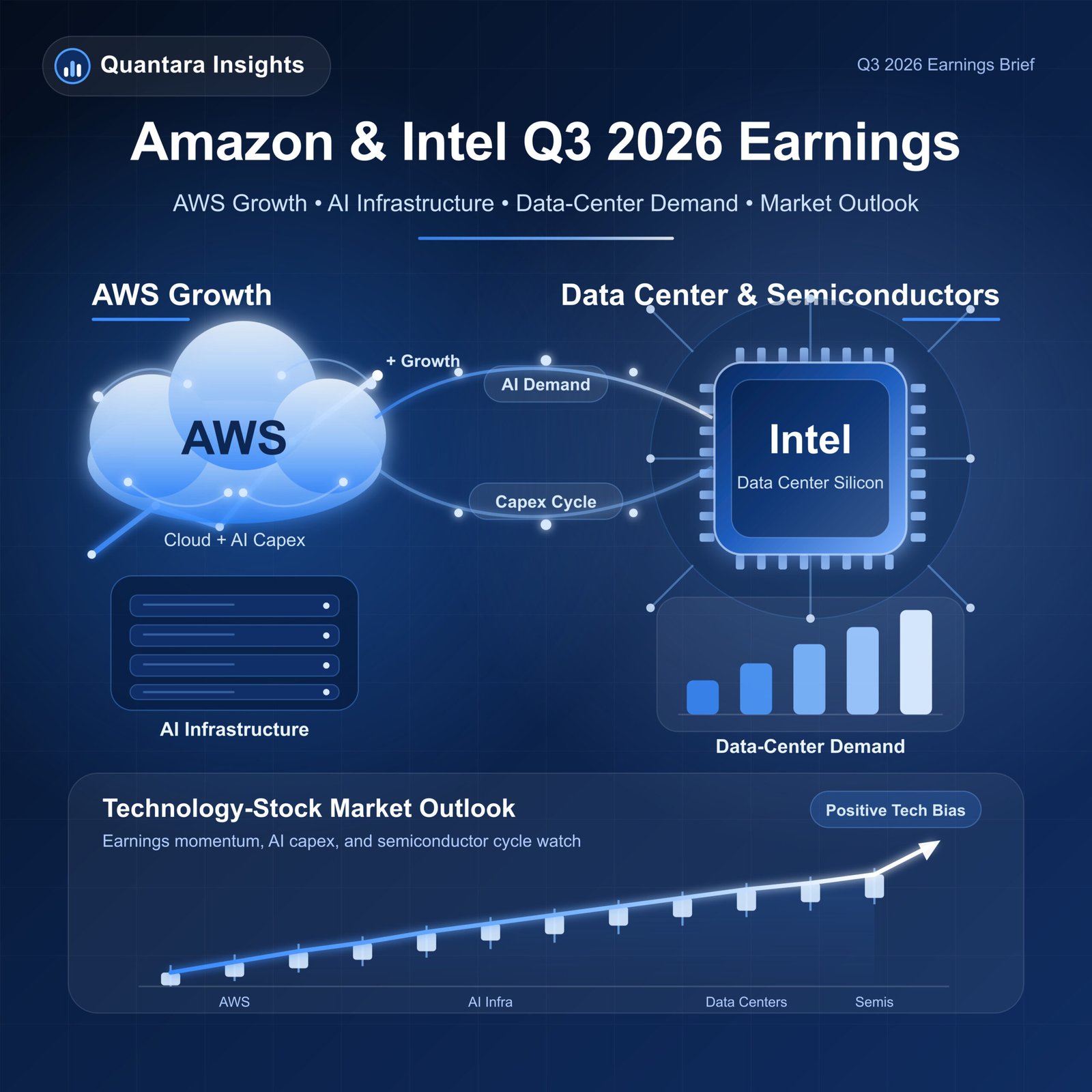
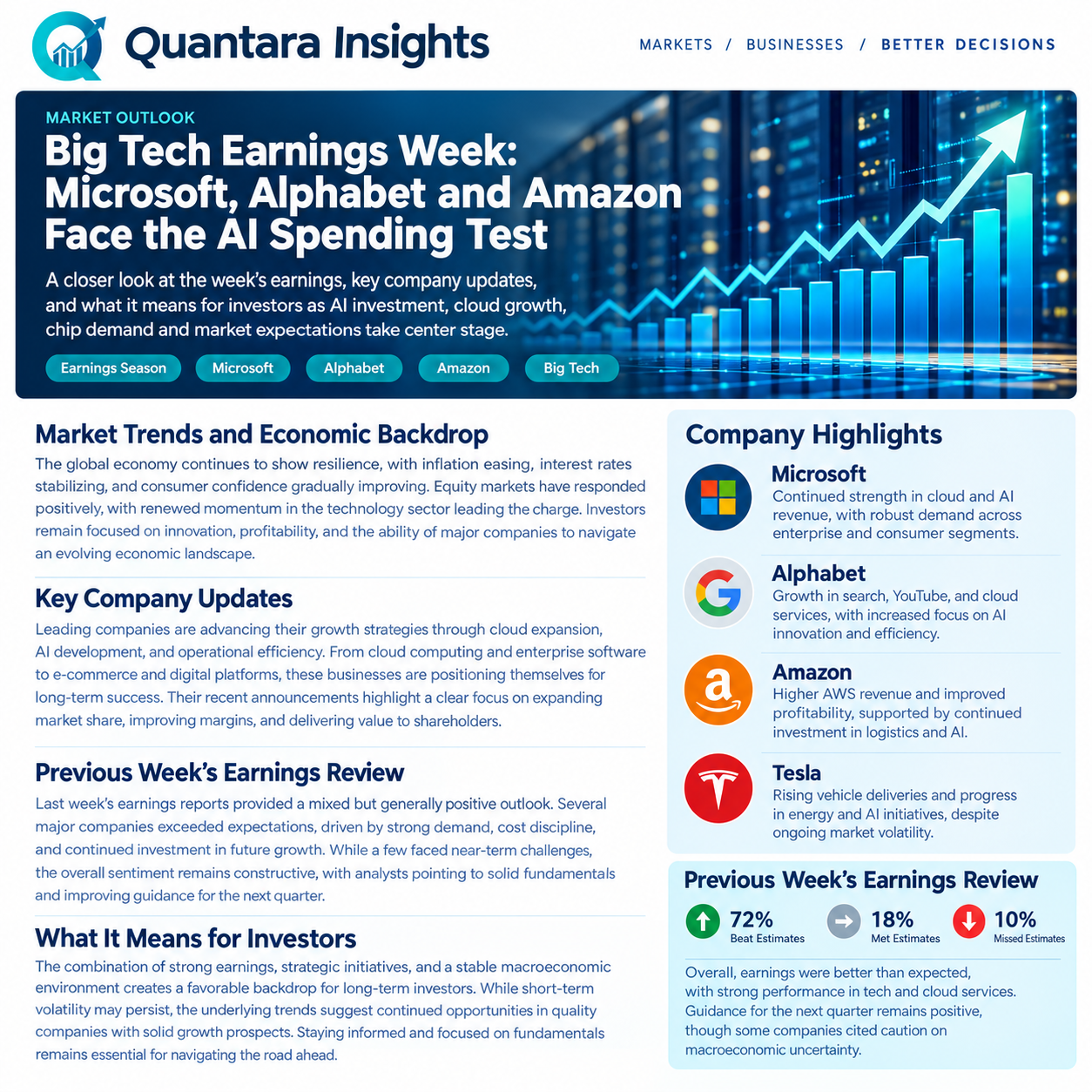
The previous week’s earnings reports also offer useful context. Amazon, Microsoft, Alphabet, and Intel delivered important updates on cloud infrastructure, AI investment, semiconductor demand, and operating margins. Their results suggest that the technology sector continues to experience significant demand, although the financial benefits of that demand are not distributed evenly.
For investors, the central question is not simply whether companies can exceed quarterly expectations. It is whether their operating performance can justify the expectations already reflected in their share prices.
Earnings Season: AI, Technology and Market Expectations
The November reporting period is arriving during a significant transition in the technology industry.
Artificial intelligence has moved beyond an early adoption phase for many large businesses. Companies are increasingly integrating AI into software, cloud infrastructure, enterprise applications, data centers, and consumer products.
This transition is creating new revenue opportunities for technology providers. However, it is also increasing capital expenditure, infrastructure requirements, and competition for specialized hardware.
The distinction between revenue growth and profitable growth is becoming increasingly important.
A company may report strong sales while experiencing pressure on operating margins because of higher computing costs, increased employee expenses, or the need to invest in additional infrastructure. Another company may report slower revenue growth but generate stronger free cash flow because of improved operating efficiency.
These differences matter during earnings season because investors are evaluating both the current financial results and the sustainability of future growth.
Why This Week Matters for Technology Stocks
Apple, Palantir, AMD, and Shopify operate in different parts of the technology ecosystem, but their earnings reports share several important themes.
First, investors will be looking for evidence that AI-related investment is generating measurable commercial benefits. Second, they will be assessing whether rising infrastructure and component costs are affecting margins. Third, management guidance will help determine whether current growth rates can continue into the next financial period.
The reports are also important because expectations remain elevated for several companies.
When investors anticipate strong results, a company may need to deliver more than a modest earnings beat to support its share price. Conversely, a company facing lower expectations may experience a more favorable market reaction if its results demonstrate that conditions are stabilizing.
This is one reason the immediate reaction to an earnings announcement can differ substantially from the underlying financial performance.
The Broader Earnings Calendar
The week of November 2–6 includes several major reporting events.
Apple and Palantir are scheduled to report after the market closes on Monday, November 2. Shopify is expected to report before the market opens on Tuesday, November 3, followed by AMD after the close.
Qualcomm and AppLovin are scheduled to report on Wednesday, November 4, while Uber is expected to release its results earlier that day.
These announcements provide investors with an opportunity to evaluate the technology sector across multiple business models, including consumer electronics, enterprise software, semiconductors, advertising technology, and e-commerce.
The concentration of major technology reports also means that market sentiment could change quickly as investors compare results and management commentary.
Apple Earnings: Strong iPhone Demand Meets Rising Costs
Apple is one of the most important companies reporting during the upcoming earnings season.
The company remains a dominant force in consumer technology, with its iPhone business, services ecosystem, and expanding AI capabilities attracting considerable attention from investors.
The central issue facing Apple is the balance between strong product demand and rising production costs.
According to the estimates provided in the original analysis, Wall Street is looking for earnings of approximately $1.98 per share on revenue of $112.95 billion. This would represent revenue growth of approximately 10.2% compared with the same period a year earlier.
Apple’s previously issued revenue guidance ranged from $111.69 billion to $113.74 billion, while earnings guidance was between $1.91 and $2.04 per share.
The company is therefore entering the reporting period with expectations that are relatively close to its own guidance.
The key question is whether Apple can sustain its revenue momentum while protecting profitability.
iPhone Demand Remains a Major Growth Driver
The iPhone continues to play a central role in Apple’s financial performance.
The original analysis points to strong demand, with iPhone revenue growth estimated at approximately 22%. If that level of growth is sustained, it would represent a significant contribution to Apple’s overall revenue.
However, strong demand can also create operational challenges.
When customers purchase products faster than the company can manufacture them, supply constraints can limit revenue opportunities. This is particularly important for Apple because its product launches often create concentrated periods of demand.
The company must balance production capacity, inventory management, and component availability while maintaining the product quality and customer experience associated with its brand.
Investors will be looking for management commentary on whether supply constraints are temporary or whether they could affect sales during the next quarter.
Memory Chip Costs Could Pressure Margins
Rising memory prices are another important consideration for Apple.
Memory components are used across a wide range of consumer electronics, including smartphones, computers, and tablets. When component prices increase sharply, manufacturers may experience higher production costs.
Apple has historically benefited from its scale, purchasing power, and ability to manage its supply chain. However, even a company of Apple’s size can experience margin pressure when important components become significantly more expensive.
The original analysis suggests that memory cost increases are contributing to higher product prices and supply challenges.

Investors will want to understand how much of the cost increase Apple can absorb and how much it may pass on to consumers.
The company’s pricing strategy is particularly important because higher prices can affect demand in markets where consumers are already facing economic uncertainty.
Services Growth and the AI Opportunity
Apple’s services business remains an important contributor to its financial performance.
Services provide recurring revenue from products such as subscriptions, digital content, cloud storage, and payments. This business model can offer more predictable revenue than hardware sales, although growth rates can fluctuate.
The original analysis highlights a slowdown in services growth, which could become an important discussion point during the earnings call.
Investors will also be watching Apple’s AI initiatives.
The company has been expanding its AI capabilities across its ecosystem, including improvements to its software and digital assistant features. These developments could strengthen customer engagement and support future product upgrades.
However, the commercial impact of AI features is not always immediate.
The important question is whether Apple’s AI investments lead to stronger customer retention, higher product demand, or additional services revenue.
Leadership Transition and Forward Guidance
The upcoming report also represents an important leadership milestone.
The original analysis identifies this as the first full quarter under John Ternus following the leadership transition from Tim Cook.
Investors will be assessing whether the new leadership team maintains Apple’s existing strategic priorities while addressing the challenges associated with rising costs and supply constraints.
Forward guidance may be more important than the quarterly earnings figure itself.
A strong quarter accompanied by cautious guidance could create uncertainty about future growth. Conversely, a solid outlook may support investor confidence even if the company reports a relatively modest earnings beat.
The key takeaway for Apple earnings: Investors will be evaluating demand, supply availability, memory costs, services growth, AI adoption, and the company’s ability to maintain margins.
Palantir Earnings: AI Growth and Elevated Expectations
Palantir Technologies enters the reporting period with considerable investor attention.
The company has become an important participant in the enterprise AI market, providing software that helps organizations integrate data, analyze information, and support operational decision-making.
Its commercial business has been expanding, while government contracts continue to provide an important source of revenue.
The original analysis estimates that Palantir will report earnings of approximately $0.40 per share on revenue of $2.17 billion. This would represent revenue growth of approximately 83.7% year over year.
Such a growth rate would place Palantir among the more closely watched companies in the technology sector.
However, the company’s strong operating momentum also means that investors may have relatively high expectations.
Commercial AI Adoption Is a Major Growth Opportunity
Palantir’s commercial AI platform has become a central part of its growth strategy.
Businesses increasingly want to use AI to improve productivity, automate processes, and extract value from large amounts of operational data.
However, implementing AI in large organizations can be complicated.
Companies must integrate information from different systems, manage data access, establish security controls, and ensure that AI applications can be used reliably.
Palantir’s software is designed to help organizations address these challenges.
Its ability to connect AI models with enterprise data and operational workflows may provide an advantage in markets where businesses require greater control over their systems.
The upcoming report should provide further insight into whether commercial demand continues to expand and whether new customers are increasing their spending.
Sovereign AI and Enterprise Infrastructure
Sovereign AI is another important theme for Palantir.
The concept generally refers to organizations maintaining control over their AI infrastructure, data, and models within their own regulatory or operational environments.
This can be particularly important for government agencies, defense organizations, and businesses operating in highly regulated industries.
Demand for sovereign AI solutions may create opportunities for companies that can provide secure, flexible, and scalable platforms.
However, the market remains competitive.
Palantir must demonstrate that its software provides measurable operational benefits and that customers are willing to commit to long-term contracts.
The original analysis also highlights Palantir’s relationships with NVIDIA and government platforms as important parts of its commercial positioning.
These relationships may help strengthen its role in the AI ecosystem, although investors should distinguish between strategic partnerships and their actual contribution to revenue.
Revenue Growth and Margin Expectations
The original analysis identifies Palantir’s previous quarter as particularly strong, with total revenue growth reaching approximately 93%.
It also notes that management raised its full-year outlook significantly.
Those results create a demanding comparison for the upcoming report.
Investors will be looking for evidence that the company can sustain strong growth without allowing operating costs to rise excessively.
Cloud hosting costs, infrastructure expenses, and increased spending can all affect profitability.
The original analysis also highlights a slight decline in gross margin associated with hosting costs for a government client.
This illustrates an important issue for enterprise software companies.
Revenue growth is valuable, but the quality of that growth depends partly on how much profit the company retains after delivering its services.
Valuation and Investor Sentiment
Palantir’s valuation is another important consideration.
Companies experiencing rapid growth can command higher valuations because investors expect their future earnings and cash flow to increase substantially.
However, higher valuations can also make share prices more sensitive to disappointing results.
If a company delivers strong growth but falls short of market expectations, investors may reassess the premium they are willing to pay.
The original analysis indicates that Palantir has experienced a substantial share-price advance and that short interest has declined.
These developments suggest that investor sentiment has improved, although they do not guarantee a positive reaction to the earnings announcement.
The key takeaway for Palantir earnings: Commercial AI adoption, revenue growth, operating margins, customer demand, and management’s forward outlook will be central to the investment discussion.
AMD Earnings: Data Center Growth and Semiconductor Demand
Advanced Micro Devices is one of the most important semiconductor companies reporting during the upcoming earnings season.
AMD has been expanding its position in data center computing, where demand for processors and AI accelerators has increased as businesses invest in cloud infrastructure and artificial intelligence.
The original analysis estimates that AMD will report earnings of approximately $1.94 per share on revenue of $13.12 billion. This would represent revenue growth of approximately 41.9% compared with the same period a year earlier.
The company’s data center business is expected to remain the primary driver of growth.
However, investors will also be evaluating the sustainability of its expansion, the competitive environment, and the performance of its gaming and PC businesses.
Data Center Revenue Is Becoming Increasingly Important
AMD’s data center business has become a major contributor to its overall financial performance.
The original analysis identifies data center revenue of approximately $6.7 billion in the previous quarter, representing growth of approximately 107% year over year.
It also notes that the segment accounted for approximately 58% of total company revenue, compared with 42% a year earlier.
This shift illustrates how AMD’s business mix is changing.
Historically, the company was more closely associated with desktop processors, laptops, and gaming hardware. Its growing data center business has expanded its exposure to enterprise computing and AI infrastructure.
The market opportunity is substantial.
Cloud providers and large technology companies require increasing amounts of computing capacity to support AI training, inference, and traditional enterprise workloads.
AMD’s ability to compete in these markets depends on performance, energy efficiency, software compatibility, supply availability, and pricing.
The upcoming report should provide additional insight into whether the company’s data center momentum is continuing.
AI Accelerators and Customer Relationships
AMD is competing in a market where NVIDIA remains a major force.
The company has been expanding its AI accelerator portfolio and building relationships with large cloud providers and enterprise customers.
The original analysis identifies relationships with Microsoft Azure, OpenAI, Meta, and Anthropic as important parts of the company’s opportunity.
However, customer announcements should not automatically be interpreted as guaranteed revenue.
Investors will be looking for evidence that these relationships are translating into meaningful product shipments and recurring demand.
The company’s ability to expand its software ecosystem is also important.
AI hardware performance is only one part of the equation. Customers must also be able to deploy workloads efficiently, integrate software, and manage infrastructure at scale.
AMD’s long-term opportunity therefore depends on both hardware development and its ability to improve the overall customer experience.
Gaming and PC Markets Remain Areas of Concern
While the data center business has been expanding, AMD’s gaming and PC operations face a different environment.
The original analysis identifies a 31% decline in gaming revenue during the previous quarter, with further weakness expected as the console cycle matures.
The PC market is also facing challenges.
Higher memory prices can increase the cost of building computers, while consumers and businesses may delay upgrades when economic conditions are uncertain.
These pressures can affect demand for processors and other components.

However, the importance of these challenges should be evaluated in the context of AMD’s overall business mix.
If data center revenue continues to grow strongly, weakness in gaming may have a smaller impact on the company’s total financial performance.
The question is whether the growth in AI infrastructure can continue to offset weakness in more mature markets.
Forward Guidance and Semiconductor Expectations
The original analysis indicates that AMD’s previous revenue guidance ranged from $12.70 billion to $13.30 billion.
Investors will be comparing the latest results against this range and assessing management’s outlook for the following quarter.
Guidance is particularly important for semiconductor companies because their revenue can be affected by product cycles, customer inventory levels, and manufacturing capacity.
A company may experience strong demand while still facing limitations in its ability to deliver products.
Investors will also be looking for information about the timing of new product launches and the company’s ability to increase supply.
The key takeaway for AMD earnings: Data center growth remains the central investment theme, but investors will also be assessing AI accelerator demand, supply availability, margins, and the outlook for gaming and PC revenue.
Shopify Earnings: E-Commerce Growth and AI Innovation
Shopify has become one of the most important companies in the digital commerce industry.
Its platform allows businesses to create online stores, manage payments, process orders, and operate across multiple sales channels.
The company has benefited from the growth of e-commerce and the increasing demand for software that helps merchants manage their businesses.
The original analysis estimates that Shopify will report earnings of approximately $0.45 per share on revenue of $3.74 billion, representing growth of approximately 31.5% year over year.
The company’s recent operating momentum has been strong, but investors will be looking for evidence that growth remains sustainable.
Revenue Growth and Merchant Activity
Shopify’s financial performance is closely connected to the activity of merchants using its platform.
Gross merchandise volume, or GMV, measures the total value of transactions processed through the platform.
It is an important indicator because it provides insight into the level of activity taking place across Shopify’s merchant ecosystem.
The original analysis identifies GMV of more than $116 billion in the previous quarter, with growth exceeding 30% for a fifth consecutive quarter.
This suggests that merchants continue to generate substantial transaction volumes.
However, GMV growth does not translate directly into revenue growth.
Shopify generates revenue through subscriptions, payment processing, merchant services, and other products.
The company’s ability to increase revenue depends partly on its ability to generate more value from existing merchants and attract additional businesses to the platform.
Payments and Free Cash Flow
Shopify’s payments business is another important contributor to its financial performance.
The original analysis identifies payments penetration of approximately 68% and a free cash flow margin of approximately 18% in the previous quarter.
These figures suggest that the company has been improving its operating efficiency while expanding its business.
Free cash flow is particularly important for growth companies.
It provides insight into how much cash a business generates after accounting for capital expenditure.
A company with strong free cash flow can invest in new products, expand its operations, and potentially return capital to shareholders without relying entirely on external financing.
However, investors should also consider the sustainability of those margins.
Higher operating costs, increased AI investment, and changes in merchant activity can affect profitability.
AI and Agentic Commerce
Shopify is investing in AI-powered tools designed to improve the experience of merchants and consumers.
The company has been expanding its AI capabilities through products that help merchants manage their stores, create applications, and improve business operations.
Agentic commerce is another emerging opportunity.
The concept involves AI systems helping consumers discover products, compare options, and potentially complete purchases.
For Shopify, this could create new ways for merchants to reach customers and process transactions.
However, the commercial impact of agentic commerce remains an important question.
Investors will want to understand whether these developments are generating additional revenue, improving merchant retention, or simply increasing operating costs.
The original analysis also identifies a slowdown in AI-related traffic growth, suggesting that investors may be looking for more evidence of measurable commercial benefits.
Growth Expectations and Valuation
Shopify’s strong growth has attracted considerable investor attention.
The original analysis indicates that the company raised its previous guidance and delivered revenue growth of approximately 34%, exceeding the earlier outlook.
It also notes that short interest has declined and that analysts have been increasing their estimates.
However, strong expectations can create additional pressure.
A company that reports solid results may still experience a negative market reaction if its guidance does not meet investor expectations.
For Shopify, the most important indicators will include revenue growth, GMV, payments penetration, free cash flow, and the commercial contribution of AI initiatives.
The key takeaway for Shopify earnings: The company is demonstrating strong operating momentum, but investors will be assessing whether e-commerce growth, improved margins, and AI investments can continue supporting its financial performance.
Other Companies to Watch During Earnings Season
The upcoming reporting week includes several additional companies that could provide insight into consumer demand, healthcare spending, advertising technology, and semiconductor investment.
These businesses operate in different markets, but their results may help investors understand the broader economic environment.
1stdibs: Improving Operations in a Challenging Luxury Market
1stdibs operates an online marketplace for luxury furniture, art, and other high-end products.
The company is expected to report a loss of approximately $0.04 per share on revenue of $22.36 million, according to the original analysis.
The revenue estimate represents relatively modest growth compared with the previous year.
However, the company has been working to improve its operating performance.
The original analysis identifies a return to growth in gross merchandise volume during the previous quarter, alongside an improvement in its full-year outlook.
This is important because the luxury housing and furniture markets have faced challenging conditions.
Higher interest rates, lower housing activity, and uncertainty among affluent consumers can affect demand for expensive home furnishings.
1stdibs has been investing in technology and operational improvements to strengthen its marketplace.
These initiatives include visual search, personalized recommendations, AI-powered customer support, and improved shipping processes.
The challenge is converting higher marketplace activity into stronger revenue and cash flow.
Investors will be looking for evidence that the company’s operational improvements can continue supporting growth despite difficult market conditions.
AppLovin: Advertising Technology and AI Monetization
AppLovin operates in the digital advertising and mobile application ecosystem.
Its technology helps advertisers acquire users and improve the performance of advertising campaigns.
The original analysis estimates that AppLovin will report earnings of approximately $3.94 per share on revenue of $2.08 billion.
This would represent revenue growth of approximately 48% year over year.
However, the company is entering the reporting period after a difficult previous quarter.
The original analysis identifies a decline in both revenue and profit relative to expectations, alongside management commentary indicating that a new AI model upgrade was introduced shortly after the quarter ended.
The upcoming report will therefore be important in determining whether the company’s advertising technology can return to stronger growth.
Investors will also be monitoring computing costs, margins, free cash flow, and the performance of its e-commerce advertising business.
AppLovin’s share price has experienced substantial volatility, which means that market expectations may be particularly sensitive to management guidance.
The key issue is whether the company’s AI investment is translating into better advertising performance and sustainable revenue growth.
Aehr Test Systems: Semiconductor Testing Demand
Aehr Test Systems provides semiconductor testing equipment and related services.
The company is exposed to demand for advanced semiconductor manufacturing and testing, including applications involving AI chips and silicon carbide.
The original analysis estimates revenue of approximately $27.45 million for the upcoming report, representing substantial year-over-year growth.
However, the company has also experienced considerable volatility in its financial performance.
The original analysis identifies record bookings of approximately $60.7 million in the previous quarter and a record backlog of approximately $80.6 million.
Management also provided a fiscal 2027 revenue outlook of approximately $130 million to $150 million.
These figures suggest that the company has opportunities to expand its business significantly.
However, semiconductor testing equipment can be subject to uneven order patterns.
Large customers may delay purchases, change production schedules, or concentrate orders within particular quarters.
Investors will therefore be looking for evidence that the company’s backlog is translating into actual revenue and that customer demand remains sustainable.
Tempus AI: Growth and the Path to Profitability
Tempus AI operates in healthcare technology, using data and AI to support clinical decision-making and precision medicine.
The original analysis estimates revenue of approximately $411.34 million, representing growth of approximately 23.1% year over year.
The company has also been working to improve its profitability.
The original analysis identifies its first positive GAAP net income during the previous quarter, alongside an improvement in adjusted EBITDA.
These developments are important because healthcare technology businesses often require substantial investment before achieving consistent profitability.
Tempus has several potential growth opportunities, including diagnostics, clinical data, and applications that support cancer treatment.
However, the company must demonstrate that these opportunities can generate sustainable revenue and cash flow.
Investors will be looking for progress in profitability, revenue growth, and the integration of new business initiatives.
Qualcomm: Diversification Beyond Smartphones
Qualcomm is facing a significant transition as it seeks to reduce its reliance on smartphone processors and expand into data centers, automotive technology, and other computing markets.
The original analysis estimates that Qualcomm will report earnings of approximately $2.16 per share on revenue of $10.15 billion.
This would represent a revenue decline of approximately 9.9% year over year.
The company’s handset business remains important, but it faces several challenges.
Memory prices have been increasing, smartphone demand can be cyclical, and Apple’s efforts to develop more of its own components may reduce Qualcomm’s long-term revenue opportunity.
At the same time, Qualcomm is investing in new markets.
Automotive technology represents an important growth opportunity, particularly as vehicles incorporate more advanced computing, connectivity, and driver-assistance capabilities.
The company has also been expanding its data center ambitions through custom chip development and other AI-related initiatives.
The central question is whether these new businesses can grow quickly enough to offset pressure in the smartphone market.
Investors will be looking for evidence that Qualcomm’s diversification strategy is translating into meaningful revenue and improved long-term visibility.
Uber: Mobility, Delivery and Autonomous Vehicles
Uber Technologies is another company attracting investor attention.
The original analysis estimates that Uber will report earnings of approximately $0.94 per share on revenue of $14.74 billion, representing growth of approximately 9.5% year over year.
Uber’s business has benefited from improving mobility demand, increasing delivery activity, and the expansion of its subscription program.
The original analysis identifies gross bookings growth of approximately 22% in the previous quarter and a free cash flow figure exceeding $10 billion.
These developments suggest that Uber has made considerable progress in improving its operating performance.

However, the company also faces several challenges.
Competition in mobility and delivery can affect pricing, driver incentives, and profitability.
The company is also investing in autonomous vehicle technology, which could change the economics of its business over time.
Autonomous vehicles may reduce the need for human drivers in certain markets, but the transition will require significant investment, regulatory approval, and technological development.
Investors will be looking for evidence that Uber can continue expanding its core business while managing the costs associated with new initiatives.
Earnings Season: What Options Markets Are Signaling
Options markets can provide useful information about how investors are positioning themselves ahead of earnings announcements.
One of the most closely watched measures is implied volatility.
Implied volatility reflects the market’s expectations of potential future price movements. It is derived from options prices and can increase substantially ahead of major corporate announcements.
When a company is expected to report earnings, options traders may anticipate a larger-than-normal share-price movement.
However, implied volatility does not indicate whether the stock is expected to rise or fall.
It reflects the magnitude of the expected movement rather than its direction.
Understanding Earnings-Related Volatility
The original analysis identifies several companies with elevated implied volatility ahead of their earnings reports.
Palantir, AMD, Shopify, AppLovin, and Aehr Test Systems are among the names expected to experience substantial share-price movements.
This is not unusual.
Companies with strong growth expectations or significant uncertainty about future results can experience sharp reactions when new information becomes available.
For example, a company may report revenue growth that exceeds expectations but provide weaker guidance for the following quarter.
Investors may respond negatively despite the positive headline result.
Conversely, a company that reports a modest earnings beat may experience a positive reaction if management provides a stronger outlook.
The difference between actual results and market expectations is therefore particularly important.
Why the First Market Reaction Can Be Misleading
The immediate reaction to an earnings announcement is not always a reliable indication of the stock’s longer-term direction.
Investors initially respond to the headline figures, but the market may take additional time to evaluate management commentary, forward guidance, and changes in business conditions.
A company may experience an initial increase in its share price before investors reassess its outlook.
Similarly, a stock may decline after the announcement and subsequently recover as the market recognizes that the underlying financial performance remains strong.
This is especially relevant for companies with elevated valuations.
When expectations are high, even a small disappointment can create a substantial market reaction.
Options-Implied Moves Are Not Forecasts
An implied move should not be interpreted as a guaranteed trading range.
Options prices reflect several factors, including expected volatility, time to expiration, interest rates, and supply and demand for particular contracts.
A stock can move beyond its implied range or remain relatively stable despite elevated implied volatility.
Investors should also recognize that options positions may represent hedging activity rather than a directional view.
A large purchase of put options, for example, may reflect an investor protecting an existing position rather than expecting the stock to decline.
The original analysis identifies several notable options transactions involving Apple, Palantir, AMD, Shopify, and other technology companies.
These transactions may provide insight into market positioning, but they should not be treated as definitive evidence of future price movements.
The key takeaway: Earnings volatility can create substantial uncertainty. Investors should focus on the underlying business performance and avoid interpreting options activity as a reliable prediction of future returns.
Last Week’s Earnings Review: Big Tech and Big Oil
The previous week’s earnings reports provided an important indication of how large technology companies and energy producers are navigating the current economic environment.
Technology companies reported strong demand for cloud infrastructure and AI-related services, while major energy producers benefited from favorable market conditions.
However, the results also highlighted the growing importance of capital expenditure, operating margins, and the sustainability of future growth.
Amazon: AWS Growth Supports the Broader Business
Amazon reported third-quarter revenue of approximately $201.94 billion, representing growth of approximately 12% year over year.
The company reported earnings of approximately $1.89 per share, below the expectations provided in the original analysis.
However, the headline earnings shortfall was accompanied by strong performance in Amazon Web Services.
AWS revenue increased approximately 39.3%, reflecting continued demand for cloud infrastructure and AI-related services.
The company also reported operating income of approximately $28.1 billion and an operating margin of approximately 13.9%.
These results suggest that Amazon continues to improve the profitability of its broader business while investing heavily in cloud infrastructure.
AWS remains a major contributor to the company’s financial performance.
The cloud business benefits from demand for computing capacity, storage, networking, and AI infrastructure.
However, Amazon’s capital expenditure remains substantial.
The original analysis identifies capital expenditure of approximately $76 billion during the quarter, with additional investment expected in the following year.
This creates an important question for investors.
Amazon must continue expanding its infrastructure to support demand, but it also needs to generate sufficient returns on that investment.
The company’s strong operating performance suggests that the AI infrastructure opportunity remains significant, although the long-term financial benefits will depend on the sustainability of demand and capital efficiency.
Microsoft: Azure Growth and AI Adoption
Microsoft delivered another strong quarter, supported by its cloud business.
The original analysis identifies revenue of approximately $92.28 billion and earnings of approximately $4.89 per share.
Azure growth accelerated to approximately 48%, while Microsoft Cloud revenue increased approximately 30%.
These results highlight the importance of cloud infrastructure and AI services to Microsoft’s overall financial performance.
The company has been investing heavily in data centers, AI models, software development, and enterprise applications.
Its AI products are becoming increasingly integrated into its broader software ecosystem.
However, Microsoft’s results also illustrate the uneven nature of technology demand.
The original analysis identifies weakness in Windows-related revenue, with PC demand affected by inventory levels and higher component costs.
This creates a contrast between the company’s expanding cloud business and the challenges facing more mature technology markets.
The key question is whether Azure and AI-related growth can continue supporting Microsoft’s overall financial performance while the PC market remains under pressure.
Alphabet: Cloud Growth and Infrastructure Spending
Alphabet’s results highlighted both the opportunity and the cost associated with AI investment.
The original analysis identifies strong Google Cloud growth, alongside continued investment in AI infrastructure and computing capacity.
Cloud demand remains an important growth driver for Alphabet.
Businesses are increasingly using cloud platforms to support AI applications, data analytics, and enterprise software.
However, Alphabet’s financial performance also reflects the substantial cost of maintaining its position in the AI market.
The company must invest in data centers, specialized chips, networking equipment, and software development.
These investments can support long-term growth, but they also affect cash flow and profitability.
The original analysis also identifies slower growth in search advertising and YouTube advertising.
This is important because advertising remains a major contributor to Alphabet’s financial performance.
The company’s ability to balance its established advertising business with its expanding AI and cloud operations will remain a key consideration for investors.
Intel: Data Center Demand and PC Market Weakness
Intel’s results provided another example of the changing semiconductor market.
The original analysis identifies third-quarter revenue of approximately $16.51 billion and earnings of approximately $0.52 per share.
The company exceeded the earnings expectations provided in the draft, but its forward guidance was weaker than anticipated.
Intel’s data center business has benefited from demand for server processors.
However, the PC market remains challenging.
Higher memory prices, weaker consumer demand, and inventory adjustments can affect processor sales.
Intel is also investing heavily in manufacturing capacity and advanced semiconductor production.
These investments are important for the company’s long-term strategy, but they can create near-term pressure on cash flow and profitability.
The key question is whether Intel can improve execution, expand production capacity, and strengthen its competitive position while managing the financial cost of its investment program.
SanDisk: Storage Demand and Growth Expectations
SanDisk reported strong revenue growth during the previous quarter, supported by demand for data center storage.
The original analysis identifies revenue of approximately $11.03 billion and earnings of approximately $49.51 per share.
These results exceeded the expectations provided in the draft.
The company also issued forward guidance above the earlier analyst estimate.
However, the analysis notes that sequential revenue growth has slowed compared with previous quarters.
This distinction matters because a company can report strong year-over-year growth while experiencing a reduction in its rate of expansion.
Investors will be looking for evidence that data center demand remains sustainable and that the company can maintain its profitability.
The consumer storage market remains more challenging, particularly as higher prices affect demand for PCs and smartphones.
Big Oil: Strong Cash Flow and Capital Allocation
The energy sector also delivered important results.
Major oil and gas companies benefited from favorable market conditions, including strong trading activity and geopolitical factors affecting energy prices.
The original analysis identifies increased cash flow, stronger shareholder returns, and continued investment in new projects across several major producers.
These developments highlight the importance of capital allocation in the energy sector.
Companies must balance dividends, share repurchases, debt reduction, and investment in future production.
However, the sustainability of these results depends partly on commodity prices and geopolitical conditions.
Energy companies can experience significant changes in profitability when oil and gas prices fluctuate.
The previous week’s results therefore reinforce the importance of evaluating both current cash generation and the risks associated with future market conditions.
What Investors Should Watch During Earnings Season
The upcoming reports will provide a useful opportunity to assess the strength of the technology sector and the broader market.
Although AI remains an important growth driver, investors are increasingly focused on the financial implications of that investment.
Revenue growth alone is not sufficient to determine whether a company is performing well.
The quality of earnings, operating margins, free cash flow, and forward guidance are equally important.
1. Revenue Growth and Earnings Quality
Investors should begin by examining whether companies are generating sustainable revenue growth.
A company may report strong revenue because of temporary demand, acquisitions, or favorable market conditions.
These factors can support short-term performance but may not necessarily indicate a durable growth opportunity.
The quality of earnings also matters.
Investors should consider whether reported profits are supported by operating cash flow or whether they depend heavily on accounting adjustments and one-time items.
For companies such as Apple, Palantir, AMD, and Shopify, the relationship between revenue growth and profitability will be particularly important.
2. AI Investment and Returns on Capital
AI investment continues to influence the financial performance of major technology companies.
However, investors should distinguish between companies that are investing in AI and companies that are successfully monetizing AI.
The ability to generate revenue from AI applications, infrastructure, and software will determine whether these investments create long-term value.
Capital expenditure is therefore an important consideration.
Companies that invest heavily in infrastructure must generate sufficient returns to justify the cost.
If AI-related revenue grows more slowly than expected, the financial benefits of that investment may take longer to materialize.
3. Forward Guidance and Management Commentary
Forward guidance is often one of the most important parts of an earnings announcement.
Investors are not only evaluating what a company has already achieved. They are also assessing what management expects to happen next.
Guidance can influence expectations for revenue growth, profitability, and future investment.
A company that reports a strong quarter but reduces its outlook may experience a negative market reaction.
Conversely, a company that provides a confident outlook may attract investor interest even if its reported results are relatively modest.
Management commentary can also provide important context about customer demand, supply constraints, and competitive conditions.
4. Margins, Cash Flow, and Capital Expenditure
Margins and cash flow are particularly important during periods of rapid growth.
Companies that expand quickly may need to increase spending on employees, infrastructure, research and development, and customer acquisition.
These costs can affect profitability.
Investors should therefore evaluate whether companies are improving their operating efficiency as they grow.
Free cash flow is another important measure because it provides insight into the amount of cash a company generates after accounting for capital expenditure.
For technology companies investing heavily in AI infrastructure, cash flow may provide a clearer indication of financial sustainability than headline revenue growth alone.
5. Market Expectations and Valuation
The final consideration is valuation.
A company’s share price reflects market expectations about its future performance.
When expectations are high, even a strong earnings report may not be sufficient to support further gains.
Investors may already have priced in significant revenue growth, margin expansion, or future AI-related opportunities.
Conversely, companies facing lower expectations may experience a more favorable reaction if their results demonstrate that conditions are improving.
This is why earnings analysis should consider both the company’s financial performance and the expectations reflected in its valuation.
The strongest investment opportunities are not necessarily found among companies reporting the highest growth rates.
They may also be found among businesses whose operating performance is improving faster than the market expects.
Additional Earnings Coverage: Travel, Healthcare and Consumer Stocks
Although technology stocks are expected to dominate market attention, the upcoming earnings will also provide insight into several other important industries.
Travel, healthcare, consumer staples, and emerging technology companies are all facing different operating conditions. Their results may help investors assess whether the broader economy is maintaining its momentum or beginning to experience more significant pressure.
Travel and Leisure: Marriott, Booking Holdings and Airbnb
The travel industry remains an important area to watch.
Marriott International, Booking Holdings, and Airbnb provide exposure to different parts of the travel market, including hotels, online reservations, and short-term accommodation.
The original analysis identifies relatively favorable underlying trends for Airbnb, suggesting that consumer demand for travel remains an important growth driver.
However, investors should consider several factors when evaluating these businesses.
Travel companies are sensitive to consumer spending, economic conditions, and changes in travel patterns. Higher accommodation prices can support revenue, but they may also influence consumer demand.
The performance of international travel markets can also differ from domestic markets.
For Marriott, investors will be looking at occupancy rates, average daily room rates, and revenue per available room.
Booking Holdings and Airbnb will provide insight into online travel demand, reservation activity, and pricing trends.
The key question is whether travel demand can remain resilient as consumers become more selective about discretionary spending.
Healthcare: Pfizer, Novo Nordisk, Cardinal Health and CVS
Healthcare companies are also entering an important reporting period.
Pfizer and Novo Nordisk have faced different market expectations, while Cardinal Health and CVS have been working to strengthen their operating performance.
For pharmaceutical companies, investors will be looking at product demand, pricing, pipeline developments, and the sustainability of revenue from established medicines.
Novo Nordisk’s performance is particularly relevant to the growing market for obesity and diabetes treatments.
However, competition, pricing pressure, and changes in healthcare policy can influence the long-term outlook.
For Pfizer, investors will be assessing its ability to strengthen its revenue base and manage the effects of changing product demand.
Cardinal Health and CVS operate in different parts of the healthcare system, including pharmaceutical distribution, pharmacy services, and healthcare delivery.
Their results can provide insight into healthcare spending, operating costs, and reimbursement conditions.
Consumer Staples: McDonald’s and Clorox
Consumer staples companies offer another perspective on the economic environment.
McDonald’s and Clorox are both established businesses with recognizable brands, but they face different operating challenges.
McDonald’s is exposed to consumer spending on restaurants, while Clorox depends on demand for household and cleaning products.
Investors will be looking at pricing, sales volumes, margins, and consumer behavior.
Higher prices can support revenue growth, but they may also affect demand if consumers become more price-sensitive.
For restaurant companies, traffic trends are particularly important.
A company may report revenue growth because of higher prices even if the number of customers visiting its locations declines.
For consumer products companies, the relationship between pricing, volume, and product mix can influence profitability.
These reports may provide useful insight into whether consumers are maintaining their spending levels or becoming more cautious.
Emerging Technology: IonQ, SoundHound and Crypto-Related Companies
The speculative technology market also deserves attention.
Companies such as IonQ and SoundHound operate in emerging markets where future growth opportunities may be substantial, but profitability and valuation remain important considerations.
IonQ is associated with quantum computing, while SoundHound operates in voice AI and conversational technology.
Both businesses are exposed to developing technologies that may create new commercial opportunities.
However, investors should distinguish between technological progress and financial performance.
Emerging technology companies can experience substantial share-price volatility because their valuations may depend heavily on expectations for future growth.
Crypto-related companies can also be sensitive to changes in digital asset prices, market liquidity, and investor sentiment.
Their financial performance may therefore fluctuate significantly even when their underlying operations remain relatively stable.
The upcoming earnings reports will provide additional information about revenue growth, operating costs, and the commercial development of these businesses.
Conclusion: Earnings Season Will Test Growth Expectations
The upcoming earnings season is likely to provide important insight into the technology sector’s ability to sustain its recent growth.
Apple, Palantir, AMD, and Shopify are among the companies attracting the most attention, but their results will represent only part of the broader market picture.
Apple will provide insight into consumer demand, pricing power, and the impact of rising component costs.
Palantir will offer an indication of the strength of enterprise AI adoption and the company’s ability to sustain rapid revenue growth.
AMD will provide important information about semiconductor demand, data center investment, and the competitive environment for AI computing.
Shopify will help investors evaluate the strength of e-commerce activity and the commercial potential of AI-powered commerce.
The previous week’s results from Amazon, Microsoft, Alphabet, Intel, and SanDisk also highlight the importance of cloud infrastructure, semiconductor demand, and capital expenditure.
Across the technology sector, the opportunity remains substantial.
However, the financial benefits of AI investment will depend on the ability of companies to convert demand into sustainable revenue, profitable growth, and cash flow.
This is the central issue investors should consider during earnings season.
Strong financial results can support confidence, but management guidance, operating margins, and the sustainability of growth will ultimately determine how the market evaluates each company.
The coming week should provide a clearer picture of which businesses are successfully navigating this transition and which may face increasing pressure to meet elevated expectations.
Editorial Note and Financial Disclaimer
This article is provided for informational and educational purposes only. It represents market commentary and analysis based on the financial information, estimates, and expectations available at the time of writing.
The content is not intended to constitute financial, investment, trading, or tax advice.
The companies discussed may experience significant share-price volatility, particularly around earnings announcements. Analyst estimates, market expectations, options-implied movements, and management guidance are subject to change and should not be interpreted as guarantees of future performance.
Investors should conduct their own research, evaluate their individual financial circumstances, and consider consulting a qualified financial professional before making investment decisions.
Past performance does not guarantee future results. Investing in equities and other financial instruments involves risk, including the potential loss of capital.