






Table of Contents
- Introduction: Earnings Season Puts AI Investment Under the Microscope
- Earnings Season Puts Big Tech and the AI Investment Cycle in Focus
- Microsoft Earnings Preview: Azure Growth Versus AI Infrastructure Costs
- Alphabet Earnings Preview: Google Cloud Growth and Search Resilience
- Amazon Earnings Preview: AWS, Retail Margins and Capital Spending
- Semiconductor Earnings: Intel, SanDisk and Seagate
- Financial Stocks: Visa, Mastercard, PayPal and SoFi
- Energy and Industrials: Exxon, Chevron, BP, Caterpillar and GE Vernova
- Consumer and High-Volatility Stocks: Chipotle, Starbucks, Whirlpool, Coinbase and Robinhood
- Canon Earnings Preview: Expectations, Short Interest and Execution
- Options Activity, Short Interest and Earnings Expectations
- Last Week’s Earnings Review: AI Investment Meets the Cost of Growth
- Meta: advertising strength alongside rising investment
- Tesla: improved cash generation and execution risks
- Netflix: subscription resilience and advertising challenges
- SpaceX: interpreting claims about private-company performance
- Bloom Energy: strong growth and the importance of cash conversion
- Defense and industrial companies: backlogs and demand visibility
- Valero and the energy sector
- Capital One: credit quality and integration
- Procter & Gamble: costs and pricing pressure
- General Motors: capital returns and commodity exposure
- The common lesson from last week
- What Investors Should Watch During the Week Ahead
- Earnings Season Outlook: Growth Must Translate Into Returns
- Editorial Note
Introduction: Earnings Season Puts AI Investment Under the Microscope
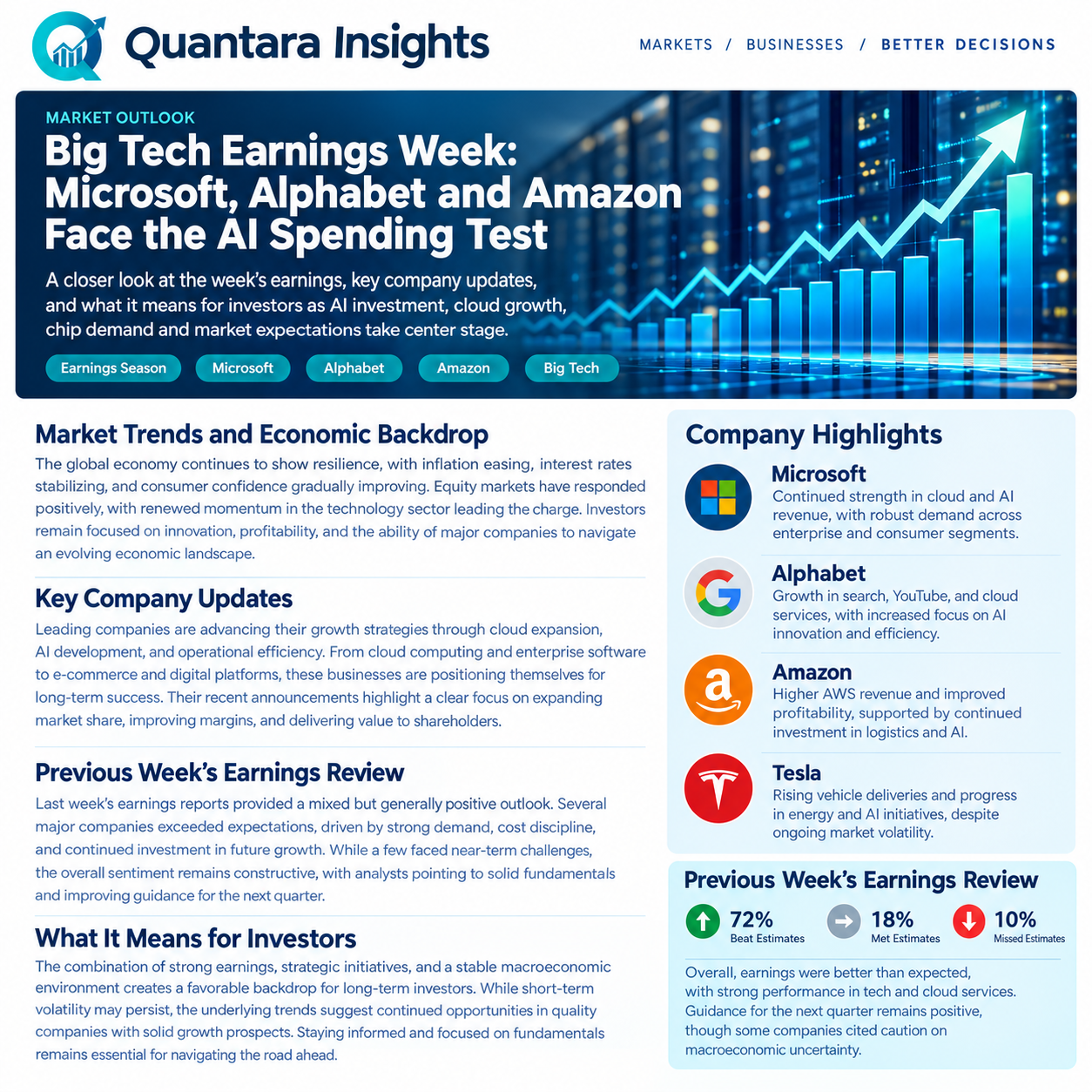
Earnings Season enters a critical phase as Microsoft, Alphabet and Amazon prepare to report results, placing artificial intelligence investment, cloud computing growth and corporate profitability at the center of the market’s attention. With major technology companies spending heavily to build data centers, expand computing capacity and develop new AI products, investors face a fundamental question: can the revenue generated by these investments justify their growing financial cost?
The week of October 26–30, 2026, brings an unusually broad collection of earnings catalysts. Alongside the major technology platforms, investors will be watching semiconductor manufacturers, storage companies, payment networks, financial technology businesses, energy producers, industrial manufacturers and consumer-facing brands. Taken together, these reports should provide a useful assessment of corporate demand, investment priorities and the financial pressures affecting different parts of the economy.
The central issue is not simply whether companies beat Wall Street’s earnings estimates. It is whether their results support the expectations already reflected in their share prices. A company can report higher revenue and stronger earnings than analysts anticipated and still experience a decline in its stock if management provides a disappointing outlook or signals that future profits will require substantially more investment.
That distinction is particularly important for Microsoft, Alphabet and Amazon. Each company operates a substantial cloud business, each is expanding its AI capabilities, and each must balance investment in future growth against the need to generate sustainable cash flow. Their businesses differ, however, in their exposure to advertising, enterprise software, online retail, cloud infrastructure and consumer spending.
The semiconductor sector offers another important perspective. Demand for AI computing requires processors, networking equipment, memory and storage infrastructure. Companies supplying these components may benefit from expanding data-center budgets, but their performance also depends on manufacturing capacity, product pricing, customer commitments and the timing of capital investment.
Outside technology, earnings from energy companies, industrial manufacturers and consumer businesses will help investors assess whether economic growth remains broad-based. Financial companies may offer insight into payment activity, borrowing demand and credit conditions, while restaurants and retailers can provide clues about household spending.
This Earnings Season is therefore about more than headline earnings surprises. Investors must assess the relationship between growth, investment, margins and cash generation. The companies best positioned to sustain their performance will need to demonstrate that spending today can support durable earnings tomorrow.
Earnings Season Puts Big Tech and the AI Investment Cycle in Focus
The technology sector has become one of the most important indicators of corporate investment in artificial intelligence. Large platforms are committing substantial resources to specialized chips, data centers, cloud capacity, networking systems and software development. Their decisions affect not only their own financial statements but also the businesses supplying the equipment and services required to build AI infrastructure.
Microsoft, Alphabet and Amazon occupy particularly important positions in this ecosystem. They provide cloud services to businesses, operate large digital platforms and invest in the computing resources needed to train and run increasingly sophisticated AI models. Their earnings reports can therefore reveal whether demand is keeping pace with the industry’s expanding infrastructure.
Why earnings expectations matter
Investors generally evaluate results against several benchmarks: reported revenue, earnings per share, previous guidance, analyst consensus and management’s outlook for future quarters. These measures are related, but they do not always tell the same story.
Revenue can rise quickly while operating expenses increase even faster. Earnings per share can exceed expectations because of tax effects, share repurchases or other items that do not necessarily indicate stronger underlying demand. Similarly, a company may report an earnings beat but reduce its forward guidance because management expects slower growth or higher costs.
For this reason, the quality of an earnings result matters alongside the headline numbers. Investors should examine organic demand, pricing, operating margins, cash conversion and the sustainability of the company’s guidance.
AI investment changes the profitability equation
Building AI infrastructure requires substantial upfront capital. Data centers need land, electricity, cooling systems, networking equipment, servers and specialized processors. These assets can generate revenue over several years, but their costs are incurred before the full economic benefit is necessarily visible.
Capital expenditure also affects financial statements differently from ordinary operating expenses. Equipment purchases generally require immediate cash outflows, while much of the accounting expense is recognized over time through depreciation. As a result, a business may report relatively strong operating earnings while free cash flow weakens because it is spending aggressively on infrastructure.
That distinction will be central to this week’s reports. Investors need to understand not only how much companies are investing but also how quickly those investments are expected to produce incremental revenue and profit.
What could change the market’s assessment?
Three developments deserve particular attention.
First, cloud growth must remain strong enough to support the investment plans of the largest providers. Second, AI products must demonstrate commercial value through paid subscriptions, higher customer spending, improved advertising performance or greater enterprise engagement. Third, management teams must explain how infrastructure investment will affect margins and cash flow over the next several quarters.
A strong report could reinforce confidence in the AI investment cycle. A weaker report may not necessarily mean that demand has disappeared, but it could lead investors to reconsider the speed at which spending will generate returns.
Microsoft Earnings Preview: Azure Growth Versus AI Infrastructure Costs
Microsoft enters this Earnings Season with attention focused on Azure, enterprise AI adoption, Copilot monetization and the financial implications of its expanding infrastructure commitments.
According to the estimates supplied for this analysis, Wall Street expects approximately $4.71 in earnings per share on revenue of $90.59 billion. Those figures should be checked against the latest published analyst consensus before publication, as estimates can change and different reporting services may use different methodologies.
The broader question is whether Microsoft can maintain strong cloud growth while funding the computing infrastructure needed to support rising AI demand.
Azure remains the principal growth indicator
Azure is central to Microsoft’s position in enterprise cloud computing. Businesses use the platform to run applications, store data, modernize IT systems and deploy AI-powered services. As companies experiment with generative AI and integrate it into operational workflows, demand for computing resources may expand.
However, cloud growth needs to be interpreted carefully. Increased demand does not automatically translate into proportionate increases in profit. The cost of serving AI workloads can vary significantly depending on the model, the amount of computing required, the customer’s usage pattern and the pricing structure of the service.
Investors should therefore look beyond Azure’s reported growth rate. Important considerations include capacity availability, customer commitments, consumption trends and the extent to which new AI workloads contribute to incremental revenue.
If Azure continues expanding at a healthy pace, it would support the argument that Microsoft’s infrastructure investments are meeting genuine customer demand. If growth slows while spending accelerates, investors may become more cautious about the timing of future returns.
Copilot and enterprise AI monetization
Microsoft’s AI opportunity extends beyond infrastructure. Copilot products are designed to bring AI assistance into productivity software, development tools, security systems and enterprise applications.
The commercial potential is considerable because Microsoft already has established relationships with businesses and access to a broad distribution network. AI features integrated into familiar software may be easier for customers to adopt than entirely new applications that require separate purchasing decisions and operational changes.
The important question is how much incremental revenue these products generate. Announcements about customer adoption or the number of available features are useful, but they do not necessarily establish the profitability of a product.

Investors should watch for evidence of paid-seat growth, higher subscription revenue, customer retention and expansion in enterprise contracts. They should also consider whether AI features create additional costs that offset part of the revenue benefit.
Copilot could strengthen Microsoft’s existing software franchise, but the financial contribution depends on pricing, adoption and the cost of delivering the service at scale.
Backlog and future revenue visibility
Large commercial commitments can provide an indication of future demand, especially in cloud infrastructure. Microsoft’s remaining performance obligations and related disclosures can help investors understand the scale of contracted business that has not yet been recognized as revenue.
However, backlog should not be treated as equivalent to immediate cash generation. The timing of revenue recognition depends on contract terms, service delivery, customer usage and other factors. Some commitments may extend over multiple years.
Investors should also consider whether Microsoft has sufficient computing capacity to fulfill those commitments efficiently. Strong demand can become a constraint if the company cannot bring new data-center capacity online quickly enough or secure the required hardware and power.
Capital expenditure and free cash flow
Microsoft’s AI infrastructure expansion creates a trade-off between long-term growth and near-term financial flexibility. Spending on data centers, servers and networking equipment can support future revenue, but it also increases cash requirements and may put pressure on free cash flow.
Investors should assess capital expenditure alongside operating cash flow, depreciation, margins and management’s investment outlook. A higher spending forecast is not automatically negative if it reflects strong demand and attractive returns. It becomes more concerning when the company cannot demonstrate that additional capacity is being used productively.
Microsoft also faces competition for enterprise technology budgets. Customers may be enthusiastic about AI while remaining selective about which projects receive funding. The company’s ability to translate experimentation into recurring, measurable business value will be important.
What investors should watch
The most useful signals from Microsoft’s report will be Azure growth, enterprise AI adoption, capacity constraints, capital expenditure and guidance for the next quarter.
Investors should also examine the performance of personal computing and gaming. These businesses have different demand drivers from cloud infrastructure and may respond differently to consumer confidence, hardware replacement cycles and product launches.
The central issue is whether Microsoft’s cloud and AI businesses can sustain growth while maintaining an attractive financial profile. Strong demand would be encouraging, but the quality of that growth will depend on profitability and cash generation as well as revenue.
Alphabet Earnings Preview: Google Cloud Growth and Search Resilience
Alphabet faces a different version of the AI investment challenge. Its business combines the advertising strength of Google Search and YouTube with Google Cloud, AI model development, consumer services and other technology initiatives.
The company’s report should help investors assess whether AI is strengthening its existing businesses quickly enough to justify the infrastructure required to compete in a rapidly changing technology market.
The estimates supplied for this article put expected earnings at approximately $2.94 per share. The associated revenue estimate should be verified against the latest company disclosures and current analyst consensus before publication.
Google Search remains a major earnings driver
Google Search remains a central component of Alphabet’s financial model. Advertisers pay to reach consumers who are actively looking for information, products and services, creating a business with substantial scale and established customer relationships.
AI introduces both opportunities and risks to that model. Better systems may improve the relevance of search results, help users find information more efficiently and support more useful advertising experiences. At the same time, AI-generated answers can change how users interact with search results and how many conventional advertising placements they encounter.
The long-term financial effect depends on user behavior, advertising formats, query volume and monetization. Investors should be cautious about assuming that greater AI usage will automatically lead to higher advertising revenue.
A key question is whether Alphabet can incorporate AI into Search while preserving the commercial value of the platform. Changes in engagement, advertising performance and monetization per query may provide more meaningful evidence than product announcements alone.
YouTube and the advertising market
YouTube provides Alphabet with exposure to video advertising, subscriptions and a broad creator ecosystem. Its performance is influenced by advertiser demand, audience engagement, content trends and competition from other video platforms.
Advertising businesses are sensitive to the economic environment. Companies may increase marketing budgets when sales prospects improve and reduce spending when economic uncertainty rises. As a result, advertising growth can reflect both platform-specific execution and broader business confidence.
Investors should examine whether advertiser demand remains resilient and whether improvements in targeting and measurement support pricing. They should also consider the balance between traditional advertising and subscription revenue.
Google Cloud and enterprise AI
Google Cloud is a major source of potential growth as organizations expand their use of data analytics, cloud applications and AI infrastructure.
The opportunity extends beyond renting computing resources. Customers may purchase AI development tools, managed databases, security products and services that connect their existing data to AI applications. These offerings can strengthen customer relationships and create recurring revenue streams.
The financial challenge is that infrastructure must often be deployed before demand reaches its full scale. Data centers, specialized processors and energy supplies require capital, while competition among cloud providers can influence pricing and margins.
Investors should look for evidence that Google Cloud is converting demand into profitable revenue. Revenue growth, operating margins, customer commitments and management’s explanation of capacity requirements are all relevant.
A large backlog may indicate demand visibility, but the timing and profitability of delivery remain important. Strong commitments are most valuable when they translate into revenue without requiring disproportionate spending or sacrificing pricing discipline.
Capital expenditure and cash flow
Alphabet’s investment plans are a major focus because the company must fund AI infrastructure while maintaining its established businesses.
Higher capital expenditure can be rational when the company expects sufficient future demand. Nevertheless, investors need to assess the implications for free cash flow, depreciation and returns on invested capital.
Another consideration is the availability of external computing capacity. When internal infrastructure is constrained, technology companies may rely on third-party providers or alternative arrangements. Those decisions can help meet customer demand but may also affect costs and operating flexibility.
Investors should ask whether Alphabet’s spending is creating an enduring competitive advantage, improving monetization or simply keeping pace with industry requirements.
The balance between innovation and financial discipline
Alphabet has the advantage of a substantial existing advertising business, extensive data resources and established technology infrastructure. Its challenge is to adapt to AI-driven changes without weakening the profitability of the services that fund its investment.
The earnings report should be assessed across several dimensions: Search monetization, YouTube advertising, Google Cloud growth, AI product adoption, operating margins and the outlook for capital spending.
A strong result would show that AI is supporting both the core business and new revenue opportunities. A more cautious outlook could raise questions about how long infrastructure investment will weigh on cash flow.
Amazon Earnings Preview: AWS, Retail Margins and Capital Spending
Amazon brings together several businesses with different financial characteristics. AWS provides cloud computing services, while the retail operation depends on consumer demand, logistics efficiency, marketplace activity and fulfillment costs. Advertising, subscriptions and other services add further sources of revenue.
For this Earnings Season, AWS and capital expenditure are likely to attract particular attention because of their connection to AI infrastructure.
The estimates supplied for this analysis indicate expected earnings of approximately $2.01 per share on revenue of $202.03 billion. These figures should be checked against the latest consensus and the company’s current reporting materials before publication.
AWS growth and cloud profitability
AWS is an important contributor to Amazon’s operating performance. Its customers range from start-ups to large corporations and public institutions that use cloud infrastructure for storage, computing, databases, analytics and AI workloads.
Demand for AI can increase consumption of computing resources, but the financial benefit depends on more than growth in usage. Amazon must manage hardware costs, energy requirements, infrastructure utilization and pricing while continuing to invest in new capacity.
Cloud margins are particularly important. A business can grow rapidly while generating disappointing returns if its costs rise faster than revenue. Conversely, efficient infrastructure utilization and a favorable service mix can improve profitability even when growth moderates.

Investors should examine AWS revenue growth, operating income, margins and management’s discussion of demand. They should also look for signs that AI workloads are adding to the existing cloud business rather than simply replacing other customer activity.
Custom chips and the AI infrastructure opportunity
Amazon’s custom silicon initiatives can help customers optimize certain workloads and provide the company with greater control over its computing infrastructure.
Specialized processors may offer advantages in performance, cost or energy efficiency for particular tasks. They also create opportunities for cloud providers to differentiate their services from competitors.
However, developing chips and integrating them into data centers requires significant investment. Product adoption, manufacturing capacity, software compatibility and customer demand all affect the economic outcome.
The key question is whether custom chips improve the overall value proposition for AWS and support profitable growth. Investor attention should focus on commercial adoption and financial contribution rather than technical specifications alone.
Retail performance and consumer demand
Amazon’s retail business provides a different perspective on the economy. Revenue depends on consumer spending, product availability, delivery performance and the company’s ability to manage fulfillment costs.
Consumers may continue purchasing essential products while becoming more selective about discretionary items. Changes in average selling prices, shipping costs and promotional activity can also influence revenue and margins.
Investors should consider whether retail growth reflects higher unit volumes, price changes, marketplace activity or a combination of factors. Operating efficiency matters because improvements in inventory management, logistics and delivery networks can increase profitability without requiring equivalent increases in revenue.
Advertising is another important component of Amazon’s model. The company can monetize shopping intent by allowing sellers and brands to reach consumers during product discovery. The growth of advertising may support margins, although performance depends on advertiser budgets and marketplace activity.
Capital expenditure and the cost of capacity
Amazon’s investment in AI infrastructure can support long-term growth, but the associated cash requirements deserve close attention.
Data centers require servers, networking equipment, electricity and cooling systems. Expanding capacity can also involve long-term commitments for facilities, power and related infrastructure.
Higher capital expenditure may temporarily reduce free cash flow even when operating performance remains healthy. Investors should therefore distinguish between investment that supports future demand and spending that is not yet producing adequate returns.
The relevant measures include operating cash flow, capital expenditure, free cash flow, debt requirements and management’s outlook. Rising investment is not necessarily a sign of financial weakness, but it increases the importance of execution and demand visibility.
What matters most in the report
Amazon’s earnings should be evaluated across AWS growth, cloud margins, retail operating efficiency, advertising performance and capital spending.
Investors should also consider whether the company’s guidance reflects genuine changes in demand or timing effects related to promotions and seasonal activity. A single quarter’s revenue growth rate may not fully represent the underlying trend.
The central question is whether Amazon can expand its cloud and AI capabilities while preserving financial flexibility. Strong AWS performance would support the growth narrative, but investors will also want evidence that infrastructure spending can translate into durable cash generation.
Semiconductor Earnings: Intel, SanDisk and Seagate
The semiconductor and data-storage industries provide a useful measure of the physical investment behind AI. AI systems depend on processors, networking hardware, memory and storage, making component suppliers important participants in the infrastructure cycle.
Yet not all semiconductor businesses benefit equally. Companies differ in product mix, manufacturing capabilities, pricing power, customer concentration and exposure to consumer electronics.
Intel: manufacturing execution and data-center demand
Intel’s investment case centers on its ability to improve execution, strengthen its manufacturing position and compete in data-center and AI-related markets.
The company faces several challenges. Semiconductor manufacturing is capital-intensive, product development requires long lead times, and customers expect reliable performance at competitive prices. Improvements in manufacturing technology must ultimately translate into commercially attractive products and stronger financial results.
Investors should examine revenue by business segment, gross margins, manufacturing yields, capital spending and the company’s ability to meet demand. Stronger data-center activity would be encouraging, but a sustainable recovery requires consistent execution across multiple quarters.
The personal-computing market also matters. PC replacement cycles and demand for new devices can affect processor sales, while changing product requirements may influence the competitive landscape.
Intel’s report should therefore be evaluated as both a recovery story and a test of capital discipline. Spending can create long-term opportunities, but the returns depend on product competitiveness and manufacturing performance.
SanDisk: storage demand and enterprise commitments
SanDisk provides exposure to flash memory and storage products used in consumer devices, enterprise systems and data-center applications.
AI workloads can increase demand for storage because organizations need to retain, retrieve and process large volumes of data. Enterprise customers may also seek predictable supply arrangements when planning large infrastructure projects.
Long-term contracts can improve demand visibility, but they do not eliminate commercial risk. Pricing terms, delivery schedules, customer concentration and the cost of producing storage products remain important.
Investors should review revenue growth, gross margins, inventory levels, supply commitments and management’s expectations for future demand. Consumer electronics may follow a different cycle from enterprise storage, so performance across those segments should be assessed separately.
The main question is whether stronger enterprise demand can support sustainable profitability without creating excessive dependence on a narrow group of customers or unusually favorable pricing conditions.
Seagate: data storage and infrastructure demand
Seagate’s position in data storage gives investors another way to evaluate the growth of data-intensive computing.
Large-scale cloud operations require substantial storage capacity, and the growth of AI applications may increase the volume of information businesses retain. However, demand can vary according to customer purchasing cycles, product transitions and infrastructure spending.
Storage companies are also exposed to supply-and-demand dynamics. Pricing can improve when industry capacity is constrained, but favorable conditions may encourage competitors to expand production, potentially changing the balance later.
Investors should watch shipments, average selling prices, gross margins, customer demand and management’s capacity plans. They should also consider the relationship between enterprise storage and consumer-device markets.
The wider semiconductor outlook
The semiconductor industry’s prospects depend on the sustainability of AI infrastructure investment. Strong demand from large cloud providers can benefit component suppliers, but the market should not assume that every company will experience equal growth.
Customers may change procurement schedules, suppliers may encounter manufacturing constraints, and rapid technological development can alter which products command premium pricing.
For investors, the most useful distinction is between temporary demand surges and durable improvements in product economics. Revenue growth is important, but margins, inventory discipline and customer commitments help determine whether that growth creates lasting value.
Financial Stocks: Visa, Mastercard, PayPal and SoFi
Financial services companies provide a different perspective on corporate earnings because their results are influenced by transaction activity, consumer spending, credit conditions and interest rates.
Visa and Mastercard operate payment networks, while PayPal focuses on digital payments and related services. SoFi combines lending with financial products and technology-driven customer acquisition. These businesses should not be assessed using identical criteria.
Visa and Mastercard: transaction volumes and spending patterns
Payment networks benefit from the movement of money through their systems. Their performance is influenced by transaction volumes, cross-border activity, consumer spending and the mix of payments processed.
Investors should examine whether spending growth remains broad-based and whether cross-border transactions continue to support revenue. They should also monitor operating expenses and regulatory developments that could affect pricing or competition.
These networks generally have different credit-risk exposures from lenders because their core business is facilitating payments rather than originating consumer loans. That distinction becomes particularly important when assessing the impact of higher interest rates or deteriorating credit conditions.
PayPal: engagement, competition and monetization
PayPal’s performance depends on transaction activity, merchant relationships, customer engagement and the economics of its payment services.
Competition is intense, with consumers and businesses able to choose among multiple digital payment providers. Growth in payment volume is useful, but investors also need to understand how much revenue and profit the company earns from that activity.
Relevant measures include transaction margins, active customer engagement, operating expenses and the contribution of higher-value services.
SoFi: growth, lending and funding costs
SoFi offers exposure to lending, financial services and a digital membership model. Its performance depends on customer acquisition, loan demand, credit quality and the cost of funding its operations.
Rapid revenue growth can be attractive, but lending businesses face risks that payment networks generally do not. Loan defaults, funding costs and changes in borrower demand can affect profitability.
Investors should review loan originations, delinquency trends, credit performance, deposit growth and management’s full-year guidance. Tax changes and interest-rate expectations may also influence reported earnings.
The broader lesson is that growth rates need to be interpreted within each company’s business model. Transaction networks, payment platforms and lenders face different economic risks, even when they all benefit from digital financial activity.
Energy and Industrials: Exxon, Chevron, BP, Caterpillar and GE Vernova
Energy and industrial companies provide useful information about commodity markets, capital investment and the condition of the broader economy.
Their earnings are affected by different variables, including oil prices, refining margins, equipment demand, project backlogs and the cost of financing major investments.
Exxon, Chevron and BP: commodity prices and capital discipline
Integrated energy companies generate revenue from activities that include production, refining, marketing and, in some cases, chemicals. Their performance depends on commodity prices as well as operating costs, production volumes and investment decisions.

Higher oil prices can improve upstream profitability, but the overall effect depends on each company’s asset mix and hedging arrangements. Refining operations may respond differently because their earnings depend partly on the spread between crude oil costs and refined-product prices.
Investors should assess production performance, realized prices, refining margins, capital expenditure and shareholder distributions. Management’s approach to debt, acquisitions and new projects can also influence financial resilience.
The key question is whether energy companies can generate attractive returns across different commodity-price environments rather than relying entirely on unusually favorable market conditions.
Caterpillar: industrial demand and infrastructure spending
Caterpillar’s results can provide insight into construction, mining, energy and industrial investment.
Demand for equipment depends on customer capital budgets, commodity prices, infrastructure projects and replacement cycles. Large order backlogs may provide visibility, but the timing of deliveries and the conversion of orders into revenue remain important.
Investors should review segment performance, equipment demand, pricing, inventory levels and management’s outlook. Changes in construction and mining activity can reveal broader trends in business confidence and capital investment.
GE Vernova: electricity infrastructure and power demand
GE Vernova operates in markets connected to electricity generation, grid equipment and energy infrastructure. Its results may help investors understand how utilities and industrial customers are responding to power demand, equipment requirements and investment plans.
The expansion of data centers creates additional interest in electricity supply and grid capacity. However, the relationship between AI investment and equipment revenue is not immediate. Projects depend on permitting, financing, construction schedules and the ability to secure necessary components.
Investors should examine orders, backlog quality, project execution, margins and cash conversion. Large orders can support future revenue, but execution risk and the timing of project completion remain important.
Consumer and High-Volatility Stocks: Chipotle, Starbucks, Whirlpool, Coinbase and Robinhood
Consumer companies and trading platforms offer a different set of indicators during Earnings Season. Restaurants and home-appliance manufacturers provide clues about household spending, while cryptocurrency and retail-brokerage businesses reflect financial-market participation and investor activity.
Chipotle and Starbucks: customer traffic and discretionary spending
Restaurant companies are affected by customer traffic, average transaction values, menu pricing, labor expenses and food costs.
Revenue can rise because more customers visit, because existing customers spend more, or because prices increase. Those drivers have different implications for the durability of growth.
Investors should examine comparable sales, traffic trends, average checks, operating margins and management’s commentary on consumer behavior. Higher menu prices may support revenue but can eventually influence customer frequency if budgets become constrained.
Starbucks faces similar questions about customer engagement, store operations and the balance between pricing and transaction volume. Its ability to improve service, manage costs and maintain customer loyalty can influence operating performance.
Whirlpool: housing and replacement demand
Whirlpool’s performance is connected to demand for major household appliances, which can be affected by housing turnover, consumer confidence, replacement cycles and financing costs.
When households delay moving or replacing appliances, demand can soften. Manufacturers may also face changes in raw-material costs, logistics expenses and competitive pricing.
Investors should monitor shipments, inventory, gross margins and management’s outlook for consumer demand. Cost control is important, but sustained improvement also depends on a healthier balance between supply and end-market demand.
Coinbase and Robinhood: trading activity and volatility
Coinbase and Robinhood have business models that expose them to changes in market participation and investor activity.
Coinbase’s performance is influenced by cryptocurrency trading, custody, subscription services and other products. Revenue can fluctuate substantially with asset prices, trading volumes and customer engagement.
Robinhood combines brokerage activity with additional financial products and services. Its results may be influenced by equity and options trading, cryptocurrency activity, interest-related revenue and customer assets.
Investors should examine transaction volumes, funded accounts, assets held on the platforms, recurring revenue and operating expenses. A period of high trading activity may generate strong results, but it does not guarantee the same level of activity in future quarters.
Options-implied volatility and short interest can help describe market positioning, but neither establishes whether a company will beat estimates or how its shares will react afterward.
Canon Earnings Preview: Expectations, Short Interest and Execution
Canon is scheduled in the supplied earnings calendar to report on October 27, 2026. Investors will be assessing demand across its imaging, printing and related businesses, along with the company’s ability to manage costs and maintain profitability.
The supplied analysis describes a mixed market setup: short interest has increased while the share price has moved higher from its previous post-earnings level. That divergence may indicate disagreement among market participants, but it does not independently predict the next price move.
Investors should prioritize reported revenue, earnings, operating margins, segment performance and management guidance. They should also consider currency movements, business investment trends and demand for imaging and office equipment.
The most useful conclusion will come from comparing operating performance with expectations, rather than treating short interest or recent share-price movements as substitutes for fundamental analysis.
Options Activity, Short Interest and Earnings Expectations
Options markets often become more active before major earnings announcements because investors seek to manage risk or express views about possible price movements.
Understanding these indicators can help investors interpret market expectations, but it is important not to confuse positioning with a reliable forecast.
What implied volatility tells investors
Implied volatility reflects the level of future price fluctuation embedded in options prices. Before an earnings report, it can rise because traders anticipate uncertainty around the company’s results and guidance.
An options-implied expected move is generally an estimate of the magnitude of potential movement over a specified period. It does not establish whether the stock is likely to rise or fall.
If options imply a larger move than a company’s historical average, that may indicate that traders expect an unusually uncertain event. It does not guarantee that the actual move will be larger.
Calls, puts and unusual trading volume
Call options provide exposure to potential upside, while put options provide exposure to potential downside or can be used to hedge an existing position. However, a large options transaction is not necessarily a straightforward directional bet.
The trade could form part of a spread, hedge, portfolio adjustment or multi-leg strategy. Publicly visible options volume alone rarely provides enough information to establish the trader’s full position.
Investors should therefore be cautious about interpreting a large call purchase as proof that a stock will rise or a put purchase as evidence that a decline is imminent.
Short interest and the potential for a squeeze
Short interest measures shares sold short and not yet covered. A rising figure may indicate greater bearish positioning, but it can also reflect hedging or other strategies.
A short squeeze can occur when rising prices force short sellers to buy shares to close their positions, adding further upward pressure. However, the existence of elevated short interest does not guarantee a squeeze.
The relevant context includes the size of short positions relative to trading volume, the availability of shares to borrow, liquidity and the company’s actual results.
Why an earnings beat may not lift a stock
Markets respond to the difference between results and expectations. If investors already anticipate exceptionally strong earnings, a modest beat may not be sufficient to support the share price.
Guidance can be even more important. A company may report strong quarterly revenue but indicate that growth will slow, margins will narrow or spending will increase.
Conversely, a company that reports a modest result but provides a stronger-than-expected outlook may attract investor interest.
The most reliable approach is to combine reported fundamentals, forward guidance, valuation and market positioning rather than relying on any single indicator.
Last Week’s Earnings Review: AI Investment Meets the Cost of Growth
The previous week’s earnings reports illustrated a central theme of the current market: strong growth can coexist with rising costs, significant investment requirements and uncertainty about future returns.
Technology businesses continued to pursue AI opportunities, while industrial and energy companies benefited from demand in their respective markets. Across sectors, investors had to distinguish between improving operating performance and one-time effects that can make quarterly results difficult to compare.
Meta: advertising strength alongside rising investment
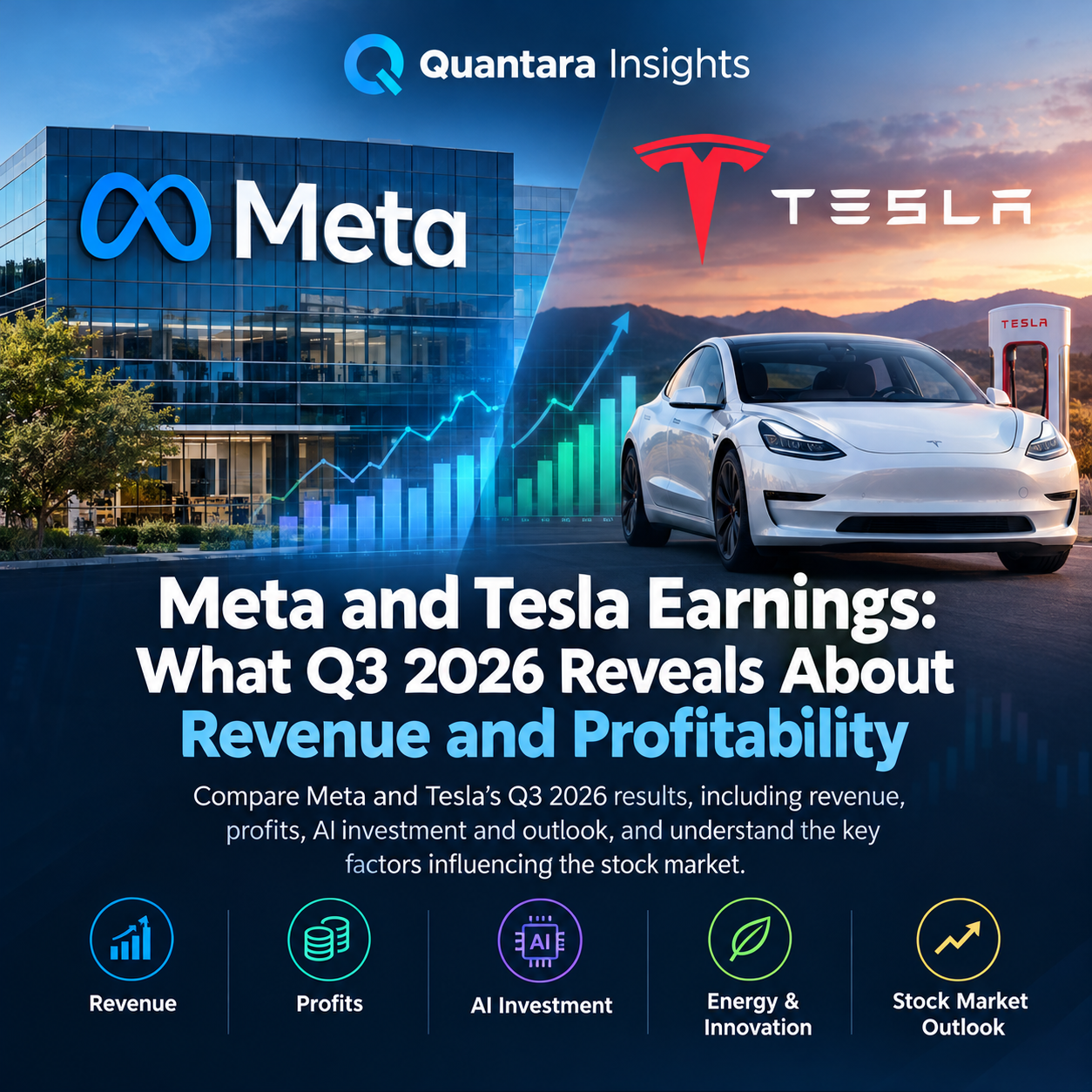
Meta’s third-quarter results provided a clear example of the difference between reported earnings and underlying operating performance.
The company reported revenue of approximately $64.6 billion, an increase of 26% from the year-earlier period. Advertising activity benefited from increased impressions and higher average advertising prices, supporting the view that Meta’s core commercial platform remained resilient.
However, reported operating income was affected by a substantial legal charge associated with an agreement involving U.S. state attorneys general. The company reported a significant reduction in operating margin, while free cash flow turned negative during the quarter.
Excluding the legal charge, the company’s operating performance would have looked materially different. Nevertheless, the cash-flow outcome and investment outlook remain important considerations.
Meta continues to invest in AI models, computing infrastructure and products designed to improve engagement and advertising performance. Its challenge is to demonstrate that those investments will produce durable commercial returns.
The report suggests that the core advertising business remains an important source of financial strength, but the cost and timing of AI investment deserve close monitoring.
Tesla: improved cash generation and execution risks
Tesla’s supplied earnings review emphasized stronger cash generation, improvements in profitability and continued development of autonomous-driving and robotics initiatives.
The company is attempting to broaden its business beyond conventional vehicle sales through software, energy products, autonomous mobility and robotics. These opportunities could create new revenue streams, but their commercial value depends on execution, customer adoption, regulation and the ability to scale production.
Investors should distinguish between products already generating meaningful revenue and initiatives that remain in development or early deployment. Demonstrations, production announcements and pilot programs can indicate progress without establishing the eventual size or profitability of a business.
Tesla’s financial performance should therefore be evaluated through vehicle demand, automotive margins, cash flow, energy operations and the capital requirements of its newer initiatives.
The broader lesson is that innovation can expand a company’s potential market, but investors still need evidence of sustainable economics.
Netflix: subscription resilience and advertising challenges
Netflix’s reported performance highlighted the strength of its subscription business alongside questions about the pace of advertising expansion and the effectiveness of its content strategy.
Subscriber retention, pricing and international engagement can support recurring revenue. However, content production remains expensive, and the performance of individual releases can influence viewing behavior and customer acquisition.
Advertising offers an additional source of revenue, but building an advertising business requires technology, sales relationships, measurement systems and a compelling offering for marketers.
Investors should consider both the size of the opportunity and the time needed to establish a profitable operation. Guidance, operating margins, subscriber engagement and content spending are important indicators of whether Netflix can sustain growth while improving its financial profile.
SpaceX: interpreting claims about private-company performance
SpaceX was included in the supplied review with detailed earnings and AI-computing figures. Those figures should not be presented as independently verified public-company earnings.
SpaceX is privately held, and its financial information is not disclosed in the same standardized quarterly format used by publicly listed companies. Without an identifiable, authoritative disclosure supporting the specific numbers, it would be inappropriate to treat the supplied earnings per share, revenue and profit figures as established facts.
The broader business themes remain relevant. SpaceX operates in launch services and satellite connectivity and has pursued ambitions in AI-related computing infrastructure. Those activities can require substantial capital and complex operational execution.
Any assessment of the company’s financial position should distinguish confirmed business developments from estimates, private-market reporting and speculation.
Bloom Energy: strong growth and the importance of cash conversion
Bloom Energy reported record third-quarter revenue of approximately $1.24 billion for the quarter ended September 30, 2026, representing growth of about 138% from a year earlier. The company also raised its full-year revenue guidance.
The result highlighted demand for its energy systems and the potential opportunity associated with expanding power requirements. Data centers and industrial customers need reliable electricity, creating interest in technologies that can support additional generation capacity.
However, rapid growth can require substantial investment in inventory, manufacturing capacity and customer delivery. Strong reported revenue does not necessarily translate immediately into equivalent free cash flow.
Investors should therefore assess backlog, margins, working capital, cash generation and the company’s ability to fulfill orders efficiently. Higher guidance is encouraging, but the financial quality of growth remains important.
Defense and industrial companies: backlogs and demand visibility
The supplied review highlighted Lockheed Martin and RTX, both of which operate in markets supported by defense procurement and long-term contracts.
Large order backlogs can provide visibility into future activity, particularly when customers commit to multiyear programs. However, backlog must be evaluated alongside delivery schedules, production capacity, contract economics and the possibility of delays.
Defense companies also face complex supply chains and manufacturing requirements. Strong demand does not remove the need for operational discipline or efficient execution.
For investors, the important questions include whether backlogs are converting into revenue, whether margins are improving and whether management can maintain delivery schedules.
Valero and the energy sector
Valero’s performance illustrates how refining margins and commodity-price relationships can influence energy earnings.
Refiners do not benefit uniformly from rising crude prices. Their profitability depends partly on the difference between the cost of crude oil and the prices received for refined products, as well as utilization rates and operating costs.
Supply disruptions can widen or narrow those margins, creating substantial changes in earnings even when underlying demand is relatively stable.
Investors should therefore avoid treating a higher oil price as automatically positive for every energy business. Production companies, refiners and integrated energy groups have different exposures.
Capital One: credit quality and integration
Capital One’s performance offers a different perspective on growth and risk. Financial institutions are affected by lending volumes, interest income, funding costs, credit losses and the operational demands of integrating acquired businesses.
A major acquisition may create opportunities to improve scale and diversify revenue, but integration can also introduce expenses and execution risks.
Investors should focus on credit quality, delinquency trends, funding costs, capital adequacy and management’s progress toward anticipated operating benefits. Changes in reported earnings should be assessed alongside the underlying health of the loan portfolio.
Procter & Gamble: costs and pricing pressure
Procter & Gamble illustrates the challenge facing consumer-product companies when input costs rise while customers remain sensitive to prices.
Strong demand and pricing power can support revenue, but higher freight, fuel, packaging and manufacturing expenses may reduce margins. Companies must decide how much of the additional cost to absorb and how much to pass on to customers.
The result depends on brand strength, competitive conditions and consumer behavior. Repeated price increases can eventually affect volume, while absorbing costs can constrain profitability.
Investors should monitor organic sales growth, pricing, volume trends, margins and guidance to understand whether the company can maintain growth without weakening customer demand.
General Motors: capital returns and commodity exposure
General Motors’ supplied review highlighted changes to its profit outlook, a substantial buyback plan and sensitivity to commodity costs.
Share repurchases can return capital to shareholders, but they do not replace the need for strong underlying business performance. Their value depends on the price paid for shares, the company’s financial flexibility and the investment opportunities available to the business.
Automakers must also manage production costs, inventory, vehicle pricing and the financial demands of developing new technologies. Changes in commodity prices can influence profitability, particularly when manufacturers cannot immediately pass higher costs on to customers.
The central issue is whether operational performance supports the company’s capital-allocation plans over time.
The common lesson from last week
The previous week’s reports reinforce three important principles.
First, strong revenue growth does not always produce stronger free cash flow. Second, large backlogs and ambitious investment plans must eventually translate into delivery, profitability and cash generation. Third, one-time charges and unusual market conditions can distort comparisons between quarters.
These lessons provide the appropriate context for the coming reports from Microsoft, Alphabet and Amazon. Investors should assess AI investment against measurable financial outcomes rather than assuming that every increase in computing demand will create equivalent shareholder value.
What Investors Should Watch During the Week Ahead
The coming Earnings Season reports will provide multiple opportunities to test market expectations against actual financial performance. Investors should prioritize a consistent set of indicators rather than reacting to isolated headlines.
Revenue and earnings relative to expectations
The first step is to compare reported revenue and earnings per share with the latest analyst consensus. Investors should also distinguish between GAAP and adjusted results, because adjustments can materially change the interpretation of profitability.
A reported beat is useful information, but it is not a complete assessment of business performance. The size and composition of the surprise matter, as does the outlook provided by management.
Cloud growth and AI monetization
For Microsoft, Alphabet and Amazon, investors should examine the rate of cloud growth and the evidence that AI is generating additional revenue.
Relevant indicators include customer adoption, paid usage, backlog, product monetization and the financial contribution of AI-related services. Companies should ideally explain how demand is developing and how they plan to meet it.
Capital expenditure, margins and free cash flow
Capital expenditure is one of the most important themes across the technology sector.
Investors should compare spending plans with operating cash flow, free cash flow and management’s expectations for future returns. Higher investment may be appropriate when demand is strong, but the scale and timing of the spending must remain economically justified.
Margins can also reveal whether growth is becoming more or less expensive to achieve. A company that expands revenue while maintaining healthy margins may be in a stronger position than one that depends on progressively higher spending to sustain growth.
Forward guidance and management commentary
Management guidance often has a greater influence on share prices than the results of a single quarter.
Investors should pay attention to changes in revenue expectations, operating expenses, capital expenditure, demand assumptions and the timing of new products or capacity.
The explanations behind those changes are equally important. A higher spending forecast associated with firm customer commitments may be interpreted differently from an increase caused by delays, inefficiencies or unexpected cost pressures.
Consumer demand, energy and industrial activity
Reports from consumer businesses can help investors assess household spending and pricing sensitivity. Financial companies can provide insight into payment volumes, borrowing demand and credit quality.
Energy and industrial companies offer a view of commodity markets, infrastructure investment and business confidence. These reports may reveal whether growth is concentrated in a few technology businesses or supported by a broader range of industries.
Valuation and market expectations
Even a strong company can be a disappointing investment if its valuation already assumes an exceptionally optimistic outcome.
Investors should consider earnings multiples, expected growth, cash generation and the range of possible outcomes. A high valuation may leave less room for execution errors or a moderation in growth.
Conversely, a lower valuation does not automatically make a stock attractive if its earnings prospects are deteriorating.
The goal is to understand what the market expects and whether the available evidence supports those expectations.
Earnings Season Outlook: Growth Must Translate Into Returns
This week’s reports put the relationship between AI investment and financial performance into focus. Microsoft, Alphabet and Amazon have the scale, customer relationships and infrastructure to benefit from expanding demand for cloud computing and AI services. However, their long-term performance will depend on how effectively they convert that opportunity into sustainable revenue, margins and cash flow.
The semiconductor and storage sectors offer a complementary perspective. AI systems require substantial physical infrastructure, creating opportunities for suppliers of processors, memory and storage. Those opportunities remain subject to manufacturing constraints, pricing, product cycles and the ability of customers to sustain their investment plans.
Financial services, energy, industrial and consumer companies will provide additional insight into the health of the broader economy. Their reports may reveal whether spending remains resilient, whether businesses are managing costs effectively and whether consumers continue to support discretionary purchases.
The previous week’s earnings review demonstrated why investors need to look beyond headline growth. Legal charges, capital spending, commodity costs and changes in customer demand can all influence reported performance. A strong quarterly result may be encouraging, but its significance depends on the underlying business trends and the outlook for future periods.
The most useful approach is to assess each company against its own operating model. Cloud providers should be judged on growth, margins and infrastructure returns. Semiconductor suppliers should be assessed on demand, pricing and execution. Financial institutions require close attention to credit quality and funding costs, while consumer businesses must demonstrate that sales growth can be sustained without damaging profitability.
Ultimately, this Earnings Season is a test of financial discipline as much as a test of growth. The companies that provide credible evidence of customer demand, efficient execution and sustainable cash generation will offer investors a clearer basis for evaluating their long-term prospects.
For market participants, the coming week is an opportunity to separate expectations from evidence. The most important question is not simply which companies report the largest earnings surprises, but which businesses demonstrate that their investments are creating durable economic value.
Editorial Note
This article is intended for general informational and educational purposes and does not constitute individualized investment advice or a recommendation to buy or sell any security. Earnings estimates, forecasts, options activity and market expectations can change, and historical performance does not guarantee future results. Readers should verify financial figures against current company disclosures and consider their own circumstances and risk tolerance before making investment decisions. Figures not supported by verifiable disclosures should be treated as unconfirmed rather than established results.