









Table of Contents
- Economic Report: The Five Themes That Matter Most
- Monday: Bessent, Iran Sanctions and the Global Economic Backdrop
- Tuesday: RBA Minutes and European Economic Data
- Wednesday: PCE Becomes the Main U.S. Economic Report
- Nvidia Earnings: Important, but Secondary to the Macro Story
- Thursday: Jackson Hole Begins as Global Central Banks Remain in Focus
- Bank of Korea: Another Rate Decision in Focus
- Friday: BLS Revisions Become a Key Labour-Market Test
- Tokyo CPI and the Bank of Japan
- The Week in Review: What Last Week’s Data Told Us
- Economic Report: What Markets Should Watch Across Assets
- Three Scenarios for the Week Ahead
- Why the Sequencing of This Economic Report Matters
- Key Takeaways for 24–28 August 2026
- Frequently Asked Questions
- What is the most important economic report this week?
- Why is PCE important to the Federal Reserve?
- What are BLS revisions?
- Will the August BLS revision immediately change payroll figures?
- Why does Jackson Hole matter for markets?
- When is Kevin Warsh speaking at Jackson Hole?
- What could the PCE report mean for the September Fed meeting?
- What does the BLS benchmark revision tell investors?
- Why are Nvidia earnings being watched this week?
- Conclusion
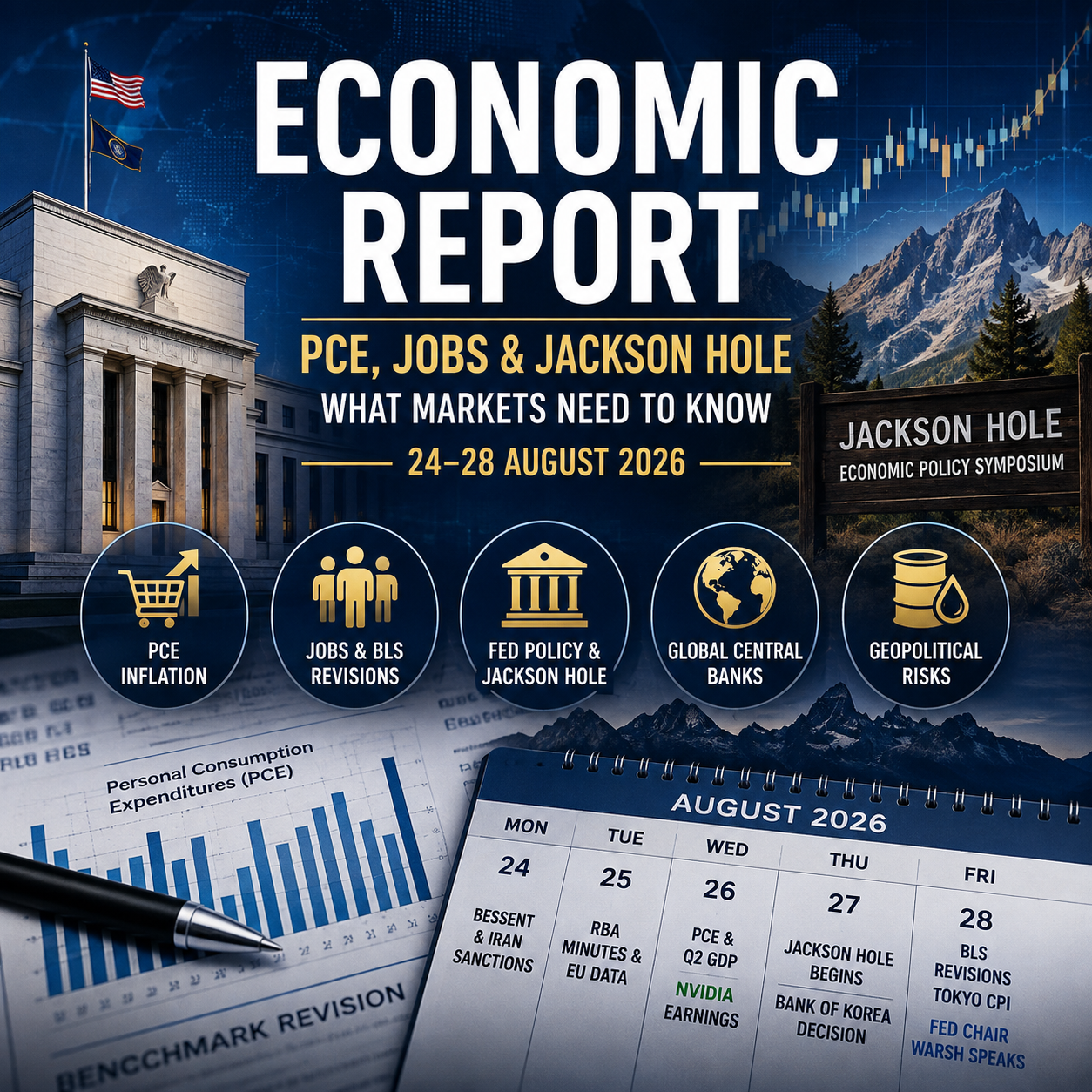
Economic Report: The week of 24–28 August 2026 brings a dense run of inflation, growth, labour-market and central-bank developments, with U.S. PCE inflation, the preliminary BLS benchmark revisions and the Jackson Hole Economic Policy Symposium likely to provide the clearest signals for markets heading into September.
The sequencing is important. The week begins with geopolitical and regional economic developments before moving into Australia’s inflation data and the U.S. PCE report on Wednesday. The U.S. second estimate of Q2 GDP arrives at the same time, while Nvidia earnings provide an important but secondary event for technology markets. The focus then turns increasingly toward central banks, culminating in Federal Reserve Chair Kevin Warsh’s keynote remarks at Jackson Hole on Friday.
The Economic Report calendar is therefore less about any single release and more about how the information fits together. Inflation data will help shape expectations for the Federal Reserve, while the preliminary BLS revisions could influence the assessment of labour-market strength. Jackson Hole then provides the first major opportunity for Warsh to frame the policy outlook before the September FOMC meeting.
The Bureau of Labor Statistics has confirmed that the preliminary national benchmark revision to March 2026 establishment-survey employment data will be published on Friday, August 28, alongside first-quarter 2026 QCEW data. The preliminary benchmark will not immediately alter the official establishment-survey estimates; the final revision is scheduled for the February 2027 Employment Situation release.
That distinction matters. Markets can react to the information contained in the preliminary estimate even though the official payroll series remains unchanged in the short term.
Against that backdrop, this Economic Report examines the major events scheduled for 24–28 August, the most important themes from the previous week and the potential implications for rates, bonds, currencies and equities.
Economic Report: The Five Themes That Matter Most
There are five broad themes running through the week.
First, PCE inflation will provide another important test of the U.S. inflation trajectory. Markets will be looking beyond the headline number toward core PCE, the monthly pace of price growth and whether the data reinforces or challenges current expectations for Federal Reserve policy.
Second, BLS revisions will provide another assessment of the labour market. The preliminary benchmark revision is particularly relevant because the Federal Reserve has been balancing concerns about inflation against a labour market that has shown signs of cooling.
Third, Jackson Hole will provide the week’s most important central-bank communication event. Warsh’s keynote on August 28 is scheduled as part of the 2026 Jackson Hole Economic Policy Symposium.
Fourth, international central banks remain in focus. The RBA, Bank of Korea and Bank of Japan all face different combinations of inflation, growth and financial-market pressures.
Fifth, geopolitical risk remains an important variable. Treasury Secretary Scott Bessent’s comments on Iran and sanctions could affect energy markets, trade flows and inflation expectations.
Nvidia earnings are also scheduled for Wednesday and will be closely followed because of the company’s influence on the technology sector and AI investment cycle. However, for this Economic Report, Nvidia remains a secondary event rather than the central theme.
The key question for investors is therefore straightforward: Will this week’s data reinforce the current expectation that the Federal Reserve can remain patient, or will inflation and labour-market information reopen the debate over the direction of U.S. monetary policy?
Monday: Bessent, Iran Sanctions and the Global Economic Backdrop
The week begins with attention on U.S. Treasury Secretary Scott Bessent and his expected update on Iran.
The economic significance extends beyond sanctions policy itself. Any escalation in economic restrictions has the potential to affect oil flows, shipping, insurance costs and the discount applied to sanctioned crude. That creates a connection between geopolitical developments and the inflation outlook.
The central issue is the extent to which the United States seeks to increase pressure not only on Iran but also on third-country buyers and intermediaries. China is particularly important because of its role in Iranian oil demand.
For markets, the most relevant transmission mechanism is likely to be energy rather than direct trade disruption. A meaningful increase in restrictions could tighten effective oil-market conditions even if headline global supply does not immediately change.

That matters because central banks remain highly sensitive to the possibility that higher energy costs could slow the progress of disinflation.
The Iran issue therefore sits in the background of the entire week’s Economic Report. If oil prices remain elevated, investors may become more cautious about interpreting short-term improvements in inflation data as evidence of a durable return toward central-bank targets.
Monday also brings Mexican inflation data and the Chicago Fed National Activity Index. Neither is likely to dominate global markets, but the Chicago Fed release will offer another indication of U.S. economic momentum.
The broader message at the beginning of the week is one of continued uncertainty. Markets enter the week with inflation, growth, labour-market conditions and geopolitical risk all competing for attention.
Tuesday: RBA Minutes and European Economic Data
Tuesday’s focus shifts toward Australia and Europe.
The Reserve Bank of Australia will publish the minutes from its August meeting, when it kept the cash rate unchanged at 4.35%.
The minutes should provide additional detail on how policymakers assessed the balance between persistent inflation and tighter financial conditions.
The RBA has remained concerned that inflation is still too high and that upside risks have not disappeared. At the same time, the tightening already delivered has made financial conditions more restrictive.
That creates an increasingly important question for Australian markets: how much additional tightening would be required if inflation remains above target, and how much weight should policymakers place on signs of softer domestic activity?
Australian inflation data due Wednesday will be more immediately important for that question, but the minutes can provide useful context for how the Bank views the risks.
The European calendar is also active.
Final German Q2 GDP data and the August Ifo expectations survey will provide additional information on the condition of Europe’s largest economy. Germany remains particularly important to the broader euro-area outlook because weak manufacturing activity and softer domestic demand have created a difficult environment for policymakers.
The U.S. calendar includes the house price index and Richmond Fed manufacturing index. These are not likely to have the same market impact as Wednesday’s PCE release, but they contribute to the wider assessment of U.S. growth.
Wednesday: PCE Becomes the Main U.S. Economic Report
Wednesday is the centre of the week’s U.S. economic calendar.
The July Personal Consumption Expenditures price index, or PCE, is scheduled alongside the second estimate of Q2 GDP.
PCE matters because it is the Federal Reserve’s preferred inflation gauge. Investors will therefore look at the data not simply as another inflation report but as an input into the debate over the future path of monetary policy.
The headline measure is expected to rise 0.1% month on month, while core PCE is expected to increase around 0.2% month on month. The annual core rate is expected to remain around 3.3%.
Those numbers would suggest continued disinflationary progress compared with earlier peaks, but not a complete return to the Federal Reserve’s 2% inflation objective.
The monthly rate is particularly important.
A 0.2% monthly increase in core PCE is not consistent with an immediate return to 2% annual inflation, but it is also not necessarily evidence of a renewed inflation shock. Markets will therefore assess the number in context, including the composition of price changes and how it compares with CPI and PPI.
Why PCE Matters for the Federal Reserve
PCE is particularly important because the Federal Reserve evaluates a broad range of inflation information rather than focusing exclusively on consumer prices measured through the CPI.
The PCE measure captures changes in consumer spending patterns and has a different weighting structure from CPI. Core PCE excludes food and energy and is therefore closely watched as a measure of underlying inflation pressure.
For markets, the question is not simply whether PCE rises or falls.
The more important questions are:
- Is core inflation slowing?
- Is the monthly pace consistent with continued disinflation?
- Are services prices still sticky?
- Are goods prices contributing to the improvement?
- Does the data alter expectations for the September FOMC meeting?
- Does it strengthen or weaken the argument for maintaining the current policy stance?
A result close to expectations could therefore produce a relatively muted reaction.
A meaningful surprise, however, could affect Treasury yields, the U.S. dollar and interest-rate expectations.
PCE, CPI and PPI: Reading the Inflation Picture Together
The recent inflation sequence provides useful context.
July CPI showed a relatively moderate monthly increase, while PPI also failed to deliver the upside surprise that some investors had feared. That has helped reduce some of the immediate pressure on the Federal Reserve.
PCE will test whether the same pattern appears in the Federal Reserve’s preferred measure.
If core PCE confirms the moderation already visible in CPI and PPI, markets could become more comfortable with the idea that inflation is gradually moving lower.
If PCE is materially firmer, the interpretation becomes more complicated.
A stronger result would not automatically imply a rate increase. The Federal Reserve considers a broad set of information, including employment, economic activity, financial conditions and inflation expectations.
Nevertheless, a firm PCE number would make it harder for markets to assume that policy can quickly become more accommodative.
U.S. GDP Revision Adds a Growth Dimension
The second estimate of Q2 GDP will arrive alongside PCE.
This provides an important counterweight to the inflation data.
The Fed’s policy problem is not simply inflation. It is the interaction between inflation and economic activity.
If GDP is revised higher while PCE remains firm, the case for maintaining restrictive policy becomes stronger.
If GDP is revised lower while PCE remains subdued, investors may become more confident that the Fed can afford to take a patient approach to inflation without unnecessarily weakening economic activity.
The combination of the two releases is therefore more important than either number in isolation.
A softer growth profile with moderate inflation would be a more dovish combination.
Resilient growth alongside sticky inflation would be more hawkish.
A mixed outcome would likely leave the market waiting for Jackson Hole.
Nvidia Earnings: Important, but Secondary to the Macro Story
Nvidia earnings arrive on Wednesday and will receive significant market attention.
The company remains one of the most important indicators for the AI investment cycle, and its results can influence semiconductor stocks, technology valuations and expectations for capital expenditure among major technology companies.
The key issues are likely to include revenue growth, guidance, gross margins and the durability of demand for its latest data-centre products.
However, Nvidia is not the central focus of this Economic Report. More On Nvidia here.
The more important macroeconomic question is how equity valuations respond to interest-rate expectations. A strong Nvidia result can support technology stocks, but higher bond yields can offset some of that support.
For that reason, investors should consider the earnings announcement alongside PCE and Jackson Hole rather than viewing it in isolation.
Thursday: Jackson Hole Begins as Global Central Banks Remain in Focus
The Jackson Hole Economic Policy Symposium begins on Thursday and runs through Saturday.
The Federal Reserve’s annual gathering has historically attracted considerable attention because major central-bank officials use the event to discuss economic and monetary-policy themes.
This year, the focus is particularly strong because Kevin Warsh will deliver the keynote remarks on Friday.
The Federal Reserve’s official calendar confirms that Warsh is scheduled to give keynote remarks at the 2026 Jackson Hole Economic Policy Symposium on August 28.
The significance of the speech lies partly in the uncertainty surrounding the Fed’s reaction function.
Markets want to know how policymakers are interpreting the recent combination of cooling labour-market data, moderating inflation and still-elevated price pressures.
Warsh’s communication style also matters.
If the Fed chair avoids detailed forward guidance, markets may be left to infer the policy path from the data itself.
That could increase the importance of every major economic release.
Why Jackson Hole Matters for Markets
Jackson Hole matters because central-bank communication can influence expectations even when no policy decision is being announced.
A speech does not change the federal funds rate.
It can, however, change expectations about where rates could go next.
That distinction is important for financial markets because asset prices are influenced by expected future interest rates as well as current policy.
If Warsh sounds comfortable with the current policy stance and stresses continued progress on inflation, Treasury yields could respond positively if investors interpret the comments as reducing the probability of an imminent policy tightening.
If he places greater emphasis on inflation risks, markets could reassess the likelihood of higher rates for longer.
The key is unlikely to be one isolated sentence.
Investors will listen for the balance between inflation, employment, economic growth and financial conditions.
Jackson Hole and September Fed Expectations
The September FOMC meeting is the next major policy decision after Jackson Hole.
That makes the symposium particularly important.
The PCE release, GDP revision and BLS benchmark data will arrive before Warsh’s speech. The sequence means the chair will have the benefit of several fresh economic signals when he speaks.
Markets may therefore interpret the speech through the lens of the data already released.
If the week’s information is consistently soft, a neutral speech could still be interpreted as relatively dovish.
If the data are firm, the same language could be viewed as hawkish.
This is why the sequencing matters.
The Economic Report is not simply a list of events. It is a chain in which each release changes the context for the next one.
Bank of Korea: Another Rate Decision in Focus
The Bank of Korea will also announce its latest policy decision.
There has been speculation around another 25-basis-point increase, which would take the seven-day repo rate to 3.00% from 2.75%.
The decision is complicated by the interaction between inflation, currency movements, growth and geopolitical uncertainty.
The Korean economy remains exposed to global technology demand, trade conditions and financial-market volatility. At the same time, inflation pressures and exchange-rate developments can limit the scope for the central bank to ease policy quickly.
The tone of the statement may be almost as important as the decision itself.
If the Bank signals that further tightening remains possible, the Korean won and local bond markets could respond.
If policymakers emphasise caution and flexibility, markets may reduce expectations for additional increases.
This is another example of the broader global theme: central banks are increasingly dealing with different domestic conditions while facing the same external risks.
Friday: BLS Revisions Become a Key Labour-Market Test
Friday brings one of the most technically important releases of the week: the preliminary annual benchmark revision to the U.S. establishment survey.
The BLS has scheduled the preliminary national benchmark revision for August 28 at 10:00 a.m. Eastern Time. The release will coincide with first-quarter 2026 QCEW data.
What Are BLS Revisions?
BLS revisions are adjustments to employment estimates that help align the Current Employment Statistics survey with more comprehensive employment information.
The regular monthly payroll report is based on a survey of employers.
The benchmark process compares those sample-based estimates with more comprehensive counts from the Quarterly Census of Employment and Wages.
The BLS explains that QCEW data are derived from unemployment-insurance records and provide a much broader employment universe than the monthly sample survey.
The benchmark revision therefore serves an important statistical purpose.
It helps ensure that the payroll series remains anchored to a more comprehensive measure of employment.
Why the BLS Revisions Matter to Markets
The preliminary benchmark revision will not immediately rewrite the official payroll data.
The BLS explicitly states that official establishment-survey estimates are not updated based on the preliminary benchmark revision. The final revision will be incorporated into the January 2027 Employment Situation release, scheduled for February 2027.
But the absence of an immediate mechanical change does not mean the information is irrelevant.
Markets are forward-looking.
If the preliminary benchmark indicates that employment has been materially overestimated, investors could reassess the perceived strength of the labour market immediately.
That could influence expectations for Federal Reserve policy even though the official historical payroll series remains unchanged until the final revision.
This is the important distinction between mechanical impact and narrative impact.
The mechanical impact is delayed.
The narrative impact can be immediate.
BLS Revisions and the Federal Reserve
The labour market is one of the most important inputs into monetary policy.
If the economy is creating jobs at a healthy pace and unemployment remains low, policymakers have greater scope to concentrate on inflation.
If employment growth is materially weaker than previously thought, the policy balance changes.
A weaker labour market could make the Fed more cautious about maintaining restrictive policy for too long.
That is why the BLS revisions deserve attention even if the headline number does not directly alter the official payroll series.
The key question is whether the preliminary revision changes the market’s understanding of the underlying employment trend.
Tokyo CPI and the Bank of Japan
Tokyo CPI will provide another important inflation signal on Friday.
The Tokyo data are closely followed because they arrive ahead of the national CPI figures and provide an indication of underlying price pressure in Japan.
Headline inflation is expected to remain around the 2% area, while the core measure is also expected to remain near that level.
Markets will focus particularly on services inflation.
Services prices are important because they can provide evidence of more persistent domestic inflation rather than temporary movements caused by energy or imported goods.
If services inflation remains firm alongside stronger wages, expectations for further Bank of Japan normalisation could strengthen.
The Japanese yen will remain an important transmission mechanism.
Higher expectations for Japanese rates can support the yen, while weaker inflation or dovish communication can reduce those expectations.
The BoJ therefore provides another example of how inflation data can translate into currency and bond-market moves.
The Week in Review: What Last Week’s Data Told Us
The previous week provided several important signals about the global economy.
Japanese Q2 GDP expanded at an annualised 1.1%, below the expected 2.0%, but the economy still recorded a third consecutive quarter of growth.
The composition was important. Domestic demand remained subdued, while exports, including semiconductor-related shipments, provided support.
The GDP miss therefore complicates the Bank of Japan’s outlook rather than necessarily eliminating the possibility of further tightening.
China’s July activity data were more concerning.
Industrial production rose 4.5% year on year, below expectations, while retail sales increased only 0.6%. Fixed-asset investment also weakened, and property investment remained particularly soft.
The data reinforced concerns over domestic demand and the continued reliance of China’s economy on exports.
For global markets, China’s performance matters because weaker domestic demand can affect commodities, Asian currencies, European exporters and global manufacturing expectations.
Canadian Inflation
Canadian inflation came in somewhat firmer than expected.
Headline CPI increased 3.0% year on year in July, while core measures also accelerated.
Gasoline prices were an important contributor, reflecting the impact of energy-market disruption.
The Bank of Canada therefore faces a complicated environment in which some inflation pressures may be temporary while underlying economic slack continues to argue for caution.

The important distinction is between headline inflation driven by volatile components and persistent underlying inflation.
UK Labour Market
The UK labour-market report presented a mixed picture.
Headline wage growth remained relatively strong, but the public-private split was significant, with public-sector pay growth considerably higher than private-sector growth.
The claimant count declined unexpectedly, while unemployment remained at 4.9%.
The data did not fundamentally change the Bank of England’s outlook.
Instead, it reinforced the case for a cautious approach in which policymakers balance persistent wage pressures against evidence that labour-market conditions are gradually cooling.
UK Inflation
UK inflation rose to 2.9% year on year, while core inflation remained at 2.6%.
The increase was influenced by regulated-price effects, particularly the energy price cap.
Services inflation moderated, which provided some relief for the Bank of England.
The broader interpretation was therefore less alarming than the headline number suggested.
The question for policymakers is whether inflation pressures continue to ease once temporary influences fade.
FOMC Minutes
The July FOMC Minutes provided little that dramatically changed the policy picture.
Most participants supported leaving rates unchanged, while several preferred an increase.
The presence of hawkish dissenters was already known.
More important for markets was the fact that subsequent economic data have shifted expectations.
The Minutes represented the Fed’s thinking at the time of the meeting.
The PCE report, BLS revisions and Jackson Hole remarks will provide newer information.
That is why markets can largely move beyond the Minutes when fresh data point in a different direction.
Riksbank and PBoC
The Riksbank maintained its policy rate at 1.75%, leaving the possibility of future tightening open if inflation remains elevated.
At the same time, weaker labour-market developments provided a counterweight.
China’s central bank also maintained its one-year and five-year loan prime rates.
The lack of immediate monetary easing despite weaker activity data highlighted the limitations facing policymakers, including pressure on bank margins and the preference for fiscal support.
Japanese Trade and Inflation
Japan’s trade deficit widened as imports increased strongly, but exports also performed well, particularly in technology-related areas.
Japanese CPI accelerated in July, reinforcing the argument that inflation remains sufficiently firm to keep policy normalisation on the agenda.
The combination of weaker GDP and stronger inflation creates a difficult policy balance for the BoJ.
Australia Employment
Australian employment unexpectedly declined in July, while unemployment increased to 4.5%.
The decline was concentrated in part-time employment, while full-time employment increased.
That distinction prevented the report from being interpreted as an outright collapse in labour-market conditions.
Nevertheless, the softer headline reduced pressure for immediate additional tightening and made the upcoming RBA minutes and CPI release more important.
European and UK PMIs
Eurozone activity indicators were stronger than expected, with manufacturing and composite measures moving further into expansionary territory.
AI-related demand and defence spending were among the areas supporting activity.
However, the regional picture remained uneven, particularly in Germany and France.
The UK PMI data were stronger in services and composite activity, while manufacturing expansion moderated.
The overall message was one of continued resilience rather than a clear acceleration.
Economic Report: What Markets Should Watch Across Assets
The week’s data will affect different asset classes through different channels.
Bonds
Treasury yields are likely to remain highly sensitive to PCE, GDP, BLS revisions and Jackson Hole.
A combination of firm inflation and resilient growth could push yields higher.
A combination of weaker inflation and softer employment information could have the opposite effect.
The reaction to Jackson Hole will depend heavily on what has already been priced by Friday.
The U.S. Dollar
The dollar remains closely linked to relative interest-rate expectations.
A more hawkish interpretation of PCE or Jackson Hole could support the dollar.
A more dovish interpretation could weaken it.
The dollar may also react to developments in Japan, Australia and South Korea as markets reassess the relative paths of global monetary policy.
Equities
Equity markets face a two-sided influence.
Lower yields can support valuations, particularly in growth stocks.
But lower yields resulting from evidence of weaker economic activity can also create concerns about earnings.
That is why the composition of the data matters.
A soft inflation report combined with stable growth would arguably be more constructive for equities than a soft inflation report accompanied by a sharp deterioration in employment expectations.
Oil and Commodities
Iran-related developments remain the most obvious geopolitical risk.
Higher oil prices can support energy companies but create difficulties for consumers and central banks.
If energy prices rise significantly, markets may become less comfortable with a rapid easing of monetary policy.
That makes the geopolitical story an important secondary input into the inflation narrative.
Three Scenarios for the Week Ahead
Scenario One: Softer Inflation and a Cooling Labour Market
The most dovish outcome would be moderate PCE inflation combined with weaker-than-expected labour-market implications from the BLS benchmark revision.
If GDP also shows signs of softer growth, markets could increase expectations that the Federal Reserve has room to become more accommodative.
In this scenario, Treasury yields could decline, while rate-sensitive equities may benefit.
Jackson Hole would then be interpreted through an increasingly dovish data backdrop.
Warsh would not necessarily need to provide an explicitly dovish message for markets to maintain that interpretation.
Scenario Two: Sticky Inflation and Resilient Growth
The more hawkish scenario would involve firmer PCE, a stronger GDP revision and a BLS benchmark revision that leaves the labour market looking robust.
Such a combination would make it harder to argue that monetary policy needs to become more accommodative.
Warsh could then place greater emphasis on inflation risks without appearing unexpectedly hawkish.
Treasury yields could rise and the dollar could strengthen.
Equities would face the challenge of higher discount rates, although strong corporate earnings could offset some of the pressure.
Scenario Three: Mixed Data and Continued Uncertainty
The most likely risk is that the data do not provide a clean signal.
PCE could remain moderate while GDP is revised higher.
The BLS benchmark could indicate some weakness without suggesting a dramatic deterioration.
Warsh could avoid detailed guidance.
In that environment, markets may continue to trade individual data releases rather than establish a firm directional view.
This would leave interest-rate volatility relatively high as investors wait for September’s policy meeting and subsequent inflation and employment reports.
Why the Sequencing of This Economic Report Matters
The most important feature of the week is the order in which the information arrives.
PCE and GDP come first.
BLS revisions follow.
Jackson Hole comes after those releases.
That creates a natural progression.
First, markets receive information about inflation and growth.
Then they receive additional information about employment.
Finally, the Fed chair speaks against that updated economic backdrop.
This sequencing means Jackson Hole does not exist in isolation.
If PCE and the BLS data move expectations materially before Friday, Warsh’s remarks will be interpreted through that new pricing environment.
The speech may confirm the market’s direction or challenge it.
Either way, the data will have done much of the groundwork.
This is why the week’s Economic Report should be viewed as a connected sequence rather than a collection of unrelated calendar events.
Key Takeaways for 24–28 August 2026
The week ahead is unusually dense for macroeconomic markets.
PCE is the central U.S. inflation release and will be closely watched for evidence that underlying price pressures are continuing to moderate.
U.S. GDP provides the growth component of the policy equation. A stronger or weaker revision could materially change the interpretation of the inflation data.
BLS revisions are important because they could influence perceptions of the underlying labour-market trend even though the preliminary benchmark will not immediately alter the official payroll series. The BLS has confirmed that the final benchmark revision will be incorporated later, while the preliminary estimate is being released on August 28.

Jackson Hole is the week’s key monetary-policy communication event. Warsh’s keynote remarks on August 28 will be assessed for clues about inflation, employment, financial conditions and the policy outlook.
Australian CPI and RBA minutes will help shape expectations for Australian monetary policy.
Tokyo CPI will provide another test of Japanese inflation and the potential timing of further BoJ normalisation.
The Bank of Korea will offer another indication of how Asian central banks are responding to inflation, exchange-rate and geopolitical pressures.
Iran-related developments remain a potential source of energy-market volatility and therefore an indirect influence on inflation expectations.
Nvidia earnings are important for technology markets and the AI investment cycle, but they remain a secondary element of this week’s broader macroeconomic story.
Frequently Asked Questions
What is the most important economic report this week?
The most important U.S. economic release is likely to be July PCE inflation, because it is the Federal Reserve’s preferred inflation measure and arrives shortly before the Jackson Hole symposium. The preliminary BLS benchmark revision is also important because it could influence perceptions of labour-market strength.
Why is PCE important to the Federal Reserve?
PCE is the Federal Reserve’s preferred inflation measure. Policymakers use it alongside other economic indicators to assess whether inflation is moving sustainably toward the central bank’s 2% objective.
What are BLS revisions?
BLS revisions are adjustments to employment estimates that help align the Current Employment Statistics survey with more comprehensive employment data. Annual benchmark revisions compare sample-based payroll estimates with employment counts derived from the Quarterly Census of Employment and Wages.
Will the August BLS revision immediately change payroll figures?
No. The preliminary benchmark revision will provide information about the estimated gap between the payroll survey and the benchmark, but official establishment-survey estimates are not immediately updated. The final revision is scheduled for the February 2027 Employment Situation release.
Why does Jackson Hole matter for markets?
Jackson Hole is an important forum for central-bank officials to discuss economic and monetary-policy issues. The market reaction often comes from changes in expectations about future interest rates rather than from an immediate policy decision.
When is Kevin Warsh speaking at Jackson Hole?
Federal Reserve Chair Kevin Warsh is scheduled to deliver keynote remarks at the 2026 Jackson Hole Economic Policy Symposium on Friday, August 28. The Federal Reserve calendar lists the event as a keynote address in Moran, Wyoming.
What could the PCE report mean for the September Fed meeting?
A softer PCE reading could strengthen expectations for a more patient or potentially easier policy stance, particularly if accompanied by weaker labour-market information. A firmer reading could reinforce the argument for keeping policy restrictive for longer.
What does the BLS benchmark revision tell investors?
It can provide information about whether the monthly payroll survey has been systematically overestimating or underestimating employment relative to more comprehensive administrative data. The preliminary result can therefore influence the market’s interpretation of labour-market strength even before the final historical revisions are published.
Why are Nvidia earnings being watched this week?
Nvidia remains a major participant in the AI infrastructure cycle, so its earnings and guidance can influence semiconductor stocks and technology-sector sentiment. For this Economic Report, however, Nvidia is a secondary market event rather than the main macroeconomic theme.
Conclusion
The week of 24–28 August 2026 is likely to be defined by the interaction between inflation, growth, employment and Federal Reserve communication.
The PCE report will provide the clearest new evidence on the U.S. inflation trajectory. The GDP revision will add information about economic momentum, while the BLS revisions could change perceptions of how strong the labour market really is.
The sequence then culminates in Jackson Hole, where Kevin Warsh will deliver his keynote remarks against the backdrop created by the week’s economic data.
That sequencing is important.
If inflation remains moderate and the labour market looks softer, markets could become more confident that the Federal Reserve can remain patient.
If inflation proves sticky and employment remains resilient, expectations for restrictive policy could strengthen.
If the data send mixed signals, volatility may remain elevated as investors wait for clearer evidence ahead of the September FOMC meeting.
Outside the United States, the RBA, Bank of Korea and Bank of Japan will provide additional evidence of how global central banks are responding to different combinations of inflation and growth pressures.
Geopolitical developments around Iran remain another variable, particularly through the oil market and the potential effect of higher energy costs on inflation.
Nvidia earnings will add an important technology-market event to the calendar, but the broader investment story remains macroeconomic.
The central question for this Economic Report is therefore not simply whether one particular release beats or misses expectations. It is whether the combined information from inflation, growth, employment and central-bank communication changes the market’s assessment of the path for interest rates.
For investors, the three most important tells are likely to be the underlying PCE inflation trend, the scale and interpretation of the preliminary BLS benchmark revision, and whether Jackson Hole reinforces or challenges prevailing expectations for Federal Reserve policy.
That makes the week ahead less about headline volatility and more about whether the incoming data produce a coherent change in the macroeconomic narrative.