
Table of Contents
- Introduction
- What the FOMC Minutes Reveal About the Fed
- Why the Fed Kept Interest Rates Unchanged
- Three Fed Officials Wanted Higher Interest Rates
- Inflation Remains the Fed’s Central Concern
- Energy Costs Are Complicating the Inflation Outlook
- How Energy Costs Could Affect Interest Rates
- The Fed Is Watching for Persistent Inflation
- The Labor Market Remains Relatively Stable
- Economic Growth Remains Resilient
- AI Investment Is Creating a New Policy Challenge
- Financial Markets Are Pricing a More Complicated Fed Outlook
- Credit Conditions Remain Mixed
- Financial Stability Risks Remain Important
- What the FOMC Minutes Say About Future Interest Rates
- Why the Next Rate Decision Is Not Guaranteed
- What Could Push the Fed Toward Higher Interest Rates
- What Could Keep the Fed From Raising Rates
- What the FOMC Minutes Mean for Households
- What the FOMC Minutes Mean for Businesses
- What Investors Should Watch Next
- The Fed’s 2 Percent Inflation Objective Remains Central
- Why the FOMC Debate Matters Beyond the Fed
- The Key Policy Risk Is Persistence
- The Case for Patience Remains Strong
- The Broader Economic Picture Is Mixed
- What the FOMC Minutes Mean for the Inflation Outlook
- A More Divided Fed Means Greater Policy Uncertainty
- FOMC Minutes: Key Takeaways
- Conclusion: What the FOMC Minutes Mean for the Fed’s Next Move
Introduction
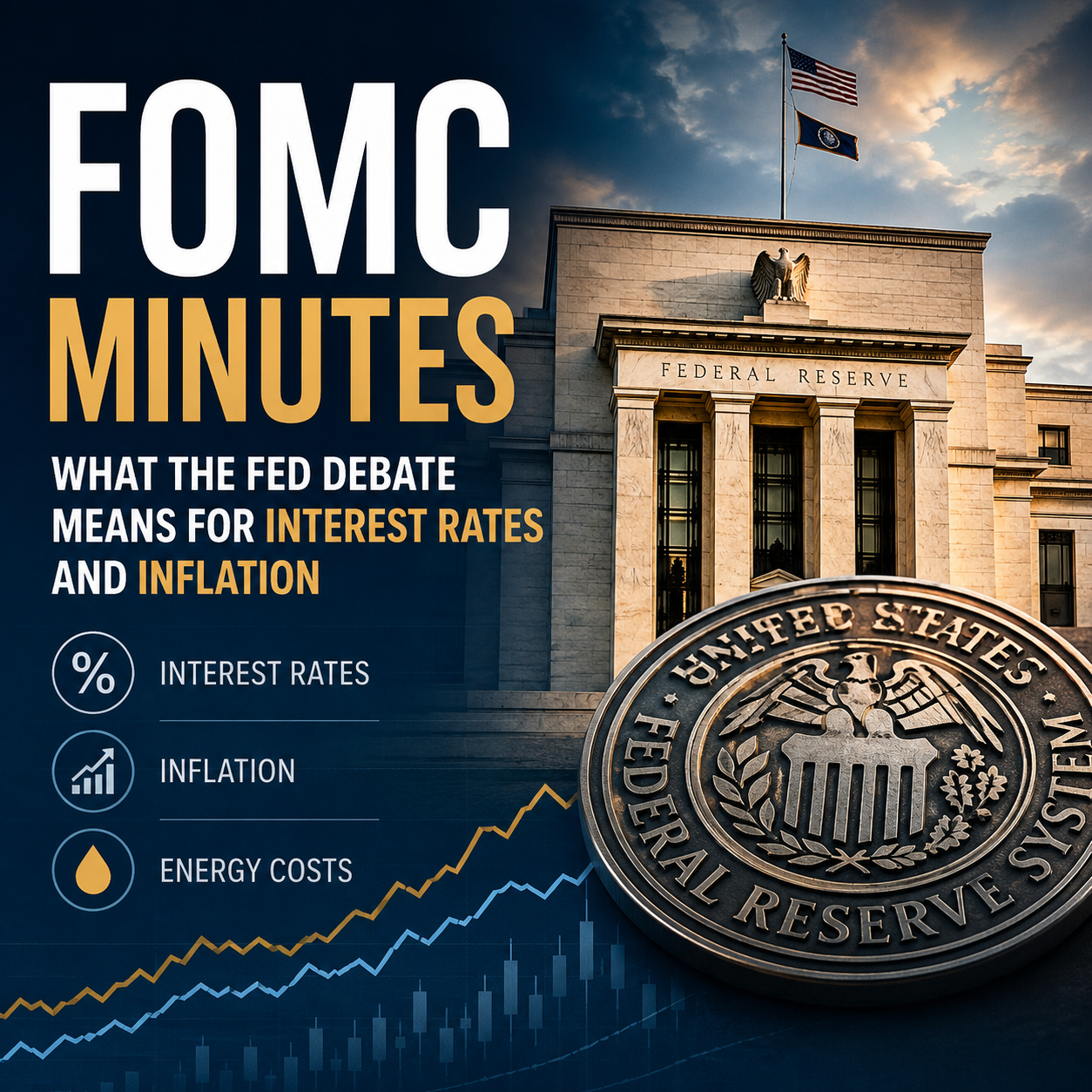
The FOMC Minutes provide a detailed look at how Federal Reserve policymakers assessed inflation, economic growth, labor-market conditions, financial stability and the future path of monetary policy. While the Committee ultimately maintained its target range for the federal funds rate, the discussion showed that the debate over interest rates has become more consequential as inflation remains above the Federal Reserve’s 2 percent objective.
The central message is not that a rate increase is certain. Instead, the FOMC Minutes show a Federal Reserve weighing competing risks. Economic activity remains resilient, labor-market conditions are broadly stable and investment remains strong, particularly in areas connected with artificial intelligence. At the same time, inflation remains elevated, energy costs have created additional price pressures and policymakers continue to face uncertainty over how quickly inflation can return to the Fed’s target.
The policy decision was supported by a majority of participants, but three members preferred a 25-basis-point increase in the federal funds rate. That disagreement is important because it demonstrates that the debate inside the Fed is no longer simply about when rates might eventually decline. Some policymakers believe the greater risk is that inflation remains too high for too long and requires a more restrictive policy stance.
For households, businesses and investors, the significance of the FOMC Minutes lies in what they reveal about the balance of risks. Inflation remains a concern, but the economy has not weakened enough to force an immediate policy response. The Fed therefore faces a difficult policy environment in which moving too slowly could allow inflation to become more persistent, while moving too aggressively could unnecessarily weaken economic activity and employment.
What the FOMC Minutes Reveal About the Fed
The most important takeaway from the FOMC Minutes is that policymakers remain divided over how restrictive monetary policy needs to be.
The majority supported keeping the federal funds target range unchanged at 3.5 percent to 3.75 percent. The decision reflected several factors. Economic activity continued to expand at a solid pace, the unemployment rate remained relatively stable and inflation, while still elevated, had shown some signs of moderation.
However, three policymakers preferred to raise interest rates by 25 basis points.
That split matters because it provides a clearer picture of the policy debate than the headline decision alone. A unanimous decision to hold rates would suggest broad agreement that the current policy setting was appropriate. A decision supported by a substantial majority but opposed by three members indicates something different: policymakers generally agree that caution is appropriate, but there is meaningful disagreement about the inflation risk.
The Fed is therefore balancing two competing objectives. It wants inflation to move sustainably toward 2 percent while also avoiding unnecessary damage to employment and economic growth.
The minutes indicate that most participants believed additional economic information could provide greater clarity before making another policy adjustment. That approach reflects the uncertainty surrounding the inflation outlook, particularly because some of the recent price pressures have been influenced by energy markets, tariffs, supply disruptions and developments connected with the Middle East.
The policy discussion also demonstrates why a single inflation report or market reaction should not be interpreted as a definitive signal of the next rate decision. Policymakers are evaluating a broad range of information, including consumer spending, labor conditions, business investment, inflation expectations, financial conditions and energy prices.
Why the Fed Kept Interest Rates Unchanged
The decision to maintain interest rates reflects the Fed’s assessment that the economy remains sufficiently strong to tolerate a cautious approach.
Economic activity has continued to expand, supported by consumer spending and business investment. The labor market has also remained broadly stable. Although employment growth has moderated compared with stronger periods, there has not been a major deterioration in labor-market conditions.
That distinction is important for monetary policy.
The Federal Reserve has a dual mandate involving maximum employment and price stability. If inflation is too high while employment remains strong, policymakers have greater room to maintain or increase restrictive policy. If inflation is high but the labor market is deteriorating rapidly, the policy calculation becomes considerably more complicated.
The FOMC Minutes suggest that policymakers currently see a relatively balanced labor market rather than an economy experiencing a sharp employment downturn.
At the same time, inflation remains above the Fed’s target. That means policymakers cannot simply declare victory on inflation based on modest improvements in some recent indicators.
The decision to hold rates therefore represents a wait-and-assess strategy rather than a declaration that monetary tightening is finished.
For markets, this distinction is significant. Holding rates steady does not necessarily mean the Fed has adopted a long-term neutral or accommodative stance. Monetary policy can remain restrictive even when policymakers choose not to raise rates at every meeting.
The current policy setting continues to place pressure on borrowing costs, demand and financial conditions. The question for policymakers is whether that pressure is sufficient to bring inflation down without creating an unnecessary economic slowdown.
Three Fed Officials Wanted Higher Interest Rates
One of the clearest signals in the FOMC Minutes is the disagreement over whether the federal funds rate should have been higher.
Three members preferred a 25-basis-point increase. Their argument centered on the persistence of inflation and the risk that waiting too long could make the eventual adjustment more difficult.
From their perspective, inflation remains meaningfully above the Fed’s 2 percent objective. Price increases are not confined to one isolated category, and some policymakers remain concerned that underlying inflation could prove more persistent than anticipated.

The argument for higher interest rates is relatively straightforward.
When demand remains resilient and inflation remains elevated, a higher policy rate can place additional downward pressure on spending and investment. It can also reinforce the central bank’s credibility by demonstrating that policymakers remain committed to price stability.
Supporters of an increase also argued that earlier action could reduce the risk of needing more aggressive tightening later.
That does not mean the dissenting policymakers were necessarily forecasting an imminent inflation crisis. Rather, their concern was that persistent inflation can become harder to reverse when businesses and households begin incorporating higher prices into their expectations and decisions.
If companies expect costs to continue rising, they may increase prices. If workers expect higher living costs to persist, wage demands can remain elevated. If consumers expect prices to rise, they may accelerate purchases. These behaviors can make inflation more persistent.
The opposing view is that monetary policy operates with a lag and that the existing policy setting may already be sufficiently restrictive. Raising rates before the effects of previous policy decisions become fully visible could unnecessarily weaken demand.
The disagreement therefore reflects a classic monetary-policy dilemma: act early to contain inflation risk or wait for clearer evidence that existing policy is working.
Inflation Remains the Fed’s Central Concern
Inflation remains the most important reason the Federal Reserve has not shifted decisively toward easier monetary policy.
The information discussed by policymakers showed that inflation remained above the 2 percent objective. Both headline and core measures were elevated, although some measures had moderated.
Headline inflation has been influenced by energy prices and other supply-related factors. Core inflation, meanwhile, remains important because it can provide a better indication of underlying price pressures by excluding some of the more volatile components.
The FOMC Minutes show that policymakers were particularly attentive to the breadth of price increases.
Some participants noted that inflation was affecting a wide range of goods and services. Others pointed to continued pressure in core services outside housing. There was also discussion of prices connected with AI infrastructure, technology products, electricity and other inputs.
This matters because the Fed needs to determine whether inflation is primarily being driven by temporary shocks or whether broader demand and price-setting behavior are keeping inflation elevated.
A temporary increase in energy prices may eventually reverse without creating a lasting inflation problem. A broad-based acceleration in prices and wages can be more difficult to address.
Policymakers therefore continue to examine measures of inflation expectations. Long-term expectations have remained relatively well anchored, which is an important positive factor.
However, some shorter-term inflation expectations have increased.
The longer inflation remains above target, the greater the concern that expectations could begin to influence actual wage and pricing decisions.
This is one reason the Fed remains cautious.
Energy Costs Are Complicating the Inflation Outlook
Energy costs have become an important part of the inflation discussion because energy prices can affect the economy in several different ways.
The most direct effect is on household expenses. Higher gasoline, electricity and other energy costs reduce the amount of income consumers have available for other purchases.
Businesses face similar pressures. Energy is an input into transportation, manufacturing, logistics, agriculture, data centers and numerous service industries. When energy costs rise sharply, companies must decide whether to absorb those increases through lower profit margins or pass them through to customers.
The FOMC Minutes indicate that policymakers were concerned about the possibility that continued geopolitical disruptions could prolong supply-chain problems and create additional upward pressure on prices.
This creates a difficult problem for the Fed.
Monetary policy cannot produce more oil or repair disrupted infrastructure. Higher interest rates cannot directly solve a supply shortage.
However, monetary policy can influence whether a temporary supply shock becomes a broader inflation problem.
If higher energy prices reduce real household income and weaken demand, the economic effect could eventually be disinflationary. But if businesses pass higher energy costs into prices across a broad range of goods and services, inflation could remain elevated.
The Fed therefore has to distinguish between a one-time price-level adjustment and a sustained inflation process.
How Energy Costs Could Affect Interest Rates
The relationship between energy costs and interest rates is not automatic.
A sharp increase in energy prices does not necessarily mean the Fed must immediately raise rates. Policymakers instead examine whether the increase is temporary, how broadly it is affecting prices and whether it is influencing inflation expectations.
If energy prices rise temporarily and then decline, the direct inflation effect can fade.
If elevated energy costs persist, the situation becomes more complicated.
Higher fuel and transportation costs can affect food, manufactured goods and services. Businesses may raise prices to protect margins. Workers may seek higher wages to compensate for increased household expenses. Consumers may adjust spending patterns.
The resulting effects can make inflation more persistent.
That is why energy costs feature prominently in the policy debate even though the Fed does not control energy production.
The minutes indicate that policymakers were particularly alert to the possibility that ongoing geopolitical developments could prolong energy and supply pressures.
For interest rates, the key question is therefore not simply whether oil or gasoline prices are high. The more important question is whether higher energy costs are producing broader and more persistent inflation.
The Fed Is Watching for Persistent Inflation
The distinction between temporary inflation and persistent inflation is central to the current policy debate.
The FOMC Minutes show that several policymakers believe the inflation outlook remains uncertain and tilted toward the upside.
Some participants argued that previous tariff increases had largely passed through to consumer prices. Others noted that newly announced tariffs could still create additional effects.
There was also discussion about how businesses are handling elevated input costs.
Some businesses have absorbed higher costs through lower margins rather than raising prices. That approach can delay the effect on consumer inflation, but it may not be sustainable indefinitely.
If profit margins become too compressed, businesses could eventually increase prices.
The possibility of additional supply shocks creates another layer of uncertainty.
Policymakers have experienced repeated periods in which inflation returned more slowly than expected. That history has made the Fed cautious about assuming that inflation will automatically return to 2 percent.
This is particularly important because inflation expectations can influence future inflation.
If households and businesses become convinced that inflation will remain elevated, their behavior can change. Businesses may set prices differently. Workers may negotiate for higher wages. Consumers may become less resistant to price increases.
That is precisely the type of dynamic monetary policymakers want to prevent.
The Labor Market Remains Relatively Stable
The labor market is providing the Fed with another reason to avoid making an abrupt policy shift.
The unemployment rate has remained relatively stable, while employment gains have continued. Wage growth has moderated compared with earlier periods but remains consistent with an economy that has not experienced a severe labor-market contraction.
The minutes describe labor demand and labor supply as broadly balanced.
Indicators such as layoffs, unemployment insurance claims and hiring activity have remained relatively stable.
That stability gives policymakers more flexibility.
If unemployment were rising rapidly, the Fed would face greater pressure to support economic activity. But with employment conditions relatively stable, policymakers can place greater emphasis on controlling inflation.
There are still areas of concern.
Some participants noted a low job-finding rate and elevated long-term unemployment. Other participants saw modest signs of labor-market strengthening.
The labor market also faces uncertainty related to artificial intelligence.
The AI buildout is generating demand for specialized workers, including engineers, machinists and electricians. At the same time, there is uncertainty about whether AI adoption could eventually reduce employment in certain occupations.
So far, policymakers have not seen evidence of widespread AI-driven layoffs.
The longer-term implications remain uncertain.
Economic Growth Remains Resilient
Economic growth is another important part of the FOMC Minutes.
Despite elevated uncertainty, economic activity has continued to expand at a solid pace.
Consumer spending has strengthened, while business investment remains strong. Much of that investment is concentrated in AI-related infrastructure, including data centers, technology equipment and other capital expenditures.
The resilience of consumer spending is significant because consumption represents a major component of U.S. economic activity.
However, the minutes also acknowledge differences among households.
Higher-income consumers may be receiving support from strong financial-market performance and asset appreciation, while lower- and moderate-income households face greater pressure from elevated prices.
That divergence could become increasingly important if inflation remains above target.
When prices rise faster than household incomes, real purchasing power declines.
Consumers may respond by reducing discretionary spending, increasing reliance on credit or shifting purchases toward lower-cost alternatives.
For the Fed, these developments create another balancing act.
Economic growth remains strong enough to support demand, but persistent inflation can gradually weaken household purchasing power.
AI Investment Is Creating a New Policy Challenge
Artificial intelligence has emerged as an increasingly important factor in the economic outlook.
The FOMC Minutes indicate that AI-related investment is supporting business spending and contributing to strong demand in several sectors.
That investment can have positive long-term effects.
If AI improves productivity, businesses may eventually produce more goods and services with fewer resources. Higher productivity can increase potential economic growth and reduce production costs.
However, the short-term effects can be different.
The construction of data centers and AI infrastructure requires large amounts of capital, energy, computing equipment, specialized labor and raw materials.
Strong demand for these inputs can increase prices.
This creates an unusual policy challenge for the Fed. AI investment could simultaneously contribute to stronger economic growth and higher short-term inflation pressures.
Several policymakers also discussed the possibility that AI productivity gains could eventually increase aggregate supply and reduce inflationary pressure.
The timing is uncertain.
If productivity gains materialize quickly, they could offset some demand-driven inflation. If investment spending grows faster than productive capacity, it could initially add to demand pressures.
The minutes therefore treat AI as both an opportunity and a source of uncertainty.
Financial Markets Are Pricing a More Complicated Fed Outlook
Financial markets have responded to the evolving policy debate through changes in Treasury yields, equity prices, credit conditions and the dollar.
The FOMC Minutes indicate that nominal Treasury yields increased during the period under review, driven largely by higher real yields.
This suggests that investors were demanding greater compensation for holding longer-term debt amid changing expectations about monetary policy and economic conditions.
Higher Treasury yields can influence the broader economy because they affect borrowing costs for households, businesses and governments.
Mortgage rates, corporate financing costs and other credit conditions can respond to movements in government bond yields.
Equity markets also remain important.
Stock valuations have been elevated, particularly among companies associated with AI and technology infrastructure.
Strong corporate earnings and optimism about future AI-related growth have supported equity prices.
However, high valuations can create financial-stability concerns if expectations change suddenly.
If investors significantly revise their expectations about future AI earnings, asset prices could decline. A major repricing could tighten financial conditions and affect companies, lenders and investors with exposure to the sector.
The Fed is therefore monitoring financial stability as well as conventional inflation and employment indicators.
Credit Conditions Remain Mixed
Credit availability remains relatively favorable for larger businesses and municipalities, while smaller businesses and some households continue to face tighter conditions.
Bank lending has continued to expand, and corporate financing remains strong.
At the same time, private credit markets have attracted greater scrutiny.
Investor concerns about liquidity and redemption activity could create vulnerabilities if financial conditions deteriorate.
Household credit conditions are also uneven.
Mortgage activity remains subdued, while credit cards remain available to existing borrowers but can be more difficult to obtain for new applicants.
These conditions illustrate why monetary policy affects different parts of the economy at different speeds.
A policy rate that appears manageable for a large corporation may be much more restrictive for a small business or household.
That transmission process is one reason policymakers must evaluate more than headline economic growth.
Financial Stability Risks Remain Important
The FOMC Minutes also highlight financial-stability concerns.
The staff assessment continued to characterize several financial vulnerabilities as notable.
Asset valuations remain elevated, particularly in equity markets.
Leverage among hedge funds remains high, while some financial institutions have significant exposure to less liquid or riskier assets.
The banking system remains better capitalized than during previous periods of financial stress, which provides an important source of resilience.
However, policymakers continue to monitor vulnerabilities associated with leverage, funding markets and concentrated exposures.
The rapid expansion of AI infrastructure financing is particularly noteworthy.
Some AI-related capital expenditures are increasingly financed through borrowing, including funding from nonbank investors and regional banks.
If AI investment continues to generate strong returns, these financing structures may remain manageable.
If expectations about future profitability decline sharply, however, asset prices could fall and financial conditions could tighten.
That possibility is one reason the Fed cannot focus exclusively on inflation.
Monetary policy operates within a broader financial system where asset prices, leverage, credit conditions and investor expectations interact.
What the FOMC Minutes Say About Future Interest Rates
The central question for markets is what the FOMC Minutes imply about future interest rates.
The answer is nuanced.
The minutes do not establish a predetermined path.
Instead, they show that policymakers remain highly dependent on incoming economic information.
Many participants indicated that policy tightening could become necessary if inflation failed to decline.
Some believed financial conditions might not currently be restrictive enough to bring inflation back to 2 percent.
Others believed financial conditions had already tightened and that the economy was facing substantial uncertainty.
This difference of opinion means the next policy decision cannot be reduced to a simple prediction based on the current rate.
The Fed will likely continue assessing several key indicators.
These include inflation, labor-market conditions, consumer spending, energy prices, business investment, inflation expectations and financial conditions.
The direction of those indicators will determine whether the case for higher rates strengthens or weakens.
Why the Next Rate Decision Is Not Guaranteed
The presence of three dissenting votes for higher interest rates has increased attention on the possibility of further tightening.
However, the majority decision shows that most policymakers were not prepared to raise rates immediately.
That distinction is important.
The FOMC Minutes indicate that many participants wanted more information before changing policy.
If inflation remains elevated, the argument for higher rates could become stronger.
If inflation continues to moderate while employment and consumer spending weaken, the case for another increase could become less compelling.
This is why financial markets can change their expectations quickly when new economic data are released.
Monetary policy is not determined by the minutes alone.
The minutes provide a detailed account of the discussion, but subsequent economic information can alter the policy outlook.
What Could Push the Fed Toward Higher Interest Rates
Several developments could strengthen the case for higher interest rates.
The first would be persistent inflation.
If core inflation remains elevated or begins accelerating again, policymakers may conclude that existing policy is insufficiently restrictive.
The second would be renewed increases in energy costs.
If higher energy prices spread into broader consumer and business prices, the inflation outlook could become less favorable.
The third would be continued strong demand.
If consumer spending and business investment remain robust despite restrictive monetary policy, policymakers may determine that demand is not cooling enough.
A fourth factor would be rising inflation expectations.
If longer-term expectations become less firmly anchored, the Fed would likely take that development seriously.
Finally, financial conditions could influence the decision.
If equity markets remain strong, credit remains readily available and borrowing conditions become easier, monetary policy could be less restrictive than the policy rate alone suggests.
What Could Keep the Fed From Raising Rates
The case for holding interest rates steady would become stronger if inflation continues to decline.
A sustained moderation in core inflation would provide evidence that previous policy tightening is working.
Lower energy costs would also help reduce headline inflation and relieve pressure on household budgets.
A weaker labor market could change the policy calculation as well.
If unemployment rises significantly or hiring slows sharply, the Fed would need to place greater weight on the employment side of its mandate.
Consumer spending is another important indicator.
If household finances become increasingly strained by elevated prices and borrowing costs, spending could slow.
Finally, weaker business investment could reduce demand.
AI-related investment has been a major source of economic momentum. A slowdown in that investment could have meaningful effects on growth.
What the FOMC Minutes Mean for Households
For households, the FOMC Minutes matter because Federal Reserve policy influences borrowing costs, savings returns and economic conditions.
Higher interest rates generally make borrowing more expensive.
That can affect mortgages, credit cards, auto loans and other forms of consumer credit.
At the same time, higher rates can benefit savers by increasing yields on certain deposit accounts and fixed-income investments.
The more important issue for households, however, is the interaction between interest rates and inflation.
If inflation remains elevated, households face higher prices for goods and services.

If interest rates remain high at the same time, consumers can experience pressure from both sides: higher living costs and more expensive borrowing.
This is particularly significant for households with variable-rate debt or those relying on credit for major purchases.
The Fed’s objective is to bring inflation down without causing an unnecessarily severe economic slowdown.
What the FOMC Minutes Mean for Businesses
Businesses are affected by both interest rates and inflation.
Higher borrowing costs can discourage expansion, hiring and capital investment.
However, businesses also face higher input costs when inflation remains elevated.
Energy costs are particularly important for transportation, manufacturing, logistics and energy-intensive industries.
Businesses must decide whether to absorb higher costs or pass them on to customers.
If competition is strong, companies may have limited ability to raise prices.
If demand remains strong, businesses may have more flexibility to pass costs through.
This is one reason the Fed pays close attention to corporate pricing behavior.
The minutes indicate that some businesses have absorbed higher costs through lower margins.
That approach may limit inflation in the short term, but it can become difficult to sustain if input costs remain elevated for an extended period.
What Investors Should Watch Next
Investors should pay attention to several indicators when assessing the future path of interest rates.
The first is inflation.
A sustained decline would support the argument that the Fed can remain patient. A renewed acceleration would strengthen the case for tighter policy.
The second is the labor market.
Employment data will help policymakers determine whether economic conditions remain resilient or are beginning to weaken.
The third is energy.
Changes in oil and gasoline prices can have a significant influence on headline inflation and household purchasing power.
The fourth is consumer spending.
Strong spending could support continued economic growth but may also make it more difficult to reduce demand-driven inflation.
The fifth is financial conditions.
Treasury yields, credit spreads, equity valuations and the dollar all influence the broader economic environment.
Finally, investors should watch Federal Reserve communications.
Speeches and public comments from policymakers can provide additional context about the balance between inflation and employment risks.
The Fed’s 2 Percent Inflation Objective Remains Central
The FOMC Minutes repeatedly return to the importance of the Federal Reserve’s 2 percent inflation objective.
That target provides the benchmark against which policymakers assess progress.
Inflation does not need to fall immediately to 2 percent for the Fed to consider policy successful. Policymakers are looking for evidence that inflation is moving sustainably toward the objective.
The word “sustainably” is important.
A temporary decline in inflation caused by lower energy prices may not be enough if underlying inflation remains elevated.
Similarly, a single month of stronger inflation does not necessarily prove that disinflation has ended.
The Fed must evaluate trends.
That is why policymakers are examining a wide range of data rather than relying on one indicator.
Why the FOMC Debate Matters Beyond the Fed
The policy disagreement reflected in the FOMC Minutes has implications beyond the federal funds rate.
The Federal Reserve is one of the most influential institutions in global financial markets.
Changes in U.S. monetary policy can affect Treasury yields, exchange rates, equity valuations, credit markets and capital flows.
A more restrictive Fed can contribute to tighter global financial conditions.
A less restrictive Fed can have the opposite effect.
The U.S. dollar is particularly important because movements in the dollar can influence trade, commodity prices and financial conditions around the world.
Foreign central banks must also consider the effects of U.S. monetary policy on their own economies.
That makes the debate over U.S. interest rates relevant internationally.
The Key Policy Risk Is Persistence
The central issue emerging from the FOMC Minutes is persistence.
The Fed can tolerate temporary price shocks more easily than a sustained inflation process.
If energy prices rise temporarily and then fall, the direct impact on inflation may fade.
If higher energy costs lead to broader price increases, wage pressures and changing inflation expectations, the situation becomes more difficult.
Similarly, tariff-related price increases may be temporary if they represent a one-time adjustment in the price level.
But if businesses and consumers begin treating higher inflation as normal, the problem becomes more persistent.
This explains why some policymakers favor a more restrictive stance even while the economy remains relatively strong.
Their concern is not simply the inflation rate today.
It is where inflation could be headed if policy does not respond sufficiently.
The Case for Patience Remains Strong
Despite the disagreement, the majority of the Fed supported maintaining the current policy setting.
The argument for patience is also significant.
Monetary policy works with a delay.
The effects of previous rate increases can take time to move through household budgets, corporate borrowing decisions, housing activity and investment.
Raising interest rates too quickly could create unnecessary weakness if inflation is already beginning to decline.
Policymakers must therefore avoid reacting excessively to temporary movements in prices.
This is especially important when inflation is being influenced by supply-side developments that monetary policy cannot directly control.
The majority appears to believe that waiting for additional information provides a better opportunity to distinguish temporary pressures from persistent inflation.
The Broader Economic Picture Is Mixed
The economy described in the FOMC Minutes does not fit neatly into either a strong-growth or weak-growth category.
Growth remains resilient.
Consumer spending has improved.
Business investment is strong.
AI-related capital expenditure is significant.
The labor market remains broadly stable.
At the same time, inflation is elevated.
Household purchasing power is under pressure.
Some credit markets are restrictive.
Financial-stability vulnerabilities remain notable.
Geopolitical uncertainty continues to affect energy prices and supply chains.
That mixture explains why the Fed is facing a difficult policy environment.
There is no single economic indicator that resolves the policy question.
Instead, policymakers must determine which risks are most likely to become persistent.
What the FOMC Minutes Mean for the Inflation Outlook
The inflation outlook remains uncertain.
The staff assessment anticipated that inflation would decline as some energy-related pressures eased and as the effects of previous shocks diminished.
However, policymakers acknowledged meaningful upside risks.
Those risks include renewed energy disruptions, persistent services inflation, tariff-related price pressures and changes in inflation expectations.
The possibility of AI-related demand pressures adds another variable.
If productivity improves significantly, AI could eventually help reduce costs and increase economic capacity.
If investment demand remains extremely strong before those productivity gains materialize, it could add to inflationary pressure in the short term.
This makes AI another factor the Fed must monitor.
A More Divided Fed Means Greater Policy Uncertainty
The disagreement over interest rates means monetary-policy uncertainty is likely to remain elevated.
A divided committee does not necessarily mean policy is unstable.
It means policymakers have different assessments of the risks facing the economy.
Some see persistent inflation as the greater danger.
Others believe existing policy is already sufficiently restrictive and that waiting for more information is appropriate.
Both perspectives have legitimate economic arguments.
The eventual policy direction will depend on which risks become more visible in the data.

That makes the next phase of monetary policy particularly dependent on inflation, employment, consumer spending and energy developments.
FOMC Minutes: Key Takeaways
The FOMC Minutes provide several important conclusions about the Federal Reserve’s current policy debate.
First, the Fed remains committed to bringing inflation back toward its 2 percent objective.
Second, the economy continues to show resilience, with consumer spending and business investment supporting growth.
Third, the labor market remains broadly stable, giving policymakers room to focus on inflation.
Fourth, energy costs are an important source of uncertainty because geopolitical developments can create additional supply and price pressures.
Fifth, three policymakers preferred higher interest rates, demonstrating that there is meaningful disagreement over how restrictive monetary policy should be.
Sixth, the majority believes additional information can help clarify whether inflation is declining sufficiently.
Seventh, AI investment is becoming increasingly important to the economic outlook, creating both potential productivity gains and short-term demand pressures.
Eighth, financial stability remains an important consideration because elevated asset valuations, leverage and AI-related financing could create vulnerabilities if expectations change sharply.
Finally, the minutes do not provide a predetermined path for future monetary policy.
They instead show a Fed attempting to balance persistent inflation against economic resilience, labor-market stability and the possibility that previous policy actions will eventually produce greater disinflation.
Conclusion: What the FOMC Minutes Mean for the Fed’s Next Move
The FOMC Minutes reveal a Federal Reserve that is increasingly focused on the persistence of inflation while remaining cautious about changing policy too quickly.
The decision to maintain interest rates reflects the majority’s view that the economy remains resilient and that more information is needed before taking another step.
But the three dissenting votes are significant.
They demonstrate that some policymakers believe inflation remains sufficiently persistent to justify additional tightening now. Their concern is that delaying action could allow price pressures to become more entrenched and potentially require more aggressive measures later.
At the same time, the case for patience remains substantial.
The effects of previous policy decisions have not disappeared. Inflation has shown some signs of moderation, labor-market conditions remain stable and energy prices can create temporary distortions in headline inflation.
The most important issue going forward is therefore whether inflation continues to decline or proves more persistent than expected.
Energy costs will remain an important variable, particularly if geopolitical disruptions continue to affect oil markets and supply chains. Consumer spending, business investment and AI-related activity will also help determine whether demand remains strong enough to keep inflation elevated.
For households and businesses, the immediate message is that borrowing costs are likely to remain closely tied to the Fed’s assessment of inflation.
For investors, the message is that monetary policy remains data-dependent and that the disagreement within the Federal Reserve increases the importance of upcoming economic indicators.
The FOMC Minutes do not guarantee a future rate increase, nor do they signal that monetary easing is imminent.
Instead, they provide a detailed picture of a central bank confronting a difficult balance: inflation remains above target, the economy remains resilient, energy costs introduce additional uncertainty, and policymakers disagree over whether the current level of interest rates is restrictive enough.
The direction of monetary policy will ultimately depend on whether the incoming evidence shows that inflation is moving convincingly toward 2 percent or whether persistent price pressures require the Fed to maintain or increase its restrictive stance.
For now, the clearest conclusion is that the Federal Reserve remains focused on price stability, but the path toward that objective is becoming increasingly dependent on how inflation, energy costs, economic growth and labor-market conditions evolve.