








Table of Contents
- Why This Earnings Season Matters
- Nvidia Is the Central Test for the AI Trade
- Marvell Technology Faces a Different AI Test
- Salesforce Must Turn AI Momentum Into Measurable Growth
- CrowdStrike Rides the AI Security Cycle
- Other Technology Stocks Worth Watching
- Retail Earnings Add Another Dimension
- The Bigger Themes Driving This Earnings Season
- What Investors Should Watch After the Headlines
- Why Earnings Season Is About More Than Earnings
- The Importance of Separating Long-Term Trends From Short-Term Noise
- What Could Make This Earnings Season Different
- Earnings Season and the Next Phase of the AI Market
- What Could Go Wrong for Investors
- How Investors Can Read the Results
- Earnings Season Outlook: Nvidia Leads as Investors Look Beyond the Headlines
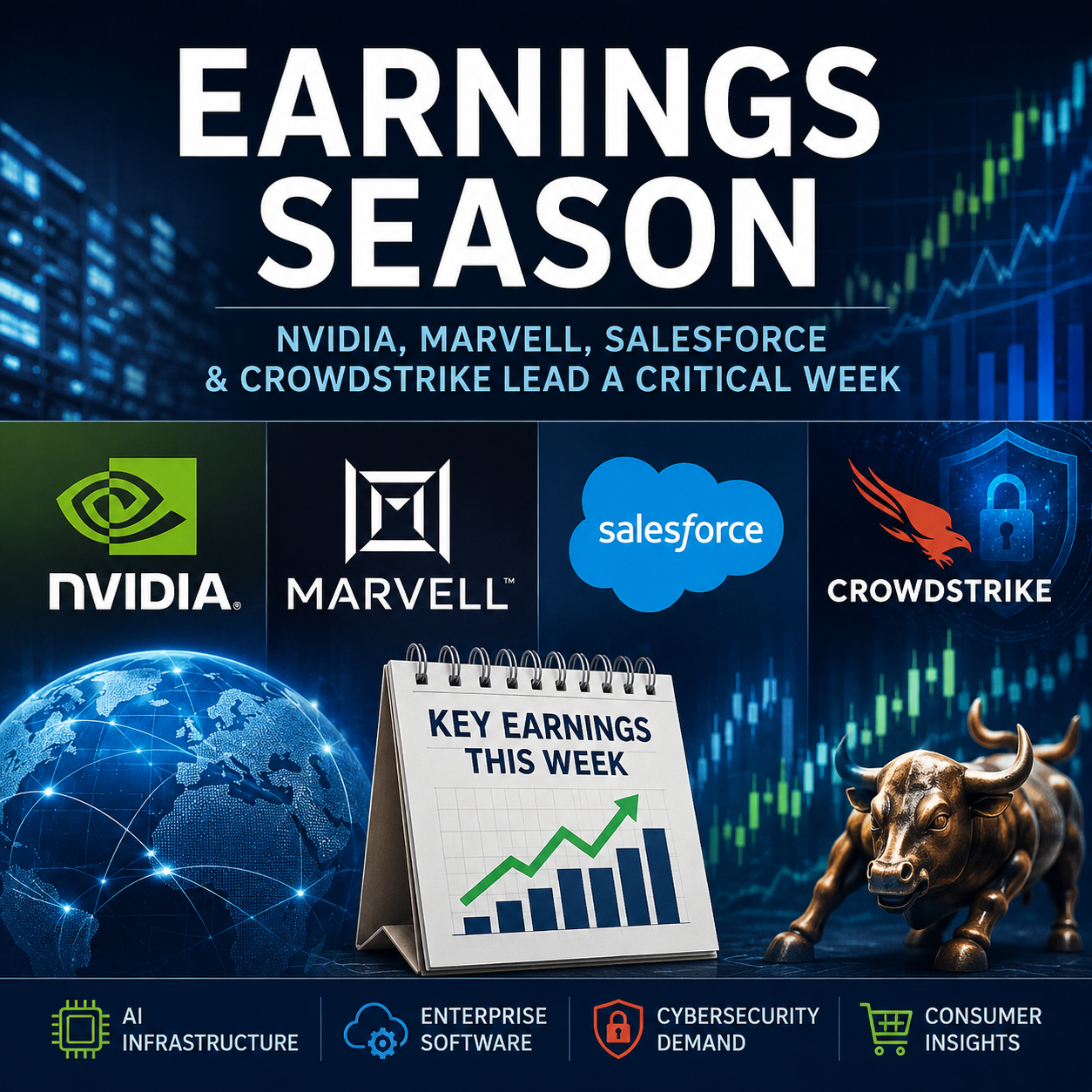
Earnings Season moves into one of its most closely watched weeks of August, with Nvidia, Marvell Technology, Salesforce and CrowdStrike among the companies attracting significant investor attention.
The calendar is particularly important because the technology sector remains closely tied to the broader artificial intelligence investment cycle. Nvidia’s results are expected to provide one of the clearest indications of whether spending on AI infrastructure remains strong, while Marvell Technology offers another view into the semiconductor and custom-chip opportunity.
At the same time, Salesforce and CrowdStrike face a different test. Both companies are benefiting from the expanding use of artificial intelligence, but investors increasingly want to see measurable financial results behind the technology narrative.
That distinction matters throughout Earnings Season. A company can report strong revenue growth and still disappoint investors if expectations were even higher. Conversely, a company facing low expectations can produce a relatively modest quarter and still see its shares respond positively if management provides a stronger outlook.
This week’s calendar also extends beyond technology. Walmart, Target, Home Depot and other major retailers are providing additional insight into consumer spending, pricing, margins and the impact of tariffs. Companies such as Intuit, Okta and Synopsys add further depth to the software and technology picture.
Nvidia remains the central attraction.
The company is scheduled to report fiscal second-quarter results on August 26, and analysts are expecting another substantial year-over-year increase in revenue and earnings. Current estimates place Nvidia’s quarterly revenue expectation around $92 billion, with investors focused heavily on continued AI infrastructure demand and the company’s next-generation platforms.
The bigger question is no longer simply whether Nvidia can beat expectations.
The question is whether its results, guidance and commentary can demonstrate that the extraordinary pace of AI investment remains sustainable.
Why This Earnings Season Matters
Earnings Season is always important, but the current environment gives investors several additional issues to consider.
The first is artificial intelligence.
Over the past several quarters, AI investment has moved from an emerging technology theme into a major capital-spending cycle involving hyperscalers, cloud providers, enterprises and governments. Nvidia has been at the center of that spending, while companies such as Marvell Technology are positioned to benefit from demand for custom silicon, networking and data-center infrastructure.
The second issue is expectations.
When expectations become elevated, simply reporting good results may not be enough. Investors can respond negatively to a strong quarter if revenue growth slows, guidance disappoints or management suggests that demand may become more difficult to sustain.
The third issue is valuation.
Many technology companies have experienced significant share-price moves based on expectations surrounding AI. As a result, investors are increasingly comparing current valuations with future earnings and cash flow rather than focusing exclusively on quarterly results.
The fourth issue is the consumer.
Retail earnings provide a useful counterbalance to the technology story. Walmart, Target, Home Depot and other retailers are showing whether households continue to spend, where consumers are becoming more price-sensitive and how companies are managing inflation, tariffs and operating costs.
That combination makes this stretch of Earnings Season particularly informative.
It is not simply about which companies beat or miss estimates. It is about understanding where corporate growth is coming from and whether management teams believe those trends can continue.
Nvidia Is the Central Test for the AI Trade
Nvidia is once again the most closely watched company on the earnings calendar.
The semiconductor leader is scheduled to report its fiscal second-quarter results after the U.S. market closes on Wednesday, August 26. Wall Street expects another enormous quarter, with current estimates calling for approximately $92 billion in revenue and adjusted earnings of about $2.09 per share.
Those numbers illustrate the scale of the expectations surrounding Nvidia.
The company is no longer being evaluated like a traditional semiconductor manufacturer. Its results are increasingly viewed as an indicator of the health of the broader AI infrastructure market.
That creates both an opportunity and a challenge.
Strong results could reinforce the argument that cloud companies and other large technology customers remain committed to expanding AI infrastructure. However, a strong quarter that merely meets expectations may not necessarily be enough to generate a major share-price response.
Investors want evidence of continued acceleration.
What Investors Are Watching in Nvidia’s Results
Revenue remains the headline number, but several other indicators could be just as important.
Data-center revenue is likely to receive significant attention because it has become the dominant driver of Nvidia’s growth. Investors will also be looking for commentary on demand for its Blackwell platform and the progression toward its Vera Rubin architecture.
The company’s previous quarter demonstrated the continuing strength of AI infrastructure demand. Nvidia reported $81.6 billion in quarterly revenue, up 85% from a year earlier, while data-center revenue increased 92%. Management guided to approximately $91 billion of revenue for the following quarter.
That creates a substantial hurdle.
Investors are now looking beyond the initial AI infrastructure buildout and asking how long hyperscalers can maintain their spending pace.
That is one reason Nvidia’s guidance may matter more than the historical numbers.
AI Infrastructure Spending Remains the Key Question
The broader AI ecosystem requires enormous investment.
Cloud providers need data centers, networking equipment, processors, power infrastructure and cooling systems. Companies developing AI models need access to increasingly powerful computing resources.
Nvidia sits at the center of that ecosystem.
The company’s financial results therefore provide investors with a window into spending decisions being made by some of the world’s largest technology companies.
Recent developments surrounding AI infrastructure financing have also increased the focus on how future data-center expansion will be funded. Nvidia has participated in initiatives involving significant infrastructure commitments, reinforcing the scale of the capital required to expand AI capacity.
For investors, the important issue is not whether AI spending is large.
It clearly is.
The issue is whether the resulting demand can continue growing quickly enough to justify the valuations assigned to companies benefiting from the cycle.

Nvidia’s Growth Expectations Create a High Bar
Nvidia’s biggest advantage is also one of its biggest challenges.
The company has consistently delivered extraordinary growth, but that performance has raised expectations.
Current market commentary suggests investors are increasingly interested in what happens after the immediate quarterly report. The next quarter’s outlook, future AI infrastructure demand and the pace of new system deployments could have as much influence on the stock as the reported results themselves.
This means Nvidia does not necessarily need to deliver a weak quarter for the stock to struggle.
The market could simply decide that the future growth rate does not justify the existing valuation.
That is an important distinction during Earnings Season.
Marvell Technology Faces a Different AI Test
Marvell Technology provides another important perspective on the AI infrastructure cycle.
While Nvidia is primarily associated with accelerated computing and AI systems, Marvell operates across data-center connectivity, custom silicon, networking and related infrastructure.
That positioning makes Marvell particularly relevant as large technology companies increasingly develop customized computing architectures.
Marvell is scheduled to report on August 27, one day after Nvidia. Current expectations call for another substantial year-over-year increase in revenue and earnings.
The timing could make the report especially interesting because investors will already have Nvidia’s results in hand.
If Nvidia provides strong evidence of continued AI infrastructure spending, Marvell’s results could offer a second confirmation of the same trend.
Custom Silicon and AI Infrastructure Drive the Story
One of the most important themes surrounding Marvell Technology is custom silicon.
Large cloud providers increasingly want hardware designed around their specific workloads. Custom chips can potentially improve efficiency, performance and cost management for certain applications.
That creates an opportunity for companies capable of designing and supplying specialized semiconductor solutions.
Marvell’s data-center business has become an increasingly important part of its growth story. Its first-quarter fiscal 2027 results produced record revenue of $2.418 billion, representing 28% year-over-year growth.
The company’s interconnect business has also become a major focus as AI systems require increasingly sophisticated networking.
The Google Partnership Adds a New Dimension
Marvell’s relationship with Google has added another significant element to the investment story.
Recent reporting indicates that Google and Marvell have expanded their collaboration around custom AI chips, with Google receiving an option tied to a substantial future purchase of Marvell shares under specified conditions. The partnership is focused on developing custom AI infrastructure and related components.
The importance of the relationship goes beyond the immediate financial figures.
It demonstrates how major cloud providers are increasingly looking for alternatives and complements to standardized AI hardware.
For Marvell Technology, that could create a long-term opportunity across custom accelerators, networking and other components required to build increasingly complex AI systems.
What Could Move Marvell Technology After Earnings
Investors will likely focus on three areas.
First is revenue growth.
Second is the company’s outlook for data-center demand.
Third is the pace at which custom silicon and interconnect opportunities convert into actual revenue.
Marvell has already established a strong growth trajectory, which means expectations are elevated.
The market will want evidence that recent partnerships and customer commitments are translating into sustainable financial performance rather than simply creating an attractive long-term narrative.
That distinction will be important.
Salesforce Must Turn AI Momentum Into Measurable Growth
Salesforce enters this week’s Earnings Season with a different set of questions.
The company is one of the world’s largest enterprise software providers, and its artificial intelligence strategy is now a central component of its growth narrative.
Salesforce is scheduled to report on August 26. Current analyst expectations call for approximately $11.33 billion in quarterly revenue and adjusted earnings of around $3.28 per share.
That would represent roughly 11% year-over-year revenue growth.
For a company of Salesforce’s size, double-digit growth remains meaningful.
However, investors want to know whether AI can create an additional growth engine rather than simply becoming another feature layered onto the existing software platform.
Agentic AI and Salesforce’s Growth Strategy
Salesforce has invested heavily in Agentforce and the broader concept of AI agents capable of performing tasks on behalf of businesses.
The opportunity is potentially significant.
Instead of using AI simply to generate text or summarize information, enterprises could use AI agents to handle customer service, sales, marketing, analytics and administrative workflows.
That could increase the value of enterprise software platforms.
But the investment case depends on monetization.
Investors need evidence that customers are paying for these capabilities at a scale large enough to affect overall revenue growth.
That is why Salesforce’s commentary surrounding customer adoption, bookings and future demand will be important.
Bookings, Cash Flow and Margins Matter
Revenue receives the most attention in quarterly results, but Salesforce investors have several other metrics to consider.
Bookings provide insight into future revenue.
Free cash flow provides information about the company’s ability to generate cash from operations.
Margins show whether growth is translating into stronger profitability.
These metrics can help investors determine whether Salesforce’s AI strategy is creating durable economic value.
A company can generate considerable excitement around AI while still needing time to turn that interest into recurring revenue.
Salesforce therefore faces a relatively straightforward test.
The company needs to demonstrate that artificial intelligence is contributing to customer demand while its existing business remains stable.
Why Salesforce Faces a Higher Standard
Salesforce has already spent considerable time explaining how AI can reshape enterprise software.
The market now wants measurable evidence.
Recent market coverage indicates that investors are paying close attention to Salesforce’s ability to maintain growth while addressing concerns about AI disruption within traditional software.
That creates an interesting dynamic.
AI could be a growth opportunity for Salesforce, but it could also change how customers purchase software.
If businesses begin relying more heavily on AI agents, they may eventually require fewer traditional software seats.
Salesforce therefore needs to demonstrate that it can benefit from the transition rather than simply defend its existing business model.
CrowdStrike Rides the AI Security Cycle
CrowdStrike enters Earnings Season with a strong position in cybersecurity and an increasingly important role in the AI discussion.
The company is scheduled to report on August 26 alongside Nvidia and Salesforce.
Current analyst expectations call for continued revenue growth, with recent previews highlighting quarterly earnings expectations of approximately $1.09 per share.
The company’s opportunity is somewhat different from that of Nvidia or Marvell Technology.
Rather than selling the infrastructure used to build AI systems, CrowdStrike is positioned to help companies secure increasingly complex digital environments.
That includes environments where artificial intelligence itself is becoming part of the threat landscape.
AI Is Reshaping Cybersecurity Spending
Artificial intelligence presents cybersecurity companies with both opportunities and risks.
Businesses can use AI to identify threats faster, analyze enormous amounts of data and automate parts of incident response.
At the same time, cybercriminals can use AI to automate attacks, create more convincing phishing campaigns and increase the scale of malicious activity.
That means AI adoption could increase the need for cybersecurity.
Recent industry commentary has highlighted this changing relationship between AI and cybersecurity, with analysts viewing AI as a potential catalyst for increased security spending.
For CrowdStrike, the opportunity is to become an increasingly important part of that security infrastructure.
ARR and Customer Expansion Remain Important
Annual recurring revenue remains one of the most useful indicators for understanding the health of a subscription-based cybersecurity company.
Revenue tells investors what the company recognized during the quarter.
ARR provides additional insight into the recurring business that can support future revenue.
Investors will therefore be watching customer additions, expansion rates and the performance of newer products.
The company’s valuation also makes expectations important.
CrowdStrike has attracted considerable investor attention, and recent market activity shows that expectations surrounding the August 26 report are elevated. Options markets have also been pricing in significant potential volatility around the report.
That does not mean the company needs to produce extraordinary results.
It does mean investors may react strongly to relatively small differences between expectations and actual performance.
The Growth Expectations Investors Must Consider
CrowdStrike’s challenge is similar to Salesforce’s in one important respect.
AI is an opportunity, but investors want measurable financial results.
If AI-related security demand increases customer spending and improves product adoption, the company could benefit from a long-term structural trend.
However, the market will also be watching operating margins, free cash flow and the cost of maintaining rapid growth.
The most useful question is therefore not simply whether CrowdStrike is growing.
It is whether the company can continue growing at an attractive rate while maintaining healthy economics.
Other Technology Stocks Worth Watching
Although Nvidia, Marvell Technology, Salesforce and CrowdStrike dominate the technology discussion, the broader calendar contains several other companies that can help investors understand the direction of the market.
Intuit is one example.
The company is navigating changes across tax preparation, payments, small-business software and artificial intelligence. Its results provide another perspective on how consumers and businesses are responding to AI-enabled software.
Okta is another company worth monitoring.
Identity management has become increasingly important as companies adopt cloud services, AI applications and distributed work environments. The more digital systems businesses operate, the more important identity security becomes.
Synopsys provides another angle on the semiconductor industry.
Its electronic design automation and intellectual-property businesses are closely connected to the increasingly complex process of designing advanced chips.
These companies may not receive the same level of attention as Nvidia, but together they demonstrate how broad the AI investment theme has become.
It is no longer limited to one semiconductor company.
AI affects chips, networking, software, cybersecurity, cloud infrastructure, enterprise applications and the tools required to design new hardware.
That is one reason Earnings Season remains such an important source of information for investors.
Retail Earnings Add Another Dimension
The technology story is only one part of this week’s Earnings Season.
Retail results provide a useful look at the consumer and offer an important counterbalance to the enthusiasm surrounding AI.
Walmart, Target and Home Depot have all provided investors with information about spending patterns, pricing, operating costs and consumer confidence.
The results also demonstrate why investors should look beyond headline earnings numbers.
Walmart’s Business Model Continues to Evolve
Walmart remains one of the most important companies to watch because its scale gives it visibility into consumer behavior across income groups.
The company has increasingly expanded beyond traditional retail.
Advertising, membership programs, marketplace operations and e-commerce have become increasingly important components of its business model.
Online sales growth has also remained significant.
This matters because retail profitability increasingly depends on more than simply selling merchandise.
Higher-margin businesses such as advertising can improve the economics of the overall platform.
At the same time, Walmart must continue managing price sensitivity among consumers.
Higher fuel costs, pharmacy pricing pressures and changing household budgets can affect spending patterns even when overall sales remain healthy.
The broader lesson is that consumers may still be spending, but they remain selective about where that spending goes.
Target’s Turnaround Deserves Attention
Target offers a different retail story.
The company has been working to rebuild traffic, improve merchandise selection and strengthen its value proposition.
Its recent results showed signs of improvement, including stronger comparable sales and increased store traffic. The company also raised its full-year earnings outlook.
However, investors need to separate underlying operating performance from temporary benefits.
Tariff-related refunds can create a meaningful short-term impact on earnings, but they do not necessarily indicate a permanent improvement in profitability.
That is a broader lesson for Earnings Season.
One-time items can make quarterly results look better or worse than the underlying business trend.
Investors should therefore examine what is repeatable.
Home Depot and the Housing Market
Home Depot provides another important economic indicator.
The home-improvement retailer is closely connected to housing activity, renovation demand and consumer confidence.
Recent results showed improved comparable sales and stronger performance across a broader range of departments. However, housing turnover remains subdued, which continues to create an important constraint on large home-improvement projects.
That means smaller repair and maintenance projects can provide support, but a sustained recovery in larger-ticket spending may require a healthier housing market.
For investors, this makes Home Depot’s results useful beyond the company itself.
They provide information about how households are approaching discretionary spending and home investment.
The Bigger Themes Driving This Earnings Season
Several themes connect the technology and retail reports.
Artificial Intelligence Spending
AI remains the most obvious.
Nvidia and Marvell Technology provide exposure to the infrastructure side of the market, while Salesforce and CrowdStrike represent software and cybersecurity applications.
The key issue is sustainability.
AI investment has grown at extraordinary rates, but eventually companies must demonstrate returns on that spending.
The market is beginning to move toward that stage of the cycle.
Instead of asking whether AI matters, investors are increasingly asking which companies will generate the most durable financial returns from AI.
Consumer Resilience
Retail results offer another important indicator.
Consumers continue to spend, but the pattern is uneven.
Value-oriented retailers may benefit when households become more price-sensitive, while premium or discretionary categories may face more pressure.
Companies with strong digital businesses, loyalty programs and advertising platforms may also have advantages because they can generate revenue from multiple sources.
Corporate Margins and Costs
Another important issue is the cost environment.
Companies continue to deal with labor costs, transportation expenses, tariffs, energy prices and technology investment.
A company can grow revenue rapidly without creating much additional shareholder value if costs rise just as quickly.
That makes margins particularly important during Earnings Season.
Interest Rates and the Broader Economy
Interest rates remain relevant for technology and consumer companies alike.
Higher long-term borrowing costs can increase the cost of financing large infrastructure projects, including AI data centers.
They can also affect housing affordability, business investment and consumer spending.
The relationship between AI investment and financial conditions is therefore becoming increasingly important.
Recent market commentary has highlighted rising long-term Treasury yields as one of the factors investors are considering alongside Nvidia’s earnings report.
Expectations Versus Actual Results
Perhaps the most important theme is expectations.
This is the element that can be easiest to overlook.
A company does not operate in a vacuum.
Investors are constantly comparing actual results with what they already expected.
That means a company reporting 20% growth could see its shares fall if investors expected 25%.
Conversely, a company reporting only modest growth could see its stock rise if expectations were significantly lower.
Understanding this distinction is essential when interpreting Earnings Season.
What Investors Should Watch After the Headlines
The first reaction to an earnings report is often based on the headline numbers.
However, the more valuable information usually comes from the details.
Revenue Growth
Revenue shows whether demand is expanding.
For Nvidia, investors will be focused heavily on data-center revenue.
For Marvell Technology, the mix of data-center, networking and custom silicon demand will be important.
For Salesforce, investors will want to see whether revenue growth remains durable as AI changes enterprise software.
For CrowdStrike, recurring subscription growth and customer expansion are central to the investment case.
Guidance
Management guidance can be more important than the quarter that just ended.
A company may report a strong quarter but provide conservative expectations for the following period.
That can change the market’s view immediately.
Nvidia’s next-quarter outlook will therefore be closely watched, just as Salesforce and CrowdStrike investors will examine their respective forward guidance.
Free Cash Flow
Profitability is important, but cash generation is often a better indicator of financial flexibility.
Strong free cash flow can support investment, acquisitions, debt reduction and share repurchases.
It can also provide a cushion when economic conditions become less favorable.
Margins
Revenue growth without margin improvement can produce limited long-term benefits.
Investors should examine gross margins, operating margins and the factors management identifies as influencing future profitability.
For semiconductor companies, production costs and product mix can have a significant impact.
For software companies, infrastructure costs, sales spending and research and development can influence margins.
Forward Demand
Perhaps the most important question is what management teams are seeing beyond the current quarter.
Are customers increasing orders?
Are large contracts expanding?
Are businesses committing more capital to AI?
Are consumers becoming more cautious?
Are companies delaying purchases?
These comments can provide information that cannot be captured by the historical earnings statement alone.
Why Earnings Season Is About More Than Earnings
The term Earnings Season can make quarterly reporting sound like a simple exercise in comparing earnings per share with analyst estimates.
In reality, it is much broader.
Corporate earnings reports provide a snapshot of economic activity.
They show where businesses are investing, where consumers are spending, where costs are rising and where demand is weakening.
This week’s technology reports are particularly useful because they cover several stages of the AI ecosystem.
Nvidia represents high-performance computing and AI infrastructure.
Marvell Technology represents custom silicon, networking and connectivity.
Salesforce represents enterprise software and AI agents.
CrowdStrike represents cybersecurity in an increasingly automated digital environment.
Together, these companies provide a more complete picture of how artificial intelligence is moving through the economy.
The retail companies provide a different but equally important perspective.
They show how consumers are responding to prices, income pressures and changing economic conditions.
Taken together, these reports provide investors with more information about the underlying economy than any single earnings announcement could provide.
The Importance of Separating Long-Term Trends From Short-Term Noise
One of the biggest challenges during Earnings Season is separating durable trends from temporary developments.
A company may benefit from a one-time refund.
Another company may experience an unusual cost increase.
A semiconductor manufacturer may see an inventory correction.
A software company may have a particularly strong contract quarter.
A retailer may benefit from favorable weather.
None of these necessarily changes the long-term investment case.
That is why investors should examine several quarters rather than focusing exclusively on one report.
For Nvidia, the long-term question is whether AI computing demand remains structurally strong.
For Marvell Technology, the question is whether custom silicon and connectivity become increasingly important as AI infrastructure expands.
For Salesforce, the issue is whether AI becomes a meaningful new source of enterprise revenue without damaging the existing software model.
For CrowdStrike, the question is whether cybersecurity spending continues to grow as organizations deploy increasingly complex AI systems.
These questions cannot be answered by a single earnings report.
But each quarter adds another piece to the picture.
What Could Make This Earnings Season Different
The current reporting cycle is taking place at an interesting point in the technology market.
AI has moved beyond early experimentation.
Businesses are now spending significant amounts of money on infrastructure, applications and security.
That transition creates a different standard for companies.
Investors increasingly want to know whether AI spending produces measurable productivity gains, revenue growth or cost savings.
That could gradually shift the market’s focus.
The first phase of the AI cycle was dominated by infrastructure demand.
The next phase could increasingly focus on monetization.
That would benefit companies that can demonstrate a clear connection between AI investment and financial returns.
It could also expose companies whose AI strategies remain primarily promotional.
This is particularly important for software businesses.
The market has already heard about AI copilots, agents and automation.
Now investors want to know how many customers are paying for them, how much they are paying and whether those products increase customer retention or spending.
The same principle applies to semiconductor companies.
AI hardware demand may be enormous, but investors still need to understand the durability of the spending cycle.
Earnings Season and the Next Phase of the AI Market
Nvidia remains the clearest indicator of AI infrastructure demand, but the broader Earnings Season is becoming increasingly useful for understanding the next stage of the market.
If Nvidia reports another strong quarter and provides a confident outlook, it would reinforce the argument that AI infrastructure spending remains healthy.
If Marvell Technology follows with strong demand for custom silicon and interconnect products, it could provide additional evidence that the AI hardware ecosystem is broadening.

If Salesforce demonstrates that AI products are translating into meaningful customer adoption and revenue, it could strengthen the argument that enterprise AI is beginning to generate measurable commercial value.
If CrowdStrike continues to benefit from increased cybersecurity spending associated with AI adoption, it could demonstrate another way the technology is creating demand outside the semiconductor industry.
That is why the reports should not be viewed independently.
They are connected.
Each company occupies a different part of the broader technology ecosystem.
What Could Go Wrong for Investors
A professional analysis also needs to consider the risks.
The first risk is excessive expectations.
When investors become convinced that a company will deliver exceptional results, even a strong report may not be enough.
The second is slowing AI spending.
The largest technology companies have enormous capital requirements, and eventually investors may question whether the returns justify continued increases in spending.
The third is valuation.
A strong company can still be a poor investment if its stock price already assumes years of exceptional growth.
The fourth is economic weakness.
Higher borrowing costs, slower consumer spending or weaker business investment could affect companies across multiple sectors.
The fifth is competition.
Nvidia faces competition across AI accelerators and networking.
Marvell Technology operates in a highly competitive semiconductor environment.
Salesforce must navigate changes in enterprise software caused by AI.
CrowdStrike faces competition across cybersecurity and cloud security.
Strong businesses still have to defend their market positions.
How Investors Can Read the Results
A useful approach to Earnings Season is to divide each report into three categories.
The first is what happened.
This includes revenue, earnings, margins and cash flow.
The second is why it happened.
Investors should determine whether growth came from increased demand, pricing, acquisitions, new products, favorable comparisons or temporary factors.
The third is what happens next.
This is where guidance, customer commentary and management’s outlook become critical.
For Nvidia, that means examining future AI demand.
For Marvell Technology, it means evaluating custom silicon and networking opportunities.
For Salesforce, it means determining whether AI is contributing to sustainable software growth.
For CrowdStrike, it means assessing whether cybersecurity demand and recurring revenue can continue expanding.
This framework can prevent investors from becoming overly focused on a single headline number.
Earnings Season Outlook: Nvidia Leads as Investors Look Beyond the Headlines
The coming week will be one of the most informative periods of the current Earnings Season.
Nvidia will receive the most attention, and understandably so.
The company’s results have become a major indicator of the strength of the global AI infrastructure cycle. Current expectations are extremely high, with Wall Street looking for another major increase in revenue and earnings.
Marvell Technology offers a complementary view of the semiconductor industry, particularly around custom silicon, networking and AI connectivity.
Salesforce represents the software side of the AI transition, where the central question is whether AI can generate measurable commercial growth while protecting the company’s existing business.
CrowdStrike brings cybersecurity into the discussion, highlighting the increasing need to secure digital infrastructure as AI adoption expands.

Meanwhile, retailers such as Walmart, Target and Home Depot provide insight into consumer behavior and the broader economy.
That combination makes this an unusually useful week for investors.
The key is not to focus exclusively on which companies beat estimates.
Instead, investors should consider the quality of the growth, the durability of demand, the strength of guidance and the amount of future growth already reflected in share prices.
For Nvidia, the question is whether AI demand remains powerful enough to support extraordinary growth.
For Marvell Technology, it is whether custom silicon and interconnect demand can continue expanding.
For Salesforce, it is whether AI becomes a genuine growth driver rather than simply an attractive product narrative.
For CrowdStrike, it is whether cybersecurity remains a structural beneficiary of the increasingly complex AI environment.
And for the broader market, the question is whether corporate earnings can continue supporting elevated equity valuations despite changing economic and financial conditions.
This is ultimately what makes Earnings Season valuable.
Quarterly reports provide investors with a regular opportunity to test the stories that have driven stock prices.
The strongest companies will not necessarily be the ones with the most exciting headlines. They will be the companies that can demonstrate durable demand, disciplined spending, healthy cash generation and credible long-term growth.
As the week unfolds, Nvidia may dominate the conversation, but the broader lesson will come from the combined results.
AI infrastructure, custom chips, enterprise software, cybersecurity, retail spending and corporate profitability are all contributing pieces of the current market picture.
Investors who look beyond the immediate headlines and focus on the underlying trends will have a clearer view of where the market may be heading next.