





Table of Contents
- Why This Earnings Season Matters
- Walmart Earnings: The Consumer Remains the Main Story
- Alibaba Earnings: AI Growth Meets the Cost of Investment
- Target Earnings: Can the Recovery Become Sustainable?
- Baidu Earnings: AI Momentum Faces a Skeptical Market
- Home Depot and Lowe’s Add a Housing Perspective
- Analog Devices and the Industrial AI Cycle
- Other Companies to Watch During Earnings Season
- The Bigger AI Theme Running Through Earnings Season
- What Investors Should Watch During Earnings Season
- Key Risks During Earnings Season
- How to Read Earnings Results Without Overreacting
- The Main Themes Investors Should Carry Forward
- Earnings Season Outlook: What Comes Next
- Frequently Asked Questions About Earnings Season
- What is Earnings Season?
- Why is Earnings Season important for investors?
- When are Walmart earnings scheduled?
- What should investors watch in Walmart earnings?
- When are Alibaba earnings expected?
- What is the main issue for Alibaba earnings?
- When are Target earnings scheduled?
- What should investors watch in Target earnings?
- When are Baidu earnings expected?
- What is the main Baidu earnings story?
- Why does AI matter during Earnings Season?
- Should investors focus only on earnings-per-share results?
- Why can a company fall after beating earnings expectations?
- What is the most important theme of this week’s reports?
- Conclusion
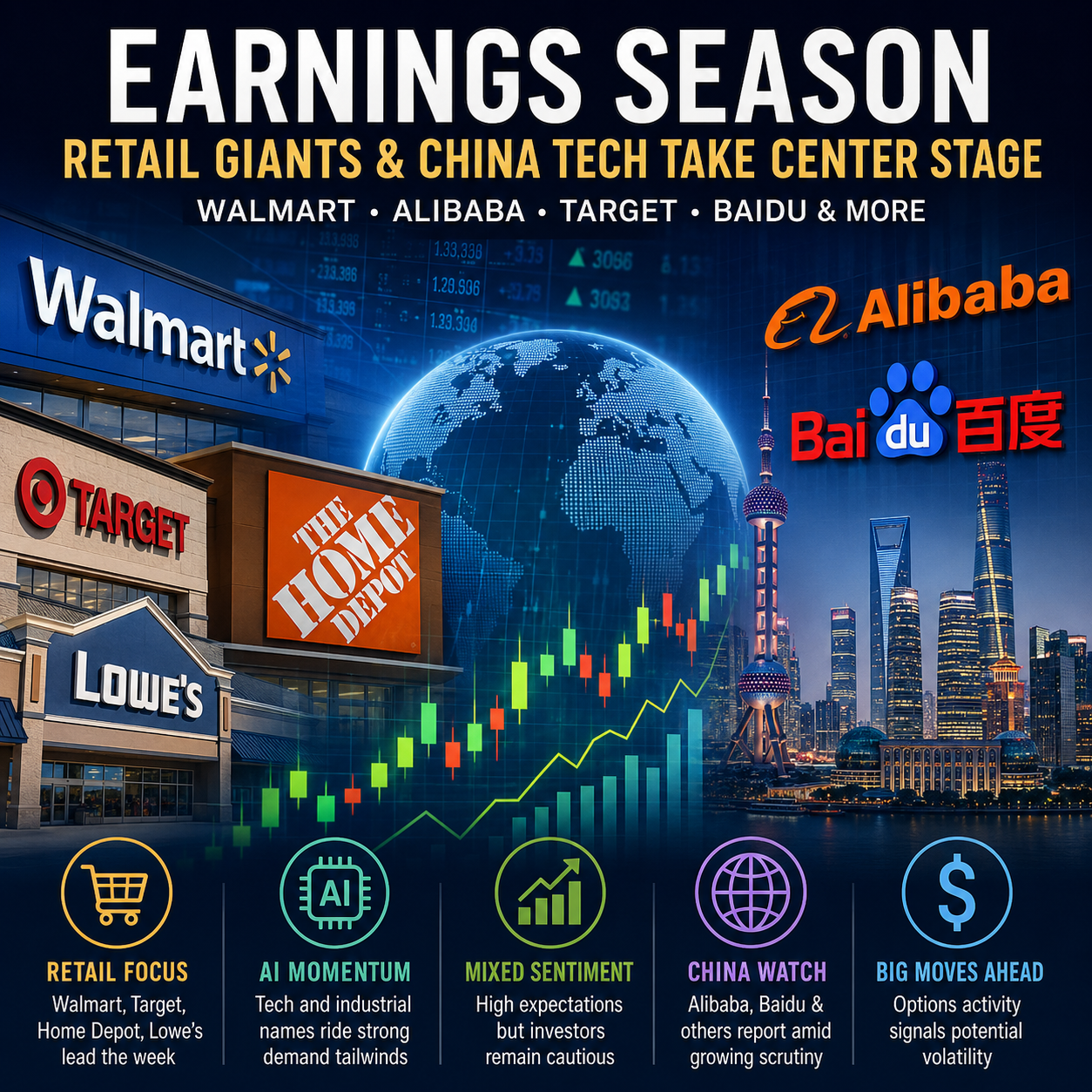
Earnings Season moves into an important stretch as major retailers, Chinese technology companies, semiconductor businesses and other large publicly traded companies prepare to release quarterly results. For investors, the week is less about any single earnings number and more about what those numbers reveal about consumer demand, artificial intelligence spending, margins, cloud growth and management expectations.
Walmart, Alibaba, Target and Baidu are among the most closely watched names because each offers a different view of the current business environment. Walmart provides a window into household spending and value-conscious consumers. Target is attempting to demonstrate that its recent improvement can develop into a sustainable recovery. Alibaba is investing heavily in artificial intelligence and cloud infrastructure while attempting to balance growth with profitability. Baidu is similarly trying to turn its artificial intelligence investments into a more meaningful commercial advantage.
This Earnings Season also includes Home Depot, Lowe’s, Analog Devices, BILL, H World, Klarna, Hesai and several other companies. Together, the reports provide a broader picture of the economy than any individual quarterly result can provide.
The central issue is straightforward: are companies generating durable growth, or are investors increasingly being asked to look beyond today’s numbers toward future opportunities?
That distinction matters because expectations can be just as important as reported results. A company can beat analyst estimates and still see its shares struggle if management provides cautious guidance. Conversely, a company can report mixed quarterly numbers but receive a favorable response if investors believe the underlying business is improving.
That makes this week’s Earnings Season particularly relevant for understanding the direction of several major market themes.
Why This Earnings Season Matters
The current Earnings Season is taking place against several competing economic and corporate trends.
Consumers remain highly focused on value, which benefits retailers with strong scale and pricing power. At the same time, higher fuel and input costs can pressure margins. Companies operating in discretionary categories face a different challenge because shoppers can postpone purchases when household budgets become more constrained.

Technology companies face another question. Artificial intelligence investment remains one of the most important sources of corporate spending, but investors increasingly want evidence that AI-related investment can produce revenue, operating leverage and long-term returns.
That distinction is especially important for Alibaba and Baidu. Both companies have been investing heavily in AI capabilities, cloud infrastructure and related technologies. Their results can therefore help investors assess whether AI is becoming a meaningful business driver rather than simply an area of elevated capital expenditure.
Semiconductor companies provide another perspective. Analog Devices is positioned at the intersection of industrial technology, data centers and AI infrastructure. Its results could help demonstrate whether demand is broadening beyond a small number of large technology companies.
Meanwhile, Home Depot and Lowe’s provide information about housing, renovation activity and consumer willingness to make larger purchases.
The most useful way to approach this Earnings Season is therefore to look beyond individual earnings-per-share figures.
Investors should examine:
- Revenue growth
- Comparable-store sales
- Gross margins
- Operating margins
- Free cash flow
- Management guidance
- Consumer behavior
- AI-related revenue
- Cloud growth
- Capital expenditure
- Cost pressures
- Inventory levels
- Demand trends
Those measures can provide a more complete picture of whether a company’s growth is sustainable.
Walmart Earnings: The Consumer Remains the Main Story
Walmart earnings are among the most important events of the week because Walmart’s scale gives investors a broad view of consumer spending.
Walmart is scheduled to report on Thursday, August 20, 2026, at approximately 7:00 a.m. ET. The supplied estimates call for adjusted earnings of about $0.73 per share and revenue of approximately $186.32 billion. Management’s guidance has been approximately $0.72 to $0.74 per share on revenue between $184.50 billion and $186.27 billion.
The numbers themselves are important, but the bigger issue is what Walmart says about the customer.
During this Earnings Season, investors are paying close attention to the behavior of lower-income households, grocery demand, general merchandise trends and the impact of fuel prices.
Walmart’s enormous customer base makes its commentary particularly useful. The company serves consumers across a wide range of income levels, meaning changes in shopping behavior can sometimes reveal broader shifts in household priorities.
Walmart’s Sales and Profit Outlook
The latest setup suggests that expectations are relatively constructive but not without concerns.
Walmart’s previous quarter demonstrated improvement in merchandise margins, stronger customer traffic and continued development of higher-margin businesses such as advertising, memberships and marketplace activity.
Those businesses matter because Walmart’s long-term profitability is not based exclusively on selling merchandise.
Advertising provides a higher-margin revenue opportunity. Membership programs can strengthen customer relationships and encourage repeat purchases. The marketplace expands product selection without requiring Walmart to own every item it sells.
The combination creates a more diversified profit structure.
This is one of the most important issues to watch in Earnings Season: whether Walmart can continue increasing profit faster than sales.
Revenue growth alone does not necessarily translate into stronger earnings. If Walmart needs to lower prices aggressively to protect market share, gross margins could suffer. If advertising, membership and marketplace businesses continue expanding, those higher-margin areas could help offset some pressure.
Fuel, Inflation and the Consumer
Fuel prices represent another important consideration.
The supplied analysis highlights a change in customer behavior, including smaller gasoline purchases among lower-income consumers. That type of behavior can be an early indication that households are becoming more cautious.
For Walmart, this creates an unusual combination of opportunity and risk.
When consumers become more price-sensitive, Walmart can benefit from its reputation for value. Customers may shift spending toward lower-priced products or move purchases away from more expensive retailers.
However, higher fuel costs can also reduce disposable income.
The company therefore faces two competing forces: more value-seeking customers can support traffic, while higher household costs can limit overall spending.
Management commentary during Earnings Season should help clarify which force is currently stronger.
The other major issue is guidance.
If Walmart raises its outlook, investors could interpret that as evidence that current trends are holding up better than expected. If management simply maintains its previous forecast, the market may focus more closely on margins, fuel costs and the second-half outlook.
The key question is not whether Walmart can produce one strong quarter.
It is whether Walmart can maintain sales momentum while protecting profitability in an environment where consumers remain highly price-conscious.
Alibaba Earnings: AI Growth Meets the Cost of Investment
Alibaba earnings provide a different perspective on the current Earnings Season.
Alibaba Group Holding Limited is expected to report on Thursday, August 20, 2026, at approximately 5:30 a.m. ET. The supplied estimates call for about $1.94 in earnings per share and approximately $38.63 billion in revenue.
The headline revenue growth expectation is approximately 11.7% year over year.
However, the central Alibaba story is not simply revenue growth.
It is the relationship between artificial intelligence, cloud computing, capital investment and profitability.
Alibaba has been investing heavily in AI infrastructure, computing capacity and related technologies. Investors therefore want to know whether those investments are creating a durable new growth cycle.
Alibaba’s AI and Cloud Investment
Alibaba’s cloud business is at the center of the story.
The supplied analysis points to cloud growth of approximately 40% in the previous quarter and a substantial increase in AI-related revenue since November.
Those trends suggest that AI is becoming commercially relevant to the business.
The challenge is that building AI infrastructure is expensive.
Data centers require significant capital. Advanced computing infrastructure requires substantial investment. AI development also requires engineering talent, hardware and ongoing research spending.
As a result, Alibaba’s growth cannot be evaluated through revenue alone.
Investors need to consider the quality of that growth.
If cloud and AI revenue grow rapidly while margins deteriorate substantially, the market may remain skeptical. If Alibaba can demonstrate that AI demand is translating into recurring, high-value cloud revenue, the long-term investment case becomes stronger.
That tension will be one of the defining themes of this Earnings Season.
Profit and Cash Flow Remain Important
Alibaba’s recent results showed the cost of its investment strategy.
The supplied draft notes a significant decline in an important profit measure and a return to negative cash flow as the company increased spending on chips and data centers.
That creates a clear investor debate.
One side sees the spending as necessary investment for a major technology transition.
The other side asks how long shareholders should wait for the investment to generate returns.
Both perspectives are reasonable.
AI infrastructure can create opportunities that are difficult to measure in a single quarter. At the same time, sustained negative cash flow can limit financial flexibility if growth fails to meet expectations.
The upcoming Alibaba earnings report should therefore be evaluated through three questions:
- Is cloud growth accelerating or slowing?
- Is AI-related revenue becoming a meaningful contributor?
- Is management gaining greater visibility into the return on its AI investment?
If Alibaba provides stronger evidence that AI demand is becoming recurring and scalable, investors may become more comfortable with the spending profile.
If revenue growth remains modest while costs continue rising rapidly, the market could focus more heavily on profitability.
Target Earnings: Can the Recovery Become Sustainable?
Target earnings will provide another important test during Earnings Season.
Target is scheduled to report on Wednesday, August 19, 2026, at approximately 6:30 a.m. ET. The supplied estimates call for approximately $2.26 per share on revenue of about $26.00 billion, with the whisper estimate slightly higher on earnings.
Target enters the report with a very different setup from Walmart.
While Walmart has maintained broad momentum, Target has been working to rebuild confidence after an extended period of weaker sales.
The company recently posted a significant improvement, with the supplied analysis highlighting a 5.6% increase in sales. Improvements across categories, including food and baby products, helped support the rebound.
But investors now face a more difficult question.
Was the improvement the beginning of a durable recovery, or was it helped by temporary factors that will be harder to repeat?
The Importance of the Comparison
One of the most important factors in this Earnings Season is the comparison Target is facing.
The company is now moving against a period that included significant demand associated with the Nintendo Switch 2 launch.
That creates a tougher year-over-year comparison.
A retailer can deliver positive results while reporting slower growth simply because the previous year’s comparison was unusually strong.
Investors should therefore focus on underlying sales trends rather than interpreting one percentage in isolation.
Target’s product mix will also matter.
Food can provide more consistent traffic than discretionary merchandise. Baby products and household essentials can create repeat purchases. Seasonal and entertainment-related products can generate strong demand but may also create more volatile comparisons.
Is the Turnaround Becoming Sustainable?
Target’s share-price performance has already raised expectations.
The supplied analysis notes that the stock had gained substantially since the previous report, while short interest had also increased.
That creates an interesting setup for Target earnings.
When a stock rises significantly before results, the company may need to demonstrate more than a simple beat.
Investors may want evidence that:
- Sales momentum is broadening.
- Traffic remains healthy.
- Margins are improving.
- Inventory is under control.
- Food and essentials remain strong.
- Discretionary spending is stabilizing.
- Management’s full-year outlook remains credible.
Target does not necessarily need extraordinary growth.
It needs consistency.
The market is looking for evidence that the company can build on recent improvements rather than repeatedly moving between strong and weak quarters.
That makes Target one of the more interesting turnaround stories of this Earnings Season.
Baidu Earnings: AI Momentum Faces a Skeptical Market
Baidu earnings add another major AI story to the week’s results.
Baidu is expected to report before the market opens on Tuesday, August 18, 2026, at approximately 5:00 a.m. ET. The supplied estimates call for around $1.51 in earnings per share and approximately $4.65 billion in revenue.
Revenue growth is expected to be relatively modest.
That might appear less exciting than the AI growth numbers elsewhere in the technology sector, but Baidu’s investment case is increasingly connected to the transformation of its core business through AI.
AI Cloud and Core Business
The previous quarter offered several developments worth monitoring.
The supplied analysis indicates that AI-related businesses accounted for more than half of Baidu’s core revenue and that AI cloud infrastructure revenue increased substantially.
GPU-related demand was also particularly strong.
Those numbers suggest that Baidu is moving from an AI development story toward an AI commercialization story.
That distinction is important.
Many companies can announce new AI models or infrastructure investments. Fewer can demonstrate that those investments are generating measurable revenue.
Baidu’s AI cloud business is therefore one of the most important metrics in this Earnings Season.
The company’s ERNIE model strategy is another factor.
Baidu is competing in a rapidly evolving Chinese AI market where technology leadership can change quickly. The company therefore needs to demonstrate not only strong products but also commercial adoption.
The Market Is Still Skeptical
The biggest issue surrounding Baidu earnings may be the difference between operational progress and investor sentiment.
The supplied analysis highlights substantial short-interest growth and a significant decline in the stock following the previous report.
That means the market is demanding evidence.
Baidu can report improving AI fundamentals, but investors may still ask whether those improvements are large enough to change the company’s long-term growth trajectory.
The upcoming report should therefore be evaluated on both operational and financial measures.
Investors should watch AI cloud growth, margins, cash flow, core revenue trends and management’s expectations for continued AI demand.
Robotaxi activity and the performance of iQIYI also remain relevant, although they represent different parts of the broader business.
The central question is whether AI becomes a catalyst capable of offsetting weaker areas elsewhere in the company.
Home Depot and Lowe’s Add a Housing Perspective
The Earnings Season retail picture extends beyond Walmart and Target.
Home Depot and Lowe’s are also scheduled to report, providing investors with a useful view of the home-improvement market.
Home Depot is expected to report Tuesday, August 18, 2026, while Lowe’s is scheduled for Wednesday, August 19.
The two companies operate in similar markets, but their results can provide different signals about consumers and housing.
Home Depot: Sales Growth Versus Margin Pressure
Home Depot enters the report with expectations for revenue growth but continued attention on margins.
The supplied analysis highlights positive comparable sales, strength from professional customers and online activity.
However, earnings have faced pressure from lower gross margins and higher costs.
Tariffs, fuel and energy prices are additional considerations.
That means investors should look beyond the headline revenue figure.
If sales increase while margins deteriorate, the quality of that growth becomes less attractive.
Home Depot’s acquisition activity also adds another layer to the story, with the Mingledorff’s HVAC deal expanding its addressable market.
The bigger economic issue is housing affordability.
Large renovation projects are often sensitive to financing costs and consumer confidence. If homeowners remain cautious about expensive projects, demand can remain uneven.
Lowe’s: Digital Growth With Margin Questions
Lowe’s enters Earnings Season with a different set of strengths.
The supplied analysis highlights online sales growth, four consecutive quarters of positive comparable sales and increased use of its Milo AI assistant.
Those developments suggest that Lowe’s is improving its digital customer experience.
However, margins remain the key concern.
Acquisition-related costs and higher fuel and shipping expenses can reduce the benefit of revenue growth.
Management has also characterized the housing environment as particularly challenging.
The contrast between Lowe’s digital progress and the broader housing environment makes the report particularly useful.
If online growth continues while margins stabilize, investors could see evidence that the company is gaining operating momentum.
If sales remain healthy but profitability weakens, the market may remain cautious.
Analog Devices and the Industrial AI Cycle
Analog Devices provides another important technology angle during Earnings Season.
The company is expected to report on Wednesday, August 19, 2026, with the supplied estimates calling for approximately $3.33 in earnings per share and about $3.92 billion in revenue.
The important story is the company’s exposure to industrial and data-center demand.
AI is often associated with consumer applications and large language models, but the infrastructure supporting AI requires semiconductors, power management, networking and industrial equipment.
Analog Devices sits within that broader infrastructure ecosystem.
The supplied analysis points to strong industrial growth and particularly rapid data-center growth in the previous quarter.
That makes the company useful for understanding whether AI spending is broadening.
If AI infrastructure investment continues to support semiconductor demand, companies such as Analog Devices can benefit even without being direct AI software providers.
This is another reason this Earnings Season is important.
The AI story is increasingly moving through the supply chain.
Other Companies to Watch During Earnings Season
Although Walmart, Alibaba, Target and Baidu are the primary focus, several additional companies could provide useful context.
BILL
BILL enters the week with a focus on profitability, AI investment and cost management.
The supplied analysis indicates that the company achieved its first GAAP profit in the previous quarter and increased its operating margin.
At the same time, core growth has moderated.
The company has also announced substantial workforce reductions as part of a strategy to improve efficiency and prioritize AI.
The question during Earnings Season is whether margin improvement can continue without damaging the company’s growth prospects.
H World
H World offers a view into China’s hospitality sector.
The previous quarter showed improvement in revenue per available room and stronger adjusted net income.
The company has also been expanding internationally.
However, management has maintained its broader outlook rather than aggressively raising expectations.
That combination suggests a company that is improving but remains cautious about the recovery.
Klarna
Klarna’s results are important because they combine fintech growth with consumer credit trends.
The supplied analysis highlights a major improvement in profitability, revenue growth and customer adoption.
The company has also expanded partnerships across the payments ecosystem.
The main issue is whether growth can remain strong as comparisons become more difficult.
Hesai
Hesai offers exposure to autonomous driving and LiDAR technology.
The company has secured major automotive relationships and has reported several consecutive profitable quarters.
However, investors must balance unit growth against falling average selling prices and investment in newer physical-AI opportunities.
That makes Hesai another example of a company where revenue growth does not tell the complete story.
The Bigger AI Theme Running Through Earnings Season
One of the clearest themes of this Earnings Season is that artificial intelligence is no longer confined to a small group of software companies.
AI is increasingly affecting:
- Cloud computing
- Semiconductors
- Data centers
- Networking
- Payments
- Retail
- Autonomous vehicles
- Digital advertising
- Customer service
- Industrial automation
Cisco, Applied Materials, Super Micro Computer and other companies have provided additional evidence that AI infrastructure spending is influencing broader corporate investment.
But investors should remain disciplined.
AI-related revenue growth can be substantial while the cost of generating that revenue also rises rapidly.
The market therefore needs to distinguish between AI demand and AI profitability.
Alibaba is a clear example.
The company is seeing stronger cloud and AI demand but is also spending heavily on infrastructure.
Baidu presents another version of the same question.
AI cloud and related businesses are growing, but investors want to know whether that growth can translate into sustainable financial improvement.
Analog Devices offers a more mature version of the theme, where AI demand supports semiconductor infrastructure without the company being primarily identified as an AI business.
This broadening of the AI cycle could become one of the most important long-term themes emerging from the current Earnings Season.
What Investors Should Watch During Earnings Season
Investors can make earnings analysis more useful by focusing on a consistent set of questions.
1. Did revenue meet expectations?
Revenue provides the foundation for the analysis.
A company that consistently grows revenue has more opportunities to expand earnings over time.
But revenue quality matters.
Growth created through discounting, acquisitions or temporary factors may not have the same value as organic growth.

2. What happened to margins?
Margins often tell investors more than revenue.
A company can grow sales while losing profitability if costs rise faster than revenue.
This is especially relevant for Walmart, Home Depot and Lowe’s.
3. Did management change guidance?
Guidance can be more important than the quarter itself.
If management raises its outlook, investors may interpret it as evidence of confidence.
If guidance falls, a quarterly beat may quickly become less important.
4. What is happening with cash flow?
Cash flow is particularly important for companies investing heavily in AI.
Alibaba and Baidu need to demonstrate that their investment programs can eventually generate returns.
Revenue growth alone is not enough.
5. Is consumer demand changing?
Walmart and Target provide complementary perspectives.
Walmart’s scale offers insight into value-conscious consumers, while Target provides information about discretionary spending and household priorities.
6. Are AI investments becoming commercial?
This question will become increasingly important throughout future earnings cycles.
Investors should look for measurable revenue, customer adoption, recurring contracts and improving economics.
Announcements alone are not enough.
7. What does management say about the next quarter?
A company’s future outlook can determine how the market interprets the current results.
Management commentary about demand, costs, hiring, capital expenditure and pricing should receive close attention.
Key Risks During Earnings Season
Every Earnings Season carries uncertainty, and this week is no exception.
Consumer weakness
If consumers become more cautious, retailers could face slower discretionary sales.
Higher operating costs
Fuel, energy, transportation and other input costs can pressure margins.
Difficult comparisons
Companies such as Target may face unusually strong prior-year comparisons that make current growth harder to achieve.
AI spending
Technology companies may need to spend heavily before AI investments generate sufficient returns.
Currency and international exposure
Alibaba, Baidu and other global companies can experience currency-related effects that complicate year-over-year comparisons.
Investor expectations
A company can produce a solid quarter and still disappoint if investors expected something stronger.
This is one of the most important principles for understanding Earnings Season.
Markets react to the difference between expectations and reality, not simply whether a company makes money.
How to Read Earnings Results Without Overreacting
A professional approach to Earnings Season requires separating the headline from the underlying trend.
A company reports a beat.
That is useful information, but it is not necessarily the conclusion.
The next questions should be:
Why did it beat?
Was the result driven by stronger sales, lower expenses, tax benefits, buybacks, timing or another temporary factor?
Can it repeat the performance?
A one-quarter improvement is less meaningful if management expects conditions to normalize.
Did the balance sheet improve?
Strong earnings accompanied by weak cash flow can create a different investment profile from strong earnings accompanied by stronger cash generation.
Did management become more confident?
The language used during an earnings call can reveal whether executives see current trends as temporary or structural.
This approach is particularly useful this week because many of the companies being watched are in transition.
Walmart is expanding higher-margin businesses while navigating consumer pressures.
Target is attempting to establish a sustained recovery.
Alibaba is investing aggressively in AI and cloud.
Baidu is attempting to convert AI capabilities into commercial growth.
The differences between those stories matter.
The Main Themes Investors Should Carry Forward
The most important takeaway from this Earnings Season is that the market is becoming more selective about growth.
Strong revenue growth remains valuable, but investors increasingly want to know what sits underneath it.
For retailers, that means margins, traffic, product mix and consumer behavior.
For technology companies, it means AI monetization, cloud demand, capital expenditure and cash flow.
For industrial businesses, it means whether AI infrastructure demand is spreading into the wider supply chain.
For Chinese technology companies, it also means whether AI can help restore stronger growth while maintaining financial discipline.
That creates several important comparisons.
Walmart versus Target
Walmart represents scale, value and relatively resilient consumer demand.
Target represents a recovery story that needs to prove its recent improvement can continue.
Alibaba versus Baidu
Alibaba has a major cloud and AI investment story.
Baidu has an AI-driven transformation story centered on cloud, models and autonomous technology.
Both face the same broad question: can AI growth become financially meaningful?
Home Depot versus Lowe’s
Both companies are exposed to housing and home improvement.
Their results can help investors understand whether consumers are delaying large projects or simply shifting where they spend.
Retail versus technology
Retail results show what consumers are doing today.
Technology results increasingly show what businesses are investing in for tomorrow.
That contrast is one reason the week has such broad market relevance.
Earnings Season Outlook: What Comes Next
The current Earnings Season is not simply a collection of quarterly reports.
It is a test of several major market narratives.
The consumer story is being tested by Walmart and Target.
The housing and discretionary-spending story is being tested by Home Depot and Lowe’s.
The AI investment story is being tested by Alibaba, Baidu and Analog Devices.
The semiconductor and infrastructure cycle is being tested by technology suppliers.
The fintech and consumer-credit environment is being tested by companies such as Klarna and BILL.
Investors should therefore resist the temptation to judge the week based on one headline number.
The more useful question is whether companies are showing evidence of durable growth, stable margins and credible forward guidance.
For Walmart, the critical issue is whether its scale and higher-margin businesses can offset consumer and fuel pressures.
For Target, the question is whether its recovery can continue against difficult comparisons.
For Alibaba, the focus is whether AI and cloud growth can justify the cost of investment.
For Baidu, the question is whether AI is becoming large enough to change the company’s broader growth profile.
And for the wider market, the question is whether the artificial intelligence investment cycle continues to expand beyond the companies most directly associated with AI.
That is the larger story investors should carry forward from this Earnings Season.
Frequently Asked Questions About Earnings Season
What is Earnings Season?
Earnings Season is the period when publicly traded companies release quarterly financial results. Companies typically report revenue, earnings, margins, cash flow and management guidance, giving investors updated information about business performance.
Why is Earnings Season important for investors?
Earnings Season provides fresh information about corporate growth, profitability, consumer demand and future expectations. It can also reveal whether broader economic trends are affecting individual industries.
When are Walmart earnings scheduled?
Walmart is scheduled to report its fiscal second-quarter results on Thursday, August 20, 2026, at approximately 7:00 a.m. ET, according to the schedule reflected in the supplied analysis.
What should investors watch in Walmart earnings?
The most important areas include sales growth, customer traffic, merchandise margins, advertising and membership growth, fuel costs, consumer behavior and full-year guidance.
When are Alibaba earnings expected?
Alibaba is expected to report on Thursday, August 20, 2026, at approximately 5:30 a.m. ET based on the supplied earnings schedule.

What is the main issue for Alibaba earnings?
The main issue is whether Alibaba’s AI and cloud investments are producing sufficiently strong revenue growth to justify the significant spending required for infrastructure, chips and data centers.
When are Target earnings scheduled?
Target is scheduled to report on Wednesday, August 19, 2026, at approximately 6:30 a.m. ET according to the supplied schedule.
What should investors watch in Target earnings?
Investors should focus on comparable sales, customer traffic, food and essential categories, discretionary demand, margins, inventory and management’s expectations for the remainder of the year.
When are Baidu earnings expected?
Baidu is expected to report before the market opens on Tuesday, August 18, 2026, at approximately 5:00 a.m. ET, based on the supplied schedule.
What is the main Baidu earnings story?
The main story is the growth of AI-related businesses, particularly AI cloud and infrastructure, and whether those businesses can produce sustainable financial growth despite pressure elsewhere in the company.
Why does AI matter during Earnings Season?
AI matters because it is influencing investment across cloud computing, semiconductors, data centers, networking, software and autonomous technology. Investors increasingly want evidence that AI spending is producing measurable commercial returns.
Should investors focus only on earnings-per-share results?
No. EPS is important, but investors should also examine revenue, margins, cash flow, guidance, customer demand, capital spending and management commentary. Those factors can provide a clearer picture of business quality.
Why can a company fall after beating earnings expectations?
A stock can decline after an earnings beat if investors expected an even stronger result, management lowered guidance, margins deteriorated, future growth looks weaker or the share price already reflected optimistic expectations.
What is the most important theme of this week’s reports?
The key themes are consumer resilience, margin management, AI monetization, cloud growth, infrastructure investment and the ability of companies to maintain growth as comparisons become more difficult.
Conclusion
This Earnings Season offers investors a broad look at the forces shaping markets in the second half of 2026.
Walmart is positioned as a key indicator of consumer spending and value-seeking behavior. Target is attempting to prove that its recent improvement represents a sustainable recovery. Alibaba and Baidu are trying to demonstrate that significant AI investment can translate into commercially meaningful growth. Home Depot and Lowe’s provide insight into housing and discretionary spending, while Analog Devices offers a view into the industrial and semiconductor side of the AI infrastructure cycle.
The most important lesson is to look beyond the headline earnings number.
Revenue growth matters. Earnings matter. But margins, cash flow, guidance and management’s view of future demand can matter just as much.
The same principle applies across the entire Earnings Season.
A strong quarter is useful, but sustainable growth is more important.
An AI announcement can attract attention, but recurring AI revenue is more meaningful.
A retail sales increase can look encouraging, but improving profitability and customer behavior provide a stronger foundation.
As Walmart, Alibaba, Target, Baidu and the other companies report, investors will have an opportunity to compare these different business models and determine which trends appear temporary and which appear structural.
For market participants, that broader perspective may be more valuable than any single earnings surprise.