









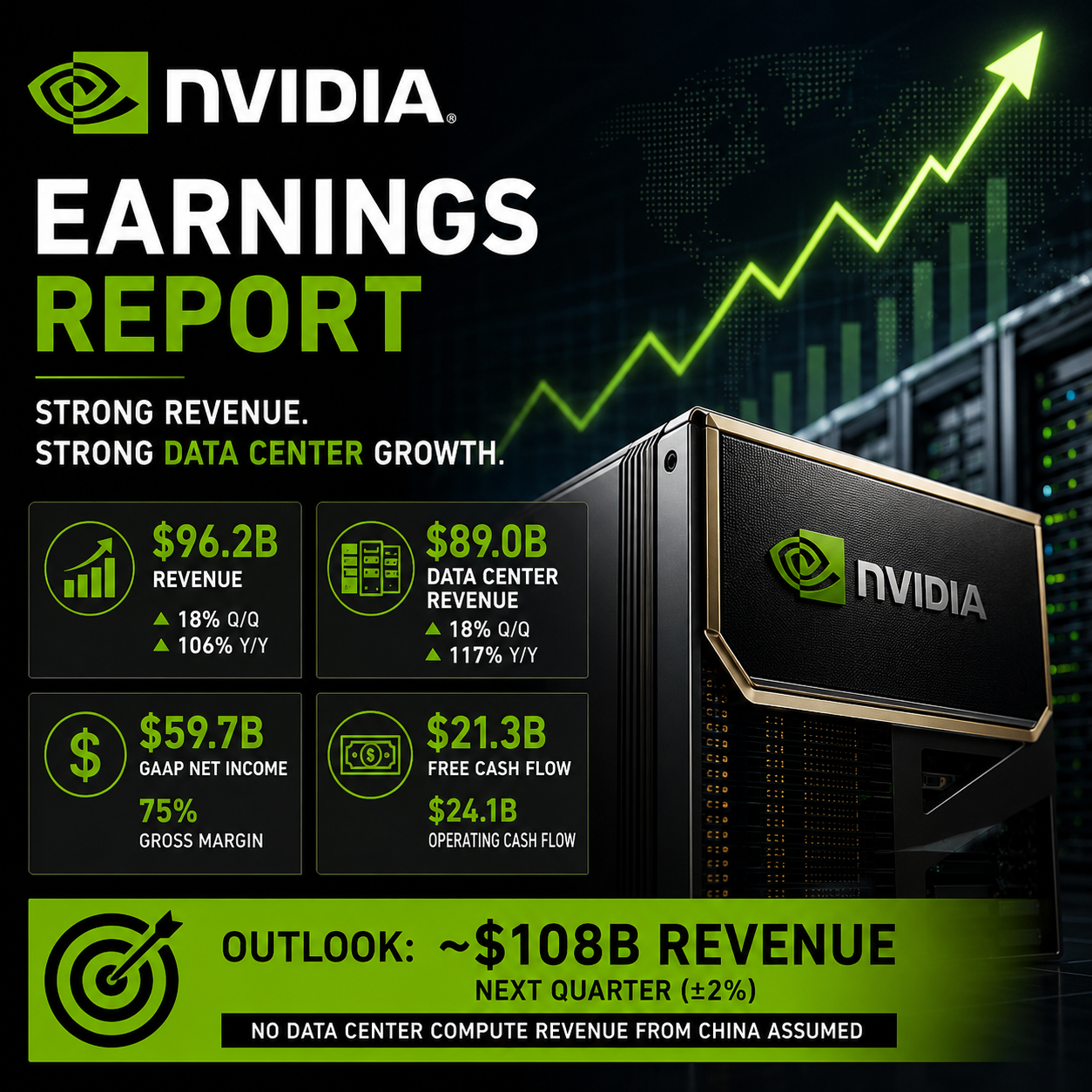
NVIDIA earnings for the latest quarter show a business continuing to expand at a substantial pace, led by demand for artificial intelligence infrastructure and accelerated computing. Revenue reached $96.2 billion, an increase of 18% from the previous quarter and 106% from the same quarter a year earlier.
The most important part of the results remains the Data Center business. Data Center revenue reached $89.0 billion, up 18% sequentially and 117% year over year. The scale of that business means Data Center revenue now represents the overwhelming majority of NVIDIA’s quarterly revenue.
The earnings figures also show that the company’s growth is translating into significant profitability. NVIDIA reported $72.1 billion in GAAP gross profit, a 75.0% GAAP gross margin, $63.7 billion in operating income and $59.7 billion in net income.
On a non-GAAP basis, NVIDIA reported $54.0 billion in net income and $2.22 in diluted earnings per share. GAAP diluted earnings per share were $2.46.
The financial results also provide a useful view into NVIDIA’s cash generation and balance sheet. Operating cash flow reached $24.1 billion during the quarter, while free cash flow was approximately $21.3 billion.
For the next quarter, the NVIDIA outlook calls for revenue of $108 billion, plus or minus 2%. The company is not assuming any Data Center compute revenue from China in that outlook.
Taken together, the numbers point to three central themes: exceptionally strong revenue growth, continued expansion of the Data Center business and substantial cash generation.
NVIDIA Revenue Reaches $96.2 Billion
The headline number from the latest NVIDIA earnings report is revenue of $96.221 billion.
That compares with:
- $81.615 billion in the previous quarter
- $46.743 billion in the same quarter a year earlier
The sequential increase was approximately $14.6 billion, representing 18% growth. Compared with the year-ago quarter, revenue increased by approximately $49.5 billion.
This is important because NVIDIA is no longer growing from a relatively small revenue base. The company is producing quarterly revenue approaching $100 billion while still reporting double-digit sequential growth.
The revenue performance also exceeded the company’s previous quarterly outlook. NVIDIA had previously guided for revenue of approximately $91 billion for the quarter, plus or minus 2%. Actual revenue came in substantially above that range.
The result demonstrates the continuing strength of demand for NVIDIA’s computing platforms.
Revenue growth is increasingly connected to the broader buildout of AI infrastructure. Cloud providers, technology companies, enterprises, research institutions and other organizations are investing in computing capacity required to train, deploy and operate increasingly sophisticated AI models.
For NVIDIA, this has created demand across processors, networking, systems and software.
The latest earnings therefore need to be viewed not simply as a semiconductor sales result. They reflect the expansion of a broader computing infrastructure business.
Data Center Revenue Is the Main Growth Engine
The most significant figure in the NVIDIA earnings report is arguably the $89.0 billion in Data Center revenue.
Data Center revenue increased:
- 18% from the previous quarter
- 117% from a year earlier
The $89 billion figure also represents approximately 92% of total quarterly NVIDIA revenue.
That concentration explains why Data Center performance is so important when evaluating NVIDIA’s financial results.
The company’s Data Center business is benefiting from continued investment in AI computing infrastructure. The demand extends beyond individual GPUs. Customers increasingly require complete systems capable of supporting large-scale AI workloads.
That includes computing, networking, storage, CPUs, accelerated infrastructure and software.
NVIDIA’s Vera Rubin platform is an important part of this next phase of infrastructure development. The company has said that the platform is moving into full production, with systems being deployed through major infrastructure partners.
The broader strategy is to provide customers with increasingly complete AI infrastructure rather than competing solely on the performance of an individual processor.
That approach could help NVIDIA maintain a significant position as AI workloads become more complex.
Why Data Center Growth Matters for NVIDIA Revenue
The relationship between Data Center revenue and overall NVIDIA revenue has become increasingly direct.
When Data Center revenue rises, the effect on total company revenue is substantial because of its size relative to the rest of the business.
In the latest quarter, Data Center revenue increased by approximately $13.8 billion from the previous quarter, compared with total company revenue growth of approximately $14.6 billion.
That means the Data Center business accounted for most of NVIDIA’s sequential revenue increase.
The comparison with the year-ago quarter is even more significant. Data Center revenue rose from approximately $41.1 billion to $89.0 billion.
That represents an increase of nearly $48 billion in a year.

This explains why investors and analysts continue to focus heavily on Data Center revenue when assessing NVIDIA earnings.
The important question is no longer simply whether NVIDIA is selling more GPUs. It is whether demand for AI infrastructure continues to support sustained investment by customers.
The latest figures indicate that demand remained strong during the quarter.
NVIDIA Earnings Show Strong Profitability
Revenue growth is only part of the financial picture. The profitability figures are equally important.
NVIDIA reported $72.142 billion in GAAP gross profit during the quarter, compared with $33.853 billion in the same quarter a year earlier.
GAAP gross margin was 75.0%, compared with 72.4% a year earlier.
That represents an improvement of 2.6 percentage points.
A 75% gross margin at NVIDIA’s current revenue scale demonstrates the financial strength of its business model.
Operating expenses were $8.408 billion, compared with $5.413 billion in the year-ago quarter.
Operating expenses therefore increased substantially, but revenue and gross profit grew at a considerably faster rate.
The result was GAAP operating income of $63.734 billion, compared with $28.440 billion a year earlier.
That represents operating income growth of approximately 124%.
The figures demonstrate the operating leverage within NVIDIA’s business.
As revenue grows, the company is able to generate significantly more operating income even while investing heavily in research and development, sales and administration.
NVIDIA Net Income and Earnings Per Share
NVIDIA reported $59.688 billion in GAAP net income for the quarter.
That compares with $26.422 billion in the same quarter a year earlier.
GAAP net income therefore increased by approximately 126% year over year.
GAAP diluted earnings per share were $2.46, compared with $1.08 in the year-ago quarter.
Non-GAAP net income was $53.954 billion, compared with $24.763 billion a year earlier.
Non-GAAP diluted earnings per share were $2.22, compared with $1.01 in the comparable quarter.
These results show that the increase in NVIDIA revenue is translating into significant earnings growth.
For investors evaluating earnings quality, it is important to consider both revenue and profitability. NVIDIA is not simply reporting higher sales; the company is also producing substantial operating income and net income from those sales.
Gross Margin Remains at 75%
One of the notable elements of the latest NVIDIA earnings is the stability of gross margin.
GAAP gross margin was 75.0%.
Non-GAAP gross margin was also 75.0%.
That compares with a non-GAAP gross margin of 72.5% in the year-ago quarter.
The improvement matters because NVIDIA is operating at a significantly larger scale while maintaining a very high level of gross profitability.
Gross margin can be influenced by product mix, manufacturing costs, system configurations, supply-chain conditions and other factors.
The fact that NVIDIA maintained a 75% margin while revenue reached $96.2 billion suggests that demand for its current product platforms remains strong enough to support substantial profitability.
The company expects gross margin to remain elevated in the next quarter, although its outlook calls for approximately 74.0%, plus or minus 50 basis points.
That modest reduction does not necessarily indicate a deterioration in the business. Margins can fluctuate as new products ramp, product mix changes and infrastructure systems become a larger component of the business.
NVIDIA CFO Financial Review
The financial results provide a broader picture beyond revenue and earnings.
NVIDIA’s chief financial officer is Colette Kress, who has served as the company’s executive vice president and chief financial officer since joining NVIDIA in 2013. The CFO perspective is particularly relevant because NVIDIA’s growth now involves substantial working-capital requirements, infrastructure investment, inventory management and shareholder returns.
The quarterly financial statements show that NVIDIA generated $24.077 billion in cash from operating activities.
That is a substantial amount of operating cash flow for a single quarter.
Six-month operating cash flow reached $74.421 billion, compared with $42.779 billion during the comparable period.
The increase demonstrates the strength of NVIDIA’s underlying cash generation.
However, the cash-flow statement also highlights an important feature of a rapidly growing technology business: working capital requirements can increase significantly as revenue expands.
Accounts receivable increased by $22.346 billion during the quarter, while inventories increased by $5.784 billion.
Those movements reflect the scale of NVIDIA’s business and the capital required to support growing sales.
For financial analysis, this makes operating cash flow particularly important. Earnings provide one measure of profitability, while cash flow shows how much cash the business is generating from its operations.
Free Cash Flow Remains a Major Financial Strength
NVIDIA generated approximately $21.341 billion in free cash flow during the quarter.
Free cash flow was calculated from operating cash flow after purchases related to property and equipment and intangible assets and principal payments associated with those assets.
For the six months, NVIDIA generated approximately $69.895 billion in free cash flow.
That compares with approximately $39.584 billion during the comparable six-month period.
Free cash flow provides an important measure of NVIDIA’s financial flexibility.
A company generating substantial free cash flow can fund research and development, infrastructure, acquisitions, shareholder returns and other investments without relying entirely on external financing.
NVIDIA’s latest results show that the company is generating substantial cash while simultaneously expanding its business.
That combination is important because the AI infrastructure market requires considerable investment.
NVIDIA itself must continue investing in research and development and expanding its ability to support customers as computing requirements increase.
NVIDIA Balance Sheet Shows Significant Liquidity
The balance sheet also provides important context for the NVIDIA earnings report.
At the end of the quarter, NVIDIA had approximately:
- $22.4 billion in cash and cash equivalents
- $34.1 billion in marketable debt securities
- $42.8 billion in marketable equity securities
- $63.1 billion in accounts receivable
- $31.6 billion in inventories
Total current assets were approximately $197.4 billion.
Total assets reached approximately $320.3 billion.
Shareholders’ equity stood at approximately $229.0 billion.
Total liabilities were approximately $91.3 billion.
The balance sheet shows that NVIDIA has substantial financial resources available to support continued expansion.
At the same time, the company has increased its long-term debt compared with the beginning of the year.
Long-term debt was approximately $32.4 billion, compared with approximately $7.5 billion at the beginning of the year.
The increase in debt should be viewed alongside NVIDIA’s cash generation and broader capital position rather than in isolation.
The company’s strong operating cash flow and large asset base provide significant financial capacity.
NVIDIA Returns Approximately $26 Billion to Shareholders
NVIDIA also continued returning capital to shareholders.
During the quarter, the company returned approximately $26.0 billion through share repurchases and cash dividends.
The cash-flow statement shows approximately $19.7 billion in payments related to common-stock repurchases and approximately $6.0 billion in dividends paid.
NVIDIA had approximately $99 billion remaining under its share repurchase authorization at the end of the quarter.
The company also announced that its next quarterly cash dividend will be $0.25 per share, payable October 1 to shareholders of record as of September 10.
The scale of the repurchases is significant.
It demonstrates that NVIDIA is not only investing heavily in the expansion of its business but is also returning substantial amounts of capital to shareholders.
For investors, capital allocation is increasingly relevant as NVIDIA’s cash generation expands.
NVIDIA Outlook Points to $108 Billion in Revenue
The NVIDIA outlook for the next quarter is another major feature of the earnings report.
NVIDIA expects revenue of approximately $108 billion, plus or minus 2%.
The midpoint of that guidance represents another increase from the current quarter’s $96.2 billion.
If achieved, the midpoint would represent sequential growth of approximately 12%.
The outlook is particularly important because NVIDIA has already reached an extremely large revenue base.
Maintaining double-digit sequential growth at this scale requires significant demand across the company’s customer base.
The outlook therefore provides investors with an indication of management’s expectations for continued demand.
At the same time, NVIDIA has explicitly stated that its outlook assumes no Data Center compute revenue from China.
That makes the $108 billion outlook particularly relevant when evaluating the underlying demand outside that market.
China Remains an Important Variable in the NVIDIA Outlook
China remains one of the factors investors will need to monitor when evaluating NVIDIA’s future revenue.
The company’s latest outlook does not assume any Data Center compute revenue from China.
That does not mean China has become irrelevant to NVIDIA. Rather, it means the company’s near-term revenue expectations have been constructed without relying on Data Center compute sales from that market.
This creates an important distinction.
NVIDIA’s latest outlook is based on expected demand from the rest of its global customer base, while developments involving China could affect future revenue depending on regulatory conditions, product availability and customer demand.
For investors, the key issue is therefore not simply whether China contributes to the next quarter.
The broader question is how NVIDIA’s global AI infrastructure demand develops independently of that market.
The latest revenue and Data Center figures suggest that NVIDIA currently has considerable demand outside China.
Vera Rubin and the Next Phase of AI Infrastructure
NVIDIA is also positioning Vera Rubin as a major platform for the next stage of AI infrastructure.
The company says Vera Rubin is moving into full production.
The platform is designed around the increasingly demanding requirements of AI workloads, including agentic AI and large-scale inference.
This is significant because AI infrastructure is evolving.
Early AI infrastructure investment focused heavily on training increasingly large models.
The next stage increasingly involves running those models at scale.
That requires substantial computing resources because inference occurs continuously when AI applications are used.
As enterprises and consumers adopt AI agents and other AI-powered applications, the amount of inference required could increase substantially.
NVIDIA’s strategy is to provide the computing infrastructure needed across that entire lifecycle.
That includes CPUs, GPUs, networking, storage, systems and software.
Blackwell Remains Important to NVIDIA’s Growth
NVIDIA’s Blackwell platform remains a central part of its AI computing business.
The company highlighted Blackwell’s performance in recent benchmarking and continues to expand the platform across AI infrastructure.
The importance of Blackwell extends beyond processor performance.
NVIDIA’s competitive position increasingly depends on its ability to combine hardware with networking, software and development tools.
This integrated approach can make it easier for customers to build AI infrastructure around NVIDIA’s technology.
The result is a business model that is broader than selling individual graphics processors.
As AI systems become more complex, the infrastructure required to operate them also becomes more sophisticated.
NVIDIA’s earnings increasingly reflect this broader platform approach.
AI Infrastructure Is Becoming a Larger Business Ecosystem
One of the most important themes from the latest NVIDIA earnings is the expansion of the AI infrastructure ecosystem.
The company highlighted partnerships involving cloud providers, technology companies, infrastructure developers, governments and financial institutions.
NVIDIA is also expanding its offerings in AI agents, software libraries, open models, robotics and physical AI.
This matters because the long-term opportunity is not limited to training large language models.
AI is increasingly being incorporated into enterprise software, scientific computing, robotics, autonomous vehicles, industrial systems and other applications.
Each new application can create additional demand for computing infrastructure.
That creates a potential cycle in which improvements in AI capabilities lead to more applications, which in turn require more computing capacity.
NVIDIA is positioning its platform to participate in multiple parts of that cycle.
Edge Computing Revenue Also Continues to Grow
Although Data Center receives most of the attention, NVIDIA’s other businesses are also contributing to growth.
Edge Computing revenue reached approximately $7.2 billion during the quarter.
That represented:
- 13% growth from the previous quarter
- 27% growth from a year earlier
The Edge Computing business includes areas such as AI-enabled PCs, robotics, autonomous vehicles and other applications where computing occurs closer to the point of use.
NVIDIA’s RTX and DGX platforms are part of its broader strategy to extend AI computing beyond large Data Center environments.
The company is also expanding its presence in autonomous vehicles and robotics.
That gives NVIDIA additional potential sources of long-term revenue beyond Data Center infrastructure.
NVIDIA Is Expanding Into Physical AI
Physical AI is another area receiving increasing attention.
NVIDIA has been developing platforms for robotics, autonomous vehicles and other physical systems that can use AI to perceive and interact with the real world.
The company has introduced platforms and models aimed at humanoid robotics, autonomous vehicles and industrial applications.
The significance of physical AI is that it potentially extends AI computing into areas where machines must process large amounts of visual, sensor and environmental information in real time.
That creates different computing requirements from conventional enterprise software.
NVIDIA’s strategy is to provide the underlying infrastructure and development tools for these applications.
If adoption increases, physical AI could become another long-term source of demand for NVIDIA computing platforms.
NVIDIA’s Software Strategy Supports Its Hardware Business
Another important element of the NVIDIA business is software.
The company continues to expand CUDA, CUDA-X libraries, developer tools, AI agent frameworks and industry-specific software.
Software matters because it can strengthen the broader NVIDIA ecosystem.
Customers developing applications around NVIDIA’s hardware and software stack may become more deeply integrated with that environment over time.
This can provide NVIDIA with an advantage beyond the specifications of an individual chip.
The company’s expansion into AI agents and domain-specific applications also creates additional opportunities to bring its computing platform into enterprise workflows.
That is increasingly relevant as businesses move from experimenting with AI to deploying AI systems in production.
NVIDIA Earnings Reflect a Broader Shift in Computing
The latest NVIDIA earnings are also evidence of a broader shift in the computing industry.
Traditional computing infrastructure remains important, but AI workloads are driving demand for accelerated computing at unprecedented scale.
Companies need more computing capacity to train models, operate inference workloads and deploy AI applications.
That requires a combination of processors, memory, networking, storage and software.
NVIDIA has built its business around many of these requirements.
The company’s current financial performance therefore reflects both its competitive position and the scale of investment taking place across the technology industry.
The question for investors is how long this level of infrastructure spending can continue and how the economics evolve as the market matures.
The Importance of Operating Expenses
NVIDIA’s operating expenses increased during the quarter.
GAAP operating expenses reached approximately $8.4 billion, compared with $5.4 billion a year earlier.
Research and development accounted for approximately $7.1 billion.
Sales, general and administrative expenses were approximately $1.4 billion.
The increase in research and development spending reflects the need to continue developing new architectures, software and platforms.
For NVIDIA, maintaining its technological position requires significant investment.
The company’s product roadmap spans multiple generations of computing technology, making research and development one of the most important long-term expenditures.
The latest earnings demonstrate that NVIDIA can increase research spending while still producing substantial operating income.
Six-Month Results Show the Scale of the Business
Looking beyond the quarter provides another perspective.
For the first six months of the period, NVIDIA reported:
- $177.837 billion in revenue
- $133.299 billion in gross profit
- 75.0% gross margin
- $117.270 billion in operating income
- $118.010 billion in net income
- $4.85 GAAP diluted earnings per share
- $99.502 billion in non-GAAP net income
- $4.09 non-GAAP diluted earnings per share
Six-month operating cash flow reached approximately $74.4 billion.
Six-month free cash flow reached approximately $69.9 billion.

These figures highlight how rapidly NVIDIA has expanded.
The company is generating more than $100 billion in revenue over a six-month period while maintaining a gross margin of approximately 75%.
That scale makes NVIDIA one of the most financially significant companies in the global technology sector.
What the NVIDIA Outlook Means for Investors
The NVIDIA outlook provides several points for investors to monitor.
First is revenue growth.
The company expects approximately $108 billion in revenue in the next quarter, plus or minus 2%.
Second is Data Center demand.
Because Data Center revenue accounts for such a large portion of total revenue, changes in that business will have a significant impact on the company as a whole.
Third is gross margin.
NVIDIA expects approximately 74.0% gross margin in the next quarter.
Fourth is operating expenses.
The company expects approximately $9.2 billion in GAAP operating expenses and $9.0 billion in non-GAAP operating expenses.
These figures will help investors assess whether the company’s substantial revenue growth continues to translate into strong earnings.
Key Risks to Monitor
Strong NVIDIA earnings do not eliminate business risks.
The company operates in a rapidly changing technology environment where competition, regulation, supply constraints and customer spending patterns can change.
One important consideration is customer concentration.
Large cloud providers and technology companies account for substantial portions of AI infrastructure spending.
If major customers slow their capital expenditure plans, demand for computing infrastructure could be affected.
Another factor is product transitions.
NVIDIA must continually introduce new architectures while managing production, supply chains and customer deployments.
The transition between generations can influence margins and inventory.
Regulatory restrictions also remain relevant, particularly regarding China.
NVIDIA’s current outlook explicitly excludes Data Center compute revenue from China, making the company’s global demand base particularly important.
Competition is another factor.
Other semiconductor companies and technology providers continue to develop AI accelerators and related infrastructure.
The strength of NVIDIA’s software ecosystem and integrated platform will therefore remain an important competitive consideration.
Why Cash Flow Matters Alongside NVIDIA Earnings
Investors often focus on earnings per share, but cash flow provides another important measure of financial health.
NVIDIA’s latest quarter generated approximately $24.1 billion in operating cash flow and $21.3 billion in free cash flow.
Those numbers demonstrate that the company’s reported profitability is accompanied by substantial cash generation.
Cash flow is particularly important for a company operating in a capital-intensive technology environment.
NVIDIA can use its cash generation to fund research and development, expand infrastructure, pursue strategic opportunities and return capital to shareholders.
The company is therefore balancing three major financial priorities: investing for future growth, maintaining a strong financial position and returning capital to shareholders.
NVIDIA’s Financial Position Supports Continued Investment
The balance sheet provides NVIDIA with significant flexibility.
Total assets reached approximately $320.3 billion, while shareholders’ equity stood at approximately $229.0 billion.
The company also held substantial cash, marketable securities and other investments.
That financial position provides resources for continued investment in technology and infrastructure.
NVIDIA’s financial strength is particularly relevant because the AI infrastructure market remains in an expansion phase.
The company needs to invest ahead of future product demand while maintaining enough flexibility to respond to changes in customer requirements.
The latest earnings indicate that NVIDIA has the financial capacity to continue doing so.
NVIDIA Earnings: What Comes Next?
The next stage of NVIDIA’s story will depend on whether AI infrastructure spending continues to expand at a high rate.
The latest quarter provides evidence that demand remains strong.
Revenue increased 106% year over year.
Data Center revenue increased 117%.
Gross margin reached 75%.
Operating income more than doubled.
Net income more than doubled.
Operating cash flow reached $24.1 billion.
Free cash flow exceeded $21 billion.
The next-quarter revenue outlook of $108 billion indicates that management expects the expansion to continue.
The challenge for NVIDIA will be maintaining this rate of growth as the revenue base becomes increasingly large.
At the same time, the company is expanding beyond traditional AI training into inference, agentic AI, robotics, autonomous vehicles and other applications.
That diversification could become increasingly important over the longer term.
Frequently Asked Questions About NVIDIA Earnings
What were NVIDIA’s latest earnings?
NVIDIA reported quarterly revenue of $96.2 billion, up 18% from the previous quarter and 106% from a year earlier. GAAP net income was $59.7 billion, while GAAP diluted earnings per share were $2.46.
How much was NVIDIA Data Center revenue?
NVIDIA reported $89.0 billion in Data Center revenue, up 18% sequentially and 117% year over year.
What is NVIDIA’s revenue outlook?
NVIDIA expects approximately $108 billion in revenue for the next quarter, plus or minus 2%.

What is NVIDIA’s Data Center outlook?
NVIDIA’s current outlook does not assume any Data Center compute revenue from China. The company’s overall revenue outlook is based on expected demand across its global business.
How profitable was NVIDIA during the quarter?
NVIDIA reported a 75.0% GAAP gross margin, $63.7 billion in operating income and $59.7 billion in GAAP net income.
How much free cash flow did NVIDIA generate?
NVIDIA generated approximately $21.3 billion in free cash flow during the quarter and approximately $69.9 billion during the first six months.
How much cash does NVIDIA have?
NVIDIA reported approximately $22.4 billion in cash and cash equivalents at the end of the quarter, alongside substantial marketable securities and other financial assets.
How much did NVIDIA return to shareholders?
NVIDIA returned approximately $26 billion to shareholders through share repurchases and cash dividends during the quarter.
What is driving NVIDIA’s revenue growth?
The primary driver is the Data Center business, which generated $89.0 billion of quarterly revenue. Demand for AI computing infrastructure remains the central factor behind NVIDIA’s current revenue expansion.
Why is NVIDIA’s Data Center business so important?
Data Center revenue represented approximately 92% of NVIDIA’s quarterly revenue. Because of that scale, changes in Data Center demand have a major effect on NVIDIA’s overall revenue, earnings and outlook.
Conclusion: NVIDIA Earnings Show Strong Financial Momentum
The latest NVIDIA earnings report presents a business that continues to grow rapidly while maintaining substantial profitability and cash generation.
Revenue reached $96.2 billion, up 106% year over year.
Data Center revenue reached $89.0 billion, up 117%.
GAAP gross margin was 75.0%.
GAAP operating income reached $63.7 billion.
GAAP net income reached $59.7 billion.
Operating cash flow was approximately $24.1 billion, while free cash flow was approximately $21.3 billion.
NVIDIA also returned approximately $26 billion to shareholders during the quarter and ended the period with approximately $99 billion remaining under its share repurchase authorization.
Perhaps most importantly for the forward outlook, NVIDIA expects approximately $108 billion in revenue in the next quarter, plus or minus 2%.
The results indicate that the AI infrastructure buildout continues to provide significant demand for NVIDIA’s products and platforms.
Data Center remains the central driver of the business, while Vera Rubin, Blackwell, networking, software, Edge Computing, robotics and physical AI provide additional areas for future expansion.
The key issue going forward will be whether NVIDIA can sustain its exceptional growth rate as its revenue base becomes larger.
For now, the latest earnings show continued revenue expansion, strong margins, substantial cash generation and a forward outlook that remains closely tied to the ongoing investment in AI infrastructure.