




Executive Summary
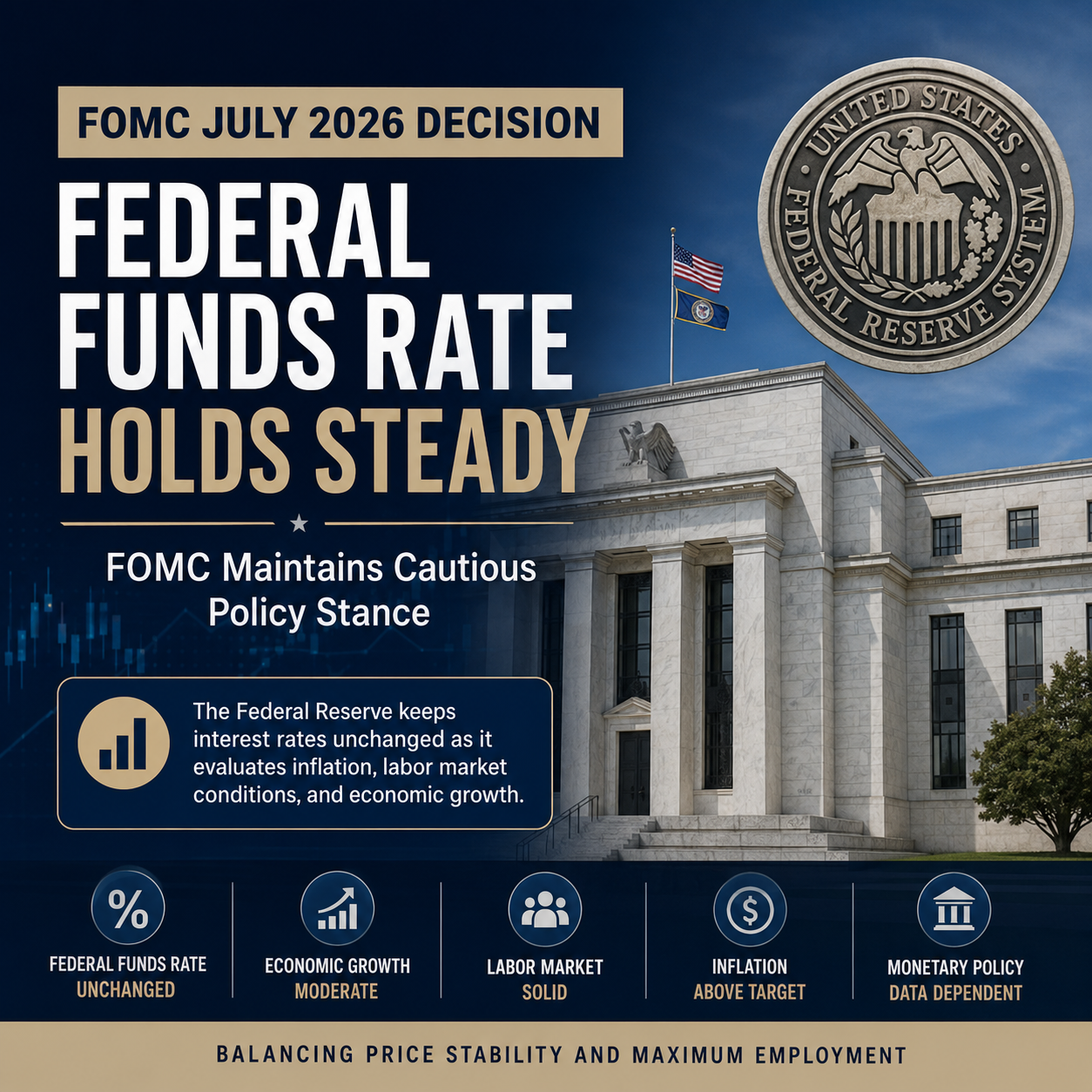
Federal Funds Rate policy remained unchanged following the latest meeting of the Federal Open Market Committee (FOMC), reflecting the Federal Reserve’s continued commitment to balancing inflation risks with its dual mandate of maximum employment and price stability. The Committee voted to maintain the target range for the federal funds rate while acknowledging that economic activity has continued to expand at a moderate pace, labor market conditions remain generally solid, and inflation, although lower than previous peaks, continues to run somewhat above the Federal Reserve’s long-term objective.
The decision was widely anticipated by financial markets and reinforces the Federal Reserve’s data-dependent approach to monetary policy. Rather than signaling an imminent shift toward lower interest rates or additional policy tightening, the Committee emphasized that future adjustments to the federal funds rate will depend on incoming economic information, evolving risks, and continued progress toward sustainable inflation.
The latest policy statement also reaffirmed the Federal Reserve’s ongoing balance sheet reduction program, indicating that policymakers remain committed to normalizing monetary conditions while carefully monitoring broader economic developments.
Although the decision itself did not introduce significant changes to monetary policy, the accompanying statement provides valuable insight into how policymakers currently view inflation, employment, economic growth, and financial conditions. Collectively, these factors will continue to shape future Federal Reserve decisions in the months ahead.
Key Takeaways
| Policy Area | Latest FOMC Decision |
|---|---|
| Federal Funds Rate | Unchanged |
| Monetary Policy | Restrictive but data dependent |
| Inflation | Elevated but moderating |
| Employment | Labor market remains solid |
| Economic Growth | Moderate expansion continues |
| Balance Sheet | Ongoing reduction continues |
| Future Decisions | Dependent on incoming economic data |
The latest FOMC decision reflects continuity rather than a significant policy shift. Policymakers continue to recognize progress in reducing inflation while remaining cautious about declaring victory too early. This balanced approach suggests the Federal Reserve believes monetary policy remains appropriately positioned to respond as economic conditions evolve.
Why the Federal Funds Rate Was Left Unchanged
The decision to maintain the Federal Funds Rate demonstrates the Federal Reserve’s preference for patience as it evaluates the cumulative effects of previous monetary policy actions. Interest rate changes typically influence economic activity with a considerable lag, meaning policymakers must assess not only current economic conditions but also the delayed effects of earlier policy tightening.
Since beginning its policy normalization cycle, the Federal Reserve has substantially increased the federal funds rate to address elevated inflation. Those higher borrowing costs have gradually influenced consumer spending, business investment, housing activity, and broader financial conditions.
The latest FOMC statement indicates that policymakers believe the current level of the federal funds rate continues to provide sufficient monetary restraint while allowing additional time to evaluate incoming economic data.
Maintaining the current policy stance also reduces the risk of responding prematurely to short-term economic fluctuations. Inflation often follows an uneven path toward the Federal Reserve’s long-term objective, and temporary improvements do not necessarily indicate that underlying price pressures have been fully resolved.

Consequently, the Committee continues to emphasize a measured and data-driven approach rather than providing forward guidance tied to a predetermined schedule.
Inflation Continues to Shape Monetary Policy
Inflation remains the central consideration influencing Federal Reserve policy decisions.
Although inflation has moderated considerably from its highest levels, the latest FOMC statement makes clear that price pressures remain above the Committee’s long-term objective. This continued elevation explains why policymakers have chosen to maintain restrictive monetary conditions rather than begin easing policy prematurely.
The Federal Reserve’s objective extends beyond reducing headline inflation. Policymakers seek evidence that inflation is moving sustainably toward the two percent target across a broad range of goods and services rather than responding to temporary or isolated price movements.
Several factors continue to influence inflation dynamics, including labor market conditions, consumer demand, housing costs, energy prices, global supply chains, and broader financial conditions. Because these variables evolve at different speeds, inflation progress is rarely linear.
The Committee therefore continues to monitor a wide range of economic indicators before determining whether additional adjustments to the federal funds rate are warranted.
Importantly, the latest statement does not suggest complacency regarding inflation. Instead, it reflects confidence that existing monetary policy remains appropriately restrictive while acknowledging that inflation risks have not fully disappeared.
Economic Activity Continues to Expand
The FOMC observed that economic activity has continued to expand at a moderate pace.
This assessment suggests that higher interest rates have slowed demand without causing a significant deterioration in overall economic performance. Consumer spending, business investment, and services activity have generally remained resilient despite elevated borrowing costs.
For policymakers, moderate economic growth represents an important balance.
Growth that remains excessively strong could sustain inflationary pressures by supporting robust demand throughout the economy. Conversely, a sharp slowdown could increase unemployment and reduce overall economic stability.
The Federal Reserve therefore seeks conditions that allow inflation to decline while maintaining a healthy labor market and sustainable economic expansion.
Current economic conditions appear broadly consistent with that objective, although policymakers continue to acknowledge uncertainty surrounding future developments.
Business investment decisions, household spending patterns, financial market conditions, international developments, and fiscal policy all have the potential to influence future economic performance.
As a result, the Committee continues to emphasize flexibility rather than committing to a predetermined policy path.
Labor Market Conditions Remain Solid
Employment conditions continue to provide important support for the broader economy.
According to the latest FOMC assessment, labor market conditions remain solid despite tighter monetary policy. Hiring activity has moderated compared with previous years, but overall employment continues to demonstrate resilience.
A healthy labor market contributes to stable household income, consumer confidence, and ongoing economic activity. At the same time, policymakers remain attentive to labor market imbalances that could contribute to persistent inflation through elevated wage growth.
The Federal Reserve’s dual mandate requires balancing maximum employment with price stability.
Achieving both objectives simultaneously often requires careful calibration of monetary policy. Excessively restrictive policy could weaken employment unnecessarily, while insufficient restraint could allow inflationary pressures to become more persistent.
The current federal funds rate reflects the Committee’s judgment that existing policy remains appropriately positioned to support continued progress toward both objectives.
How the Latest FOMC Statement Differs from Previous Meetings
While the Federal Reserve made no change to the Federal Funds Rate, subtle changes in the language of the FOMC statement continue to provide valuable insight into the Committee’s assessment of economic conditions and the direction of future monetary policy.
Financial markets often focus less on the policy decision itself and more on the wording accompanying that decision. Even minor adjustments in the Committee’s description of inflation, employment, or economic growth can influence expectations regarding future interest rate decisions.
The latest statement continues to characterize economic activity as expanding at a moderate pace while acknowledging that labor market conditions remain solid. Inflation, however, continues to be described as somewhat elevated relative to the Federal Reserve’s longer-run objective.
Importantly, the Committee maintained its emphasis on carefully assessing incoming data before making future policy adjustments. This reinforces the Federal Reserve’s commitment to flexibility rather than following a predetermined schedule for either tightening or easing monetary policy.
The statement also continues to recognize that uncertainty surrounding the economic outlook remains elevated. While inflation has made meaningful progress toward the Federal Reserve’s objective, policymakers continue to view the balance of risks as requiring careful evaluation.
This measured approach reflects the Committee’s belief that policy decisions should remain responsive to changing economic conditions rather than market expectations or fixed timelines.
The Federal Reserve’s Data-Dependent Approach
One of the defining characteristics of recent Federal Reserve communications has been the repeated emphasis on a data-dependent approach to monetary policy.
Rather than signaling future changes to the Federal Funds Rate well in advance, policymakers continue to evaluate a broad range of economic indicators before determining whether additional policy adjustments are appropriate.
These indicators include:
- Inflation trends
- Labor market conditions
- Consumer spending
- Business investment
- Gross Domestic Product (GDP)
- Wage growth
- Housing activity
- Financial conditions
- Inflation expectations
- Credit market conditions
By considering multiple indicators rather than relying on a single economic measure, the Federal Reserve seeks to reduce the risk of making policy decisions based on temporary fluctuations or incomplete information.
This strategy also allows policymakers to respond appropriately should economic conditions change unexpectedly.
For businesses, investors, and households, the continued emphasis on incoming data suggests that future monetary policy decisions will remain closely tied to measurable economic outcomes rather than predetermined policy objectives.
Balance Sheet Reduction Continues
In addition to maintaining the Federal Funds Rate, the Federal Reserve reaffirmed its commitment to reducing the size of its balance sheet.
Balance sheet normalization represents an important component of the broader monetary policy framework.
During periods of economic stress, the Federal Reserve expanded its holdings of Treasury securities and agency mortgage-backed securities to provide liquidity and support financial markets. As economic conditions improved and inflation accelerated, policymakers began reducing those holdings as part of the normalization process.
Unlike changes to the federal funds rate, balance sheet reduction operates more gradually by reducing liquidity within the financial system over time.
The latest statement confirms that this process remains ongoing and continues according to previously announced plans.
Maintaining balance sheet reduction alongside an unchanged federal funds rate indicates that the Federal Reserve believes overall financial conditions remain appropriately restrictive.
Although balance sheet policy typically receives less public attention than interest rate decisions, it continues to play an important role in the broader implementation of monetary policy.
Implications for Financial Markets
The decision to leave the Federal Funds Rate unchanged was broadly anticipated by financial markets, limiting the immediate market reaction.
Nevertheless, every FOMC statement influences expectations regarding future monetary policy, making the accompanying language particularly important for investors.
Bond markets generally evaluate Federal Reserve communications through the lens of future interest rate expectations. If investors perceive that inflation is moderating more quickly than expected, bond yields may decline as markets begin pricing potential future rate reductions.
Conversely, language suggesting inflation remains persistent may support higher yields by reinforcing expectations that policy will remain restrictive for longer.
Equity markets often respond differently.
Stable interest rate policy can provide greater certainty for businesses and investors, particularly when accompanied by continued economic growth and resilient employment conditions. However, expectations regarding future earnings, financing costs, and economic activity ultimately determine longer-term equity performance.
Currency markets also monitor Federal Reserve communications closely.
The relative level of U.S. interest rates compared with those of other major central banks influences international capital flows and can affect the value of the U.S. dollar.
Although the latest FOMC decision did not materially alter monetary policy, the continued emphasis on inflation and data dependency reinforces the Federal Reserve’s cautious approach.
What the Federal Funds Rate Means for Consumers
Although the Federal Funds Rate primarily affects overnight lending between financial institutions, its influence extends throughout the broader economy.
Changes in the federal funds rate eventually affect many of the borrowing costs faced by households.
These include:
- Mortgage rates
- Home equity loans
- Auto loans
- Credit card interest rates
- Personal loans
- Savings account yields
- Certificates of deposit
Because the Federal Reserve maintained the current target range, consumers are unlikely to experience immediate changes in borrowing costs directly attributable to this meeting.
However, financial institutions continuously adjust lending rates based on broader market expectations, Treasury yields, competitive conditions, and overall economic developments.
As a result, consumer borrowing costs may continue evolving independently of any single FOMC meeting.
Households considering major financial decisions should therefore monitor broader interest rate trends rather than focusing exclusively on individual Federal Reserve announcements.
Implications for Businesses
Businesses also remain sensitive to changes in the Federal Funds Rate.
Higher borrowing costs can influence investment decisions, capital expenditures, hiring plans, inventory management, and overall financing strategies.
The decision to leave policy unchanged provides businesses with a greater degree of short-term certainty.
Companies planning long-term investments often prefer stable monetary policy because it improves the predictability of financing costs and future cash flow projections.
At the same time, firms continue to operate within an environment characterized by relatively elevated interest rates compared with recent historical averages.
Consequently, many businesses remain focused on capital discipline, operational efficiency, and prudent balance sheet management while awaiting greater clarity regarding the future direction of monetary policy.
Industries with greater sensitivity to financing costs—including commercial real estate, construction, manufacturing, and capital-intensive sectors—may continue monitoring future FOMC communications particularly closely.
Inflation Remains the Central Policy Challenge
Despite significant progress over recent years, inflation continues to represent the Federal Reserve’s principal policy challenge.
The Committee’s latest statement indicates that inflation remains somewhat elevated relative to its longer-run objective, reinforcing the need for continued vigilance.
Inflation affects households, businesses, and financial markets in numerous ways.
Persistent inflation reduces purchasing power, increases uncertainty for business planning, and complicates long-term investment decisions.
For policymakers, the challenge lies in reducing inflation without unnecessarily weakening economic growth or employment.
This balancing act defines much of the current monetary policy environment.
The Federal Reserve’s decision to maintain the current Federal Funds Rate reflects its assessment that existing policy continues to exert appropriate restraint on economic activity while allowing additional time for inflation to move toward its target.
Rather than responding aggressively to short-term data releases, the Committee appears committed to evaluating sustained trends before considering future policy adjustments.
This measured approach reduces the risk of reversing progress achieved through previous monetary tightening while preserving flexibility should economic conditions evolve differently than expected.
Risks Facing the Federal Reserve
While the decision to leave the Federal Funds Rate unchanged reflects confidence that current monetary policy remains appropriately restrictive, policymakers continue to face a number of economic risks that could influence future decisions.

The most immediate challenge remains ensuring that inflation continues moving sustainably toward the Federal Reserve’s long-run objective. Although price pressures have eased considerably from previous highs, inflation has proven more persistent than many economists initially anticipated. Progress has been uneven across different sectors of the economy, requiring the Committee to evaluate a broad range of indicators rather than relying on any single measure.
At the same time, the Federal Reserve must consider the cumulative effects of maintaining relatively high Interest Rates over an extended period. Monetary policy affects economic activity with a lag, meaning the full impact of previous policy decisions may not yet be fully reflected in employment, investment, or consumer spending. This delayed transmission increases the complexity of policymaking, as actions taken today may influence the economy many months into the future.
Global developments also remain an important consideration. Changes in international trade, geopolitical events, commodity prices, and financial market conditions can affect domestic inflation and economic growth. While the FOMC’s mandate is focused on the U.S. economy, policymakers cannot ignore external developments that may alter financial conditions or influence inflation expectations.
Financial stability represents another area of ongoing attention. Banks, financial institutions, and capital markets have generally adjusted to higher interest rate levels, but prolonged periods of restrictive monetary policy can create pressure in interest-rate-sensitive sectors. Commercial real estate, regional banking activity, and highly leveraged businesses remain areas that policymakers continue to monitor carefully.
Ultimately, the Committee must balance multiple objectives simultaneously. Maintaining price stability while preserving maximum employment requires careful calibration of monetary policy, particularly during periods when economic signals are mixed or evolving.
Outlook for Future FOMC Meetings
The latest statement provides little indication that the Federal Reserve intends to commit to a specific policy path over the coming months. Instead, the Committee continues to emphasize flexibility, reinforcing its view that future decisions regarding the Federal Funds Rate will depend on incoming economic information rather than predetermined expectations.
Several key economic indicators are likely to shape future FOMC discussions, including:
- Monthly inflation reports.
- Labor market data, including payroll growth and unemployment.
- Wage growth and broader measures of labor market conditions.
- Consumer spending and household demand.
- Business investment.
- Gross Domestic Product (GDP) growth.
- Inflation expectations.
- Financial market conditions.
If inflation continues to moderate while economic growth remains stable, policymakers may determine that existing policy has achieved the desired level of monetary restraint. Conversely, if inflation proves more persistent than anticipated, the Committee retains the flexibility to maintain restrictive policy for longer or adjust the Federal Funds Rate if necessary.
The Federal Reserve has consistently communicated that no single economic report determines monetary policy. Instead, the Committee evaluates cumulative evidence across a broad range of indicators before making policy decisions. This approach reduces the likelihood of reacting to temporary fluctuations while supporting longer-term economic stability.
For financial markets, businesses, and households, the emphasis on incoming data suggests that future FOMC meetings will continue to be evaluated primarily through changes in the Committee’s economic assessment rather than expectations of immediate policy action.
What This Means for Investors
Investors should interpret the latest FOMC decision as a continuation of the Federal Reserve’s cautious and disciplined approach to monetary policy rather than the beginning of a new policy cycle.
For fixed-income investors, an unchanged Federal Funds Rate provides additional clarity regarding short-term interest rate expectations. Bond yields will continue to respond not only to Federal Reserve communications but also to inflation data, economic growth, and market expectations regarding future policy adjustments.
Equity investors remain focused on the relationship between monetary policy and corporate earnings. Stable interest rates can improve planning certainty for businesses, but financing costs remain elevated compared with the exceptionally accommodative environment that prevailed in previous years.
Long-term investors should also recognize that monetary policy represents only one factor influencing financial markets. Corporate profitability, productivity, fiscal policy, technological innovation, consumer demand, and international developments continue to play significant roles in determining investment performance.
The latest FOMC statement reinforces that policymakers are seeking a sustainable balance between supporting economic expansion and restoring price stability. As long as inflation remains above target, markets are likely to continue closely monitoring each policy statement for indications regarding the future direction of the Federal Funds Rate.
Long-Term Monetary Policy Perspective
The Federal Reserve’s current policy stance reflects broader lessons learned from previous inflation cycles. History has demonstrated that reducing inflation often requires patience, consistency, and clear communication rather than rapid or frequent changes in policy direction.
Maintaining credibility remains central to effective monetary policy. By emphasizing a data-dependent framework and avoiding commitments based on short-term market expectations, the FOMC seeks to reinforce confidence that policy decisions are guided by economic conditions rather than external pressures.
The current level of the Federal Funds Rate should therefore be viewed within the broader context of the Federal Reserve’s long-term objectives. The Committee continues to pursue a monetary policy framework that promotes sustainable economic growth while maintaining price stability and supporting maximum employment.
Although individual FOMC meetings attract significant public attention, monetary policy operates over much longer time horizons. Decisions made today are intended to influence economic conditions well into the future, underscoring the importance of gradual, measured, and evidence-based policymaking.
Conclusion
The latest FOMC meeting resulted in no change to the Federal Funds Rate, reinforcing the Federal Reserve’s commitment to a cautious, data-dependent approach to monetary policy. While inflation has moderated from previous highs, it remains above the Committee’s longer-run objective, justifying the continuation of a restrictive policy stance.
The accompanying statement presents a balanced assessment of the U.S. economy. Economic activity continues to expand at a moderate pace, labor market conditions remain broadly solid, and inflation has continued to improve, although additional progress is still required. Collectively, these developments support the Committee’s decision to maintain current interest rate policy while allowing additional time to assess the cumulative effects of previous policy actions.
Equally significant is the Federal Reserve’s continued emphasis on flexibility. Rather than signaling a predetermined path for future Interest Rates, policymakers reiterated that future adjustments to the Federal Funds Rate will depend on incoming economic data, the evolving outlook, and the balance of risks affecting both inflation and employment.
The ongoing reduction of the Federal Reserve’s balance sheet further illustrates that monetary policy normalization extends beyond changes to the federal funds rate alone. Balance sheet policy remains an important complementary tool in maintaining appropriate financial conditions while supporting the Federal Reserve’s broader objectives.

For households, businesses, investors, and financial institutions, the latest FOMC decision provides continuity rather than surprise. The Committee’s communication reinforces the importance of monitoring economic fundamentals rather than attempting to anticipate policy changes based solely on market expectations.
Looking ahead, inflation, labor market performance, economic growth, and broader financial conditions will continue to shape future FOMC discussions. Until policymakers gain greater confidence that inflation is moving sustainably toward the Federal Reserve’s objective, the current Federal Funds Rate is likely to remain a central component of the Committee’s strategy for preserving price stability while supporting long-term economic expansion.