




Executive Summary
Earnings Season begins in earnest during the week of 13–17 July 2026, marking one of the most important periods of the year for equity investors. The second-quarter reporting cycle arrives against a backdrop of record equity valuations, resilient corporate earnings expectations, elevated oil prices, and continued investment in artificial intelligence infrastructure. Together, these forces will help determine whether the current bull market can extend into the second half of 2026.
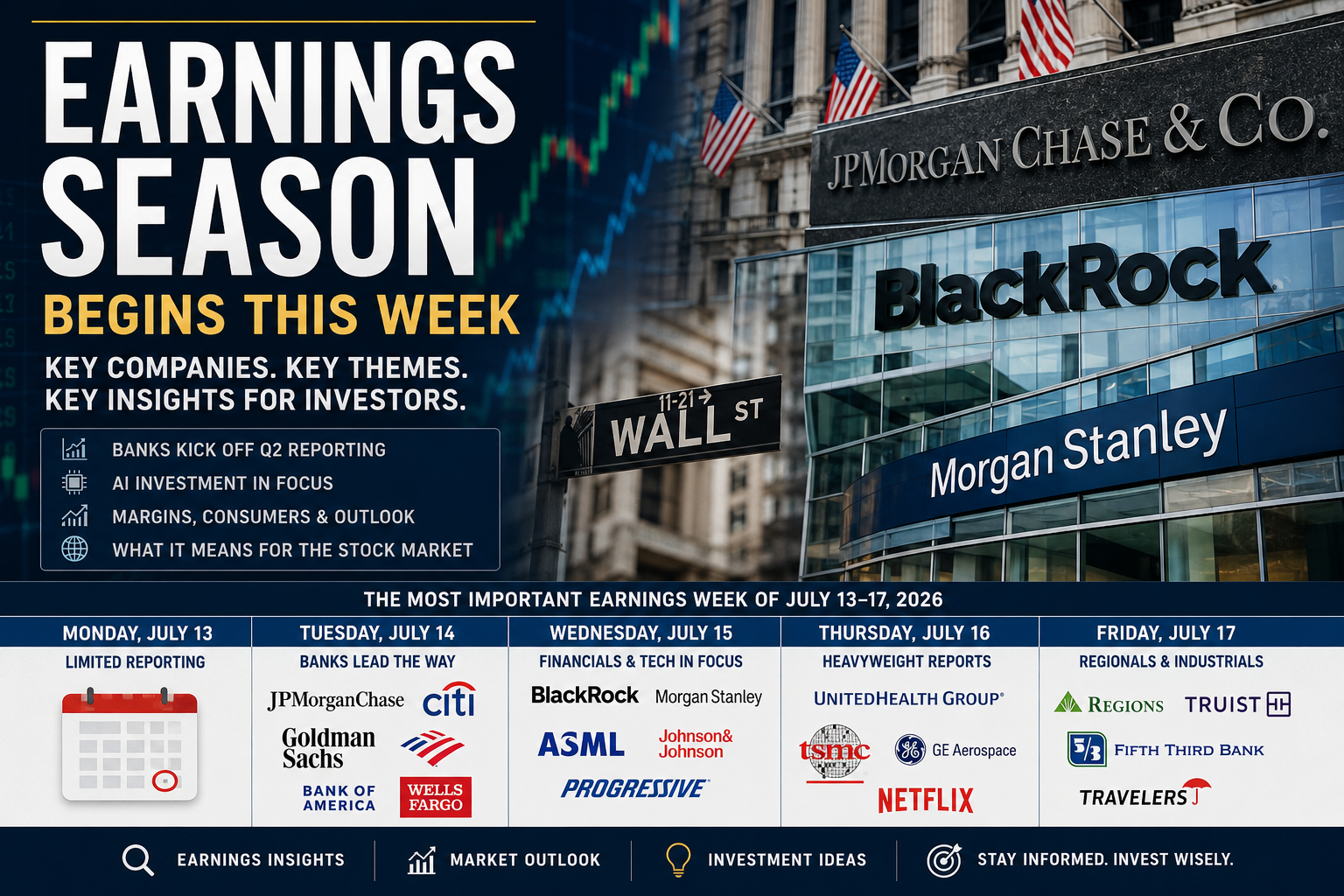
Wall Street’s attention will initially focus on the major U.S. banks, with JPMorgan Chase, Citigroup, Goldman Sachs, Bank of America, and Wells Fargo opening the reporting season on Tuesday. Their results will provide investors with the first comprehensive assessment of consumer credit conditions, corporate borrowing activity, investment banking trends, trading revenue, and executive confidence following a volatile second quarter.
Beyond financials, investors will closely monitor BlackRock and Morgan Stanley for insights into global asset flows, institutional investment trends, and wealth management activity. Technology leaders including ASML, Taiwan Semiconductor Manufacturing Company (TSMC) and Netflix will then shift attention toward artificial intelligence investment, semiconductor demand and digital advertising, while healthcare, industrial and transportation companies provide a broader assessment of economic momentum.
Although analysts expect another quarter of record earnings for the S&P 500, expectations are also elevated. Management commentary, forward guidance and capital allocation decisions may ultimately prove more influential than headline earnings figures, particularly as markets continue to price in strong corporate profit growth through 2027.
This article examines the companies, sectors and macroeconomic themes likely to influence markets during one of the year’s most closely watched reporting weeks.
Key Takeaways
| Theme | Why It Matters |
|---|---|
| Major banks launch reporting season | Financial institutions traditionally establish the tone for market sentiment. |
| JPMorgan Chase remains the most influential report | Investors will closely analyse loan growth, credit quality, trading revenue and management outlook. |
| BlackRock and Morgan Stanley provide institutional perspective | Their results offer insight into investment flows, wealth management and market confidence. |
| Technology remains a major earnings driver | ASML, TSMC and Netflix will update investors on AI spending and consumer demand. |
| Energy prices remain a key variable | Higher oil prices may pressure corporate margins but continue supporting energy-sector profits. |
| Forward guidance could outweigh reported earnings | Markets increasingly react to management expectations rather than historical financial performance. |
Earnings Season Begins With Elevated Expectations
Earnings Season arrives at an unusually important moment for global financial markets. Equity indices remain near record highs despite geopolitical uncertainty, higher energy prices and a monetary policy environment that remains restrictive by historical standards. Investors are therefore entering the reporting period looking for confirmation that corporate earnings growth continues to justify elevated valuations.
Consensus forecasts indicate another strong quarter for the S&P 500, supported primarily by continued strength across technology, financials and energy. While artificial intelligence remains an important driver of earnings expansion, analysts increasingly expect broader participation across multiple sectors, suggesting that corporate profitability is becoming more diversified than earlier in the year.
This broader earnings base represents an encouraging development for long-term investors. Rather than relying solely on a handful of technology leaders, earnings growth is now expected to extend into financial services, industrial companies, energy producers and selected consumer businesses. Such diversification typically provides stronger support for sustained market advances than narrow sector leadership alone.
At the same time, expectations have risen considerably. Equity valuations already reflect substantial optimism regarding corporate profitability over the next several quarters. As a result, simply meeting consensus estimates may not be sufficient to support further gains. Investors will instead focus on management guidance, capital expenditure plans and executive commentary regarding demand conditions during the second half of the year.
The Macroeconomic Backdrop Supports Corporate Earnings
Several macroeconomic trends have combined to create an unusually supportive environment entering the second-quarter reporting season.
Economic activity has remained resilient despite higher borrowing costs, while labour market conditions continue to support consumer spending. Business investment also remains robust, particularly in areas linked to artificial intelligence infrastructure, cloud computing and semiconductor manufacturing.
Meanwhile, higher oil prices have created a mixed backdrop for corporate America. Energy producers stand to benefit from improved pricing, while transportation companies, manufacturers and some consumer-facing businesses face additional cost pressures. Investors will therefore pay close attention to management commentary regarding pricing power and margin preservation.
Corporate margins remain another central theme. Although elevated energy costs typically compress profitability, many companies have demonstrated an ability to offset higher input costs through pricing strategies, operational efficiencies and productivity improvements. If management teams continue to report stable or expanding margins despite these headwinds, investor confidence in future earnings growth may strengthen further.
Another supportive factor has been the limited number of negative earnings pre-announcements ahead of reporting season. Historically, companies tend to reduce expectations when operating conditions deteriorate meaningfully. The relatively modest level of earnings warnings entering July suggests that many management teams remain comfortable with current business conditions.
Together, these macroeconomic factors establish a constructive backdrop for the reporting season, although elevated expectations leave relatively little room for disappointment.
Why the Banking Sector Will Set the Market Tone
The first major reports of Earnings Season traditionally come from the largest U.S. financial institutions, making Tuesday’s releases among the most closely watched of the entire quarter.
Banks occupy a unique position within the economy. Their financial performance reflects conditions across consumer lending, commercial credit, investment banking, trading activity, capital markets and wealth management simultaneously. As a result, bank earnings frequently provide one of the earliest comprehensive assessments of economic health.
Investors will examine several key indicators throughout the reporting week, including:
- Net interest income trends
- Consumer credit quality
- Commercial loan demand
- Investment banking activity
- Trading revenue
- Deposit growth
- Credit loss provisions
- Corporate client activity
- Executive outlook for economic growth
Collectively, these measures provide insight into both current operating conditions and management expectations for the months ahead.
Unlike many industries where quarterly results primarily reflect company-specific performance, large banks often function as economic barometers. Their commentary frequently influences investor expectations across virtually every sector of the equity market.
Consequently, Earnings Season effectively begins not with technology companies or industrial manufacturers, but with the financial institutions that help finance the broader economy.
JPMorgan Chase Leads the Financial Sector Into Earnings Season
Among all companies reporting during the opening week of Earnings Season, JPMorgan Chase is expected to receive the greatest attention from institutional investors. As the largest U.S. bank by assets, its quarterly results often establish the narrative for the broader financial sector and influence market sentiment across multiple industries.

While the headline earnings figures will naturally attract interest, investors are likely to focus more closely on management’s assessment of the U.S. economy, business investment, consumer spending, and credit conditions. Quarterly reports increasingly serve as economic scorecards, with executive commentary often carrying as much weight as the reported financial results themselves.
Key Areas Investors Will Monitor
| Metric | Why It Matters |
|---|---|
| Net Interest Income | Indicates profitability from lending activity. |
| Trading Revenue | Reflects market volatility and client activity. |
| Investment Banking Fees | Measures corporate confidence and deal activity. |
| Consumer Credit | Highlights household financial health. |
| Commercial Lending | Gauges business expansion and capital investment. |
| Credit Provisions | Signals expectations for future loan losses. |
| Capital Returns | Shows confidence through dividends and share buybacks. |
The second quarter presented favourable conditions for many of the world’s largest investment banks. Elevated volatility across equity, fixed income, currency and commodity markets generally supports trading operations, while stable employment conditions help preserve loan quality.
Another closely watched area will be management’s discussion of corporate borrowing activity. Companies have continued investing despite higher interest rates, particularly in technology infrastructure and artificial intelligence projects. Investors will want confirmation that this capital spending cycle remains intact.
Perhaps the most anticipated portion of the earnings call will be management’s broader economic outlook. Institutional investors often view JPMorgan Chase as one of the most influential corporate voices on the U.S. economy, making its commentary an important input for broader market expectations.
BlackRock Offers an Important Read on Global Investment Flows
If JPMorgan Chase reflects the health of banking, BlackRock provides one of the clearest windows into investor behaviour worldwide.
As the world’s largest asset manager, BlackRock oversees trillions of dollars across equity, fixed income, multi-asset portfolios and exchange-traded funds. Changes in client allocations therefore provide valuable insight into institutional confidence and global investment trends.
During this Earnings Season, investors will be particularly interested in several themes:
- Net inflows into equity products
- Fixed income demand
- ETF growth
- Alternative investments
- Institutional client activity
- Wealth management trends
Strong inflows would reinforce confidence that investors continue allocating capital toward financial markets despite elevated valuations. Conversely, weaker flows could indicate a more cautious institutional environment.
Another area likely to receive attention is the growing adoption of technology across investment management. Artificial intelligence, automation and portfolio analytics continue reshaping the asset management industry, making operational efficiency another important discussion point.
BlackRock’s outlook frequently extends well beyond its own business. Because it serves pension funds, sovereign wealth funds, financial advisers and institutional investors globally, its observations often provide an early indication of broader capital market trends.
Morgan Stanley Completes the Financial Picture
While investment banks generate significant revenue from capital markets activity, Morgan Stanley has increasingly diversified through wealth management and investment advisory services.
That diversified business model makes the firm’s quarterly results particularly valuable during Earnings Season, as they capture both institutional and retail investor activity.
Several themes deserve attention:
Wealth Management
Client assets have continued growing alongside equity markets. Investors will evaluate whether higher market values continue translating into stronger fee income and client engagement.
Investment Banking
Corporate financing activity remains an important measure of executive confidence. Improvements in mergers, acquisitions and equity issuance could indicate stronger business optimism heading into the second half of the year.
Trading Operations
Like other major investment banks, Morgan Stanley benefited from increased market volatility during the second quarter. Fixed income, foreign exchange and equity trading revenues will therefore receive considerable attention.
Asset Management
Institutional asset allocation trends may further confirm the investment themes highlighted by BlackRock, particularly regarding equity demand and international diversification.
Together, the reports from JPMorgan Chase, BlackRock and Morgan Stanley provide investors with a comprehensive assessment of banking, wealth management and institutional investment activity.
Citigroup, Goldman Sachs and Bank of America Expand the Banking Story
Although JPMorgan Chase typically attracts the largest audience, the broader banking picture only emerges after reviewing results from several major institutions.
Citigroup
Citigroup’s global footprint provides valuable insight into international business conditions, cross-border capital flows and multinational corporate activity. Investors will look for updates regarding emerging markets, transaction banking and commercial lending demand.
Goldman Sachs
Goldman Sachs remains highly sensitive to investment banking and trading conditions. Strong advisory activity, capital markets issuance and fixed income trading would reinforce confidence that corporate clients remain active despite geopolitical uncertainty.
With volatility remaining elevated throughout the second quarter, markets will expect another solid performance from the firm’s trading businesses.
Bank of America
Bank of America provides one of the clearest readings on U.S. consumer behaviour due to its extensive retail banking operations.
Areas of focus include:
- Consumer spending
- Deposit balances
- Mortgage activity
- Credit card performance
- Small business lending
These indicators collectively help investors assess the resilience of household finances and domestic economic activity.
Wells Fargo
Wells Fargo’s results remain particularly relevant for commercial real estate, mortgage lending and traditional retail banking.
Its commentary regarding regional lending conditions, commercial borrowers and deposit competition will add another layer to the overall financial sector narrative.
Technology Takes Centre Stage During the Second Half of the Week
Following the opening wave of financial earnings, investor attention shifts toward technology and artificial intelligence.
The technology sector has contributed a disproportionate share of earnings growth over recent years, making company guidance especially important during this reporting period.
Three companies stand out:
- ASML
- Taiwan Semiconductor Manufacturing Company
- Netflix
Each provides insight into a different segment of the global technology ecosystem.
ASML Remains a Critical Indicator for AI Investment
Few companies occupy a more strategic position within the semiconductor supply chain than ASML.
Its advanced lithography equipment is essential for manufacturing the world’s most sophisticated computer chips, making customer orders a leading indicator of future semiconductor investment.
Investors will monitor:
- New equipment bookings
- Revenue guidance
- Capacity expansion
- Customer demand
- Artificial intelligence infrastructure spending
Strong order growth would reinforce expectations that AI-related capital expenditure remains robust heading into 2027.
TSMC Will Provide the Semiconductor Industry’s Outlook
Taiwan Semiconductor Manufacturing Company serves many of the world’s largest technology firms, making its earnings one of the most influential events of the reporting season.
Because monthly revenue figures are already disclosed, investors typically place greater emphasis on management commentary than reported financial results.
Areas likely to dominate the discussion include:
| Focus Area | Investor Interest |
|---|---|
| Advanced-node demand | AI infrastructure growth |
| Capacity expansion | Future chip supply |
| Capital expenditure | Industry investment cycle |
| Customer demand | Technology spending outlook |
| Long-term guidance | Semiconductor market health |
TSMC’s commentary frequently influences expectations across semiconductor equipment manufacturers, chip designers and broader technology indices.
Netflix Faces Questions Beyond Subscriber Growth
Netflix enters this Earnings Season under a different set of investor expectations than in previous years.
With subscriber numbers no longer serving as the primary performance metric, investors have shifted their attention toward:
- Revenue growth
- Operating margins
- Advertising revenue
- Content spending
- Free cash flow
- Pricing strategy
The development of the company’s advertising-supported business continues to represent an important long-term growth opportunity.
Management’s outlook regarding engagement, advertising demand and operating leverage will likely prove more influential than quarterly subscriber trends.
Healthcare Provides a Valuable Economic Cross-Check
Healthcare companies often behave differently from cyclical industries, making their earnings useful for assessing broader economic conditions.
This week, investors will focus on:
- UnitedHealth
- Johnson & Johnson
- Elevance Health
Medical cost trends remain one of the sector’s most closely watched variables. Any indication that healthcare expenses are stabilising could improve investor sentiment toward managed care companies.
Healthcare also provides diversification during periods of economic uncertainty, making management commentary particularly valuable if broader macroeconomic conditions weaken later in the year.
Industrials and Transportation Reveal the Health of the Real Economy
Financial markets often respond quickly to changing economic conditions, but industrial companies demonstrate whether underlying business activity remains strong.
Several reports scheduled later in the week will therefore attract considerable interest.
GE Aerospace
Commercial aviation demand remains robust, supporting aircraft engine maintenance and aftermarket services.
United Airlines
Fuel costs increased significantly during the quarter, making pricing power one of the airline industry’s most important themes.
Investors will evaluate whether higher ticket prices successfully offset increased operating expenses.
J.B. Hunt
Freight volumes provide one of the clearest indicators of goods movement throughout the economy.
Strong intermodal demand would reinforce confidence that manufacturing and consumer activity remain healthy.
Cintas
Employment trends remain closely linked to uniform rental demand, making Cintas an unexpectedly valuable indicator of labour market conditions.
Collectively, these industrial reports help determine whether economic momentum extends beyond technology and financial services.

Market Themes That Could Shape Earnings Season
While individual company results will dominate daily headlines, several broader themes are likely to determine whether Earnings Season ultimately supports another advance in the stock market or prompts investors to reassess current valuations. Institutional investors will be looking beyond quarterly earnings per share, paying closer attention to the economic signals hidden within management commentary and forward guidance.
Rather than asking whether companies beat consensus estimates, portfolio managers will focus on a more important question: Does corporate America still expect earnings growth to accelerate into the second half of 2026?
If management teams broadly reaffirm their outlooks, confidence in the current bull market is likely to strengthen. However, signs of slowing demand, weaker margins or reduced capital expenditure could quickly shift investor sentiment.
1. Artificial Intelligence Spending Remains the Market’s Growth Engine
Artificial intelligence continues to dominate corporate investment plans across multiple industries. Although the market’s attention often centres on semiconductor manufacturers, the AI investment cycle extends far beyond chip production.
Investors will be listening for commentary regarding:
| AI Theme | Why It Matters |
|---|---|
| Data centre expansion | Indicates continued infrastructure investment. |
| Cloud computing demand | Reflects enterprise technology spending. |
| Enterprise software adoption | Measures commercial AI implementation. |
| Capital expenditure | Demonstrates long-term business confidence. |
| Energy infrastructure | Supports future computing capacity. |
Companies supplying hardware, software, networking equipment and cloud infrastructure all benefit when corporations continue increasing technology budgets.
Reports from ASML and TSMC will therefore provide important confirmation regarding whether this investment cycle remains intact heading into 2027.
2. Corporate Margins Face Their Next Test
One of the most encouraging developments over the past year has been the resilience of corporate profit margins.
Despite higher wages, elevated borrowing costs and rising energy prices, many companies have maintained strong profitability through operational efficiencies and disciplined cost management.
This Earnings Season, investors will closely monitor whether businesses can continue protecting margins while navigating:
- Higher transportation costs
- Increased energy expenses
- Wage inflation
- Supply chain adjustments
- Currency fluctuations
Management commentary suggesting stable or improving margins would likely reinforce confidence that corporate earnings growth remains sustainable.
3. Consumer Spending Still Supports Economic Growth
Consumer activity remains one of the largest contributors to economic growth.
Although higher interest rates have increased borrowing costs, employment conditions have remained relatively healthy, supporting household spending throughout much of the year.
Several companies reporting this week provide valuable insight into consumer behaviour.
Key Consumer Indicators
- Credit card spending
- Loan repayments
- Travel demand
- Entertainment spending
- Subscription growth
- Healthcare utilisation
Results from Bank of America, JPMorgan Chase, Netflix, UnitedHealth, and United Airlines collectively offer one of the clearest pictures of household financial conditions.
4. Energy Prices Continue Influencing Corporate Outlooks
Higher oil prices remain an important variable entering this reporting season.
For energy producers, stronger crude prices generally translate into improved profitability. However, industries with significant fuel requirements—including airlines, manufacturers and logistics companies—face additional operating costs.
Investors will therefore evaluate how effectively companies have managed these pressures.
Particular attention will be paid to:
- Pricing power
- Operating efficiency
- Fuel hedging strategies
- Transportation costs
- Supply chain resilience
If management teams indicate that higher costs have been successfully absorbed without materially affecting profitability, investor confidence could improve further.
Sector Outlook
Financials
Outlook: Positive
The banking sector enters Earnings Season supported by healthy capital levels, resilient credit conditions and improving trading activity.
Key companies include:
- JPMorgan Chase
- Morgan Stanley
- BlackRock
- Goldman Sachs
- Citigroup
- Bank of America
- Wells Fargo
Institutional investors will primarily assess lending activity, investment banking, asset management flows and executive confidence.
Technology
Outlook: Positive
Technology remains the largest contributor to expected earnings growth.
Key reports include:
- ASML
- TSMC
- Netflix
Investors will look for continued AI investment, semiconductor demand and advertising growth.
Healthcare
Outlook: Neutral
Healthcare enters the quarter facing mixed expectations.
Key concerns include:
- Medical costs
- Insurance margins
- Regulatory developments
- Healthcare utilisation
Results from UnitedHealth and Johnson & Johnson will help determine whether earnings pressures are easing.
Industrials
Outlook: Moderately Positive
Industrial companies continue benefiting from infrastructure spending, manufacturing investment and improving freight activity.
Reports from GE Aerospace, J.B. Hunt and Cintas will provide important confirmation regarding business investment trends.
Stocks to Watch During Earnings Season
| Company | Why Investors Are Watching |
|---|---|
| JPMorgan Chase | Banking outlook, credit quality, trading revenue |
| BlackRock | Global investment flows and ETF demand |
| Morgan Stanley | Wealth management and investment banking |
| Citigroup | International banking activity |
| Goldman Sachs | Capital markets and trading performance |
| Bank of America | Consumer spending and deposits |
| Wells Fargo | Commercial lending and mortgages |
| ASML | AI semiconductor equipment demand |
| TSMC | Global chip production outlook |
| Netflix | Revenue growth and advertising |
| UnitedHealth | Healthcare cost trends |
| United Airlines | Travel demand and fuel costs |
| GE Aerospace | Aerospace demand |
| J.B. Hunt | Freight activity |
| Cintas | Employment trends |
Bull, Base and Bear Market Scenarios
Bull Case
The most constructive outcome would involve broad earnings beats accompanied by confident forward guidance.
Characteristics include:
- Strong banking profits
- Stable consumer spending
- Continued AI investment
- Expanding corporate margins
- Healthy capital expenditure
- Positive management commentary
Under this scenario, investors would likely interpret second-quarter results as confirmation that corporate earnings remain capable of supporting elevated equity valuations.
Base Case
The most likely outcome remains moderate earnings growth with generally stable corporate guidance.
Characteristics include:
- Mixed earnings surprises
- Stable margins
- Continued but slower investment
- Balanced management outlook
- Limited changes to full-year forecasts
This outcome would probably allow markets to consolidate recent gains while awaiting additional economic data.
Bear Case
The downside scenario would emerge if management teams broadly reduce expectations for the second half of the year.
Warning signs include:
- Weak forward guidance
- Rising credit losses
- Reduced capital expenditure
- Margin compression
- Slowing consumer demand
- Declining investment banking activity
Such developments could prompt investors to reassess current market valuations and increase volatility across global equities.

Reporting Calendar: Week Beginning Monday, July 13, 2026
| Date | Key Earnings |
|---|---|
| Monday | Limited reporting activity |
| Tuesday | JPMorgan Chase, Citigroup, Goldman Sachs, Bank of America, Wells Fargo |
| Wednesday | BlackRock, Morgan Stanley, ASML, Johnson & Johnson, Progressive |
| Thursday | UnitedHealth, TSMC, GE Aerospace, Netflix |
| Friday | Regional banks, Travelers and European industrial companies |
This sequence makes the middle three trading days the most significant period of the week, with investors receiving updates from banking, technology, healthcare and industrial leaders in rapid succession.
Investment Themes for the Second Half of 2026
Beyond quarterly earnings, investors should continue monitoring several longer-term structural trends.
Artificial Intelligence
Corporate investment in AI infrastructure remains one of the strongest secular growth drivers across global markets.
Financial Services
Higher market activity and improving investment banking conditions continue supporting diversified financial institutions.
Infrastructure
Industrial investment remains supported by manufacturing expansion and digital infrastructure spending.
Healthcare Innovation
Long-term demographic trends continue supporting demand despite near-term margin pressures.
Capital Allocation
Companies maintaining disciplined capital allocation through dividends, share buybacks and strategic investment may continue outperforming peers.
Final Investment Outlook
This Earnings Season arrives at a pivotal moment for financial markets.
Corporate America enters the reporting period with strong earnings expectations, resilient economic conditions and continued investment in artificial intelligence. At the same time, elevated valuations leave little room for widespread disappointment, increasing the importance of management guidance and forward-looking commentary.
The opening reports from JPMorgan Chase, BlackRock and Morgan Stanley will establish the initial tone for investors, offering valuable insight into banking conditions, institutional investment flows and wealth management trends. As the week progresses, technology leaders such as ASML, TSMC and Netflix will help determine whether the AI investment cycle remains a durable driver of earnings growth.
Healthcare, industrial and transportation companies will complete the broader economic picture, providing additional evidence regarding consumer resilience, business investment and global demand.
Although short-term market reactions are often driven by individual earnings surprises, the broader significance of this reporting season lies in its ability to confirm—or challenge—the outlook for corporate profits through the remainder of 2026. Investors who focus on trends in margins, capital expenditure, credit quality and executive confidence rather than headline earnings alone are likely to gain the clearest understanding of where the stock market may be headed next.
If corporate leaders broadly reaffirm expectations for continued growth despite higher energy prices and ongoing geopolitical uncertainty, this reporting season could reinforce the foundation for further market gains. Conversely, any meaningful deterioration in guidance or business confidence would warrant closer scrutiny as investors assess the sustainability of current valuations.
For long-term investors, the week beginning Monday, July 13, 2026, is therefore more than the start of another quarterly reporting cycle—it represents an important test of the economic, financial and technological themes that have driven global markets throughout the year.