








Table of Contents
- Week Ahead: The Main Economic Events
- RBA Policy Decision: The First Major Test
- Australian CPI: Inflation Remains Central
- US PCE Inflation: A Key Test for the Fed
- US ISM Manufacturing: Activity, Prices and Employment
- US NFP: The Main Event of the Week
- Payroll Revisions Could Matter
- PCE and NFP: Two Sides of the US Policy Outlook
- Eurozone CPI: Inflation Returns to Focus
- Japanese Tankan Survey: Business Confidence and Investment
- Tokyo CPI: Another Important BoJ Indicator
- Swiss CPI: Inflation and the Franc
- UK Political and Economic Developments
- China: Industrial Profits and Manufacturing Activity
- Week in Review: Chinese LPR
- SARB Policy Decision
- UK Flash PMI: Growth and Inflation in Tension
- Eurozone Flash PMI: Services Continue to Lead
- US-China Relations
- Norges Bank
- Swiss National Bank
- Riksbank
- Banxico
- Japanese Flash PMI Review
- Australian Employment
- Economic Report: The Main Themes for the Week Ahead
- Economic Report: Why the Sequence of Releases Matters
- Economic Report: What to Watch Beyond the Headlines
- Economic Report: Market Positioning Into October
- Economic Report: A Dense Week of Cross-Market Signals
- Economic Report: Conclusion
Economic Report: The week of 28 September–2 October brings a dense run of global economic releases, with the Reserve Bank of Australia, US PCE inflation, ISM Manufacturing, eurozone CPI and the September US employment report all competing for attention.
The sequence matters. The RBA policy decision arrives early in the week, followed by Australian inflation, while the US calendar builds toward PCE on Wednesday, ISM Manufacturing on Thursday and NFP on Friday. At the same time, eurozone inflation, Japanese data, Swiss CPI and UK political developments add further layers to an already busy calendar.
The key issue is not simply whether individual data points beat or miss expectations. The more important question is how the releases alter the broader assessment of inflation, labour-market conditions, economic activity and the path of monetary policy.
For the US, the combination of PCE inflation, manufacturing activity and NFP provides a useful sequence through which markets can reassess the balance between price pressures and employment conditions. In Australia, the RBA decision is likely to set the tone for the local rates market, while the following day’s CPI release provides another important test of the inflation outlook.
In Europe, September CPI will arrive as markets continue to assess the European Central Bank’s next steps. Japan also provides several important indicators, including the Tankan survey and Tokyo CPI, while the UK political calendar may offer clues about fiscal policy ahead of the Budget.
The result is a week in which positioning may develop early, but the largest adjustments could come as the data sequence progresses.
Week Ahead: The Main Economic Events
The week’s calendar is broad, but several releases stand out because of their potential relevance to monetary-policy expectations.
Monday: BoJ minutes from the July meeting and Chinese industrial profits.
Tuesday: RBA policy announcement, Spanish inflation, eurozone economic sentiment, Canadian GDP, retail sales and US JOLTS job openings.
Wednesday: Australian CPI, Japanese retail sales, Chinese manufacturing PMI, UK GDP, German labour-market data, French and German inflation, US ADP employment, final US GDP and PCE.
Thursday: Japanese Tankan survey, Swiss CPI, US jobless claims, US ISM Manufacturing and several regional releases.
Friday: Tokyo CPI, eurozone CPI and the September US NFP report.
The structure gives the week a clear progression. The RBA sets the first major monetary-policy event, while the US calendar becomes increasingly important from Wednesday onward. By Friday, the focus shifts toward employment and the implications of the latest data for the broader US policy outlook.
RBA Policy Decision: The First Major Test
The RBA policy announcement is scheduled for Tuesday, 29 September, following the September Monetary Policy Board meeting on 28–29 September.
The decision itself is important, but the accompanying communication may be more significant for markets than the rate move. When a policy outcome is already heavily anticipated, the statement, voting structure, guidance and Governor’s comments can provide more information about the next stage of the cycle than the headline decision.
The previous meeting left the Cash Rate unchanged at 4.35%, while the central bank maintained a relatively firm approach to inflation. The RBA has repeatedly emphasized that inflation remains too high and that upside risks need to be contained, even as financial conditions have become restrictive and economic growth has slowed.
The central bank has also indicated that inflation is not expected to return to the midpoint of its target range quickly. That creates a difficult policy balance.
On one side, the economy is slowing and tighter financial conditions are already affecting demand. On the other, inflation remains above target and some domestic price pressures have proved persistent.
That makes the RBA’s assessment of the inflation outlook particularly important.
What to Watch in the RBA Statement
The first point to monitor will be whether the RBA maintains its emphasis on upside inflation risks.
A continued focus on inflation persistence would suggest that policymakers remain concerned about the possibility of price pressures becoming entrenched. Conversely, any meaningful change in the language surrounding inflation, demand or financial conditions could alter expectations about the future policy path.
The vote split will also matter.
A unanimous decision can provide one signal, while a divided vote may reveal greater disagreement about the appropriate policy setting. For markets, the composition of the decision can sometimes provide more information than the rate itself.
Governor Michele Bullock’s press conference will therefore be closely watched.
Questions are likely to focus on the balance between inflation and growth, the degree of policy restriction required and whether the central bank believes further tightening is necessary.
Australian CPI Follows the RBA

One of the more unusual aspects of the week’s calendar is that Australian monthly CPI arrives immediately after the RBA decision.
That creates an important sequencing issue.
The central bank will have to make its policy assessment before seeing the latest monthly inflation reading. Markets, however, will receive the CPI data almost immediately afterwards.
Headline Australian CPI is expected to accelerate in August, with energy and fuel costs likely to contribute to the increase. Underlying inflation is also expected to remain elevated, keeping attention focused on the Trimmed Mean measure.
The timing means the CPI release could quickly become the more important event for expectations beyond the September decision.
If the data shows renewed strength in underlying inflation, attention may return to whether the RBA has completed its tightening cycle. If inflation is softer than expected, the focus could shift toward the degree to which economic weakness is becoming more important in the policy discussion.
Australian CPI: Inflation Remains Central
Australian inflation remains one of the most important variables for the domestic rates outlook.
The headline CPI measure is expected to move higher, while the Trimmed Mean measure is expected to remain around its previous level. The distinction between the two will be important.
Headline inflation can be heavily influenced by volatile components such as fuel and energy. Underlying measures provide a better indication of the persistence of broader price pressures.
Housing, services and other domestic components therefore deserve close attention.
A stronger headline number driven primarily by energy would have a different policy implication from a broad-based increase in services and other underlying prices.
The RBA has repeatedly stressed that inflation needs to move sustainably toward target rather than simply falling temporarily because of volatile components.
For that reason, the composition of the Australian CPI report may matter as much as the headline figure.
US PCE Inflation: A Key Test for the Fed
The US PCE price index is scheduled for release on Wednesday, 30 September.
The Personal Consumption Expenditures price index is one of the key inflation measures monitored by the Federal Reserve. The core PCE measure excludes food and energy and is particularly useful for assessing underlying price trends.
The latest available data showed headline PCE inflation at 3.7% year-on-year in July, while core PCE was 3.3%.
The August release will therefore be closely watched for evidence of whether inflation pressures are stabilizing, accelerating or gradually moderating.
Why PCE Matters
PCE provides a somewhat different perspective from CPI.
The two measures use different methodologies and expenditure weights, and PCE can capture changes in consumer spending patterns more dynamically.
That means a divergence between CPI and PCE does not necessarily represent a contradiction. Instead, the measures can provide different information about the same broader inflation environment.
For markets, however, the core PCE trend is particularly important because it is closely watched in the Federal Reserve’s monetary-policy framework.
The monthly change will also matter.
A stronger monthly increase can raise questions about whether the recent inflation trend is becoming less cooperative. A softer reading could provide more evidence that price pressures are gradually moderating.
The Broader Inflation Picture
PCE will not be assessed in isolation.
Recent CPI and PPI data have also pointed to continued price pressures across parts of the economy. Producer prices provide information about upstream costs, while CPI provides another view of consumer-facing inflation.
The interaction between those measures and PCE is therefore important.
If multiple indicators point in the same direction, the market interpretation tends to be clearer. If they diverge, attention is likely to shift toward the underlying components and the persistence of the move.
The September Federal Reserve meeting also raised the importance of inflation expectations for the policy outlook.
Officials have continued to describe inflation as elevated, while several policymakers have highlighted risks from demand, supply conditions, energy prices and other cost pressures.
That makes the August PCE report particularly relevant as markets consider how persistent inflation could affect subsequent policy decisions.
US ISM Manufacturing: Activity, Prices and Employment
The US ISM Manufacturing PMI is due on Thursday, 1 October.
The headline index is expected to show another month of expansion, with the consensus cited in the source material around 55.0 compared with 54.6 previously.
The headline number, however, is only part of the story.
For markets, the internal components of the survey can provide a more detailed picture of the manufacturing economy.
New Orders and Production
New orders provide an indication of incoming demand, while production shows how manufacturers are responding to that demand.
A sustained increase in both would suggest that the improvement in manufacturing activity is broadening rather than being driven by a narrow component.
The recent flash manufacturing PMI provided a positive signal, with the output and new-orders components strengthening.
The new-orders trend is particularly important because it can provide an early indication of future production requirements.
Prices Paid
The prices-paid component deserves particular attention.
When inflation is already a major concern for monetary policymakers, rising input prices can provide information about potential future pressure on producer and consumer prices.
A stronger prices-paid reading would therefore have a different market implication from a stronger headline driven purely by production.
The same applies to supplier deliveries.
Longer delivery times can reflect supply constraints, stronger demand or disruptions within supply chains. The cause matters when assessing the inflationary implications.
Employment
The manufacturing employment component is another useful indicator.
If factory employment strengthens alongside new orders and production, the report would suggest a broader improvement in manufacturing conditions.
If employment remains weak despite stronger production, the interpretation would be more mixed.
That is why the ISM report is best treated as a collection of signals rather than a single headline number.
US NFP: The Main Event of the Week
The NFP report on Friday, 2 October is likely to provide the most closely watched US labour-market release of the week.
The September Employment Situation is scheduled for release at 8:30 a.m. Eastern Time.
Current expectations in the source material call for nonfarm payrolls to increase by around 100,000, compared with 162,000 previously.
The unemployment rate is expected to remain around 4.1%.
Average hourly earnings are expected to increase by approximately 0.3% month-on-month, with the annual rate expected to move slightly higher.

Payroll Growth
The headline payroll number remains important, but it needs to be considered alongside the recent trend.
The source material puts the three-month average around 71,000, the six-month average around 107,000 and the twelve-month average around 50,000.
Those averages provide useful context.
A single monthly payroll number can be volatile, while a longer sequence can provide a clearer picture of labour-market momentum.
This makes revisions particularly important.
If the August figure is revised significantly, the interpretation of the September result could change even if the headline September number is close to expectations.
Unemployment Rate
The unemployment rate will be another major focus.
A stable unemployment rate would indicate that the labour market remains relatively steady, but the broader details of participation and employment growth will determine how that stability should be interpreted.
The Federal Reserve is watching the labour market not only because of employment itself, but because labour-market conditions interact with wage growth, household demand and inflation.
A labour market that is cooling gradually could support a different policy interpretation from one that is weakening rapidly.
Average Hourly Earnings
Wage growth will also receive close attention.
A monthly increase of 0.3% would keep the annual rate around the expected 3.2% level.
Wages are not a direct measure of inflation, but they provide useful information about labour costs and household purchasing power.
If wage growth remains elevated while employment stays firm, markets may continue to consider the possibility that demand remains sufficiently resilient to keep inflation pressures persistent.
If wage growth slows alongside weaker payroll growth, the broader labour-market picture would look more subdued.
Initial Jobless Claims
Weekly jobless claims have remained relatively low in the period leading into the report.
Initial claims were around 198,000 in the reference period corresponding to the BLS survey window, while continuing claims also declined between the relevant reference periods.
These figures provide some support for the view that outright labour-market deterioration has not accelerated sharply.
However, claims-based models are not infallible.
Seasonal adjustment factors can have a significant impact, particularly around periods in which employment patterns change.
That makes the claims data useful background information rather than a substitute for the NFP report itself.
Payroll Revisions Could Matter
One of the more important issues surrounding the NFP report is the potential for revisions.
The source material highlights analysis suggesting that seasonal adjustment factors could materially affect the interpretation of the payroll numbers.
If the previous month’s employment growth is revised lower, a moderate September increase could look considerably stronger by comparison.
Conversely, if previous data are revised only modestly, a September figure below expectations could reinforce the perception that labour-market momentum has slowed.
This is one reason why the NFP headline should never be considered independently of revisions.
Markets will also examine the household survey, participation rate, unemployment rate and wage data to determine whether the report represents a broad change in labour-market conditions.
PCE and NFP: Two Sides of the US Policy Outlook
The combination of PCE and NFP is particularly important because the two reports address different parts of the Federal Reserve’s policy framework.
PCE provides information about inflation.
NFP provides information about employment.
The Federal Reserve must balance both.
A week in which inflation remains firm while employment also holds up would provide a different policy signal from one in which inflation softens while labour-market conditions deteriorate.
The sequencing is therefore useful.
PCE arrives on Wednesday, ISM Manufacturing on Thursday and NFP on Friday.
By the end of the week, markets will have received a much broader set of information about prices, activity and employment.
Eurozone CPI: Inflation Returns to Focus
Eurozone CPI is due on Friday alongside the US employment report.
Preliminary September HICP inflation is expected to rise from the previous reading, with the source material pointing to expectations in the 3.5%–3.8% range.
The precise number will matter, but so will the composition.
Services inflation remains particularly important because it tends to be more closely connected with domestic wage and demand conditions than energy prices.
Energy prices have also become increasingly relevant, particularly given changes in fuel costs and broader global energy-market conditions.
Services Inflation
The services component will be closely monitored for evidence that higher costs are feeding into broader domestic price pressures.
The ECB has continued to distinguish between temporary energy-related effects and more persistent inflation.
If services inflation remains elevated, the market may continue to focus on the possibility that inflation is proving more persistent than previously expected.
The Timing With NFP
The timing creates an interesting market sequence.
Eurozone CPI arrives before the US NFP report on Friday.
That means European inflation can influence euro and European rates pricing before the US employment data subsequently shifts the focus back toward the Federal Reserve.
The result can be a two-stage trading session in which the initial market reaction to European inflation is reassessed after the US labour-market data.
For investors and analysts, separating the two events is therefore important when interpreting intraday market movements.
Japanese Tankan Survey: Business Confidence and Investment
The Japanese Tankan survey is due on Thursday.
The large manufacturing index is expected to increase modestly, while the large non-manufacturing index is expected to ease.
The manufacturing sector continues to benefit from global technology demand, including AI-related investment, while services businesses remain exposed to higher input and energy costs.
The Tankan survey provides more than a simple confidence measure.
Capital expenditure plans, price assumptions and corporate expectations can provide information about how Japanese companies are responding to economic conditions.
For the Bank of Japan, business pricing behaviour and investment plans are particularly relevant because the central bank is assessing whether inflation dynamics are becoming more sustainable.
Tokyo CPI: Another Important BoJ Indicator
Tokyo CPI is due on Friday.
Core inflation is expected to remain close to the Bank of Japan’s 2% target.
The Tokyo data are closely monitored because they provide an early indication of national inflation trends.
Services prices and corporate pass-through will be particularly relevant.
If domestic inflation remains persistent, the data could reinforce the importance of the BoJ’s normalization process.
The central bank has also retained flexibility around the size and timing of future rate adjustments, meaning inflation data will remain central to the policy discussion.
Swiss CPI: Inflation and the Franc
Swiss CPI is due on Thursday.
The latest inflation data showed relatively low headline inflation, with imported inflation playing an important role.
Energy prices and housing costs were among the components contributing to price movements.
The Swiss National Bank has also adjusted its inflation projections and retained language indicating a willingness to intervene in foreign exchange markets when necessary.
For the Swiss franc, the combination of inflation and currency dynamics remains important.
A stronger franc can reduce imported inflation, while a weaker currency can increase the cost of imported goods and energy.
UK Political and Economic Developments
The UK Labour Party annual conference is another event to watch during the week.
Unlike the major economic releases, the conference is not a conventional data event.
Its importance lies in the potential for policy announcements and fiscal messaging ahead of the Budget.
Statements from senior political figures can provide information about the government’s priorities, spending plans and broader economic strategy.
For markets, the focus is likely to be on fiscal credibility, borrowing requirements and the potential impact on government bond markets.

The Chancellor’s comments may also be assessed for any indications about the government’s approach to the economy ahead of the Budget.
The distinction between political messaging and economic data is important.
Unlike a CPI or employment release, political statements can be interpreted in different ways and may not immediately translate into measurable changes in economic conditions.
China: Industrial Profits and Manufacturing Activity
China provides several important releases during the week.
Industrial profits will offer information about corporate conditions, while the NBS Manufacturing PMI will provide a broader view of factory activity.
The Chinese economy remains an important component of the global growth outlook.
Manufacturing activity is particularly relevant for commodity markets and economies closely linked to Chinese demand.
The performance of new orders, output and prices will therefore be worth monitoring.
China’s policy settings also remain important.
The People’s Bank of China has kept key lending rates unchanged for an extended period, reflecting the balance between supporting domestic activity and protecting bank margins.
Week in Review: Chinese LPR
The previous week’s Chinese Loan Prime Rate decision saw the one-year LPR remain at 3.00% and the five-year LPR at 3.50%.
The decision was widely expected.
The extended period of unchanged rates reflects the authorities’ cautious approach to additional monetary easing.
Resilient exports and industrial activity have reduced some of the immediate pressure for further rate cuts, while commercial-bank margins remain a constraint.
Future easing expectations are therefore likely to remain dependent on domestic demand and the broader growth environment.
SARB Policy Decision
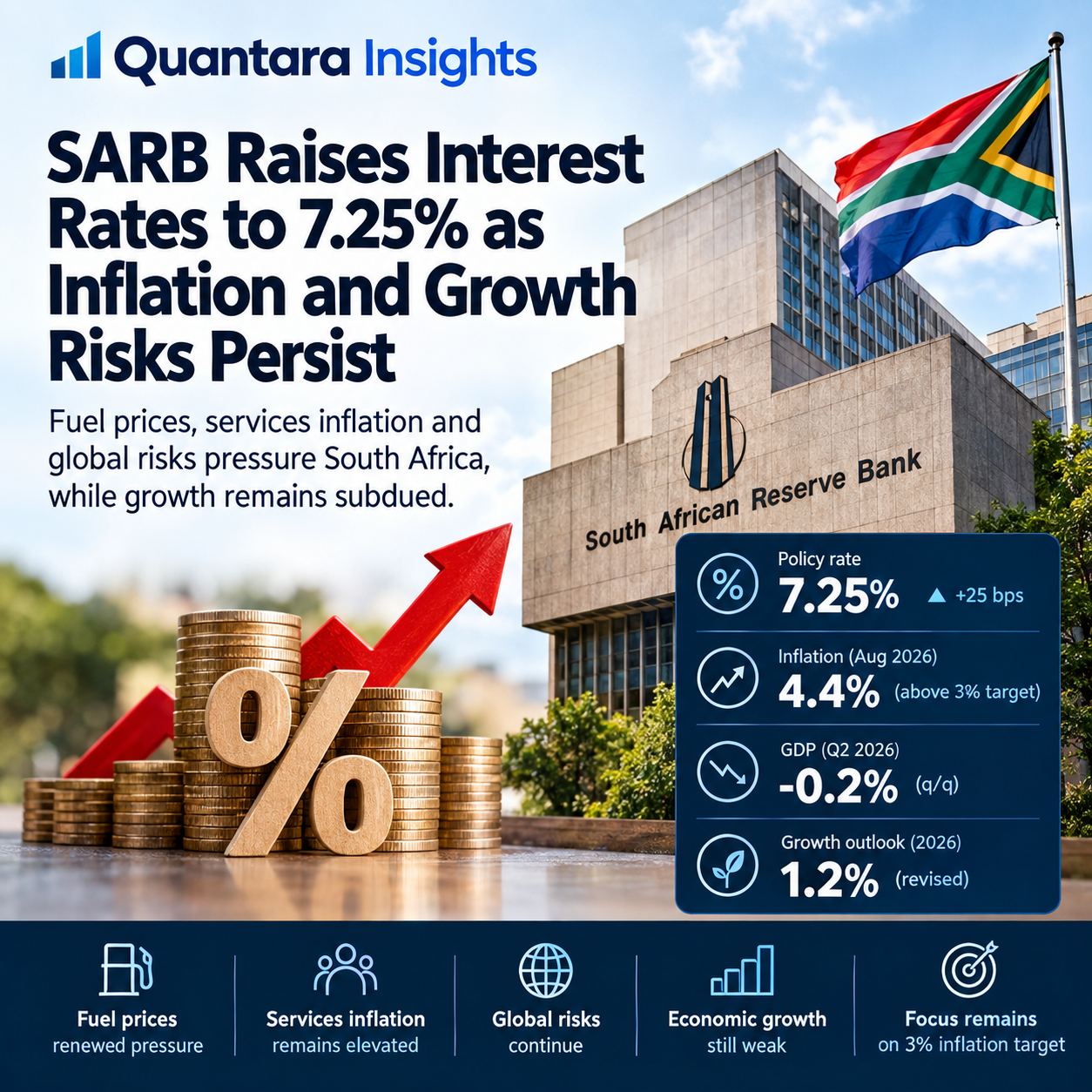
The South African Reserve Bank raised its benchmark rate by 25 basis points to 7.25%, marking its second increase of the year.
The decision was unanimous.
The central bank also considered alternative options, including a larger increase and a hold, before settling on the 25-basis-point move.
Inflation remains the central concern.
The SARB increased its inflation forecasts and also raised its oil-price assumptions.
The Governor emphasized the importance of inflation returning toward the 3% target as the impact of the fuel-price shock fades.
The central bank also highlighted the possibility of second-round effects if large shocks remain persistent.
For South African markets, the combination of inflation, fuel prices, the rand and domestic services inflation remains important when assessing the next phase of monetary policy.
UK Flash PMI: Growth and Inflation in Tension
The latest UK flash PMI data presented a mixed picture.
Services and composite activity were softer than expected, while manufacturing performed better.
The overall message was one of relatively subdued economic growth alongside continued price pressure.
That combination creates a difficult environment for the Bank of England.
Weak growth limits the scope for aggressive tightening, while persistent inflation makes rapid easing difficult to justify.
The UK’s fiscal calendar adds another layer of uncertainty.
The upcoming Budget means markets will also be assessing government borrowing and spending plans alongside the economic data.
Eurozone Flash PMI: Services Continue to Lead
The latest eurozone PMI data showed services remaining relatively strong, while manufacturing performance was more mixed.
The composite picture pointed to continued momentum heading into the fourth quarter.
At the same time, price pressures increased.
That combination has implications for the ECB.
Stronger activity alongside renewed inflationary pressure can make the policy discussion more complicated, particularly if energy prices remain elevated.
Germany and France showed broadly similar patterns, with services holding up better than manufacturing.
For Germany, manufacturing remains particularly important given the country’s exposure to global goods demand and industrial activity.
US-China Relations
The latest high-level US-China discussions produced a warmer tone but limited concrete progress on some of the more structural areas of disagreement.
The existing trade truce was extended for a further period, providing some near-term stability.
However, significant issues surrounding technology, advanced chips, AI and trade policy remain unresolved.
For markets, the immediate significance lies in the reduction of near-term uncertainty rather than the resolution of the underlying disputes.
Trade policy remains an important variable for global manufacturing, supply chains and inflation.
Norges Bank
Norges Bank raised its policy rate by 25 basis points to 4.50%.
The decision represented the tightening side of a closely divided pre-meeting expectation.
The accompanying communication was more cautious in the near term while maintaining some scope for additional tightening later.
The broader message was that rates may need to remain elevated for an extended period.
The Norwegian krone strengthened initially following the decision before broader market positioning became more influential.
Swiss National Bank
The Swiss National Bank maintained its policy rate at 0.0%.
The key change was in the language surrounding foreign-exchange intervention.
The bank retained its willingness to be active in the foreign exchange market, although the wording was adjusted from the previous formulation.
Inflation forecasts were also revised higher, particularly in the near term.
Even so, inflation remained within the SNB’s stated target range.
For the Swiss franc, currency valuation and imported inflation remain closely connected.
Riksbank
Sweden’s Riksbank maintained its policy rate at 1.75%.
The accompanying forecasts contained a more hawkish element, with the central bank indicating that rate increases could begin later in the year.
The projections suggested a gradual normalization path extending into 2027.
At the same time, the Riksbank acknowledged that some of the recent strength in economic growth could reflect temporary factors.
That leaves the future path dependent on the persistence of domestic activity and inflation.
Banxico
Mexico’s central bank maintained its policy rate at 6.50% in a unanimous decision.
Both headline and core inflation forecasts were revised higher, with inflation now expected to return to the 3% target later than previously projected.
The central bank also emphasized that Mexican monetary policy does not need to mechanically follow the Federal Reserve because domestic macroeconomic conditions differ.
That distinction remains important for emerging-market central banks, where exchange rates, domestic inflation and capital flows all interact with global interest-rate expectations.
Japanese Flash PMI Review
Japan’s private-sector growth slowed during September.
Composite PMI declined to 52.5, manufacturing fell to 54.1 and services moved down to 51.6.
Despite softer activity, input-cost pressures remained elevated.
The combination of a weaker yen, higher energy costs and increased labour expenses continued to put pressure on companies.
Businesses continued to pass some of these costs through to customers.
Employment growth also strengthened, reaching its fastest pace in seven months.
The data therefore present a mixed picture: activity has softened, but cost pressures and labour demand remain relatively firm.
Australian Employment
Australian employment increased by 39,500 in August, stronger than the expected 20,000 increase.
However, the unemployment rate increased to 4.6% as participation also increased.
That distinction is important.
A rising participation rate means more people are entering the labour force, which can push the unemployment rate higher even when employment is increasing.
The broader interpretation is that labour supply may be expanding faster than labour demand.
That would imply some gradual accumulation of labour-market slack rather than an outright collapse in employment.
Seasonal effects also need to be considered when interpreting the monthly result.
Economic Report: The Main Themes for the Week Ahead
The calendar can ultimately be reduced to three major themes: inflation, employment and monetary policy.
Inflation
Inflation remains central across the major economies.
US PCE, Australian CPI, eurozone CPI, Tokyo CPI and Swiss CPI will all provide additional information about price pressures.
The key issue is persistence.
Markets will want to distinguish between temporary energy-related movements and broader increases in services, wages and domestic prices.
That distinction is particularly important for central banks.
Employment
The US labour market will take centre stage with NFP on Friday.
Payroll growth, unemployment, participation, wages and revisions will all contribute to the overall assessment.
The data should be viewed in the context of recent claims and other labour-market indicators rather than as a standalone monthly number.
A gradual cooling in employment conditions would be different from a rapid deterioration.
Monetary Policy
The RBA decision provides the first major central-bank event of the week.
The Federal Reserve remains focused on the balance between inflation and employment, while the ECB continues to monitor price pressures and economic activity.
The Bank of Japan is also assessing whether inflation has become sufficiently persistent to justify further policy normalization.
This means the week’s economic data will feed into several different policy debates simultaneously.
Economic Report: Why the Sequence of Releases Matters
One of the defining features of this week is the order in which the information arrives.
The RBA decision comes first.
Australian CPI follows.
The US PCE report then provides a fresh inflation signal before ISM Manufacturing adds information about activity, prices and employment.
Finally, NFP provides the most comprehensive look at the US labour market.
This sequence allows markets to continually update expectations.
The first part of the week may establish the initial framework, while the US data later in the week could change the broader picture.
That is why it may be more useful to consider the calendar as a sequence rather than a collection of unrelated events.
Economic Report: What to Watch Beyond the Headlines
Headline numbers will attract the most immediate attention, but the details underneath them can be more informative.
For PCE, core inflation and the monthly change will matter.
For ISM Manufacturing, new orders, production, prices paid, supplier deliveries and employment deserve attention.
For NFP, payroll revisions, unemployment, participation and average hourly earnings will help establish the broader labour-market picture.
For Australian CPI, the Trimmed Mean and services-related components will help distinguish between temporary and persistent inflation.
For EZ CPI, services inflation and the underlying components will remain important for the ECB outlook.
For the RBA, the statement, vote and Governor’s communication may matter more than the headline rate decision if the outcome is already reflected in market expectations.
Economic Report: Market Positioning Into October
The data released during the week will feed directly into the next stage of central-bank expectations.
For Australia, the RBA decision and CPI report will provide information about whether inflation is moving in the direction required for a sustained return toward target.
For the US, PCE and NFP will offer complementary information about the two sides of the Federal Reserve’s mandate.
For Europe, CPI will help determine whether recent inflation pressures are temporary or becoming more persistent.
For Japan, Tankan and Tokyo CPI will provide further evidence on whether the domestic economy and price environment can support additional monetary-policy normalization.
The market response will therefore depend not only on whether individual releases beat or miss consensus, but also on whether they change the broader policy narrative.
Economic Report: A Dense Week of Cross-Market Signals
The week of 28 September–2 October is unusually concentrated in terms of the number of significant economic releases.
The RBA provides the first major policy event.
Australian CPI then offers a fresh inflation test.
The US calendar follows with PCE, GDP and related personal-income data, before ISM Manufacturing adds information about activity and input prices.
The week concludes with NFP, while eurozone CPI and Japanese inflation data provide additional signals from outside the US.
That combination makes the calendar particularly relevant for rates, currencies and broader macroeconomic positioning.
The important point is that the releases are interconnected.
Inflation affects monetary policy.
Monetary policy affects financial conditions.
Financial conditions affect demand.
Demand affects employment and corporate pricing.
Employment and wages, in turn, feed back into inflation.
The economic data should therefore be interpreted as part of a wider macroeconomic cycle rather than as isolated events.
Economic Report: Conclusion
The week ahead brings a broad mix of inflation, employment, manufacturing and central-bank events across the major economies.
The RBA decision is likely to establish the initial focus, with the accompanying communication providing information about the central bank’s assessment of inflation and growth. Australian CPI then offers an immediate test of that assessment.
In the US, PCE provides the key inflation release, while ISM Manufacturing offers additional information about activity, prices and employment. The week concludes with NFP, where payroll growth, unemployment, wages, participation and revisions will all be important.
In Europe, EZ CPI will provide another test of the inflation outlook and the potential direction of ECB policy. Japan’s Tankan survey and Tokyo CPI will contribute to the Bank of Japan’s assessment of domestic activity and price pressures.
The broader theme running through the Economic Report is the interaction between inflation and growth.
Central banks are attempting to balance persistent price pressures against economies that are showing varying degrees of moderation. That makes the composition of the data particularly important.
For markets, the most useful approach is therefore to look beyond individual headline figures and assess what the combined data say about inflation persistence, labour-market conditions, economic momentum and the likely direction of monetary-policy expectations.
With NFP, PCE, ISM Manufacturing, the RBA and EZ CPI all arriving within the same five-day period, the week provides a substantial amount of new information for the October policy outlook.
The calendar is dense, but the core questions are straightforward: Is inflation continuing to moderate? Are labour markets cooling or stabilizing? Is economic activity holding up? And how are central banks responding to the balance between those forces?
Those questions will remain at the centre of the macroeconomic discussion as the new month begins.