


Table of Contents
- What Did the SARB Decide on Interest Rates?
- Why Did the SARB Raise Interest Rates?
- South Africa’s Inflation Rate Reaches 4.4%
- Fuel Prices Are a Major Inflation Risk
- Services Inflation Remains a Key Concern
- Why Inflation Expectations Matter
- South Africa’s Growth Outlook Has Weakened
- What Happened to GDP in the Second Quarter?
- Why Higher Interest Rates Can Affect Economic Growth
- The SARB’s Growth Forecast Remains Cautious
- Global Economic Conditions Remain Uncertain
- Higher Global Interest Rates Add to the Challenge
- The Rand Remains an Important Part of the Inflation Outlook
- Food Inflation Provides Some Relief
- What Is the SARB’s Inflation Target?
- When Could Interest Rates Start Falling?
- The Risk of Second-Round Inflation Effects
- Higher Wages Could Affect the Inflation Outlook
- Why Structural Reform Matters for South Africa’s Growth
- Energy and Transport Are Central to the Growth Outlook
- Public Finances and Investor Confidence
- What the Latest SARB Decision Means for Households
- What the Rate Decision Means for Businesses
- What the Rate Decision Means for Economic Growth
- The Outlook for Services Inflation
- What Could Push Inflation Higher?
- What Could Improve the Inflation Outlook?
- The SARB’s Approach Remains Data Dependent
- Why the 3% Target Remains Important
- SARB Interest Rate Decision: Key Takeaways
- Frequently Asked Questions About the SARB Interest Rate Decision
- What is the SARB policy rate now?
- Why did the SARB raise interest rates?
- What is the MPC?
- What is South Africa’s inflation rate?
- What is the SARB inflation target?
- Why is services inflation important?
- What happened to South Africa’s economic growth?
- Will interest rates fall soon?
- How do higher interest rates affect consumers?
- How do higher interest rates affect businesses?
- What is the outlook for South African growth?
- Conclusion: SARB Balances Inflation Risks With a Weak Growth Environment
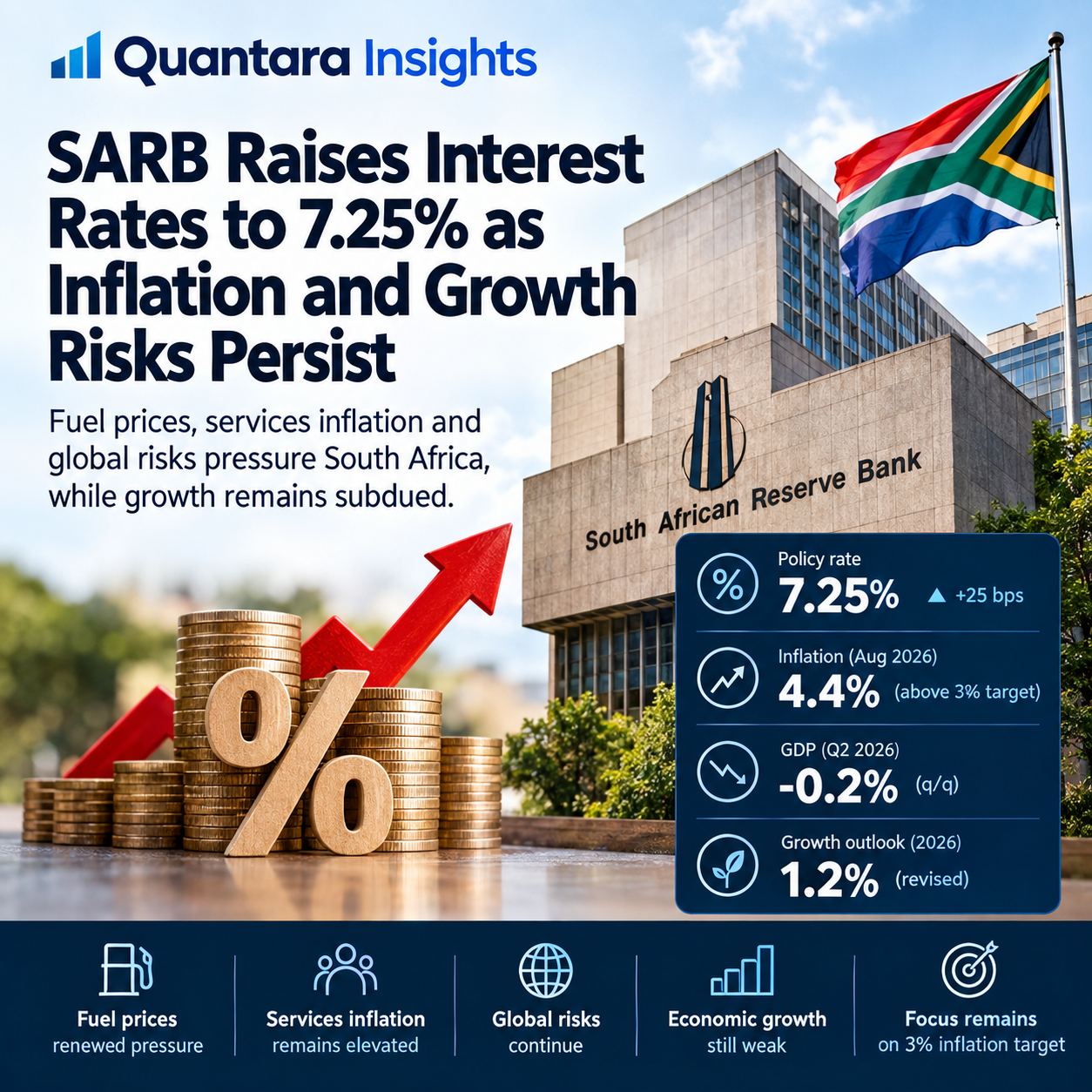
SARB has raised South Africa’s policy rate to 7.25%, as the Monetary Policy Committee responds to renewed inflation risks, higher fuel prices, elevated services inflation and a more uncertain global economic environment.
The decision comes at a difficult point for the South African economy. Growth has weakened, with real gross domestic product contracting by 0.2% in the second quarter of 2026 after expanding by 0.4% in the first quarter. At the same time, inflation increased to 4.4% in August, while pressure from fuel prices and services inflation remains an important consideration for monetary policy.
The SARB has indicated that inflation is expected to remain above the 3% target for a period before gradually returning towards the target over the longer term. The central bank continues to assess the risks surrounding the inflation outlook, including developments in global energy markets, geopolitical conflict, exchange-rate movements, inflation expectations and wage pressures.
The latest MPC decision therefore reflects the challenge facing policymakers: balancing the need to contain inflation while recognising that higher interest rates can also weigh on household spending, investment and economic growth.
The policy decision was unanimous, with the policy rate increased by 25 basis points to 7.25%, effective from 25 September 2026.
What Did the SARB Decide on Interest Rates?
The SARB increased the policy rate by 25 basis points, taking it from 7.00% to 7.25%.
The decision was made by the Monetary Policy Committee, commonly referred to as the MPC, and reflects the central bank’s assessment that inflation risks have increased.
The decision follows a period in which South Africa’s inflation outlook has been affected by developments in global energy markets and geopolitical tensions. Fuel prices have become a significant source of renewed inflation pressure, while services inflation remains above the central bank’s preferred level.
The MPC has maintained its focus on returning inflation to the 3% target over time. Although monetary policy cannot directly prevent an initial supply shock, the central bank can influence whether temporary price increases become embedded in broader inflation expectations, wages and pricing decisions.
That distinction is important.
An increase in the price of fuel, for example, is initially a direct price shock. However, if businesses subsequently increase prices across a wide range of goods and services to compensate for higher costs, and workers seek significantly higher wages because they expect inflation to remain elevated, the original shock can become more persistent.
The SARB is therefore concerned not only about the immediate inflation rate but also about the possibility of second-round effects.
Why Did the SARB Raise Interest Rates?
The decision to raise interest rates reflects several interconnected developments.
The most immediate issue is the renewed pressure from fuel prices. The global environment has become more challenging, with geopolitical conflicts disrupting energy markets, trade routes and supply chains.
Higher international energy prices can feed directly into South African inflation through transport and fuel costs. They can also affect businesses through higher operating expenses, logistics costs and production costs.
The second issue is services inflation.
While inflation in some goods categories has been relatively contained, services inflation remains elevated. Services are particularly important for monetary policy because prices in this part of the economy can be influenced by domestic wage pressures, operating costs and inflation expectations.
The third issue is the international interest-rate environment.
Major central banks are also confronting inflationary pressures and uncertainty. Higher global interest rates can affect financial markets, capital flows and exchange rates. For South Africa, changes in global interest rates can influence the rand and domestic borrowing conditions.
The fourth issue is inflation expectations.

If households, businesses and financial markets begin to expect inflation to remain substantially above the central bank’s target, those expectations can influence wage negotiations, contracts and pricing decisions.
The MPC therefore has to consider both current inflation and the possibility that higher inflation becomes more persistent.
South Africa’s Inflation Rate Reaches 4.4%
South Africa’s annual headline inflation rate increased to 4.4% in August 2026, up from 4.3% in July.
The August inflation data provides important context for the latest SARB decision.
Although inflation remains below the levels experienced during some previous periods of global inflationary pressure, it is above the central bank’s 3% target.
The latest inflation picture is also uneven.
Food inflation remains comparatively low, although it increased slightly in August after several months of moderation. Fuel developments have been more challenging, while services inflation continues to represent an important source of domestic price pressure.
This creates a different inflation environment from one in which price increases are broadly accelerating across every major category.
Instead, the current situation reflects a combination of external shocks and persistent domestic pressures.
That distinction matters because monetary policy is generally less effective at dealing directly with supply-side shocks. Higher interest rates cannot produce more oil, increase agricultural output or reopen disrupted international shipping routes.
The role of monetary policy is instead to prevent temporary shocks from becoming entrenched in the broader inflation process.
Fuel Prices Are a Major Inflation Risk
Fuel prices have become one of the most important considerations in the latest SARB assessment.
Fuel affects the economy through several channels.
The most obvious effect is the direct impact on households and motorists. When petrol and diesel prices rise, consumers have less disposable income available for other spending.
The second effect is transportation.
Businesses depend on road, rail, air and maritime transport to move goods and people. Higher fuel costs can therefore increase the cost of production and distribution.
The third effect is indirect.
A company facing higher transportation costs may eventually adjust the prices of its products or services. This means an initial increase in fuel prices can spread into other parts of the economy.
The extent to which this occurs depends on competition, demand, profit margins, productivity and expectations.
The MPC therefore monitors fuel prices closely because a sustained energy shock can have a much broader economic impact than the initial increase at the petrol station.
The latest policy decision reflects the view that these risks cannot simply be ignored.
Services Inflation Remains a Key Concern
Services inflation is one of the most important elements of the current South African inflation outlook.
Goods prices can be heavily influenced by international supply chains, exchange rates and commodity markets. Services, however, are often more closely connected to domestic economic conditions.
Examples include financial services, insurance, transport, accommodation, education, healthcare and other consumer services.
Services inflation can be persistent because service providers face domestic labour, rental, administrative and operating costs.
The latest SARB assessment highlights the fact that services inflation remains elevated relative to the 3% inflation target.
This is important because persistent services inflation can indicate that inflationary pressures are becoming embedded in the domestic economy.
The central bank therefore wants inflation expectations to move closer to the 3% target.
If households and businesses believe inflation will remain significantly above 3%, they may make decisions based on that expectation. Workers may seek larger wage increases, companies may adjust prices more frequently and businesses may build higher inflation assumptions into contracts.
Those behaviours can make it harder to return inflation to target.
Why Inflation Expectations Matter
Inflation expectations are a central part of monetary policy.
Suppose consumers expect prices to rise rapidly over the next several years. They may bring forward purchases, negotiate higher wages or accept larger price increases.
Businesses may also expect their costs to rise and therefore increase prices before those costs actually materialise.
This can create a feedback loop.
The SARB therefore wants inflation expectations to remain anchored.
Recent survey information indicates that expectations have eased somewhat, although longer-term expectations remain above the central bank’s 3% target.
Market-based measures of inflation expectations have also become more sensitive to the latest developments.
The central bank’s concern is not that every temporary price increase must immediately be offset through higher interest rates.
Instead, the objective is to ensure that temporary shocks do not permanently change expectations about the future inflation environment.
That is one reason the MPC has described its approach as measured but attentive to the balance of risks.
South Africa’s Growth Outlook Has Weakened
While inflation remains a concern, South Africa is also facing a significant growth challenge.
Statistics released in September showed that the economy contracted by 0.2% in the second quarter of 2026.
The contraction followed growth of 0.4% in the first quarter.
The second-quarter decline was broad enough to highlight continued structural constraints in the economy.

Mining, trade and manufacturing were among the sectors contributing to the weakness.
Mining production contracted significantly, while manufacturing also recorded a decline. Trade activity weakened, reflecting softer activity across parts of wholesale and motor trade as well as food and beverage industries.
The result is an economy that is struggling to generate sufficiently strong and consistent growth.
This creates a difficult policy environment for the SARB.
Higher interest rates can help contain inflation, but they can also affect borrowing costs and domestic demand.
That means monetary policy must take account of the economic consequences of tighter financial conditions while maintaining its inflation mandate.
What Happened to GDP in the Second Quarter?
South Africa’s GDP decreased by 0.2% during the second quarter of 2026.
Several industries contributed to the contraction.
Mining activity declined by 3.0%, while trade contracted by 1.9%. Manufacturing also declined, recording another quarterly contraction.
At the same time, not every part of the economy weakened.
Transport, storage and communication increased by 0.9%. Construction expanded for a second consecutive quarter, while agriculture recorded another increase.
Household consumption expenditure also increased by 0.4%.
However, these areas of strength were insufficient to offset weakness elsewhere in the economy.
The GDP figures illustrate the uneven nature of South Africa’s current economic performance.
There are sectors generating activity and employment, but the overall economy remains constrained by weak productivity, infrastructure limitations, global uncertainty and subdued investment.
Why Higher Interest Rates Can Affect Economic Growth
The relationship between interest rates and economic growth is important for households and businesses.
When interest rates rise, borrowing generally becomes more expensive.
For households, this can affect mortgage repayments, vehicle finance, personal loans and other forms of credit.
For businesses, higher financing costs can affect investment decisions.
A company considering a new factory, expansion project or equipment purchase may reassess that investment if the cost of financing increases.
Higher rates can therefore reduce demand and slow economic activity.
However, monetary policy also works in the opposite direction when inflation is too high.
If inflation remains elevated for an extended period, households and businesses face uncertainty over future costs and purchasing power. Persistent inflation can also undermine the real value of savings and distort investment decisions.
The SARB therefore has to balance these effects.
The objective is not simply to achieve the lowest possible interest rates at any point in time. The broader objective is price stability, which provides a more predictable environment for households, businesses and investors.
The SARB’s Growth Forecast Remains Cautious
The latest SARB assessment expects South Africa to rebound during the second half of 2026, although the annual growth forecast has been reduced to approximately 1.2%.
The central bank continues to see medium-term growth around the 2% level, assuming global conditions stabilise and domestic reforms improve the operating environment.
However, the risks to that outlook remain skewed to the downside.
This reflects the combination of global uncertainty and domestic structural constraints.
A stronger growth trajectory would require improvements in areas such as electricity supply, transport infrastructure, logistics, productivity and investment.
The central bank has also emphasised the importance of sustainable public finances and permanently lower inflation.
These factors affect the country’s broader economic resilience.
Global Economic Conditions Remain Uncertain
The South African economy is closely connected to global markets.
Changes in international energy prices, commodity demand, exchange rates, global interest rates and capital flows can have significant effects on domestic economic conditions.
The latest global environment is particularly challenging because geopolitical conflicts are affecting energy supplies and international trade.
Disruptions involving major energy-producing regions can increase oil prices and transportation costs.
The Russia-Ukraine conflict also continues to affect global trade and supply chains.
For South Africa, these developments matter because the country imports significant quantities of fuel and remains exposed to international commodity and financial markets.
The SARB therefore cannot assess domestic inflation in isolation.
Global developments can influence the rand, imported inflation, bond yields and domestic financing conditions.
Higher Global Interest Rates Add to the Challenge
Another important issue is the direction of global interest rates.
When major central banks raise rates, international financial conditions generally become tighter.
This can affect emerging markets through capital flows and exchange-rate movements.
South Africa is particularly sensitive to global financial conditions because investors assess the country alongside other emerging and developed markets when allocating capital.
If global bond yields rise substantially, investors may demand higher returns from emerging-market assets.
This can place pressure on local bond yields and the exchange rate.
A weaker rand can increase the domestic price of imported goods and fuel, potentially adding to inflation.
The SARB has therefore considered scenarios involving higher global interest rates.

These scenarios indicate that a more substantial increase in global rates could result in further rand depreciation and higher domestic inflation, requiring a tighter monetary policy response.
The Rand Remains an Important Part of the Inflation Outlook
The exchange rate plays a significant role in South Africa’s inflation dynamics.
A stronger rand can help contain imported inflation because imported goods and inputs become relatively less expensive in rand terms.
A weaker rand can have the opposite effect.
This is particularly important for fuel and other internationally traded products.
The recent resilience of the rand has helped contain some import-price pressures.
However, the exchange rate remains vulnerable to global developments.
Changes in commodity prices, international interest rates, investor sentiment and South Africa’s fiscal position can all influence the currency.
The SARB therefore considers exchange-rate movements when assessing the balance of risks.
It does not target a specific exchange-rate level, but the effect of currency movements on inflation remains an important consideration for monetary policy.
Food Inflation Provides Some Relief
Not all components of the inflation basket are creating the same degree of concern.
Food inflation has remained relatively favourable compared with some other inflation categories.
Strong agricultural production has helped support lower food-price increases.
Food inflation reached comparatively low levels, although August data showed a modest increase after several months of moderation.
This is important for households because food represents a significant component of consumer spending.
Agricultural conditions will remain important going forward.
Weather conditions, rainfall, production costs and international food markets can all affect domestic food prices.
The risk of adverse weather conditions is therefore part of the wider inflation assessment.
For now, however, food inflation has provided some offset to the stronger pressures coming from fuel and services.
What Is the SARB’s Inflation Target?
The SARB’s inflation target is 3%.
The central bank’s monetary policy framework is designed to bring inflation back towards that target over time.
The latest outlook indicates that inflation may remain elevated before gradually declining towards 3%.
The timing of that return depends on several factors, including fuel prices, global inflation, the exchange rate, inflation expectations and domestic services inflation.
The MPC has made clear that the current policy path is not a fixed commitment.
Instead, decisions will continue to be made on a meeting-by-meeting basis.
That means future interest rates will depend on incoming economic data and changes to the inflation outlook.
When Could Interest Rates Start Falling?
The latest SARB projection model indicates that the policy rate could remain broadly stable through the remainder of the year, followed by reductions later in the forecast period as inflation moves closer to the 3% target.
However, the central bank has stressed that the model’s projected rate path is not a promise.
Future rate decisions will depend on the data available at each MPC meeting.
This distinction is important for consumers and businesses.
A projected future rate reduction does not guarantee that rates will fall at a particular meeting or by a particular amount.
If inflation remains above target for longer than expected, the timing of future rate reductions could change.
Similarly, if inflation falls faster than expected and the broader risk environment improves, the policy outlook could also change.
The Risk of Second-Round Inflation Effects
The concept of second-round effects is central to understanding the latest SARB decision.
A first-round effect occurs when an external shock directly increases prices.
For example, an increase in global oil prices can raise domestic fuel prices.
A second-round effect occurs when that initial shock spreads through the economy.
Transport companies may increase prices. Businesses may raise product prices. Workers may negotiate higher wages. Service providers may adjust fees.
If these responses become widespread, the inflation shock can persist even after the original cause has faded.
This is one of the main reasons the MPC is concerned about services inflation and inflation expectations.
The central bank’s goal is to prevent temporary external shocks from becoming embedded in domestic price-setting behaviour.
Higher Wages Could Affect the Inflation Outlook
Wage growth is another factor considered by monetary policymakers.
Higher wages can support household spending and improve living standards, particularly when wage increases exceed inflation.
However, if wage increases become significantly disconnected from productivity and inflation trends, businesses may attempt to recover higher labour costs through increased prices.
This can contribute to persistent inflation.
The SARB has therefore considered scenarios involving higher inflation expectations and stronger wage growth.
Such scenarios point towards a tighter policy stance and potentially higher interest rates for longer.
Again, this does not mean that every wage increase is inflationary.
The relationship depends on productivity, profit margins, demand conditions and the broader economic environment.
Why Structural Reform Matters for South Africa’s Growth
Monetary policy alone cannot solve South Africa’s structural growth constraints.
The SARB has repeatedly highlighted the importance of reforms that improve productivity and the country’s business environment.
Transport and energy infrastructure are particularly important.
Efficient ports, railways and roads reduce the cost of moving goods.
Reliable electricity supports production and investment.
Improved infrastructure can also increase the competitiveness of South African businesses in international markets.
Structural reforms can therefore improve the economy’s productive capacity without creating the same inflationary pressures that can accompany demand-driven expansion.
This is particularly important when monetary policy is constrained by inflation risks.
Energy and Transport Are Central to the Growth Outlook
South Africa’s transport and energy systems have a direct relationship with economic growth.
When infrastructure works efficiently, businesses can produce and distribute goods at lower cost.
When infrastructure constraints persist, businesses face higher costs and uncertainty.
The effects can be particularly significant for exporters, manufacturers, retailers and mining companies.
Improving logistics can therefore support both productivity and investment.
The same applies to energy.
A reliable electricity system reduces operational interruptions and makes long-term investment decisions easier.
The SARB has identified structural interventions in transport and energy as important components of South Africa’s medium-term growth strategy.
Public Finances and Investor Confidence
Another component of the economic outlook is fiscal sustainability.
High levels of public debt can increase the government’s financing requirements and make the economy more sensitive to changes in global borrowing costs.
In an environment where global bond yields are elevated, countries with stronger macroeconomic fundamentals may be better positioned to absorb external financial shocks.
The SARB has therefore emphasised the importance of sustainable debt and permanently lower inflation.
Sound public finances can help reduce the country’s risk premium, while credible monetary policy can contribute to investor confidence.
These factors do not eliminate global risks, but they can strengthen South Africa’s ability to respond to them.
What the Latest SARB Decision Means for Households
For households, the increase in the policy rate to 7.25% can affect borrowing costs.
Consumers with variable-rate loans may experience higher interest expenses.
Prospective homebuyers may also face higher financing costs than they would under a lower policy-rate environment.
Higher rates can reduce disposable income for households carrying significant debt.
At the same time, savers may receive higher returns on certain interest-bearing products.
The overall impact therefore depends on whether a household is primarily a borrower, saver or a combination of both.
The broader economic effect also depends on how long the higher rate environment persists.
What the Rate Decision Means for Businesses
Businesses also need to consider the effect of higher interest rates.
Companies that rely heavily on borrowing may face increased financing costs.
Higher rates can influence investment decisions, particularly for projects where returns are uncertain or where debt financing represents a substantial portion of the capital structure.
However, businesses also benefit from a stable inflation environment.
Persistent inflation creates uncertainty around input costs, wages, pricing and long-term contracts.
For this reason, the SARB’s inflation objective remains relevant to businesses even when tighter monetary policy creates short-term financing pressure.
A predictable inflation environment can support longer-term planning and investment.
What the Rate Decision Means for Economic Growth
The relationship between monetary policy and growth is one of the most important issues facing South Africa.
The country needs stronger economic expansion to improve employment opportunities, investment and household incomes.
At the same time, rapid demand growth in an economy with limited productive capacity can create inflationary pressure.
The challenge is therefore to achieve sustainable growth rather than short-term expansion driven by excessive demand.
Structural reform can help address this challenge by increasing productive capacity.
If infrastructure improves, logistics become more efficient and investment increases, the economy can potentially grow faster without creating the same level of inflation pressure.
The Outlook for Services Inflation
The future path of services inflation will be particularly important for the MPC.
If services inflation remains elevated, the central bank may need to maintain a restrictive policy stance for longer.
If services inflation begins moving sustainably towards 3%, the inflation outlook could become more favourable.
The key issue is persistence.
Temporary price increases caused by specific events are generally less concerning than broad-based price increases that continue for an extended period.
The SARB will therefore monitor services prices, wages, inflation expectations and domestic demand closely.
What Could Push Inflation Higher?
Several risks could cause inflation to remain above expectations.
Higher fuel prices
A prolonged increase in global oil prices could place further pressure on transport and consumer prices.
A weaker rand
Currency depreciation could increase the rand cost of imported goods and energy.
Higher global interest rates
Tighter international financial conditions could affect the exchange rate and domestic borrowing costs.
Higher inflation expectations
If households and businesses expect inflation to remain high, price-setting behaviour could become more persistent.
Higher wage growth
Stronger wage increases could contribute to services inflation if they exceed productivity growth and are passed through into prices.
Adverse agricultural conditions
Drought or other weather-related disruptions could increase food prices.
These risks do not necessarily materialise simultaneously, but they explain why the MPC continues to describe the inflation outlook as challenging.
What Could Improve the Inflation Outlook?
There are also factors that could support lower inflation.
A decline in global energy prices would reduce direct fuel pressures.
A resilient rand could continue to contain imported inflation.
Lower food-price growth could provide additional relief to households.
Improved global supply conditions could reduce pressure on transportation and imported inputs.
Most importantly, if inflation expectations decline and services inflation moves closer to the 3% target, the domestic inflation environment could become more favourable.
The SARB would then have greater scope to gradually adjust monetary policy if the broader economic conditions supported such a move.
The SARB’s Approach Remains Data Dependent
The latest MPC decision should not be interpreted as establishing a permanent direction for future interest rates.
The central bank has made clear that monetary policy decisions will remain dependent on incoming information.
This includes inflation data, GDP data, exchange-rate developments, global financial conditions, wage trends and inflation expectations.
The quarterly projection model provides a framework for assessing possible outcomes, but it does not replace the MPC’s judgement at each meeting.
That approach is particularly important in an environment where global conditions can change quickly.
Why the 3% Target Remains Important
The return of inflation to 3% remains central to the SARB’s monetary policy framework.
A lower and more predictable inflation environment can improve the ability of households and businesses to plan.
It can also reduce uncertainty around long-term contracts, investment and borrowing decisions.
The central bank’s challenge is to bring inflation back towards the target without unnecessarily weakening economic activity.
That requires careful assessment of the source and persistence of inflation.
The latest increase in the policy rate reflects the assessment that current risks justify a more restrictive stance.
SARB Interest Rate Decision: Key Takeaways
The latest SARB decision can be summarised through several key points.
First, the policy rate has increased by 25 basis points to 7.25%.
Second, the decision was unanimous among the MPC members.
Third, inflation increased to 4.4% in August 2026, remaining above the 3% target.
Fourth, fuel prices have become a renewed source of inflation pressure.
Fifth, services inflation remains elevated and requires close monitoring.
Sixth, South African growth weakened in the second quarter, with GDP contracting by 0.2%.
Seventh, the SARB expects economic activity to recover during the second half of the year, although the full-year growth outlook has been reduced to approximately 1.2%.
Eighth, the central bank continues to expect inflation to move towards 3% over the longer term.
Ninth, global interest rates, geopolitical conflict and energy-market developments remain significant risks.
Finally, structural reforms in areas such as transport and energy remain important for improving South Africa’s longer-term growth prospects.
Frequently Asked Questions About the SARB Interest Rate Decision
What is the SARB policy rate now?
The SARB policy rate is 7.25% following the September 2026 decision by the Monetary Policy Committee.
Why did the SARB raise interest rates?
The SARB raised interest rates because inflation risks have increased, particularly due to higher fuel prices, elevated services inflation, global economic uncertainty and the potential for inflation expectations to remain above the 3% target.
What is the MPC?
The MPC, or Monetary Policy Committee, is the committee responsible for setting South Africa’s monetary policy rate. It assesses inflation, economic growth, financial conditions and risks before making interest-rate decisions.
What is South Africa’s inflation rate?
South Africa’s headline consumer inflation rate increased to 4.4% in August 2026.
What is the SARB inflation target?
The SARB’s inflation target is 3%. Monetary policy is aimed at bringing inflation back towards that target over time.
Why is services inflation important?
Services inflation can be persistent because it is often influenced by domestic wages, operating costs and inflation expectations. Sustained services inflation above the target can make it harder for overall inflation to return to 3%.
What happened to South Africa’s economic growth?
South Africa’s economy contracted by 0.2% in the second quarter of 2026. The contraction followed growth of 0.4% in the first quarter.
Will interest rates fall soon?
The SARB’s projection model indicates that the policy rate could remain broadly stable before cuts later in the forecast period as inflation moves towards 3%. However, the central bank has emphasised that future decisions will be made on a meeting-by-meeting basis.
How do higher interest rates affect consumers?
Higher interest rates can increase borrowing costs for households with variable-rate loans and mortgages. They can also reduce disposable income for highly indebted consumers, while potentially benefiting some savers through higher returns on interest-bearing investments.
How do higher interest rates affect businesses?
Higher interest rates can increase financing costs and influence business investment decisions. However, maintaining lower and more predictable inflation can provide businesses with greater certainty over future costs and pricing.
What is the outlook for South African growth?
The SARB expects a rebound in economic activity during the second half of 2026 but has lowered its full-year growth projection to approximately 1.2%. Medium-term growth is projected at around 2%, subject to global stabilisation and continued domestic reforms.
Conclusion: SARB Balances Inflation Risks With a Weak Growth Environment
The latest SARB decision reflects the difficult balance facing South Africa’s monetary policymakers.
The policy rate has been increased to 7.25% at a time when economic growth is weak and GDP has contracted in the second quarter.
At the same time, inflation has moved higher, fuel prices are creating renewed pressure and services inflation remains elevated.
The challenge for the MPC is therefore not simply to respond to the latest inflation number. It is to assess whether current price shocks are likely to fade or whether they could become embedded in expectations, wages and broader domestic price-setting behaviour.
The SARB expects inflation to remain elevated for a period before gradually moving back towards the 3% target.
The path to that outcome will depend on global energy prices, geopolitical developments, the rand, food prices, services inflation, wage growth and inflation expectations.
At the same time, stronger long-term growth will require more than monetary policy.
Structural improvements in electricity, transport, logistics, productivity and the broader business environment will remain important if South Africa is to increase its productive capacity and achieve more sustainable economic expansion.
For households, businesses and investors, the key message from the latest decision is that the interest-rate environment remains closely tied to the inflation outlook.
Future interest rates will depend on the data and the balance of risks at each MPC meeting.
The immediate policy priority remains clear: prevent temporary inflation shocks from becoming persistent while creating the conditions for inflation to return to the 3% target over time.