

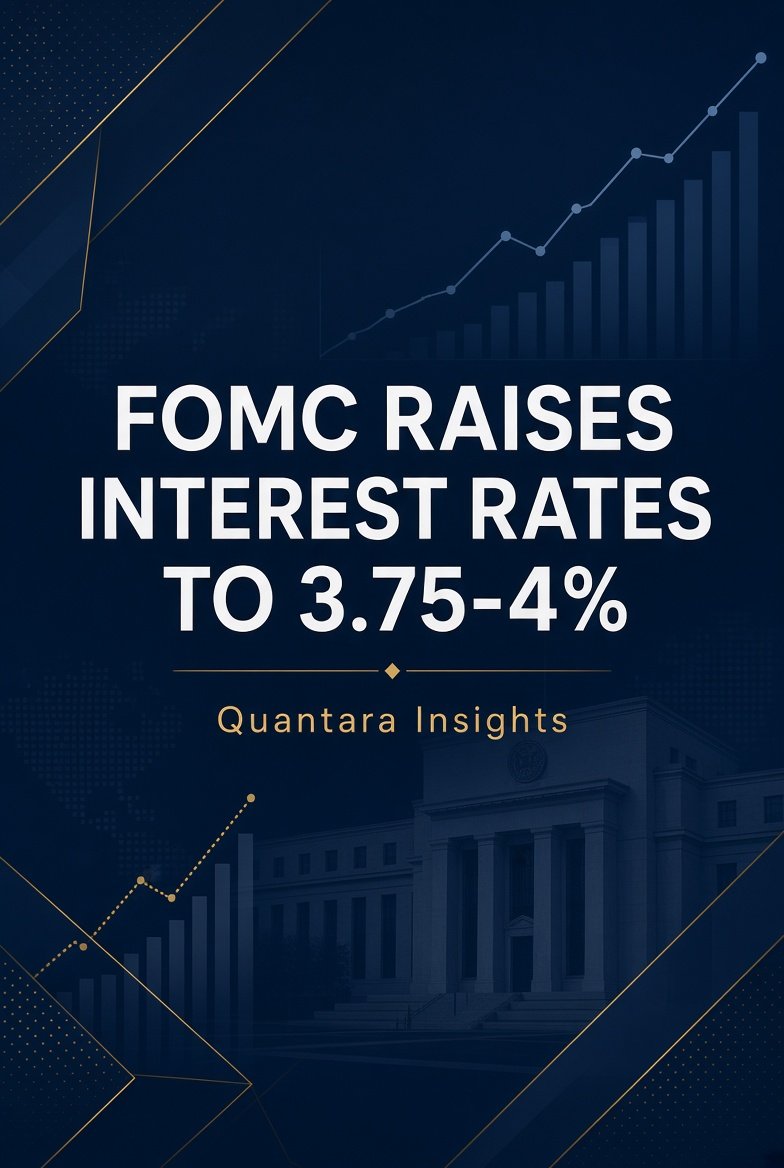

FOMC decisions continue to shape the direction of interest rates and monetary policy in the United States. Today the Federal Open Market Committee raised the target range for the federal funds rate by one-quarter percentage point to 3-3/4 to 4 percent. The decision was approved by a unanimous 12–0 vote and marks the first increase in interest rates by the Fed in three years. The Committee stated that the move supports its dual mandate and is intended to help bring inflation back to the 2 percent longer-run goal in a more timely manner.
The official statement described economic activity as expanding at a solid pace. While uncertainty remains elevated in part because of geopolitical developments, domestic spending has stayed resilient. Productivity growth is strong and capital investment is robust. Job gains have kept pace with the growth of the workforce, and the unemployment rate has changed little. At the same time, inflation remains elevated. The Committee made clear that it remains committed to delivering price stability and that the current policy action is designed to support that objective.

The Fed is also maintaining its policy of keeping ample reserves in the banking system. This operational approach continues to provide a stable foundation for implementing the new target range for the federal funds rate.
How the Rate Decision Is Being Implemented
To put the new policy stance into effect, several technical adjustments take effect on September 17, 2026. The interest rate paid on reserve balances has been raised to 3.90 percent. Standing overnight repurchase agreement operations will be conducted at a rate of 4.0 percent. Standing overnight reverse repurchase agreement operations will be offered at 3.75 percent, with a per-counterparty limit of $160 billion per day.
Open market operations will be used as needed to keep the federal funds rate within the 3-3/4 to 4 percent target range. When appropriate, the Federal Reserve may increase its holdings of securities through purchases of Treasury bills and, if necessary, other Treasury securities with remaining maturities of three years or less in order to maintain an ample level of reserves. All principal payments from the Federal Reserve’s holdings of Treasury securities will be rolled over at auction. Principal payments from agency securities will be reinvested into Treasury bills.
In a related step, the primary credit rate has been increased by one-quarter percentage point to 4.0 percent. This adjustment was approved after requests from the Boards of Directors of the Federal Reserve Banks of Cleveland, Richmond, Atlanta, Chicago, Minneapolis, Kansas City, and Dallas.
These coordinated changes ensure that the administered rates move in line with the new target range and that monetary policy continues to transmit effectively through the financial system.
The Latest Economic Projections
Alongside the rate decision, participants submitted their individual projections for the most likely economic outcomes under appropriate monetary policy. The median projections provide a clear picture of the Committee’s collective outlook.
Real GDP growth is projected at a median of 2.3 percent in 2026, rising slightly to 2.4 percent in 2027, then easing to 2.2 percent in 2028 and 2.1 percent in 2029. Over the longer run, growth is expected to settle at 2.0 percent. These figures point to continued expansion near the economy’s longer-run potential.
The unemployment rate is projected to remain steady at a median of 4.1 percent in each year from 2026 through 2029, with a longer-run median of 4.2 percent. This outlook suggests that the labor market is expected to stay roughly balanced, with job gains continuing to match the growth of the labor force.
Inflation remains the central challenge. Median projections for PCE inflation stand at 3.7 percent in 2026 before declining to 2.3 percent in 2027, 2.1 percent in 2028, and 2.0 percent in 2029 and over the longer run. Core PCE inflation, which excludes the more volatile food and energy categories, is projected at 3.4 percent in 2026, 2.5 percent in 2027, 2.2 percent in 2028, and 2.0 percent in 2029. These numbers confirm that inflation is still running well above the Committee’s 2 percent goal in the near term, even as it is expected to move closer to target over the next few years.
The projected path for the federal funds rate has shifted higher relative to earlier expectations. The median projection is now 4.1 percent at the end of both 2026 and 2027, then declines to 3.9 percent in 2028, 3.6 percent in 2029, and 3.2 percent over the longer run. This higher near-term path is consistent with the decision to raise the target range at the September meeting and with the assessment that inflation remains elevated.

Compared with the projections released in June 2026, the current outlook shows modestly stronger growth in the near term, a lower path for the unemployment rate, and a higher path for the federal funds rate. Inflation projections for 2026 are slightly higher than in June, while the longer-run inflation target remains firmly at 2.0 percent.
Reading the Outlook: Growth, Jobs, and Inflation Together
The combination of solid projected growth, a stable unemployment rate near its longer-run level, and still-elevated inflation helps explain why the FOMC chose to firm the stance of monetary policy. By raising interest rates, the Committee is working to ensure that demand does not outrun the economy’s productive capacity in a way that would keep inflation persistently high. At the same time, the projections suggest that participants see a path in which the economy continues to expand at a healthy pace while inflation gradually returns to 2 percent.
The statement’s emphasis on strong productivity growth and robust capital investment is particularly important. Sustained gains in productivity expand the economy’s supply capacity, which can help reconcile solid growth with moderating inflation over time. Resilient domestic spending further indicates that households and businesses have continued to spend even after earlier policy adjustments.
Uncertainty is explicitly recognized. Geopolitical developments are cited as one factor keeping uncertainty elevated. In this environment, the FOMC’s approach remains data-dependent. Future decisions will be guided by incoming information on inflation, employment, spending, and the broader economic outlook rather than by any fixed timetable.
Why Interest Rates Matter for the Broader Economy
The federal funds rate is the interest rate at which banks lend reserves to one another overnight. Changes in this rate influence a wide range of borrowing costs for households and businesses, including rates on mortgages, auto loans, credit cards, and commercial credit. Higher interest rates tend to moderate demand for interest-sensitive goods and services, which in turn can ease upward pressure on prices.
The Fed’s dual mandate requires attention to both price stability and maximum employment. The current projections indicate that participants expect the unemployment rate to remain near its longer-run level even as policy rates are raised. This balance is consistent with a view that the underlying strength of the economy can absorb a measured increase in interest rates without a sharp rise in joblessness.
Keeping longer-term inflation expectations well anchored is a key objective of monetary policy. By taking action now to bring inflation back to 2 percent in a timely way, the Committee aims to prevent elevated inflation from becoming embedded in wage- and price-setting behavior. Well-anchored expectations make it easier for monetary policy to achieve its goals with less disruption to economic activity.
The Path of Policy Looking Ahead
The median projection for the federal funds rate of 3.2 percent over the longer run suggests that once inflation has returned sustainably to 2 percent, participants anticipate a gradual decline in the policy rate toward a more neutral level. The exact timing and pace of any future changes will depend on how the economic data evolve.

The decision to maintain an ample level of reserves remains in place. This framework has proven effective at keeping the federal funds rate within the target range and at supporting the smooth transmission of monetary policy. The continued rollover of Treasury principal and the reinvestment of agency principal into Treasury bills help maintain the size of the System Open Market Account while gradually shifting its composition toward shorter-maturity securities.
Putting the September Decision in Context
This rate increase is the first by the FOMC in three years. After a prolonged period in which policy rates were held steady, the Committee judged that a modest firming was appropriate given the combination of solid growth and elevated inflation. The quarter-point size of the move is measured and deliberate, signaling a careful response rather than an aggressive shift.
The unanimous 12–0 vote underscores a shared assessment among participants that the current economic conditions warranted the increase. At the same time, the detailed projections show that participants continue to see a path in which inflation declines toward 2 percent while growth and employment remain resilient.
Key Takeaways from the Data
Several points stand out from the September 2026 materials. First, economic activity is expected to continue expanding at a solid pace near longer-run potential. Second, the labor market is projected to remain roughly balanced, with the unemployment rate holding steady near 4.1 percent. Third, inflation is still elevated in the near term at 3.7 percent for overall PCE prices and 3.4 percent for core PCE prices, but is expected to move closer to the 2 percent goal over the next few years. Fourth, the path for the federal funds rate has been revised higher in the near term relative to the June projections, consistent with the decision to raise the target range now.
These elements together support the Committee’s judgment that a 25-basis-point increase in the federal funds rate is appropriate at this time. The policy action is intended to help ensure that inflation returns to 2 percent in a timely manner while the broader economy continues to expand.
Conclusion
The FOMC decision to raise the target range for the federal funds rate to 3-3/4 to 4 percent reflects a careful weighing of the dual mandate. With economic activity expanding at a solid pace, the labor market remaining resilient, and inflation still elevated, the Committee determined that a modest increase in interest rates would support a more timely return to price stability. The accompanying economic projections show median expectations for continued growth near trend, unemployment near its longer-run level, and inflation gradually declining toward 2 percent, alongside a higher near-term path for the federal funds rate.
Monetary policy remains focused on delivering price stability while fostering conditions consistent with maximum employment. The technical implementation steps ensure that the new target range is effectively achieved. As new data arrive, the FOMC will continue to adjust the stance of policy as appropriate to achieve its statutory objectives. This measured step—the first increase in interest rates in three years—underscores the Committee’s commitment to its inflation goal while recognizing the underlying strength of the U.S. economy.