






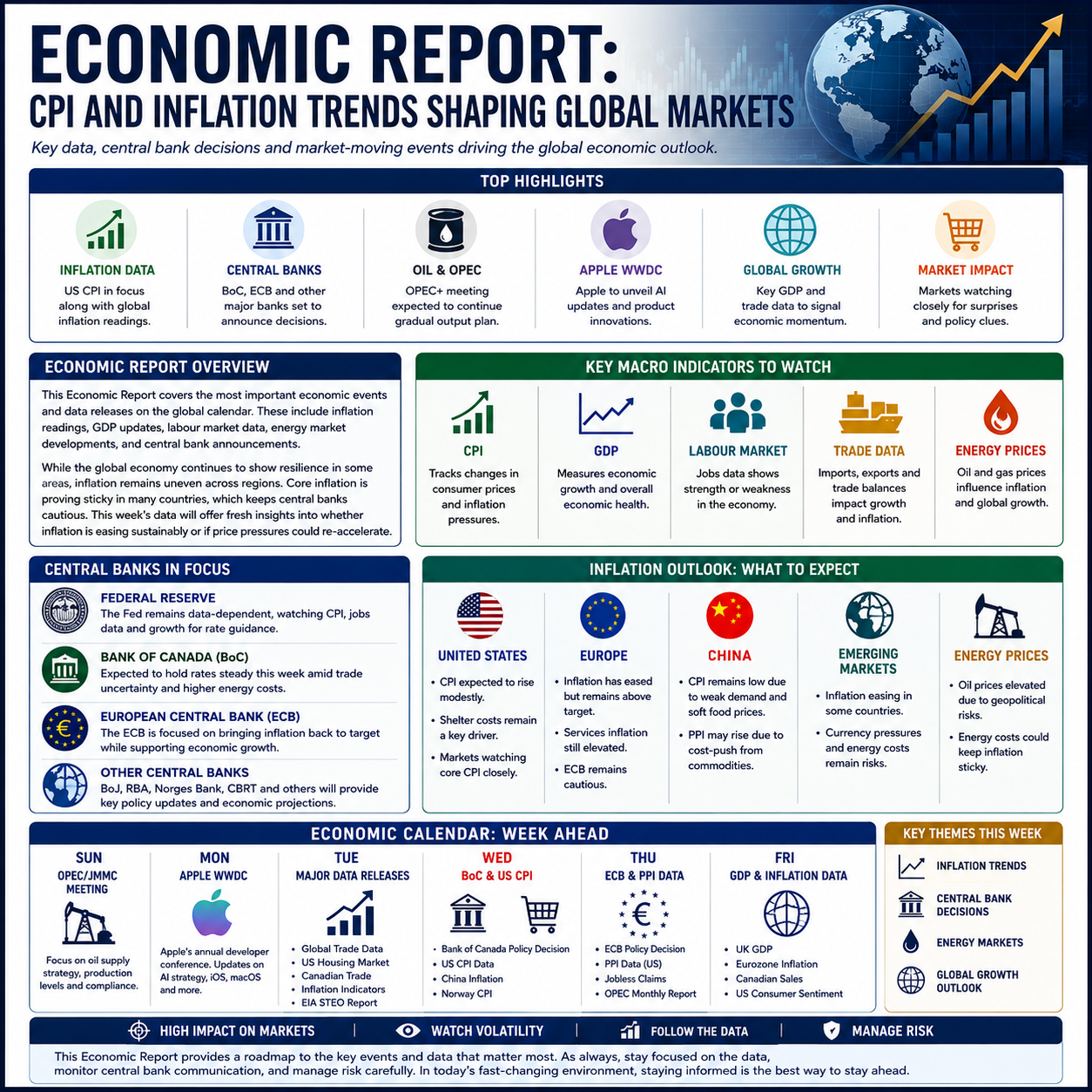
Economic Report (Global Week Ahead Market Analysis)
The Economic Report for the upcoming global macro week presents a concentrated period of high-impact data releases, central bank policy decisions, and inflation-driven volatility across developed and emerging markets. At the center of this Economic Report are three dominant macro themes: CPI, Inflation, and central bank policy divergence.
Across the United States, Europe, Asia, and commodity-linked economies, investors are preparing for a data-heavy environment where every CPI release and inflation print has the potential to reshape interest rate expectations. This Economic Report highlights how inflation dynamics continue to anchor market sentiment, even as growth indicators show mixed resilience.
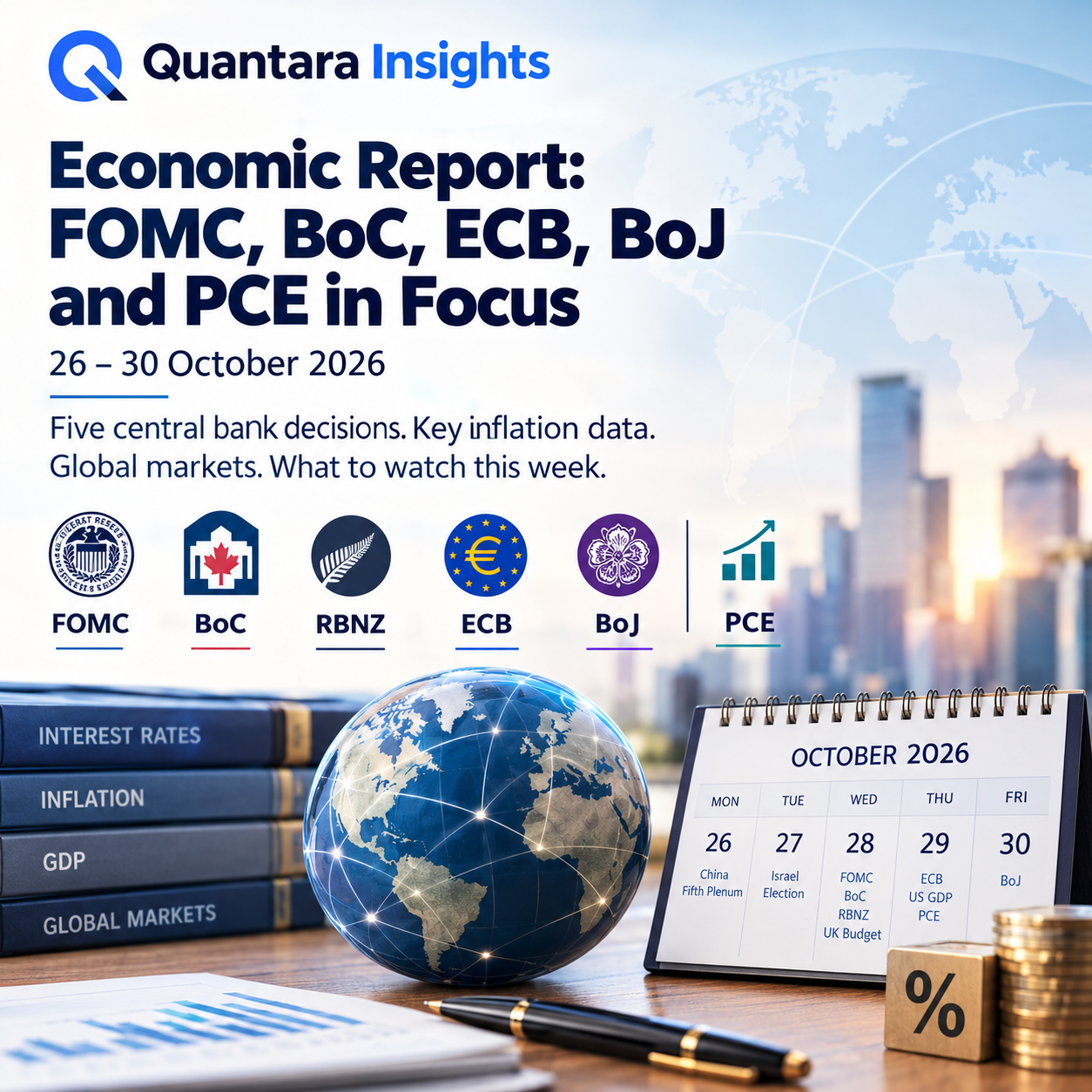
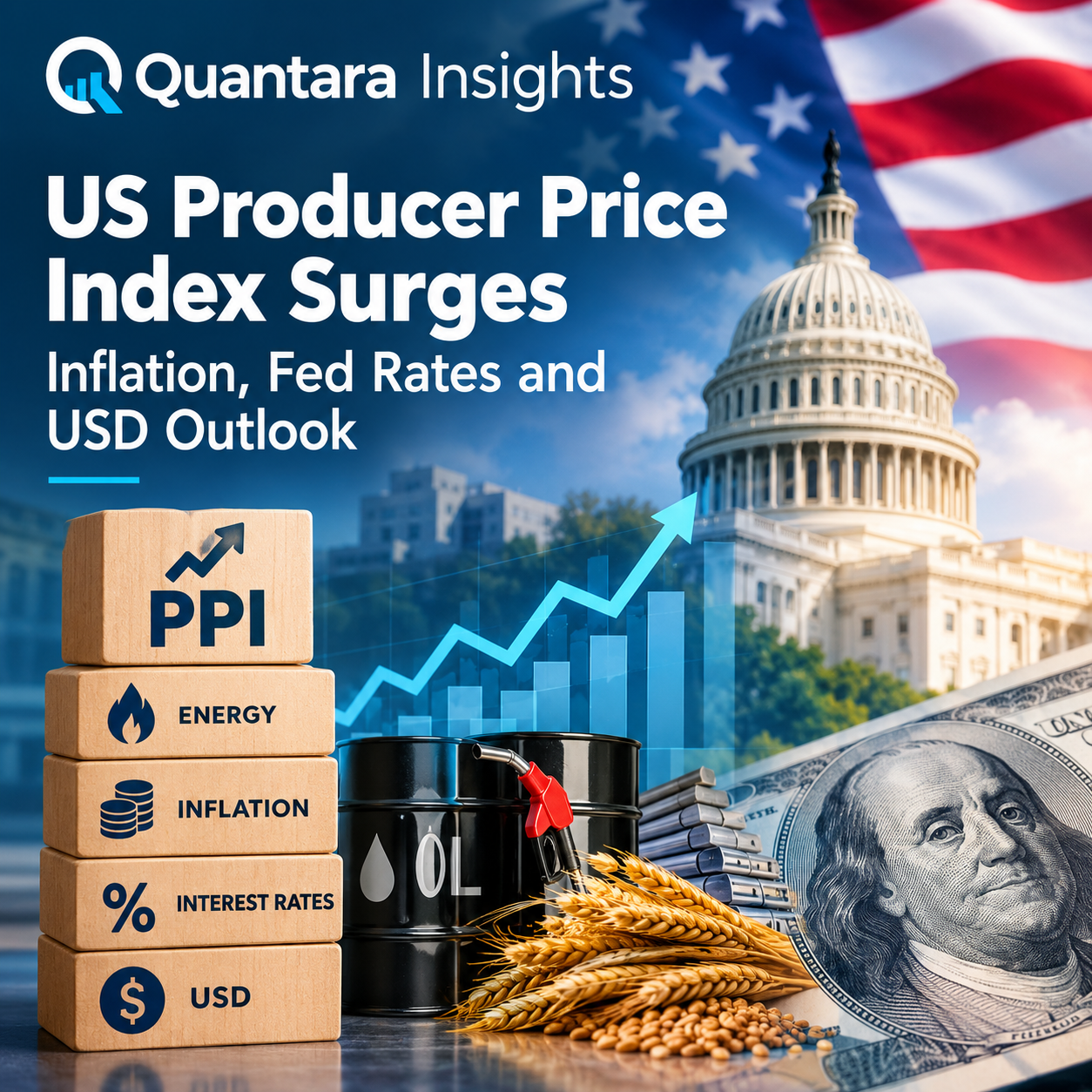
The week ahead includes US CPI, US PPI, ECB policy decisions, Bank of Canada guidance, OPEC meetings, and inflation updates from China, Norway, Sweden, and Mexico. Each component of this Economic Report feeds into a broader narrative: global inflation is moderating unevenly, but not uniformly enough to trigger a synchronized easing cycle.
Global Overview of the Economic Report Week
This section of the Economic Report focuses on the macro structure shaping global markets. Economic momentum remains uneven, with advanced economies showing slower but stable growth, while inflation pressures remain sticky in services and energy-sensitive sectors.
The Economic Report indicates that:
- Developed economies face persistent inflation stickiness
- Emerging markets show mixed CPI stability
- Energy markets remain a wildcard for inflation expectations
- Central banks are increasingly data-dependent
The overarching takeaway from this Economic Report is that inflation is no longer collapsing globally but instead transitioning into a slower, more volatile phase.

CPI and Inflation Core Drivers in the Economic Report
A key pillar of this Economic Report is the relationship between CPI and Inflation. Consumer Price Index data remains the most important short-term catalyst for interest rate expectations.
Inflation drivers highlighted in this Economic Report include:
- Energy price fluctuations
- Wage stickiness in services sectors
- Supply chain normalization delays
- Geopolitical risks affecting commodity pricing
The Economic Report emphasizes that CPI volatility is increasingly driven by external shocks rather than domestic demand. This distinction is critical for policymakers assessing inflation persistence.
US CPI Outlook in the Economic Report
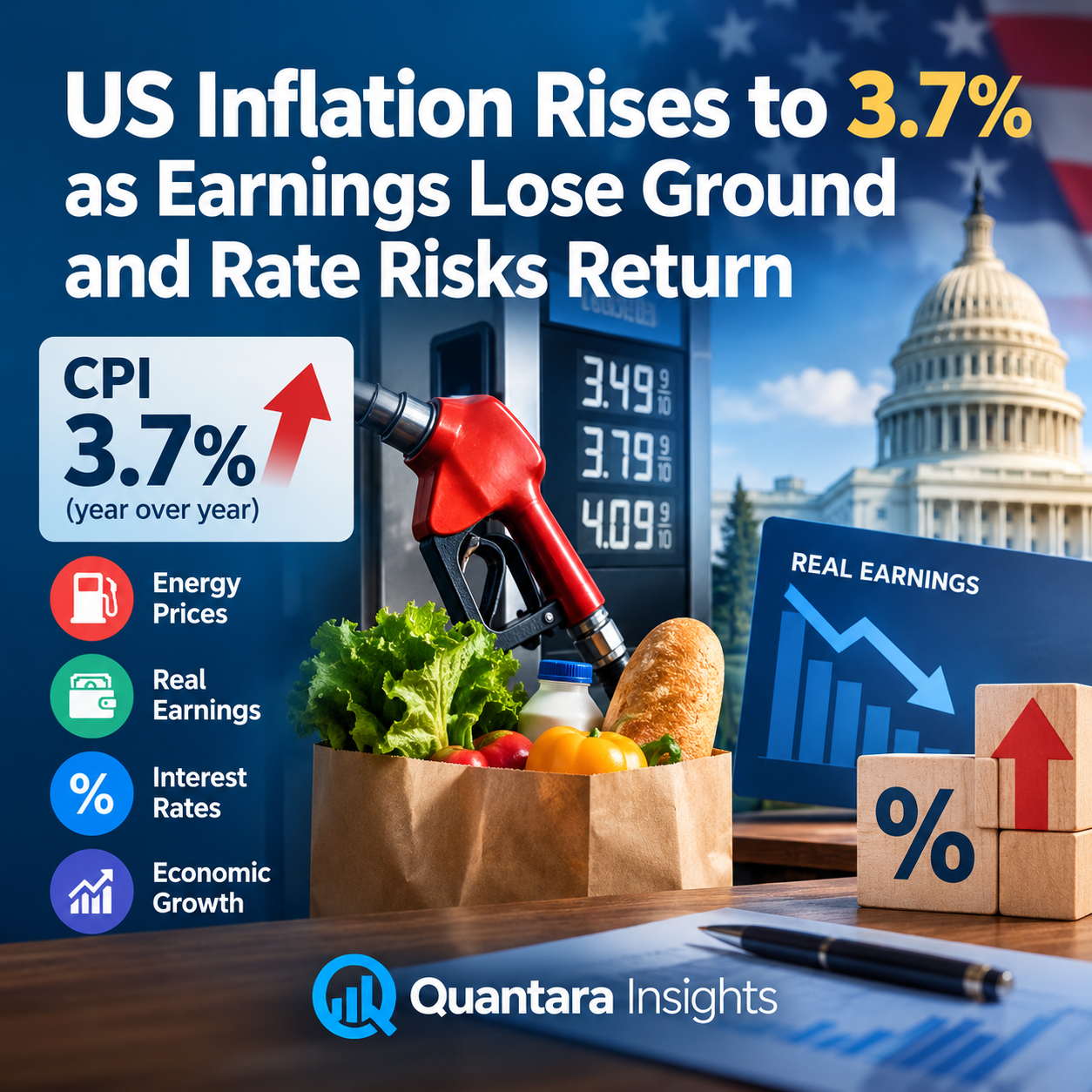
The US CPI release is the most influential component of this Economic Report. Markets expect headline CPI to rise moderately while core inflation remains sticky.
Key insights from the Economic Report include:
- Headline CPI trending higher due to energy base effects
- Core CPI showing slower disinflation progress
- Shelter inflation still contributing to persistence
The Economic Report suggests that inflation expectations in the US remain sensitive to upside surprises, particularly in core services.
Inflation Trends Across Major Economies in the Economic Report
This section of the Economic Report highlights inflation divergence across global economies.
- Europe: inflation stabilizing but still above target in services
- UK: moderate growth with uneven inflation pressure
- China: subdued demand-side inflation, mild CPI recovery
- Emerging markets: mixed inflation outcomes depending on currency stability
The Economic Report shows that global inflation is no longer synchronized, making policy coordination more complex.
Central Bank Policy Outlook in the Economic Report
Central banks are the central focus of this Economic Report, with diverging policy paths emerging globally.
Key observations include:
- Some central banks remain in tightening bias
- Others are transitioning toward policy pauses
- Forward guidance is becoming more conditional
The Economic Report highlights that inflation data remains the primary driver of policy decisions, outweighing growth concerns in most advanced economies.
US Federal Reserve Perspective in the Economic Report
The Federal Reserve remains highly data-dependent in this Economic Report cycle. Inflation and labor market resilience continue to delay expectations of rate cuts.
Key points:
- Inflation still above long-term target
- Labor market remains relatively tight
- Policy stance remains restrictive
The Economic Report indicates that markets are increasingly pricing in prolonged higher rates due to persistent CPI pressure and inflation stickiness.
European Central Bank Outlook in the Economic Report
The ECB remains a key focus of the Economic Report, with markets watching for confirmation of further policy tightening.
Key themes:
- Inflation still above target in services sector
- Energy prices remain a structural risk
- Growth outlook remains fragile
The Economic Report suggests the ECB is balancing inflation control with weakening industrial momentum.
Bank of Canada Policy Signal in the Economic Report
The Bank of Canada plays a significant role in this Economic Report, particularly due to mixed growth and inflation signals.
Key observations:
- Inflation risks remain tied to energy markets
- Labor market remains resilient
- Policy direction remains uncertain
This Economic Report highlights a potential policy divergence depending on inflation persistence.
China CPI and Inflation Dynamics in the Economic Report
China’s inflation profile is an important component of this Economic Report.
Key insights:
- CPI remains subdued due to weak demand
- Producer inflation shows mild cost pressures
- External demand influences remain significant
The Economic Report indicates that China’s inflation environment is structurally different from Western economies.
UK GDP and Inflation Interaction in the Economic Report
The UK segment of the Economic Report highlights the interaction between weak growth and moderate inflation pressure.
Key points:
- GDP growth remains uneven
- Inflation pressure persists in services
- Consumer demand remains fragile
The Economic Report suggests stagflation risks remain limited but not negligible.
OPEC and Energy Impact in the Economic Report
Energy markets are a critical inflation driver in this Economic Report.
Key observations:
- Supply discipline remains a priority
- Geopolitical risks influence pricing
- Oil markets directly impact CPI expectations
The Economic Report shows that energy remains one of the strongest inflation transmission channels globally.
Commodity Prices and Inflation in the Economic Report
Commodity dynamics are central to this Economic Report inflation narrative.
- Industrial metals affect input costs
- Agricultural prices influence food CPI
- Energy remains the dominant factor
The Economic Report highlights that commodity volatility continues to complicate inflation forecasting.
Labor Market Signals in the Economic Report
The labor market remains a key inflation determinant in this Economic Report.
Key insights:
- Wage growth remains above historical averages
- Employment remains resilient in developed markets
- Labor shortages still visible in services sectors
The Economic Report indicates that labor dynamics are sustaining inflation persistence.

Market Reaction Overview in the Economic Report
Financial markets are highly reactive to inflation data within this Economic Report framework.
Key responses include:
- Bond yields sensitive to CPI surprises
- Equity markets react to inflation expectations
- FX markets respond to central bank divergence
The Economic Report shows that inflation remains the dominant macro trading signal.
Risks to Inflation Outlook in the Economic Report
This Economic Report identifies several risks to inflation stability:
- Energy supply shocks
- Geopolitical escalation
- Currency depreciation in emerging markets
- Wage-price spiral risks in services sectors
The Economic Report suggests that upside inflation risks remain more prominent than downside risks.
Forward-Looking Scenarios in the Economic Report
The Economic Report outlines three key scenarios:
- Disinflation scenario: CPI gradually returns toward targets
- Sticky inflation scenario: Inflation stabilizes above target
- Reacceleration scenario: Energy shocks push CPI higher again
Each scenario in this Economic Report depends heavily on energy and labor market behavior.
Frequently Asked Questions (FAQs)
1. What is the Economic Report?
The Economic Report is a macroeconomic overview analyzing CPI, inflation trends, and central bank policy expectations.
2. Why is CPI important in the Economic Report?
CPI is a key inflation indicator that directly influences interest rate decisions and market expectations.
3. How does inflation affect financial markets?
Inflation impacts bond yields, currency valuations, and equity market sentiment.
4. What drives inflation in the current Economic Report?
Energy prices, wage growth, and supply chain pressures are the main drivers.
5. Why are central banks focused on inflation?
Central banks aim to stabilize prices, making inflation a primary policy target.
6. What is the inflation outlook in the Economic Report?
The inflation outlook remains mixed, with gradual disinflation but persistent risks.
Conclusion of the Economic Report
The final takeaway from this Economic Report is that global inflation is transitioning rather than declining sharply. CPI data across regions continues to show uneven progress, while inflation remains sticky in key sectors such as services and energy.
This Economic Report highlights that central banks are unlikely to shift decisively toward easing until inflation shows clearer and more sustained improvement. As a result, CPI releases will continue to dominate market expectations.
Ultimately, this Economic Report reinforces the idea that inflation is still the primary macro driver shaping global financial conditions, and CPI will remain the most important data point for markets in the weeks ahead.