



Table of Contents
- SpaceX and AMD Show Why Earnings Season Is Changing
- SpaceX Revenue Jumps 92% as Starlink Remains the Main Growth Engine
- SpaceX’s First Public Earnings Report Beat Across Key Metrics
- SpaceX AI Investment Remains a Major Investor Focus
- Starship Is Central to the Longer-Term SpaceX Strategy
- SpaceX Capital Expenditure Shows the Scale of the Investment Cycle
- SpaceX Backlog Reaches $47.5 Billion
- SpaceX Faces a Key Test as the IPO Lock-Up Period Expires
- AMD Delivers a Clean Quarterly Beat
- AMD’s Guidance Matters More Than the Quarterly Beat
- AMD’s Operating Margin Holds Up Despite Higher Investment
- AMD Capital Expenditure Jumps Above Expectations
- AMD’s AI Opportunity Comes With a Higher Cost of Competition
- Why AMD Shares Fell Despite Beating Expectations
- SpaceX and AMD Share a Common Investment Question
- Earnings Season Is Shifting From Growth to Growth Quality
- Starlink Growth Creates a More Complicated Margin Story
- AI Infrastructure Could Become a New Capital Cycle
- SpaceX’s AI Loss Is Smaller Than Expected, But Profitability Still Matters
- AMD’s Spending May Be a Signal of Confidence
- Valuation Remains a Key Consideration for Both Companies
- The Market Is Watching Forward Guidance More Closely
- SpaceX and AMD Are Both Investing Ahead of Potential Growth
- What Investors Should Watch After the SpaceX Results
- What Investors Should Watch After the AMD Results
- Why Strong Earnings Do Not Always Mean Higher Share Prices
- The Broader AI Investment Cycle Is Entering a More Demanding Phase
- Earnings Season Highlights the Difference Between Revenue and Returns
- SpaceX Has Strong Growth but a More Complex Financial Profile
- AMD Is Balancing Growth With Profitability
- The Most Important Number May Not Be the Earnings Beat
- What the SpaceX and AMD Results Say About the Market
- A More Disciplined View of AI Growth
- Conclusion: SpaceX and AMD Set a Higher Standard for Earnings Analysis
Earnings Season is putting two very different parts of the artificial intelligence investment story under scrutiny, with SpaceX and AMD reporting results that showed strong demand but also highlighted the rising cost of competing in AI.
SpaceX delivered a substantial revenue beat in its first reported quarter as a public company, helped by continued expansion of Starlink. AMD also exceeded Wall Street expectations on earnings and revenue and offered third-quarter guidance above consensus. Yet neither result translated cleanly into a positive after-hours stock reaction.
That contrast is important.
For investors, the latest Earnings Season is increasingly less about whether companies can beat quarterly estimates and more about what those beats imply for future growth, capital expenditure, margins and returns on investment. SpaceX and AMD provide two different examples of that dynamic.
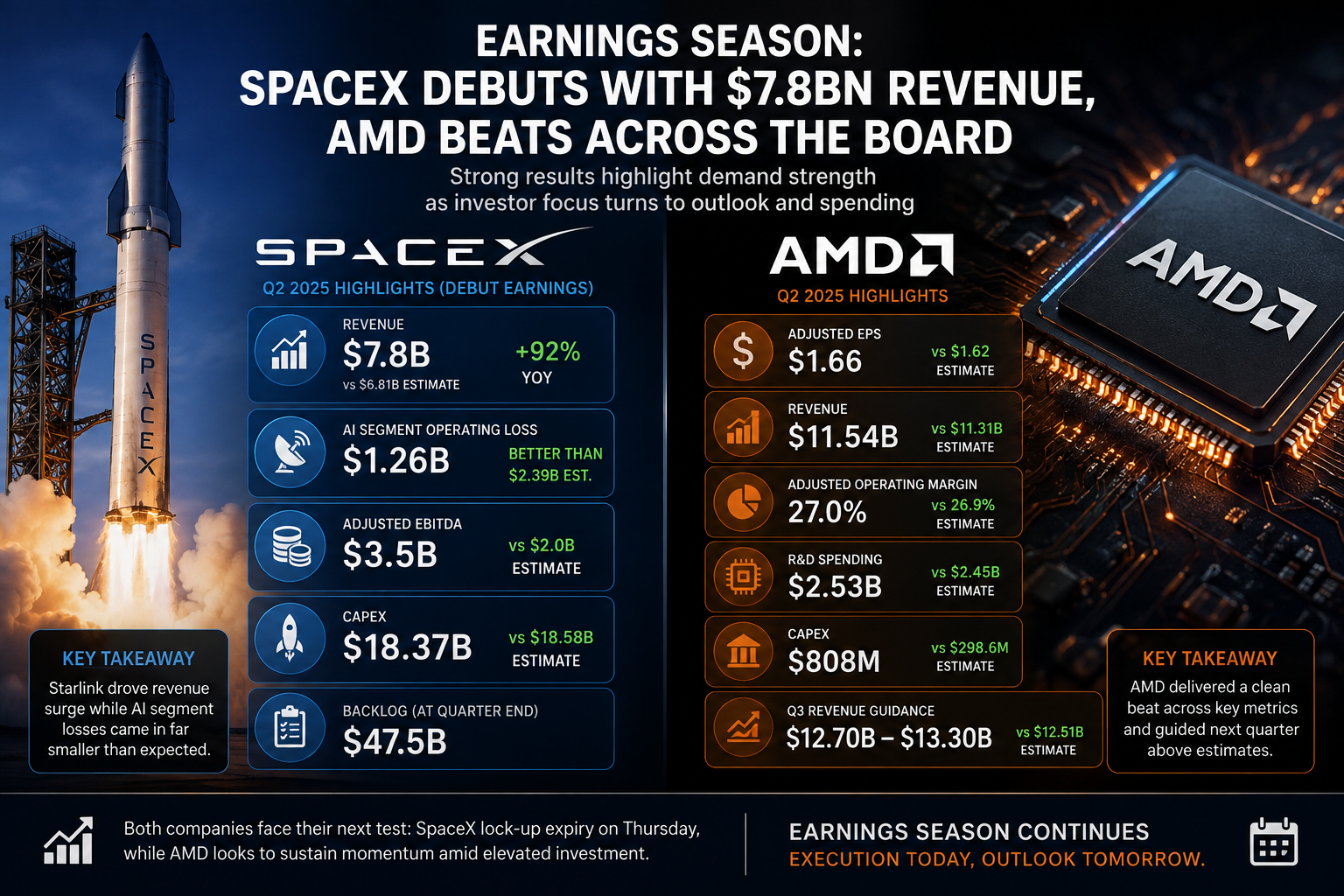
SpaceX reported second-quarter revenue of $7.8 billion, up 92% from $4.1 billion a year earlier and above the $6.81 billion estimate. Adjusted EBITDA reached $3.5 billion, substantially ahead of the roughly $2 billion expectation, while the company’s AI segment reported an operating loss of $1.26 billion, considerably narrower than the $2.39 billion loss analysts had anticipated.
AMD, meanwhile, reported adjusted earnings per share of $1.66 versus the $1.62 consensus estimate and revenue of $11.54 billion against expectations of $11.31 billion. Adjusted operating income reached $3.09 billion, while adjusted operating margin came in at 27%, slightly ahead of expectations.
The common theme is clear: demand remains strong.
The more difficult question is how much companies must spend to capture that demand.
For SpaceX, the focus is on Starlink’s growth, AI infrastructure, Starship development and the company’s expanding ambitions in orbital computing. For AMD, investors are assessing the company’s ability to increase AI-related investment while maintaining margins and converting demand into profitable growth.
The market reaction suggests investors are looking beyond headline beats.
SpaceX and AMD Show Why Earnings Season Is Changing
Traditional earnings analysis often begins with three questions: Did revenue beat expectations? Did earnings beat? Did management raise guidance?
Those questions remain important, but the latest results from SpaceX and AMD show why they are no longer sufficient on their own.
Both companies exceeded key Wall Street estimates. Both demonstrated strong underlying demand. Both offered reasons for investors to remain constructive about future growth.
Yet both stocks traded lower in after-hours trading following their respective results.
AMD shares were down roughly 5.3% in after-hours trading, according to the supplied market figures. SpaceX shares were also lower, trading down approximately 4.45%.
That response reflects the higher expectations attached to companies operating at the centre of the AI and technology investment cycle.
When expectations are already elevated, a simple earnings beat may not be enough. Investors can instead focus on the size and direction of capital expenditure, the quality of future guidance, margins, unit economics and the amount of spending required to sustain growth.
This is particularly relevant for SpaceX and AMD.
SpaceX is expanding Starlink while developing Starship and investing in AI infrastructure. AMD is increasing research and development expenditure while capital expenditure rose sharply during the quarter.
The results therefore offer a useful snapshot of an increasingly capital-intensive technology market.
SpaceX Revenue Jumps 92% as Starlink Remains the Main Growth Engine
SpaceX reported second-quarter revenue of $7.8 billion, representing a 92% increase from the $4.1 billion recorded a year earlier.
The result exceeded the $6.81 billion analyst estimate by a meaningful margin and established a strong financial starting point for SpaceX as a newly public company.

Starlink was central to the performance.
The satellite internet business continues to expand across consumer, enterprise, aviation, maritime and government markets. The company’s ability to deploy additional satellites and broaden its service footprint has made Starlink a critical component of the broader SpaceX financial story.
The significance of Starlink extends beyond subscriber growth.
A growing satellite network can support expansion across multiple customer categories, potentially increasing the addressable market for SpaceX’s connectivity business. International expansion also provides additional opportunities, although it creates a more complicated revenue mix.
One issue investors are likely to monitor is average revenue per user.
As Starlink enters additional international markets and introduces lower-priced plans, average revenue per user has declined. That does not necessarily undermine the broader growth strategy, but it does create a question around the balance between subscriber expansion and unit economics.
For investors, the important issue is whether lower pricing can generate sufficient volume and network utilization to support attractive margins over time.
That question becomes more relevant as SpaceX scales.
A high-growth connectivity business can tolerate some pressure on average revenue per user if subscriber additions, operating leverage and network utilization offset the decline. But if price reductions become the primary mechanism for customer acquisition, investors may become more cautious about the durability of the growth rate.
The latest SpaceX results therefore provide a strong headline revenue number while leaving several questions around the composition and profitability of that growth.
SpaceX’s First Public Earnings Report Beat Across Key Metrics
The revenue result was not the only area where SpaceX exceeded expectations.
Adjusted EBITDA reached approximately $3.5 billion, compared with an estimate of about $2 billion. That represents a significant difference between reported performance and what analysts had expected.
The AI segment also performed better than forecast from a loss perspective.
SpaceX’s AI business posted an operating loss of approximately $1.26 billion, substantially narrower than the $2.39 billion loss analysts had modelled.
Overall operating loss was approximately $1.3 billion.
The combination of strong revenue growth, higher-than-expected adjusted EBITDA and a narrower AI loss provides investors with several positive signals.
However, the figures also show how different parts of the company are contributing to the investment case.
Starlink represents a more established revenue-generating business, while AI and orbital computing represent areas where SpaceX is committing substantial capital with a longer-term objective.
That distinction matters during Earnings Season because the market is increasingly separating mature revenue streams from investments designed to create future growth.
SpaceX’s challenge is not simply to demonstrate that it can generate more revenue.
It must show that its expanding infrastructure can ultimately produce attractive returns.
SpaceX AI Investment Remains a Major Investor Focus
The AI segment is becoming increasingly important to the SpaceX investment narrative.
The business includes AI-related operations associated with xAI, Grok, X and an expanding data-centre operation. SpaceX is also pursuing compute-related opportunities that could eventually connect its terrestrial and orbital infrastructure.
The company has revenue associated with compute contracts involving Anthropic, Google’s Alphabet and Reflection AI, although some recurring revenue had not yet been recognised in the reported figures.
That creates an interesting dynamic.
SpaceX is not simply positioning itself as a satellite connectivity company. Its strategy increasingly touches launch services, satellite communications, AI computing, data infrastructure and potentially orbital computing.
The opportunity is substantial, but so is the capital requirement.
The company confirmed a partnership with Nvidia involving chips for its Starmind AI1 orbital compute satellites. The initiative underscores the company’s intention to develop computing infrastructure beyond conventional terrestrial data centres.
For investors, the question is whether orbital computing can eventually become economically competitive enough to justify the capital being committed today.
That answer is unlikely to be visible in one quarter’s results.
Instead, investors will probably assess the pace of spending, the development timeline, customer demand and the eventual economics of the infrastructure.
The narrower-than-expected AI operating loss is therefore encouraging, but it does not eliminate the longer-term profitability question.
Starship Is Central to the Longer-Term SpaceX Strategy
Starship remains one of the most important pieces of SpaceX’s long-term strategy.
The next-generation reusable rocket has not yet entered commercial service, but its eventual capabilities could influence several parts of the company’s business.
Higher launch capacity could support the deployment of more advanced Starlink satellites, while potentially enabling larger and more sophisticated orbital infrastructure.
That matters because SpaceX’s AI ambitions are linked to its broader space infrastructure strategy.
The company is exploring a model in which satellites are not simply communications assets but can eventually become part of a larger orbital computing network.
Starship’s eventual operational performance could therefore affect the pace at which SpaceX can expand its satellite network and develop additional infrastructure.
For now, however, Starship remains an investment rather than a fully commercialized earnings contributor.
That distinction is important when interpreting SpaceX’s valuation.
The public market is being asked to value a business with substantial current revenue alongside several large future opportunities that require significant spending before their ultimate economic potential can be established.
SpaceX Capital Expenditure Shows the Scale of the Investment Cycle
Capital expenditure is one of the most important figures in the SpaceX report.
The company reported approximately $18.37 billion in capital expenditure, compared with an estimate of $18.58 billion.
The result was broadly in line with expectations.
That is significant because it suggests SpaceX is continuing to spend at an elevated rate without materially exceeding the investment level analysts had anticipated.
The scale of the spending remains notable.
SpaceX is simultaneously funding satellite expansion, launch infrastructure, Starship development and AI-related computing initiatives.
From an investor perspective, the question is not simply whether the company can afford the spending.
The question is what returns those investments can generate.
Strong revenue growth makes substantial investment easier to justify, particularly when adjusted EBITDA is also exceeding expectations. But as the company expands into more capital-intensive businesses, investors will increasingly look for evidence that those investments can produce sustainable free cash flow and attractive returns.
That is one reason the quarterly revenue beat does not tell the entire story.
SpaceX Backlog Reaches $47.5 Billion
SpaceX ended the quarter with a reported backlog of approximately $47.5 billion.
A substantial backlog provides visibility into future demand, although the timing of revenue recognition and the profitability associated with individual contracts remain important considerations.
For a company operating across launch services, satellite communications and related infrastructure, backlog can serve as an important indicator of forward demand.
It can also help investors distinguish between temporary quarterly fluctuations and longer-term commercial commitments.
The $47.5 billion figure therefore supports the broader argument that SpaceX has a significant forward revenue opportunity.
However, backlog should not be interpreted as equivalent to immediate revenue or earnings.
The value to shareholders ultimately depends on the company’s ability to deliver those contracts efficiently while controlling costs and maintaining attractive margins.
That issue is particularly relevant as SpaceX’s capital requirements remain high.
SpaceX Faces a Key Test as the IPO Lock-Up Period Expires
SpaceX’s stock has fallen approximately 8% since its June initial public offering, which valued the company at roughly $1.75 trillion, based on the figures supplied.
The next market test comes with the expiration of the post-IPO lock-up period.
The expiration could make additional shares available for sale by insiders and early investors, potentially increasing the supply of stock in the market.
That does not automatically mean shares will decline.
Investors who have held SpaceX for an extended period may choose to retain their positions if they remain confident in the company’s long-term growth prospects. Others may take the opportunity to realise gains or rebalance portfolios.
The market impact will depend on the amount of stock ultimately offered and the level of demand from new and existing investors.
This makes the lock-up expiration an important near-term event independent of the quarterly results.
The distinction between operating performance and stock-market supply is particularly important in a newly public company.
SpaceX can deliver a strong earnings report while its shares remain under pressure if investors are concerned about valuation, shareholder selling or the scale of future capital requirements.
AMD Delivers a Clean Quarterly Beat
AMD’s latest report presents a different but related version of the same investment debate.
The semiconductor company reported adjusted earnings per share of $1.66, exceeding the $1.62 analyst estimate.
Revenue reached $11.54 billion, above the $11.31 billion consensus forecast.
Adjusted operating income came in at $3.09 billion, compared with the $3.01 billion estimate.
Adjusted operating margin was 27.0%, narrowly ahead of the 26.9% expectation.
Taken together, the figures represent a broad-based quarterly beat.
AMD exceeded expectations on earnings, revenue, operating income and operating margin.
That combination is important because it indicates that the company is not simply producing top-line growth at the expense of profitability.
The margin performance is particularly relevant as AMD continues to invest in research and development and compete in the increasingly important AI accelerator market.
AMD’s Guidance Matters More Than the Quarterly Beat
The most consequential part of the AMD report may be its outlook.
The company guided third-quarter revenue to a range of $12.70 billion to $13.30 billion, above the $12.51 billion analyst consensus.
The midpoint of that guidance implies sequential growth from the $11.54 billion reported in the second quarter.
That suggests management expects demand to continue strengthening into the second half of the year.
Guidance is often more important to investors than a historical earnings beat because stock prices reflect expectations about future cash flows.
A company can beat a quarterly estimate and still see its shares decline if investors had expected an even larger beat or stronger forward outlook.
AMD’s guidance therefore provides an important foundation for the investment case.
The range indicates that management expects the current demand environment to remain supportive.
But the market’s reaction also demonstrates that strong guidance does not eliminate questions about valuation, capital intensity and competitive positioning.
AMD’s Operating Margin Holds Up Despite Higher Investment
AMD’s 27% adjusted operating margin is notable because the company is continuing to increase spending on product development.
Research and development spending reached approximately $2.53 billion, above the $2.45 billion analyst expectation.
Higher R&D spending is consistent with a company operating in a rapidly evolving semiconductor market.
AI accelerators, data-centre processors and related technologies require sustained investment, particularly when competition is intense and product cycles are moving quickly.
The challenge is maintaining profitability while funding that investment.
AMD’s results suggest the company was able to do so during the quarter.
Operating income exceeded expectations, and the operating margin was slightly ahead of consensus.
That creates a constructive combination: stronger revenue, higher earnings and continued investment.
However, investors will want to know whether the elevated spending level represents a temporary increase or the beginning of a longer investment cycle.
AMD Capital Expenditure Jumps Above Expectations
Capital expenditure was one of the most notable numbers in the AMD report.
The company reported approximately $808 million in capital expenditure, compared with an analyst estimate of roughly $298.6 million.
That is a substantial difference.
The increase may indicate accelerated investment in infrastructure, capacity or other areas required to support future growth.
The interpretation will depend on how management explains the spending and what returns investors can expect from the additional investment.
The market does not necessarily view higher capital expenditure negatively.
In a growth industry, increased spending can be a positive signal if it reflects expanding demand and creates capacity that generates future revenue.
The concern arises when investment grows faster than the economic return it produces.
That is why AMD’s capital expenditure will likely receive more attention than the headline earnings beat alone.
The company’s ability to maintain a 27% operating margin while increasing investment provides some reassurance, but investors will continue to monitor whether capital intensity remains elevated.
AMD’s AI Opportunity Comes With a Higher Cost of Competition
AMD remains closely associated with the broader AI semiconductor investment cycle.
The company is competing for demand generated by data centres and AI workloads while seeking to strengthen its position against much larger established competitors.
That environment creates a large growth opportunity but also requires significant investment.
AI infrastructure is expensive.
Customers need processors, accelerators, networking equipment, data-centre capacity, power and supporting systems. Semiconductor companies therefore operate within a broader ecosystem in which demand can be strong while the investment required to capture that demand is also increasing.
AMD’s results reflect that tension.
The company is growing revenue and earnings while simultaneously increasing R&D and capital expenditure.
For shareholders, the central question is whether that spending can produce enough incremental revenue and profit to justify the investment.
The third-quarter guidance provides evidence of continued momentum.
The next stage of the story will be determining how much of that growth ultimately reaches operating profit and free cash flow.
Why AMD Shares Fell Despite Beating Expectations
AMD’s after-hours decline illustrates one of the most important lessons from the current Earnings Season.
Beating consensus estimates does not necessarily mean a stock should rise.
Investors buy shares based on expectations about the future. If the market has already priced in strong results, even a clean beat can produce a negative reaction if investors identify a different concern elsewhere in the report.
In AMD’s case, the combination of higher capital expenditure and ongoing investment could be one factor behind the market’s response.
The company’s results were strong on the surface.
Revenue beat.
Adjusted EPS beat.
Operating income beat.
Operating margin beat.
Third-quarter revenue guidance was above consensus.
Yet expectations for AI-related semiconductor growth are high, meaning investors may be looking for evidence of accelerating earnings power rather than simply another quarterly beat.
That creates a higher standard for the stock.
SpaceX and AMD Share a Common Investment Question
At first glance, SpaceX and AMD appear to have little in common.
One operates satellite networks, rockets and emerging AI infrastructure.
The other develops semiconductor products used across data centres and computing applications.
But the latest reports reveal a common question:
How much investment is required to convert AI and technology demand into sustainable profits?
SpaceX is investing heavily in Starlink, Starship and orbital computing.
AMD is increasing R&D and capital expenditure to compete in a rapidly expanding semiconductor market.
Both companies are demonstrating demand.
Both are investing heavily to capture future growth.
And both are being evaluated by investors who increasingly care about the return generated by that investment.
This is one of the defining themes of the current technology market.
Earnings Season Is Shifting From Growth to Growth Quality
The latest results suggest that investors are becoming more selective about the quality of growth.
Revenue growth remains important, but it is no longer enough to simply demonstrate that sales are rising.
Investors want to know how much capital is required to generate those sales.
They want to know whether margins can remain stable.
They want visibility into future demand.
They want to understand the durability of customer relationships and whether infrastructure spending will generate incremental returns.
SpaceX’s 92% year-over-year revenue growth is impressive on its face.
AMD’s increase in revenue and earnings is also encouraging.
But the market’s reaction demonstrates that both companies are being assessed through a wider financial framework.
The emphasis is moving from headline growth to the relationship between growth, investment and profitability.
Starlink Growth Creates a More Complicated Margin Story
For SpaceX, Starlink remains the most visible source of financial momentum.
The satellite internet business continues to expand into new markets and customer categories.
That expansion can increase the scale of the network and create a broader recurring revenue base.
However, international expansion also introduces pricing pressure.
Lower-priced plans can help attract customers, but they can also reduce average revenue per user.
The economic value of that strategy depends on how efficiently SpaceX can serve those customers and whether network utilization increases sufficiently to offset lower pricing.
This is why ARPU is an important metric to monitor alongside subscriber growth.
A rapidly growing customer base is not necessarily a problem if the underlying unit economics remain attractive.
Conversely, high subscriber growth could become less valuable if customer acquisition requires persistent price reductions and substantial additional infrastructure spending.
The latest SpaceX results do not resolve that question, but they make it increasingly important.
AI Infrastructure Could Become a New Capital Cycle
SpaceX and AMD also offer different perspectives on a broader AI infrastructure cycle.
AMD is investing in the hardware required to process AI workloads.
SpaceX is exploring infrastructure that could eventually support computing in orbit.
Both strategies require significant upfront investment.
The AI industry has moved beyond the initial question of whether demand exists.
Demand clearly exists across data centres, cloud services, model development and enterprise applications.
The investment debate is increasingly focused on how much infrastructure is needed, who will own it and which companies will earn attractive returns from it.
For AMD, the immediate opportunity is connected to the semiconductor supply chain.
For SpaceX, the opportunity could eventually extend from connectivity into computing infrastructure.
The financial outcome will depend on whether demand grows quickly enough to support the investments being made.
SpaceX’s AI Loss Is Smaller Than Expected, But Profitability Still Matters
The SpaceX AI segment’s $1.26 billion operating loss was considerably narrower than the $2.39 billion analysts had expected.
That is a meaningful positive variance.
But investors should distinguish between a loss that is smaller than expected and a business that is already profitable.
The AI operation remains an investment area.
Its eventual financial contribution will depend on revenue growth, infrastructure costs, customer contracts and the company’s ability to scale computing capacity efficiently.
The narrower loss could indicate better-than-expected operating performance, stronger revenue recognition or lower costs than analysts anticipated.
But it does not remove the need for continued scrutiny.
As SpaceX expands its AI strategy, investors will want to see whether the business can move from heavy investment toward operating leverage.
The timeline for that transition may ultimately matter more than the current quarterly loss.
AMD’s Spending May Be a Signal of Confidence
AMD’s $808 million capital expenditure figure is notable not only because it exceeded expectations but because it came alongside strong margins.
A company does not generally increase investment without expecting future demand to justify the spending.
The additional capital could support capacity, infrastructure or other operational requirements tied to future growth.
If that investment helps AMD generate the revenue implied by its guidance and beyond, the spending could prove economically productive.
The risk is that the semiconductor market is cyclical and highly competitive.
Demand can change.
Product cycles can shift.
Competitors can introduce new architectures.
Customers can adjust their infrastructure plans.
AMD therefore needs to make investments that remain economically productive even as market conditions evolve.
The current results provide evidence of strong demand, but investors will need several quarters of data to determine whether the increased investment is generating attractive returns.
Valuation Remains a Key Consideration for Both Companies
Another reason strong earnings can produce weak share-price reactions is valuation.
A company can report excellent financial results while its shares decline if the market had already assigned a high valuation based on expectations for even stronger future performance.
This issue is particularly relevant for companies associated with AI.
Investors have already placed significant value on the future growth of AI infrastructure and related technologies.
That raises the bar for companies reporting during Earnings Season.
SpaceX’s June IPO valuation of approximately $1.75 trillion represents a substantial expectation about the company’s long-term opportunity.
AMD is also operating in a market where expectations for AI semiconductor growth are high.
In both cases, investors must compare current performance with what is already reflected in the share price.
That helps explain why a beat does not automatically result in a rally.
The Market Is Watching Forward Guidance More Closely
Forward guidance has become one of the most important elements of technology earnings reports.
Historical results show what happened.
Guidance provides management’s view of what comes next.
AMD’s third-quarter revenue guidance of $12.70 billion to $13.30 billion is therefore particularly important.
The midpoint of that range is above the analyst consensus of $12.51 billion.
That suggests the company expects demand to remain strong.
SpaceX’s situation is different because its growth strategy involves multiple businesses with different maturity levels.
Starlink provides a more established recurring revenue stream, while AI infrastructure and orbital computing are still developing.
Investors will therefore likely pay close attention to operational indicators that can help establish the trajectory of those businesses.
The key issue is whether revenue growth can continue without a disproportionate increase in capital intensity.
SpaceX and AMD Are Both Investing Ahead of Potential Growth
There is a broader strategic similarity between the two reports.
Both companies are investing today based on expectations about tomorrow’s demand.
SpaceX is building satellite and launch infrastructure while expanding AI capabilities.
AMD is investing in product development and infrastructure while seeking to capture a larger share of AI-related computing demand.
That strategy can create significant long-term value if demand continues to grow.
It can also create financial pressure if demand slows or if competitors capture the majority of the opportunity.
The distinction between productive investment and excessive spending will therefore become increasingly important.
Investors do not necessarily want companies to spend less.
They want companies to spend efficiently.
What Investors Should Watch After the SpaceX Results
Several indicators will help determine whether SpaceX’s current growth rate can remain durable.
Starlink subscriber growth
Subscriber expansion remains central to the Starlink financial story.
Investors should monitor whether customer growth remains strong as the company expands into additional international markets.
Average revenue per user
ARPU provides a useful counterbalance to subscriber growth.
If subscriber numbers rise while ARPU falls, investors need to determine whether the additional scale produces sufficient economic benefits.
Capital expenditure
The $18.37 billion quarterly capex figure demonstrates the scale of SpaceX’s investment cycle.
Future results will show whether spending remains at similarly elevated levels.
AI operating losses
The $1.26 billion AI operating loss was better than expected.
The next question is whether that loss continues to narrow as revenue increases.
Starship progress
Starship remains strategically important to the company’s long-term expansion plans.
Commercial progress could influence the timing and economics of future infrastructure deployments.
Backlog
The $47.5 billion backlog provides visibility into future demand, but investors will continue to assess the timing and profitability of that business.
Lock-up expiration
The post-IPO lock-up expiration creates a potential supply event that could influence short-term trading independently of operating performance.
What Investors Should Watch After the AMD Results
AMD investors have a different set of indicators to monitor.
Revenue growth
The third-quarter guidance range of $12.70 billion to $13.30 billion will provide the next test of the company’s growth trajectory.
Operating margin
The current 27% adjusted operating margin shows that AMD is growing without a major deterioration in profitability.
Maintaining that performance while spending more will be important.
R&D spending
The $2.53 billion R&D figure highlights the company’s continued investment in product development.
Future results will show whether that investment translates into additional market share and revenue.
Capital expenditure
The sharp increase to $808 million deserves close attention.
Investors will want greater visibility into where the money is being invested and the expected return.
AI demand
AI-related infrastructure remains one of the major growth drivers for the semiconductor sector.
AMD’s ability to convert that demand into recurring revenue and profit will be central to its investment case.
Competitive positioning
The AI accelerator market remains highly competitive.
AMD’s future performance will depend not only on market growth but also on its ability to compete effectively for customer spending.
Why Strong Earnings Do Not Always Mean Higher Share Prices
The after-hours reactions to SpaceX and AMD demonstrate a fundamental principle of financial markets.
Markets do not react to results in isolation.
They react to the difference between results and expectations.
If investors expect a company to beat earnings by a wide margin, a small beat may be interpreted as disappointing.
If investors expect rapid revenue growth to accelerate, stable growth may be viewed as insufficient.
If a company increases capital expenditure substantially, investors may ask whether future returns will justify the spending.
This is why a company can report strong earnings and still see its stock fall.
It is not necessarily a contradiction.
It is a reflection of the expectations embedded in the stock price.
The Broader AI Investment Cycle Is Entering a More Demanding Phase
The latest Earnings Season results from SpaceX and AMD point to a technology market entering a more demanding stage.
The initial phase of the AI investment cycle was dominated by questions about demand.
The current phase is increasingly about economics.
Companies are spending enormous amounts on data centres, chips, connectivity, computing infrastructure and supporting technologies.
Investors are now asking whether those investments will generate sufficient revenue and earnings to justify the capital deployed.
AMD provides an example of a company attempting to scale AI-related semiconductor demand while maintaining profitability.
SpaceX offers a different example, with Starlink generating strong growth while the company invests in AI and space infrastructure.
Both demonstrate the opportunity.
Both also demonstrate the cost.
Earnings Season Highlights the Difference Between Revenue and Returns
Revenue growth is a necessary component of the investment story, but it is not the final objective.
Ultimately, investors want companies to generate returns on the capital they deploy.
SpaceX’s $7.8 billion quarterly revenue and 92% year-over-year growth demonstrate significant commercial momentum.
AMD’s $11.54 billion quarterly revenue and stronger-than-expected earnings demonstrate a business that is also executing well.
But the next questions are more difficult.
How much additional capital will be required?
How quickly can margins expand?
How durable is demand?
What will competition do to pricing?
What return will investors receive on today’s investment?
Those questions are likely to dominate the next stage of the market narrative.
SpaceX Has Strong Growth but a More Complex Financial Profile
SpaceX’s financial profile is becoming more diversified.
Starlink offers a large recurring revenue opportunity.
Launch services remain strategically important.
Starship could increase future capacity.
AI infrastructure represents another potential growth engine.
Orbital computing introduces an even longer-term opportunity.
The benefit of that diversification is that SpaceX is not dependent on one source of future growth.
The challenge is that each initiative requires capital and management attention.
The company must therefore balance established businesses with emerging opportunities.
Starlink’s performance suggests that the company has already built a substantial commercial engine.
The AI and orbital computing initiatives represent a bet on what that engine could become in the next phase.
AMD Is Balancing Growth With Profitability
AMD’s report offers a somewhat cleaner near-term financial picture.
The company beat estimates across major quarterly metrics and guided revenue above consensus.
Its operating margin remained strong despite higher R&D expenditure.
That suggests the business has some ability to fund investment while maintaining profitability.
The main uncertainty lies in how much additional investment will be needed to compete in AI over the coming quarters.
The $808 million capital expenditure figure provides an early indication that AMD is prepared to spend more to support its growth ambitions.
The investment case will increasingly depend on whether the company can turn that spending into sustained revenue and earnings growth.
The Most Important Number May Not Be the Earnings Beat
For both companies, the headline earnings beat is only the beginning of the analysis.
For SpaceX, investors need to examine the relationship between Starlink growth, ARPU, capital expenditure and AI investment.
For AMD, the focus should be on the relationship between revenue growth, margins, R&D and capital expenditure.
The underlying question is similar:
Are companies creating enough incremental economic value to justify the investment required to generate their next phase of growth?
That is a more demanding question than whether quarterly earnings exceeded consensus.
It is also the question most relevant to long-term shareholders.
What the SpaceX and AMD Results Say About the Market
The combined results offer a useful perspective on the current technology market.
Demand for AI and related infrastructure remains strong.
Companies continue to invest aggressively.
Revenue growth remains healthy in important areas.
Profitability has not disappeared despite higher spending.
But investor expectations are also high.
That combination creates a market where even positive earnings reports can produce volatility.
SpaceX’s first public earnings report demonstrates the scale of the company’s growth and its ability to generate significant revenue through Starlink.
AMD’s quarterly report demonstrates strong execution and continued demand for its products.

Neither report, however, eliminates questions about valuation, capital intensity or future returns.
Those questions are likely to become increasingly important as the AI investment cycle matures.
A More Disciplined View of AI Growth
The most useful takeaway from the latest Earnings Season may be that investors are becoming more disciplined about AI growth.
Strong demand is no longer enough.
Companies must show that they can convert demand into revenue, revenue into operating income and operating income into sustainable cash generation.
SpaceX has demonstrated significant revenue growth while investing aggressively in future infrastructure.
AMD has shown strong earnings execution while increasing investment in research, development and capital spending.
Both companies therefore represent different stages of the same broader technology investment cycle.
The opportunity remains substantial.
But so does the financial discipline required to capture it.
Conclusion: SpaceX and AMD Set a Higher Standard for Earnings Analysis
The latest results from SpaceX and AMD provide two closely watched examples of how the market is evaluating technology and AI companies.
SpaceX reported $7.8 billion in second-quarter revenue, up 92% year over year and above the $6.81 billion estimate. Adjusted EBITDA reached $3.5 billion, while its AI segment’s $1.26 billion operating loss was significantly narrower than analysts had forecast. Starlink remains the central driver of the company’s revenue growth, while AI infrastructure, Starship and orbital computing represent longer-term investment opportunities.
AMD also delivered a strong quarter. Adjusted EPS reached $1.66, revenue came in at $11.54 billion, adjusted operating income reached $3.09 billion and operating margin held at 27%. Third-quarter revenue guidance of $12.70 billion to $13.30 billion was above the $12.51 billion consensus estimate.
On the surface, both reports were strong.
The market reaction was more cautious.
That difference is the central message for investors.
During today’s Earnings Season, beating estimates is increasingly only the starting point. Investors are paying closer attention to capital expenditure, margins, guidance, unit economics and the returns companies can generate from their investment programs.
For SpaceX, the next questions centre on Starlink’s ability to maintain growth while managing ARPU pressure, the profitability trajectory of its AI operations, the economics of orbital computing and the capital required to support Starship and its broader infrastructure strategy.
For AMD, the focus will be on whether higher R&D and capital expenditure translate into sustained revenue growth, stronger AI market participation and continued operating leverage.
The two companies are operating in different industries, but the investment question is increasingly similar.
How much will it cost to capture the next phase of AI-driven growth, and how much profit will that investment ultimately produce?
That is likely to be one of the defining questions of the next stage of the technology market.
For investors, the strongest earnings report is no longer necessarily the one with the biggest quarterly beat.
It may be the one that provides the clearest evidence that growth can continue while investment becomes increasingly productive.