






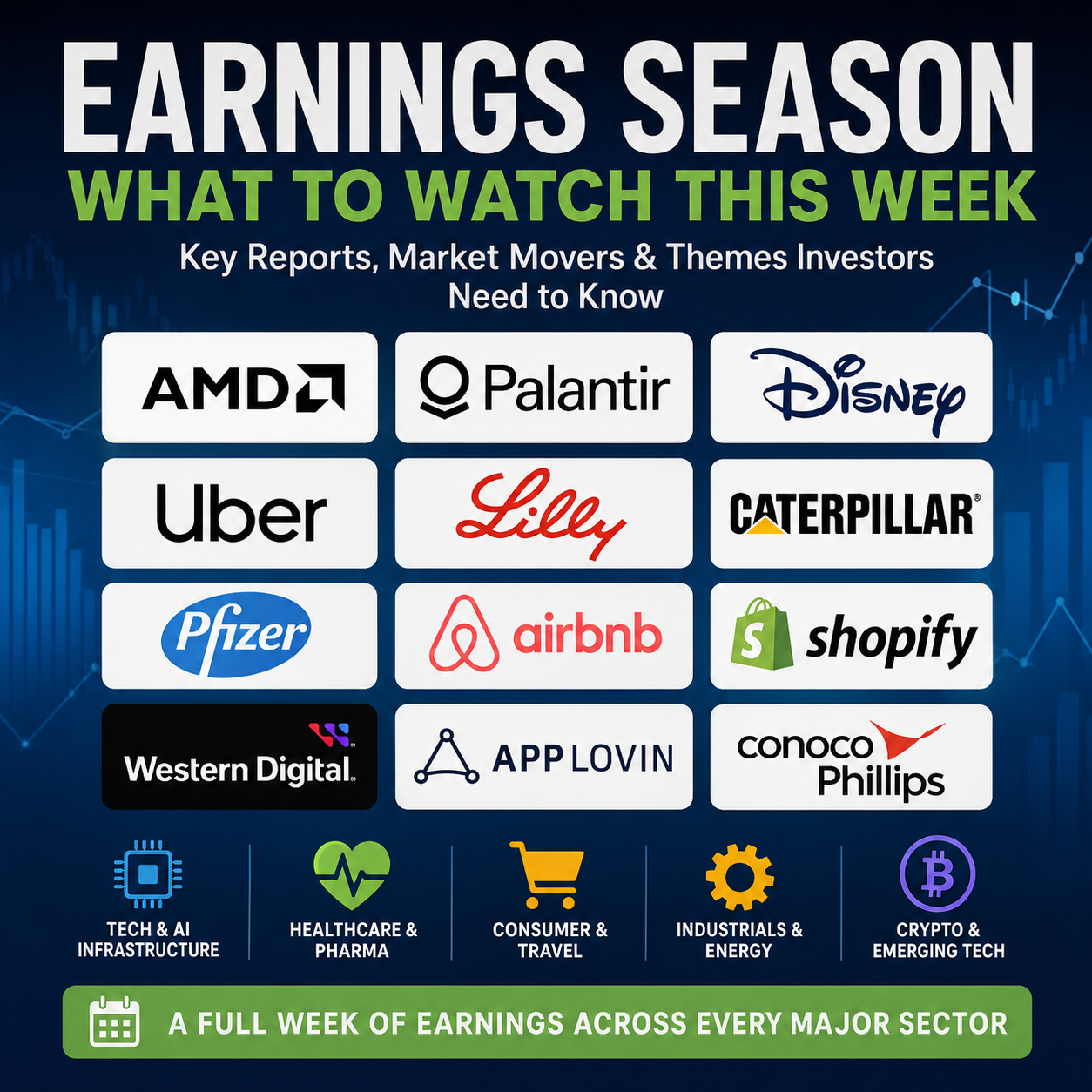
Earnings Season moves into a broader and more diversified phase during the week beginning Monday, August 3, 2026. With much of the recent attention on the largest technology companies, investors now have a wider group of reports to assess across semiconductors, artificial intelligence, software, healthcare, industrials, energy, travel, media and consumer spending.
The calendar features several closely watched companies, including Palantir, AMD, Eli Lilly, Disney, Uber, SanDisk, Western Digital, Shopify, AppLovin and ConocoPhillips. Each report offers a different piece of information about the economy and corporate spending environment.
The technology theme remains important, but this week is less concentrated around the biggest technology platforms. Instead, investors will be looking at how AI investment is affecting semiconductor demand, data-center infrastructure, storage, enterprise software and digital advertising. At the same time, healthcare companies could provide insight into pharmaceutical demand, while Disney, Uber, Airbnb and other consumer-facing businesses may offer clues about household spending and travel activity.
The figures, estimates, dates and market expectations referenced below are based on the supplied earnings calendar and analysis and should be checked against the latest company releases and market data before publication.
This Week’s Earnings Calendar at a Glance
The week begins with Palantir after the market closes on Monday and then accelerates on Tuesday with AMD, Caterpillar, Pfizer, McDonald’s, Merck and several major technology companies.
Wednesday is particularly busy, with Eli Lilly, Shopify, Uber and Disney reporting before the market opens, followed by AppLovin, Western Digital, SanDisk and Axon Enterprise after the close.
Thursday shifts toward energy, data, consumer and travel names, while Friday offers a lighter schedule featuring Take-Two Interactive, Wendy’s and Under Armour.
Monday
Before the Open
- Marriott (MAR)
After the Close
- Palantir (PLTR)
- Snap (SNAP)
- Vertex Pharmaceuticals (VRTX)
Tuesday
Before the Open
- Pfizer (PFE)
- Caterpillar (CAT)
- McDonald’s (MCD)
- Merck (MRK)
After the Close
- AMD (AMD)
- Arista Networks (ANET)
- SpaceX (SPCX)
- Booking Holdings (BKNG)
Wednesday
Before the Open
- Eli Lilly (LLY)
- Shopify (SHOP)
- Uber (UBER)
- Walt Disney (DIS)
After the Close
- AppLovin (APP)
- Western Digital (WDC)
- SanDisk (SNDK)
- Axon Enterprise (AXON)
Thursday
Before the Open
- ConocoPhillips (COP)
- Datadog (DDOG)
- Celsius Holdings (CELH)
After the Close
- DraftKings (DKNG)
- Airbnb (ABNB)
Friday
Before the Open
- Take-Two Interactive (TTWO)
- Wendy’s (WEN)
- Under Armour (UAA)
The result is a diversified week in which investors can move from AI infrastructure to pharmaceuticals, travel, energy, restaurants, media and digital commerce without waiting long for the next major report.

Earnings Season Moves Beyond the Biggest Technology Names
The defining feature of this Earnings Season is diversification.
The previous round of reports was dominated by large technology companies and the enormous investment required to build AI infrastructure. Microsoft provided a strong update that supported enthusiasm around AI spending, while Amazon benefited from cloud and advertising growth. Apple exceeded earnings expectations but faced a more cautious outlook, and Meta remained under scrutiny because of the scale of its AI investment plans.
The next phase is different.
Instead of concentrating almost entirely on mega-cap technology platforms, the market is receiving information from companies that sit further down the AI supply chain and from industries that are affected by broader consumer and economic trends.
That makes this week important for several reasons.
AMD can provide an update on semiconductor demand and AI accelerators. Palantir offers a view into enterprise software and government technology demand. SanDisk and Western Digital provide information about storage requirements created by expanding data infrastructure. Shopify and AppLovin provide additional evidence about digital commerce, advertising and AI-powered business tools.
Outside technology, Eli Lilly and Pfizer are important for healthcare. Caterpillar and ConocoPhillips offer insight into industrial and energy conditions. Disney and Uber provide a consumer-facing perspective that is different from the technology sector.
This makes the week’s reports useful not simply as individual stock events but as a collection of signals about where corporate spending and consumer activity are heading.
Monday: Palantir Takes Center Stage
Monday’s calendar is relatively concentrated, but Palantir is a major focus after the closing bell.
Palantir is scheduled to report on Monday, August 3, 2026, at approximately 4:05 PM ET. The supplied estimates call for earnings of $0.35 per share and revenue of approximately $1.81 billion, representing an estimated 80.3% year-over-year increase in revenue.
Management previously guided toward approximately $1.80 billion in revenue.
The important issue for investors is whether the company’s rapid growth can continue at a scale that supports its elevated expectations.
Palantir Earnings: Growth Remains the Central Question
Palantir has developed into one of the most closely followed companies associated with artificial intelligence, data analytics and government technology.
The supplied analysis points to particularly strong recent growth. Revenue reportedly increased 85% in the previous quarter, while U.S. sales rose 104%. Management also increased its full-year outlook by a significant amount.
The company has continued to emphasize strong demand in the U.S., with new business wins spanning government and commercial customers.
That creates a relatively straightforward question for the current report: can Palantir continue converting strong demand into revenue growth while maintaining operating performance?
The company has cited capacity and execution as important considerations as demand rises. New contracts and relationships, including work involving the U.S. Department of Agriculture and GE Aerospace, add to the growth narrative.
International sales remain a softer area, according to the supplied analysis. That means investors will likely be interested in the geographic balance of growth as well as the headline revenue number.
The stock’s recent performance also adds another layer to the report. The supplied figures indicate that shares had declined from the previous earnings report and remained below their 200-day moving average.
For Palantir, the market reaction may therefore depend on more than simply beating or missing the quarterly estimate. Forward guidance, U.S. commercial growth, government demand and the pace of new customer adoption could all influence the next move.
Tuesday: AMD Leads a Major Technology Lineup
Tuesday brings one of the most important technology reports of the week.
AMD is scheduled to report on Tuesday, August 4, 2026, at approximately 4:15 PM ET.
The supplied market estimates call for earnings of $1.62 per share on revenue of approximately $11.31 billion, representing estimated year-over-year revenue growth of 47.2%.
Management’s previous revenue guidance was approximately $10.90 billion to $11.50 billion.
That puts AMD earnings directly in the middle of the AI infrastructure conversation.
AMD Earnings: Data Centers Remain the Key Test
The most important part of the AMD story is the company’s data-center business.
According to the supplied analysis, data-center revenue increased 57% in the previous quarter to approximately $5.8 billion. Management also significantly increased its long-term forecast for the server CPU market.
The broader AI infrastructure opportunity is particularly important because AI systems require more than graphics processors. They also require CPUs, networking equipment, memory, storage and other components to support large-scale computing environments.
AMD’s opportunity therefore extends beyond competing directly for accelerator demand.
The supplied analysis also highlights major AI-related customer relationships, including an expanded Meta agreement involving Instinct chips and an earlier OpenAI agreement.
New products, including the MI450 platform and Helios systems, are another area investors will monitor.
Free cash flow also reached a record level in the previous quarter, according to the supplied figures.
However, AMD still has areas of uncertainty.
The consumer side of the business is expected to face pressure from higher memory and component costs, while gaming demand may weaken in the second half. China also remains a consideration for the company’s outlook.
That makes the AMD earnings report a test of whether data-center momentum can remain strong enough to offset weaker areas of the portfolio.
Why AMD Matters Beyond AMD
The significance of AMD earnings extends beyond the company’s own stock.
A strong report could reinforce the idea that AI infrastructure spending is spreading through the semiconductor ecosystem. A weaker update could raise questions about the pace at which customers are expanding computing capacity.
Investors will therefore be watching revenue, data-center growth, product demand, customer commitments and guidance.
The broader question is whether AI spending remains strong enough to support continued investment across the hardware chain.
Wednesday: Disney, Uber and a Wide Range of Signals
Wednesday is arguably the most diverse day of the week.
Eli Lilly, Shopify, Uber and Walt Disney are scheduled before the open, while AppLovin, Western Digital, SanDisk and Axon Enterprise report after the close.
The combination provides a broad view of healthcare, digital commerce, transportation, entertainment, advertising and technology infrastructure.
Disney Earnings: A Consumer and Media Test
Disney enters this Earnings Season report with investors focused on the health of its consumer businesses and the performance of its media operations.
Disney’s importance comes from its broad exposure to entertainment, streaming, parks and consumer activity.
The company provides a different type of market signal from AMD or Palantir. Rather than primarily reflecting enterprise technology spending, Disney can offer information about household demand, entertainment consumption and the performance of its various consumer-facing businesses.
Investors should pay attention to revenue trends across the major business areas, management’s outlook and any comments about consumer behavior.
The broader market question is whether consumers remain willing to spend across entertainment and travel-related categories while other areas of the economy face changing conditions.
Disney also sits within the week’s broader consumer theme, which includes McDonald’s, Marriott, Airbnb, DraftKings and Uber.
Together, these companies can help investors develop a more complete picture of discretionary spending.
Uber Earnings: A Read on Mobility and Consumer Activity
Uber is scheduled to report before the market opens on Wednesday, August 5.
The company is particularly interesting because its business sits at the intersection of transportation, technology and consumer spending.
Uber earnings can provide information about demand for mobility services, the performance of its delivery operations and the overall level of activity among consumers.
Investors will likely focus on revenue, bookings, profitability and management’s outlook.
The broader question is whether consumers continue using digital transportation and delivery platforms at a healthy pace.
Uber also provides an important contrast with technology companies whose growth is driven primarily by corporate investment. Its performance is more closely connected to everyday consumer behavior and the continued adoption of digital services.
That makes Uber one of the more useful reports for understanding the consumer side of this week’s Earnings Season.
SanDisk and Western Digital: Storage Becomes an AI Story
The storage industry is another important component of the week.
SanDisk is scheduled to report after the market closes on Wednesday, August 5, while Western Digital is also expected to report that day.
The two companies provide a useful perspective on how AI infrastructure is affecting storage demand.
SanDisk’s Growth Story
The supplied estimates call for SanDisk revenue of approximately $8.30 billion, with earnings of $33.28 per share.
The company reportedly guided toward earnings between $30 and $33 per share on revenue of approximately $7.75 billion to $8.25 billion.
The previous quarter showed a sharp improvement in revenue and gross margins, according to the supplied analysis.
One of the more important developments has been the company’s move toward longer-term supply agreements. The supplied analysis identifies five contracts with approximately $42 billion in future revenue and more than $11 billion in financial guarantees.
Data-center sales also increased substantially.
The central theme is that storage requirements are expanding alongside AI infrastructure.
As AI systems generate and process enormous amounts of data, storage becomes an increasingly important part of the overall technology investment cycle.
Western Digital’s AI Exposure
Western Digital offers a similar but distinct angle.
The supplied analysis indicates that the company crossed 50% gross margins in the previous quarter and reported significantly higher earnings.
The company’s storage products are benefiting from demand associated with data centers and AI workloads.
Pricing trends are also important. The supplied analysis notes that drive pricing moved from declines toward growth.
For investors, the main question is whether these improvements represent a durable change in the storage cycle or a temporary period of strong demand.
Western Digital’s balance sheet, margins, capital returns and ability to ramp new technologies will remain important parts of the story.
Eli Lilly: Healthcare Expectations Remain Elevated
Eli Lilly reports before the market opens on Wednesday.
The supplied estimates call for earnings of $6.71 per share on revenue of approximately $20.26 billion, representing estimated revenue growth of 30.2% from the prior year.
Healthcare remains one of the most closely watched areas of this Earnings Season, particularly because of the continued attention surrounding weight-management treatments.
The supplied analysis highlights the company’s new oral treatment and its early patient adoption.
It also points to the company’s previous full-year guidance increase and strong overall growth.
At the same time, pricing remains an important issue.
Changes in coverage and reimbursement can influence the economics of weight-management treatments, making pricing and access important considerations alongside demand.
Investors will also be watching the company’s pipeline and management’s assessment of future demand.
The key issue is whether Lilly can maintain high growth while navigating pricing pressure and changes in coverage.
AppLovin: Strong Business Momentum Meets a More Cautious Stock
AppLovin is scheduled to report after the market closes Wednesday.
The supplied estimates call for earnings of $3.72 per share on revenue of approximately $1.94 billion.
That represents expected revenue growth of roughly 54.1%.
The company previously guided toward revenue between $1.92 billion and $1.95 billion.
The interesting contrast is between the company’s operating momentum and its recent stock performance.
According to the supplied analysis, AppLovin’s shares had declined since the previous report even as expectations for the business remained relatively positive.
The company has highlighted strong consumer spending trends and improvements across its advertising platform.
Its AI-powered creative tools and self-service advertising capabilities are also areas to monitor.
AppLovin is becoming an important part of the broader AI investment discussion because artificial intelligence is not limited to chips and data centers. It is also changing digital advertising, creative production, targeting and customer acquisition.
That makes AppLovin a useful test of whether AI-related gains are spreading further into the software and advertising ecosystem.
Shopify: AI Shopping Moves Into Commerce
Shopify is another important technology report on Wednesday morning.
The supplied estimates call for earnings of $0.40 per share on approximately $3.43 billion in revenue, representing growth of about 28% from the prior year.
The previous quarter reportedly produced its fastest revenue growth in more than four years.
Shopify’s exposure to AI-powered commerce is particularly relevant.
The supplied analysis notes that traffic driven by AI increased significantly and that Shopify’s commerce infrastructure is being connected to several major technology companies.
The company is positioned at an interesting point in the market because AI could change how consumers discover products, compare prices and make purchases.
The question is whether Shopify can translate this changing consumer behavior into sustained merchant growth, transaction volume and cash generation.
Investors will also be watching margins, free cash flow and the cost of expanding AI capabilities.
Thursday: Energy, Data and Travel Take the Spotlight
Thursday moves the focus away from semiconductors and toward energy, data infrastructure, consumer services and travel.
ConocoPhillips, Datadog and Celsius Holdings report before the open, followed by DraftKings and Airbnb after the close.
ConocoPhillips: Cash Flow and Production in Focus
ConocoPhillips is scheduled to report before the market opens Thursday.
The supplied estimates call for earnings of $2.96 per share on revenue of approximately $17.54 billion.
The company has benefited from exposure to oil and LNG markets, according to the supplied analysis.
Cash generation and shareholder returns remain central themes.
The company has also been investing in production opportunities, including activity in the Permian Basin and developments related to Alaska.
However, there are also operational considerations.
A Qatar-related production disruption is expected to affect output, while construction delays could affect the timing of certain projects.
The company has also reduced its global oil-demand outlook to a flat-growth expectation.
For investors, the report will therefore provide insight into how management balances capital returns, production growth and commodity-market uncertainty.
Datadog and the Enterprise Technology Cycle
Datadog provides another window into corporate technology spending.
The company is exposed to cloud infrastructure, application monitoring and enterprise software demand.
While the company does not have the same profile as AMD or Palantir, its results can provide useful information about the health of digital infrastructure budgets.
Investors will be interested in customer growth, spending levels, revenue growth, margins and guidance.
Datadog also fits into the larger AI theme because companies building AI applications require cloud infrastructure and software monitoring tools.
The report could therefore provide another indication of whether enterprise technology spending remains resilient.
Airbnb and the Travel Consumer
Airbnb reports after the market closes Thursday.
The company’s results are relevant to the broader consumer and travel theme running throughout this week.
Together with Marriott, Booking Holdings, Disney and Uber, Airbnb can help investors assess whether consumers continue prioritizing travel and experiences.
The key metrics include booking activity, revenue, margins and forward expectations.
Travel-related companies can also be affected by changing economic conditions, foreign exchange trends and consumer confidence.
For that reason, Airbnb offers a useful complement to the technology-heavy reports earlier in the week.
Friday: A Quieter Finish
Friday’s schedule is lighter, with Take-Two Interactive, Wendy’s and Under Armour among the companies reporting before the market opens.
Although the calendar is less crowded, these reports can still add useful information.
Take-Two provides another look at entertainment spending and the video game industry. Wendy’s provides a consumer and restaurant signal, while Under Armour offers a view into apparel demand.
The reports could be particularly useful when considered alongside the week’s larger consumer names.
By Friday, investors will have received information from technology, healthcare, industrials, energy, travel, entertainment and consumer companies.
That broader context may be more valuable than any individual report.
Key Themes Investors Should Watch This Week
1. AI Infrastructure Spending
AI remains the most important technology theme.
AMD, Arista Networks, SanDisk, Western Digital, AppLovin, Datadog and Shopify each provide different exposure to AI.
AMD represents semiconductors and computing. Arista represents networking. SanDisk and Western Digital represent storage. Datadog represents software infrastructure. AppLovin highlights advertising and AI tools, while Shopify illustrates AI’s potential impact on commerce.
The market will be watching whether spending remains broad enough to support companies across this ecosystem.
2. Consumer Demand
Disney, Uber, Airbnb, Marriott, McDonald’s, Wendy’s and DraftKings offer different views of consumer behavior.

No single company can represent the entire consumer economy, but the combined results can provide useful evidence.
Investors should look for changes in customer activity, transaction volumes, bookings and management commentary about spending patterns.
3. Healthcare Demand
Eli Lilly, Pfizer and Merck headline the healthcare portion of the week.
Lilly remains especially important because of the continued growth expectations around weight-management treatments.
Investors will also be watching pricing, access, demand and pipeline developments.
4. Industrial and Energy Conditions
Caterpillar and ConocoPhillips provide insight into areas that are less directly connected to AI.
Caterpillar can provide information about industrial activity and equipment demand, while ConocoPhillips offers insight into energy markets, production and cash generation.
Their results can help determine whether the strength of the market is broadening beyond technology.
5. Enterprise Software Demand
Palantir, Datadog and Shopify provide several different views of enterprise technology spending.
Palantir focuses on data and AI platforms, Datadog on cloud and software infrastructure, and Shopify on commerce.
The reports can show whether businesses continue investing in digital systems even as expectations around AI become more demanding.
6. Semiconductor and Storage Demand
AMD, SanDisk and Western Digital represent different parts of the computing infrastructure chain.
If demand remains strong across these businesses, it would reinforce the view that AI investment is creating broader hardware requirements.
If guidance becomes more cautious, investors may begin questioning whether some of the strongest growth expectations have already been reflected in valuations.
What Could Move Stocks After the Reports?
Investors often focus heavily on whether a company beats or misses its quarterly earnings estimate.
However, the initial reaction can depend on several other factors.
Revenue Growth
A company can exceed an earnings estimate while delivering weaker-than-expected revenue growth. Conversely, a company can post an earnings miss while maintaining a strong revenue outlook.
Forward Guidance
Guidance is often more important than the quarter that has just ended.
Investors want to understand what management expects for the next quarter and full year.
Margins
Revenue growth is only one part of the equation.
For companies investing heavily in AI, investors will also want to know whether additional spending is translating into sustainable gross and operating margins.
Capital Spending
AI infrastructure requires substantial investment.
Comments about capital expenditures, data centers, chips, networking and storage could influence the broader technology sector.
Customer Demand
Companies such as Palantir, AMD, Shopify and Datadog will be judged partly on the strength of customer demand.
The market will be watching whether growth comes from a small number of large contracts or a broader base of customers.
Consumer Behavior
For Disney, Uber, Airbnb, Marriott and other consumer-facing businesses, demand trends may be particularly important.
Management commentary about booking activity, transaction volumes and discretionary spending could influence expectations for the broader consumer sector.
Why This Week Could Matter for the Broader Market
This Earnings Season is becoming less about a handful of mega-cap technology companies and more about the wider corporate economy.
That distinction matters.
Large technology companies have dominated the conversation around AI spending, but the economic impact of AI extends through a much wider network of businesses.
Chipmakers require advanced manufacturing and networking. Data centers require storage and software. Enterprises need monitoring tools and cybersecurity. Digital businesses are using AI to improve advertising and commerce.
At the same time, consumers continue to influence large sections of the market through spending on travel, entertainment, restaurants and transportation.
The combination means this week’s reports could help investors determine whether the market’s growth narrative is broadening.
If multiple industries deliver solid results and maintain constructive guidance, investors could gain greater confidence that corporate demand remains healthy across sectors.
If strong results are concentrated in a narrow group of technology businesses, the market may continue to view AI as a powerful but relatively concentrated investment theme.
Palantir, AMD, Disney and Uber: Four Different Market Signals
The four primary focus companies provide a useful framework for understanding the week.
Palantir represents AI software, data analytics and government and commercial technology demand.
AMD represents semiconductor infrastructure and the expanding computing requirements associated with AI.
Disney provides a view of entertainment, consumer activity and media.
Uber provides insight into transportation, delivery and everyday digital consumer behavior.
Taken together, these businesses cover very different parts of the economy.
That is why their reports are worth following individually and collectively.
Palantir and AMD can help investors understand whether technology investment remains strong. Disney and Uber can help answer whether consumers continue spending through digital and experience-based channels.
The combination creates a more balanced view of market conditions than the technology-heavy reporting period that came before it.
What Investors Should Watch in AMD Earnings
For AMD, the key points include:
- Data-center revenue growth
- Demand for AI accelerators
- Server CPU demand
- New product adoption
- Major customer agreements
- Free cash flow
- Gaming and consumer weakness
- China-related uncertainty
- Full-year guidance
The market’s attention is likely to remain focused on whether data-center growth can continue to offset weakness elsewhere.
What Investors Should Watch in Palantir Earnings
For Palantir, the most important areas include:
- Revenue growth
- U.S. commercial sales
- Government demand
- New customer additions
- International sales
- Contract growth
- Full-year guidance
- Ability to scale with demand
The company enters the report with high expectations, making forward guidance especially important.
What Investors Should Watch in Disney Earnings

For Disney, investors should focus on:
- Consumer spending trends
- Streaming performance
- Entertainment demand
- Parks and travel activity
- Revenue growth
- Profitability
- Management’s outlook
Disney’s broad business model means investors may be looking for trends across several different divisions rather than focusing on a single metric.
What Investors Should Watch in Uber Earnings
For Uber, important areas include:
- Mobility demand
- Delivery activity
- Gross bookings
- Revenue growth
- Profitability
- Consumer behavior
- Forward guidance
Uber’s results could provide a useful read on digital consumer activity and transportation demand.
Frequently Asked Questions About Earnings Season
What is Earnings Season?
Earnings Season is the period when publicly traded companies report quarterly financial results. Companies typically provide revenue, earnings, guidance and management commentary that investors use to evaluate business performance and future expectations.
When is Earnings Season in August 2026?
The supplied calendar identifies the week beginning August 3, 2026, as an active period of corporate reporting, with major reports scheduled throughout the week.
The exact dates and reporting times should be verified against the latest company announcements before trading decisions or publication.
Which companies are most important this week?
Several companies stand out, including AMD, Palantir, Eli Lilly, Disney, Uber, SanDisk, Western Digital, Shopify, AppLovin and ConocoPhillips.
The most relevant companies depend on the sector an investor is following.
Why are AMD earnings important?
AMD earnings are important because the company is exposed to data-center computing, semiconductors and AI infrastructure.
Investors will be watching data-center demand, AI accelerator sales, server CPUs, product launches and guidance.
Why are Palantir earnings important?
Palantir provides exposure to AI software, data analytics and government and commercial technology demand.
Investors will be watching revenue growth, U.S. sales, customer demand, contracts and future guidance.
What should investors watch in Disney earnings?
Disney earnings can provide information about consumer demand, entertainment spending, streaming and travel-related activity.
Investors should pay attention to revenue, profitability and management’s outlook across the company’s major businesses.
What can Uber earnings tell investors?
Uber earnings can provide insight into mobility demand, delivery activity and digital consumer behavior.
Investors can monitor bookings, revenue, profitability and management commentary about consumer activity.
Are earnings estimates guaranteed to be accurate?
No. Earnings estimates are expectations rather than guarantees.
Actual results can differ because of changes in demand, costs, currency movements, accounting factors, guidance changes and other business conditions.
Why does guidance matter during Earnings Season?
Guidance matters because investors are typically interested in future performance as much as the quarter that has already ended.
A company can report strong historical results while providing cautious forward guidance, or report a weaker quarter while raising expectations for future periods.
What is the biggest theme this week?
AI infrastructure remains one of the most important themes, particularly through AMD, SanDisk, Western Digital, Arista Networks, Datadog, AppLovin and Shopify.
However, the week is broader than AI. Healthcare, consumer spending, industrial activity, energy and travel are also significant themes.
Final Takeaway: A Broader Test for the Market
This week’s Earnings Season offers investors a much wider view of the market than the technology-heavy reporting period that preceded it.
AMD and Palantir remain central to the AI and technology conversation, with investors watching whether strong demand can continue to support ambitious growth expectations.
SanDisk and Western Digital add an important storage perspective, while AppLovin, Shopify and Datadog demonstrate how AI is expanding into advertising, commerce and enterprise software.
At the same time, Eli Lilly, Pfizer and Merck provide insight into healthcare. Caterpillar and ConocoPhillips broaden the picture into industrial and energy markets. Disney, Uber, Airbnb, Marriott and other consumer-focused companies offer clues about spending, travel and everyday economic activity.
The most important takeaway is that investors are no longer evaluating AI in isolation.
The market is increasingly asking how technology investment connects with the rest of the economy.
For AMD, that means determining whether AI infrastructure demand can continue to drive data-center growth. For Palantir, it means assessing whether AI software demand can remain strong at scale. For Disney and Uber, the questions center more on consumer activity, travel, entertainment and digital services.
That makes the week beginning August 3 an important period for understanding the next phase of the market.
Rather than focusing only on whether individual companies beat quarterly estimates, investors may want to pay close attention to guidance, margins, customer demand, capital spending and management commentary.
Those details can provide a better indication of where corporate growth is heading next.
As the Earnings Season continues, the key question is increasingly whether strength remains concentrated in a handful of technology leaders or spreads across a broader range of industries.
This week’s reports from AMD, Palantir, Disney, Uber and the many other companies on the calendar could provide some of the clearest clues yet.