


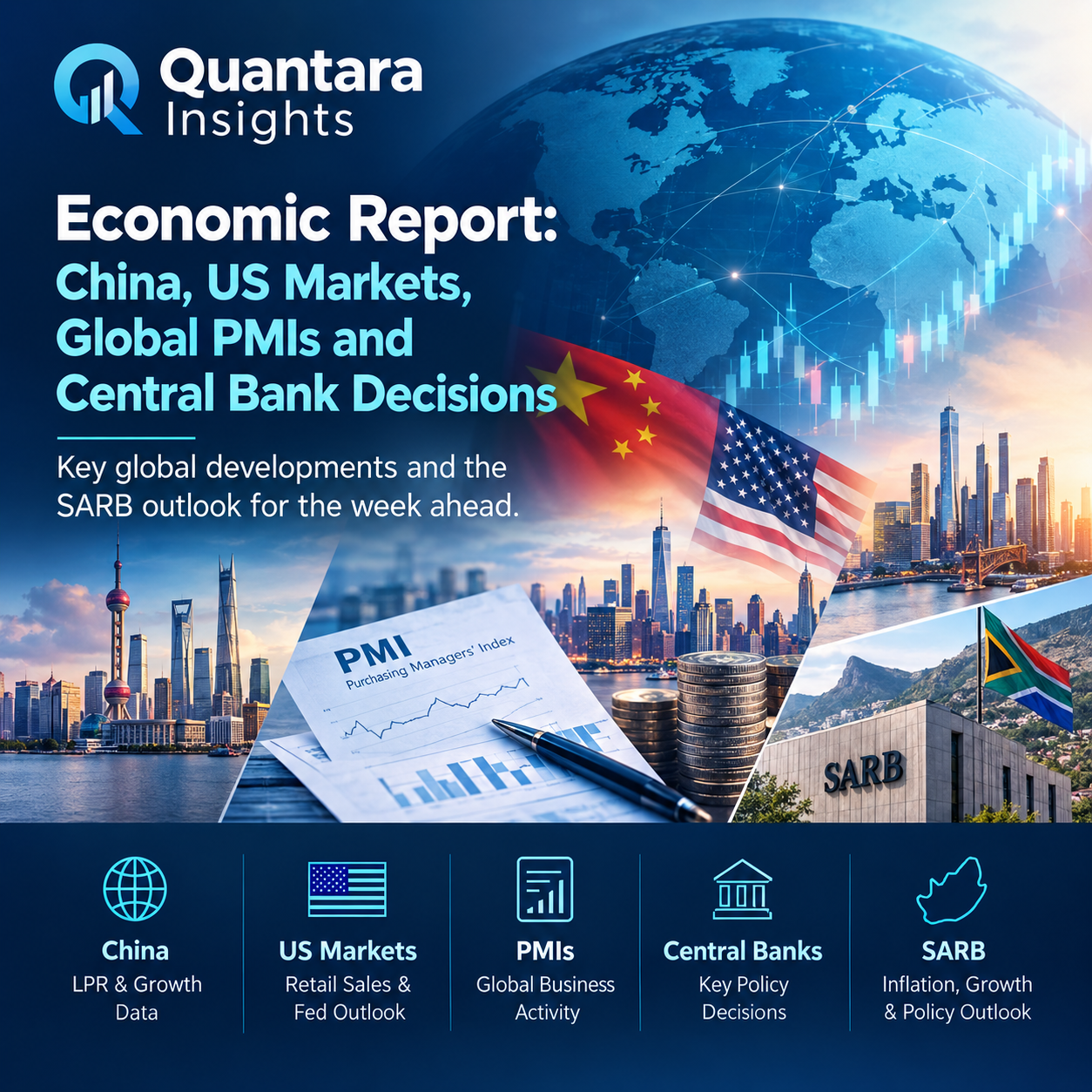

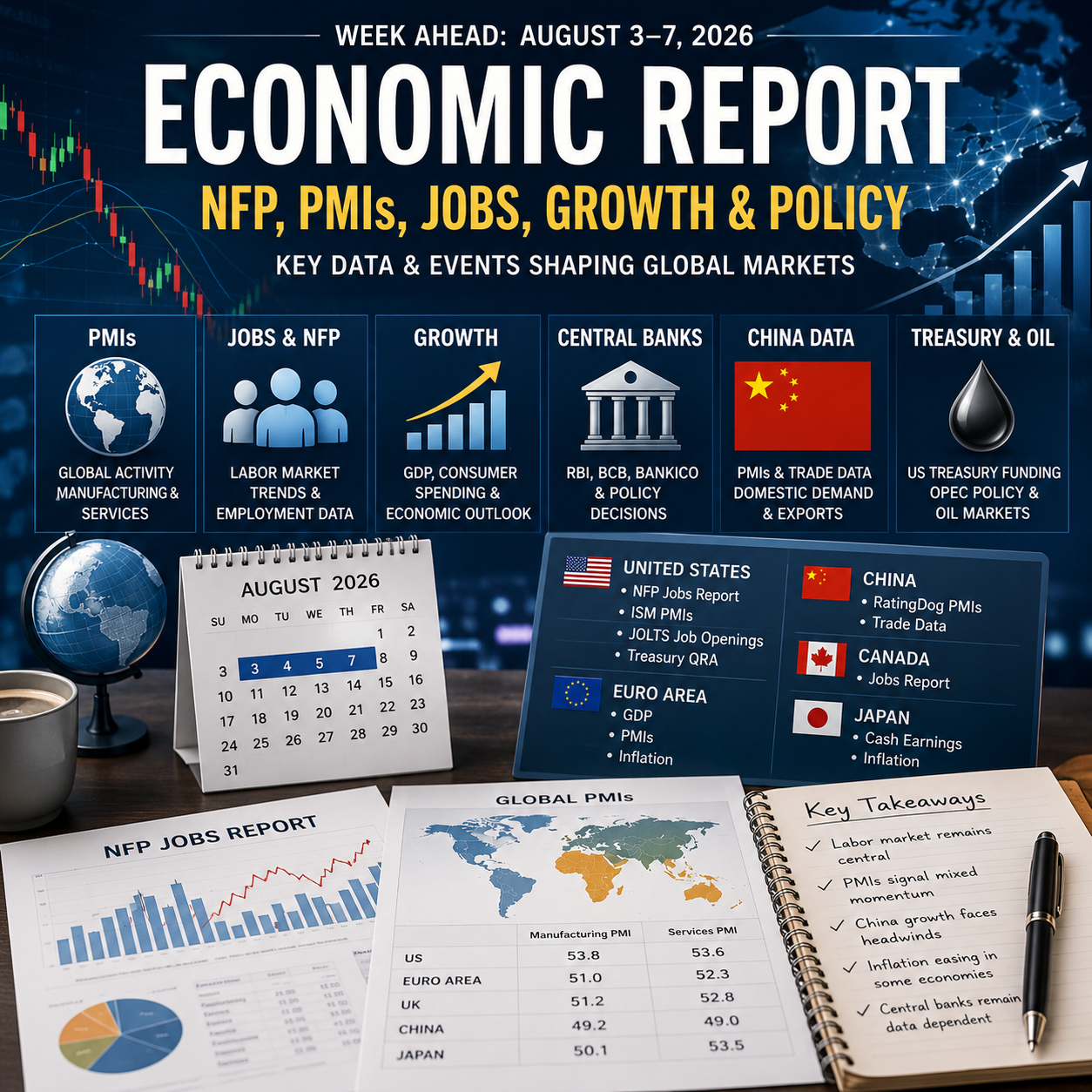
Economic Report — The week of 3–7 August 2026 brings a broad set of economic, monetary policy and market events into focus. Investors will be watching the latest PMIs from China, the US and Europe, the US Treasury’s Quarterly Refunding Announcement, central bank decisions in India and Brazil, Chinese trade data, Canadian employment figures and the US NFP jobs report.
The Economic Report also comes after a busy week in which China’s official PMIs moved into contractionary territory, the Federal Reserve kept rates unchanged, US Q2 GDP missed expectations, core PCE inflation eased, euro area growth surprised to the upside and Australian inflation came in softer than expected.
The combination of NFP, PMIs, Jobs and Growth data should help shape expectations around monetary policy, economic momentum and financial-market conditions. At the same time, oil supply policy, Chinese demand, Treasury financing and global inflation remain important themes.
Economic Report: What Markets Are Watching This Week
The central theme of the Economic Report is whether incoming data confirm a gradual cooling in some economies or point to a more uneven growth environment.
The week begins with the OPEC JMMC meeting and moves quickly into manufacturing PMIs, US labour-market indicators, central bank decisions and government financing announcements. By Friday, markets will have several important releases to assess, including Chinese trade figures, German industrial data, the Canadian Jobs Report and the US NFP report.
The main events are:
- OPEC JMMC meeting
- Chinese RatingDog Manufacturing PMI
- Final manufacturing and services PMIs across major economies
- US ISM Manufacturing PMI
- US JOLTS Job Openings
- US Treasury Quarterly Refunding Announcement
- RBI policy announcement
- BCB policy announcement
- Chinese RatingDog Services and Composite PMIs
- Banxico policy announcement
- Chinese trade data
- Canadian Jobs Report
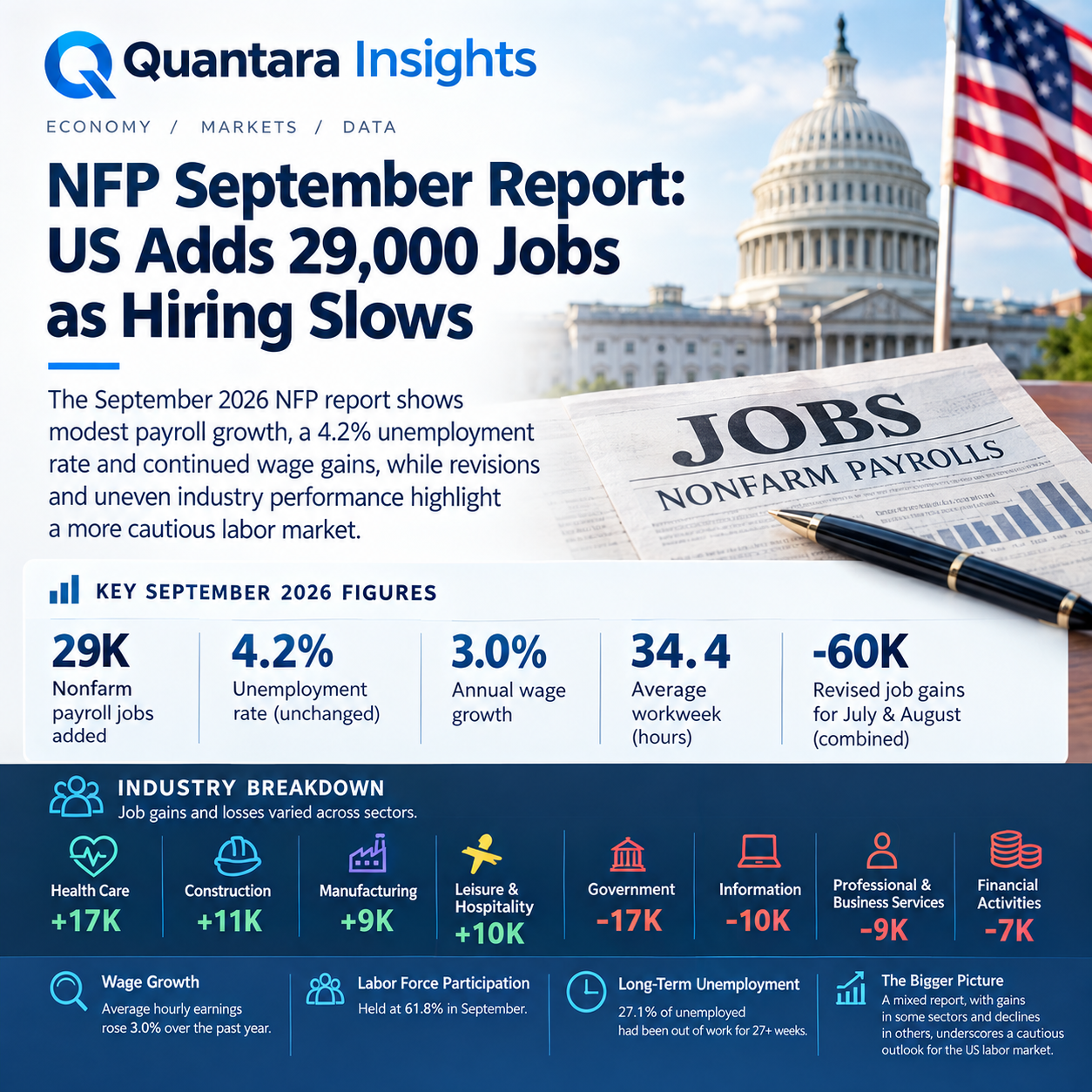
- US NFP and unemployment data
This Economic Report therefore has a strong focus on the relationship between Jobs, Growth, PMIs and monetary policy.
Economic Report: OPEC JMMC Meeting and Oil Supply Policy
The OPEC JMMC meeting is scheduled for Sunday and will be an early focus for the market.
The alliance is widely expected to endorse a planned 188k barrels per day increase in its September production target, continuing the phased output increases implemented since June.
No broader policy shift is expected at this stage. Ministers are nevertheless likely to review market conditions, production compliance and the balance between supply and demand.
One of the important questions for the Economic Report is whether OPEC+ decides to pause further output increases after September. Recent sources cited in the report indicate that some delegates see the possibility of production remaining steady through the end of the year if demand conditions soften.
OPEC has also lowered its 2026 global oil demand growth forecast for a third consecutive month. Discussions surrounding production baselines for 2027 are expected to remain relevant.
Oil markets matter to the broader Economic Report because energy prices influence inflation, consumer purchasing power, corporate costs and monetary-policy expectations. A sustained change in energy prices could therefore affect the interpretation of the week’s Growth and inflation data.
Chinese PMIs: A Key Test of Economic Momentum
Chinese PMIs will be closely watched following a disappointing set of official manufacturing and non-manufacturing readings.
The private RatingDog Manufacturing PMI is scheduled for Monday, followed by the Services and Composite PMIs on Wednesday.

The Economic Report highlights the importance of these figures because markets will be looking for evidence of whether weakness seen in the official surveys is spreading into the broader private-sector economy.
China’s official July data showed:
| Indicator | July | Previous | Forecast |
|---|---|---|---|
| Manufacturing PMI | 49.2 | 50.3 | 49.9 |
| Non-Manufacturing PMI | 49.0 | 50.2 | 50.0 |
| Composite PMI | 49.3 | 50.6 | — |
The manufacturing PMI falling below 50 indicates contraction according to the standard PMI framework.
The official data were attributed partly to adverse weather and flooding, while analysts also pointed to subdued domestic demand and continuing pricing pressures.
The Economic Report will therefore be watching the RatingDog surveys for confirmation or divergence.
A weaker private-sector reading would add to concerns about China’s domestic Growth momentum. A stronger reading could suggest that the weakness in the official data was more concentrated than initially feared.
China Policy Direction Remains Important
The latest Politburo meeting provides important context for the Chinese PMIs.
According to the supplied Economic Report, China’s Politburo reviewed first-half economic performance and established the policy direction for the remainder of 2026.
The meeting signalled continued implementation of existing support measures rather than a major new stimulus package.
At the same time, officials pledged to accelerate the issuance of local government special bonds and ultra-long treasury bonds.
Other priorities included addressing “involutionary” competition, supporting employment and domestic demand, advancing the “AI+” initiative and strengthening confidence in capital markets.
The change in language around economic performance was also notable. Leaders dropped the description of the economy as performing “better than expected” that had appeared in April.
For the Economic Report, this matters because the policy response will influence how investors interpret incoming Chinese PMIs, Jobs and Growth data.
The Fifth Plenum of the 20th Central Committee is also scheduled for October, adding another important policy milestone later in the year.
US Treasury Quarterly Refunding Announcement
The US Treasury will be another major focus in this week’s Economic Report.
The Treasury is scheduled to release its Q3 financing estimates, followed by the Quarterly Refunding Announcement on Wednesday.
The discussion comes against a backdrop of significant government financing requirements.
The Treasury previously assumed a USD 900 billion cash balance at the end of June. Based on the projections outlined in the supplied report, the Treasury General Account could peak around USD 1 trillion, plus or minus USD 50 billion, in late July.
JPMorgan has highlighted a potential USD 3.7 trillion funding gap emerging over the next four fiscal years.
The bank argued that officials may eventually need to adjust the wording surrounding auction sizes and long-term debt management.
However, the Economic Report notes that political considerations could influence the timing of any change.
JPMorgan reportedly believes that the Treasury could avoid unsettling the bond market ahead of the November midterm elections by delaying changes that might increase expectations for larger bond sales.
The issue is relevant beyond the Treasury market.
Changes in issuance expectations can affect bond yields, financial conditions and the broader interpretation of monetary policy. That makes the Quarterly Refunding Announcement an important part of the week’s wider Growth and market outlook.
RBI Decision: India Growth and Inflation in Focus
The Reserve Bank of India is widely expected to leave rates unchanged at 5.25%.
The supplied Economic Report cites a recent Reuters poll in which 68 of 72 economists expected the Repurchase Rate to remain at 5.25%, while four expected a 25-basis-point increase.
The central bank is also expected to retain a neutral policy stance.
At its previous meeting in June, the MPC unanimously left rates unchanged. Governor Malhotra said monetary policy had become more cautious and highlighted uncertainty in the global economy.
India’s domestic demand remained resilient, but elevated energy prices and supply constraints were weighing on economic activity.
The inflation outlook also remains important.
India’s GDP growth in the previous quarter exceeded forecasts at 7.8%, compared with expectations of 7.2%. Meanwhile, CPI inflation reached 4.38% in June, above the 4.3% forecast but still within the central bank’s 2–6% tolerance range.
The Economic Report therefore presents a relatively balanced picture: strong Growth and resilient demand on one side, with inflation and external risks on the other.
Brazil Central Bank: Inflation Supports Another Rate Cut
Brazil’s central bank is scheduled to meet on Wednesday.
The Economic Report notes that the country’s 12-month inflation rate undershot expectations in the mid-July reading and moved closer to the central bank’s target range.
This has increased expectations for a fourth consecutive rate cut.
At its previous meeting, the BCB reduced rates by 25 basis points to 14.25% while leaving its future policy path open.
Governor Galipolo has continued to stress concerns around inflation expectations, supporting a restrictive policy approach for longer.
The key question is whether softer inflation provides enough room for another reduction without undermining the central bank’s credibility.
The decision is therefore another important part of the global Economic Report, particularly for the interaction between inflation, monetary policy and Growth.
US ISM Manufacturing PMI: Momentum in Focus
The US ISM Manufacturing PMI is one of the week’s most important PMIs.
The supplied Economic Report uses S&P Global’s flash manufacturing PMI as a preliminary indicator.
The flash manufacturing PMI eased to 53.8 in July from 53.9 in June, reaching a four-month low.
The output index declined more sharply, falling to 53.6 from 56.2, its weakest level since March.
The underlying details point to a gradual loss of momentum.
New orders increased at their slowest pace in four months. Domestic demand remained the main source of growth, while goods exports continued to decline.
Earlier stock-building had also contributed to demand as companies responded to concerns about prices and supply availability connected to the Middle East conflict.
That effect became less prominent in July.
The Economic Report also highlights renewed supply-chain pressures. Supplier delivery times lengthened as shipping disruption through the Strait of Hormuz and demand for safety stocks added to existing tariff-related constraints.
Input-cost inflation increased to its highest level since May 2025.
Companies cited:
- Higher energy prices
- Higher shipping costs
- Tariffs
- Supplier price increases
- Broader supply-chain constraints
Selling-price inflation also accelerated to its highest rate since August 2022.
For the Economic Report, this combination creates an important tension: manufacturing activity is still expanding according to the flash reading, but growth momentum has softened while cost pressures have increased.
US Jobs Data: JOLTS and NFP Take Center Stage
US Jobs data will be one of the biggest themes of the week.
The release calendar includes JOLTS Job Openings on Tuesday and the monthly US NFP report on Friday.
The Economic Report expects headline payroll growth to receive particular attention because employment conditions remain central to Federal Reserve policy expectations.
According to the figures supplied in the report, headline payrolls are expected to increase by 88,000 in July, compared with 57,000 previously.
The unemployment rate is expected to remain at 4.2%.
Average hourly earnings are forecast to rise by 0.3% month over month, while annual wage growth is expected to remain at 3.5% year over year.
Barclays is slightly more optimistic, forecasting payroll growth of 100,000.
However, the bank also highlights uncertainty around the estimate.
Its standard monthly models, which incorporate weekly claims and broader employment indicators, point toward a stronger result, while alternative indicators suggest a more moderate reading.
This makes the Economic Report particularly sensitive to the details of the NFP release rather than simply the headline payroll number.
Why NFP Revisions Could Matter
The quality of the initial Jobs estimate is another important consideration.
Barclays noted that the June employment report had a relatively low response rate of 54.4%, which creates the possibility of significant revisions to the earlier figures.
The direction of any revision remains uncertain.
This means markets may need to assess three separate components:
- July payroll growth
- Revisions to previous months
- The unemployment rate and wage-growth data
The Economic Report therefore does not treat NFP as a single number.
A stronger payroll figure combined with stable unemployment and firm wages could reinforce expectations for a more restrictive Federal Reserve approach.
A weaker Jobs report, especially if accompanied by downward revisions, could support expectations that the labour market is losing momentum.
The wage data will also matter because they remain relevant to the inflation outlook.
Canadian Jobs Report: Labour-Market Slack Remains Important
Canada’s Jobs Report is scheduled for Friday alongside the US NFP release.
The Economic Report notes that the Bank of Canada has described labour-market conditions as soft.
The unemployment rate was 6.5% in June and has remained within a 6.2–7.0% range since the end of 2024.
The central bank views labour-market softness as evidence of ongoing economic slack.
That slack is exerting downward pressure on some prices, particularly services excluding shelter, while slower unit labour-cost growth reinforces the disinflationary trend.
However, there are signs of improvement.
The Bank of Canada noted that Jobs growth had resumed, while May and June Labour Force Survey data showed a decline in youth unemployment.
The central bank expects slack to be gradually absorbed as economic Growth strengthens.
The risk is that if hiring fails to improve, consumer spending could weaken and make the recovery more difficult to sustain.
That makes the Canadian Jobs Report an important part of the broader Economic Report.
Chinese Trade Data: Export Momentum Under Review
Chinese trade data will be released Friday.
The Economic Report highlights the importance of determining whether export momentum continued after June’s strong performance.
June’s export strength was supported by strong AI-related demand and tariff front-loading.
However, economists expect export growth to moderate as inventory stockpiling fades and shipments to the US weaken following efforts to beat higher tariffs.
Import growth is also expected to slow.
Subdued domestic demand and disruption caused by severe summer typhoons are among the factors being watched.
For markets, the data could provide another indication of how China’s external sector is adapting to higher US tariffs and weaker domestic activity.
The relationship between trade, industrial activity and domestic demand will therefore remain central to the Economic Report.
Banxico: Inflation Outlook Remains Delicate
Mexico’s central bank will meet on Thursday.
At its previous meeting, Banxico unanimously left its policy rate unchanged at 6.5%.
The Governing Board said it was appropriate to maintain the reference rate at its existing level and considered the current monetary-policy stance suitable for addressing the macroeconomic environment.
The Economic Report notes that Governor Cuadra recently described the inflation outlook as delicate.
That suggests the central bank will continue to balance inflation risks against the broader economic environment.
For investors, the Banxico decision is another example of how central banks are navigating different combinations of inflation and Growth conditions.
Economic Report: Key Lessons From the Previous Week
The week ahead follows several significant developments.
The Economic Report begins with the Federal Reserve decision, where rates remained unchanged between 3.50% and 3.75%.
The decision included three dissents, with regional Presidents Logan, Hammack and Kashkari each supporting a 25-basis-point increase.
The statement did not provide explicit forward guidance.
This means incoming data, especially Jobs, Growth and inflation, may have an important influence on expectations around the next meeting.
Federal Reserve Review: Policy Remains Data Dependent
The Federal Reserve continues to describe economic activity as expanding at a solid pace.
The Economic Report highlights strong productivity growth, capital investment and steady Jobs gains consistent with workforce growth.
The unemployment rate was described as little changed.
Markets nevertheless reacted in a dovish direction following the meeting, with investors reducing some of the hawkish positioning established beforehand.
The supplied report notes that markets subsequently assigned approximately a two-thirds probability to a rate hike at the September meeting, compared with roughly 50/50 pricing in the previous week.
The views of the dissenting officials were also important.
Kashkari supported a 25-basis-point increase because he saw risks that successive supply shocks and data-centre investment could contribute to more persistent inflation.
Hammack argued that policy was not restrictive enough and that the Federal Reserve should act to lower inflation while the labour market remained stable.
The Economic Report therefore suggests that the Fed debate remains closely connected to both inflation and the Jobs market.
Bank of Canada Minutes: Growth and Inflation Risks Remain Balanced
The Bank of Canada kept rates at 2.25% at its July meeting.
The meeting minutes showed that officials believed the trade-off between supporting Growth and containing inflation had become easier, although uncertainty remained high.
Policymakers agreed that GDP had rebounded in Q2 but differed on whether the recovery could continue.
The Economic Report identifies several risks:
- Weaker business adaptation to US tariffs
- Housing weakness in Toronto and Vancouver
- Softer consumer demand
- Flat exports
- Flat investment
- Higher medium-term inflation expectations
At the same time, the Bank of Canada saw limited evidence that higher oil prices were spreading into broader inflation.
The result is a relatively balanced policy environment, with downside Growth risks competing with upside inflation concerns.
Australia CPI: Inflation Cools More Than Expected
Australia’s Q2 inflation data also featured prominently in the previous week’s Economic Report.
Headline CPI rose 0.6% quarter over quarter, below the 0.7% forecast.
Annual inflation slowed to 3.8% from 4.1%.
The RBA’s preferred trimmed-mean measure increased 0.9% quarter over quarter, in line with expectations, while annual growth was 3.6%, below both the market forecast of 3.7% and the RBA’s 3.8% projection.
Lower automotive fuel prices were the largest contributor to the softer headline reading, while housing costs remained elevated.
The data led markets to significantly reduce expectations for an RBA rate hike in August.

For the Economic Report, the Australian figures reinforce the importance of distinguishing between headline inflation and underlying price pressures.
Bank of England: Extended Hold Remains the Base Case
The Bank of England maintained Bank Rate at 3.75%, with the decision split 6–3.
The Economic Report notes that Mann joined Pill and Greene in dissenting.
Despite the dissent, the broader reaction became more dovish after the central bank highlighted limited evidence of second-round effects.
Lombardelli also indicated that her decision to hold was not particularly close.
Governor Bailey said it would be wrong to conclude that the Bank of England was moving toward a rate hike.
The resulting market reaction was notably dovish.
The key issue for the Economic Report is therefore the balance between inflation risks and the absence of clear second-round effects.
Euro Area GDP: Growth Beats Expectations
Euro area Q2 GDP was another important positive development.
Growth came in at 0.4% quarter over quarter, above the 0.2% forecast and following a previous reading of -0.2%.
Germany also performed better than expected, with GDP increasing 0.2% quarter over quarter.
German growth was supported by stronger exports.
The Economic Report notes that some of the euro area’s strength may have been connected to exports, potentially as the region benefited from trade disruption elsewhere.
However, the data come with caveats, particularly around stockbuilding and potential distortions from Ireland’s estimate.
Even so, the stronger Q2 performance provides a more constructive Growth backdrop for the euro area.
US PCE Inflation: Core Price Growth Eases
US PCE inflation was another important component of the Economic Report.
Core PCE rose 0.1% month over month, below the 0.2% expectation.
The annual core rate declined to 3.3% from 3.4%.
Headline PCE prices fell 0.1% month over month, leaving the annual rate at 3.7%.
The softer core reading was viewed by some economists as evidence that disinflation could resume.
The data are important because the Federal Reserve closely monitors PCE inflation when assessing price pressures.
Combined with softer wage growth and housing costs, the figures could support the argument that inflation pressures may become less persistent.
The Economic Report therefore places PCE alongside NFP and other Jobs data as a key part of the Federal Reserve policy picture.
US GDP: Consumer Spending Remains Resilient
US advance Q2 GDP growth came in at 1.5% quarter over quarter, below the 2.1% consensus forecast.
However, the underlying details were more resilient than the headline figure suggested.
Real consumer spending increased 3.2% quarter over quarter, substantially above the 0.4% expectation.
Core PCE in Q2 increased 3.4%, while the price index increased 6.3%.
The Economic Report notes that analysts at ING viewed the details as showing a resilient consumer and continued investment strength.
At the same time, softer inflation metrics contributed to a cooling in expectations for further Federal Reserve tightening.
This distinction between headline GDP and its underlying components is important.
The Economic Report suggests that the US economy may be slowing without showing clear evidence of an abrupt deterioration in consumer activity.
Bank of Japan: Inflation and Policy Normalisation
The Bank of Japan left rates unchanged at 1.00%, as widely expected.
The decision was made by an 8–1 vote, with board member Takata dissenting in favour of a 25-basis-point increase.
The Economic Report notes that the BoJ retained its commitment to considering the timing and pace of future rate increases while monitoring economic, price and financial conditions.
The central bank also continued to highlight the potential impact of developments in the Middle East.
Its Outlook Report slightly raised real GDP forecasts for FY26 and FY27, while changing its core CPI forecasts.
Governor Ueda’s comments generated modest movements in the yen.
The key takeaway for the Economic Report is that Japanese monetary normalisation remains dependent on inflation and economic developments rather than a fixed timetable.
Tokyo CPI: Underlying Inflation Remains Relevant
Tokyo inflation accelerated more than expected in July.
Headline CPI rose to 2.0% year over year from 1.7%, while core CPI increased to 1.9% from 1.6%.
The BoJ’s preferred core-core measure rose to 2.0%.
Higher energy and food costs contributed to the stronger inflation figures.
The results reinforce the importance of inflation in assessing the BoJ’s next policy steps.
For the Economic Report, the Tokyo CPI data provide another indication that price pressures remain relevant even as the central bank maintains a gradual approach to policy normalisation.
China NBS PMI Review: Contraction Adds to Growth Concerns
China’s official July PMIs were among the weaker data points in the previous week’s Economic Report.
Manufacturing PMI dropped to 49.2 from 50.3, while the Non-Manufacturing PMI fell to 49.0 from 50.2.
The Composite PMI declined to 49.3 from 50.6.
The readings moved into contractionary territory.
The NBS pointed partly to adverse weather and flooding, while analysts cited subdued domestic demand and pricing pressures.
The data added to concerns about the pace of China’s economic recovery.
This is why the upcoming RatingDog PMIs are particularly important.
If private-sector surveys also show weakness, the Economic Report could point toward broader evidence of slowing activity.
If they improve, markets may view the official PMI weakness as more temporary.
Euro Area CPI: Services Inflation Still Matters
Euro area July inflation increased to 2.9% from 2.8%, in line with expectations.
The core measures were mixed.
The ex-food-and-energy measure was softer than expected, although it increased from the previous reading. Another core measure excluding food, energy, alcohol and tobacco increased unexpectedly.
Services inflation also rose to 3.3% from 3.2%.
The Economic Report notes that the figures remain consistent with expectations for a possible September policy adjustment, while future surveys and wage data will be important for identifying any second-round effects.
This makes upcoming PMIs and labour-market information important indicators for the euro area’s inflation outlook.
Economic Report: What the Data Could Mean for Markets
Taken together, the Economic Report presents a global economy with mixed signals rather than a single dominant trend.
The US economy continues to show consumer and investment resilience, but manufacturing momentum has softened.
The labour market remains central to Federal Reserve policy, making the NFP release especially important.
China’s official PMIs have weakened, increasing attention on the private surveys and trade data.
Europe has produced stronger-than-expected Q2 GDP, but services inflation remains elevated.
India continues to show strong Growth, although inflation and external risks encourage caution from the RBI.
Brazil’s softer inflation trend has opened the door to another rate cut.
Canada’s labour market remains soft but has shown some improvement.
Japan continues to face inflation pressures while the BoJ maintains a gradual policy-normalisation approach.
This mix means the Economic Report is less about one single market narrative and more about comparing different stages of the economic cycle.
Five Economic Indicators to Watch Closely
1. NFP
The US NFP report is arguably the most important single release of the week.
Markets will watch the headline payroll number, unemployment rate, wage growth and revisions.
2. PMIs
The PMIs will provide timely information about manufacturing and services activity.
China’s RatingDog surveys are particularly important following the weaker official readings.
3. Jobs
Beyond the US NFP release, the Canadian Jobs Report and US JOLTS data will provide additional information about labour-market conditions.
4. Growth
GDP and activity data remain important for determining whether economies are slowing, stabilising or accelerating.
5. Inflation and Policy
Although not one of the five primary focus keywords, inflation remains central to the interpretation of Jobs, Growth and PMIs because it determines how central banks respond to changing economic conditions.
Economic Report: The Week Ahead by Day
Sunday
The week starts with the OPEC JMMC meeting.

Markets will assess the planned September production increase and any discussion around future output policy.
Monday
The main focus shifts to Chinese Manufacturing PMI and final manufacturing PMIs from the euro area, UK and US.
The US Treasury will also release its Q3 financing estimates.
Tuesday
US JOLTS Job Openings will provide another reading on labour demand.
US Factory Orders and South Korean inflation will also be released.
Wednesday
Wednesday is particularly busy.
Key events include:
- US Treasury Quarterly Refunding Announcement
- RBI policy decision
- BCB policy decision
- Japanese Average Cash Earnings
- Chinese RatingDog Services PMI
- Chinese RatingDog Composite PMI
- Euro area Services and Composite PMIs
- UK Services and Composite PMIs
- US Services and Composite PMIs
- US ISM Manufacturing PMI
Thursday
Banxico’s policy announcement takes centre stage.
Friday
Friday brings some of the most important data of the week:
- Chinese trade data
- German industrial production
- German trade balance
- Canadian Jobs Report
- US NFP report
- US unemployment rate
- US average hourly earnings
The final day could therefore have a major influence on how the Economic Report is interpreted after the week’s earlier data.
Economic Report: What to Watch Beyond the Headline Numbers
A professional reading of the week should focus on the details behind the headlines.
For NFP, payroll growth alone is not enough. Revisions, unemployment and wages can materially change the interpretation.
For PMIs, new orders, output, employment, inventories, supplier delivery times and prices can provide a more complete picture of business conditions.
For China’s trade data, export and import growth should be assessed alongside the impact of tariff front-loading and domestic demand.
For central banks, the policy decision itself may be less important than the accompanying guidance and assessment of inflation and economic risks.
For GDP, consumer spending, investment, trade and price components can explain whether the headline number accurately represents the underlying economy.
This approach is particularly important in the current environment because the Economic Report contains several examples where headline numbers and underlying details point in different directions.
Economic Report: The Broader Market Picture
The week ahead combines several major themes.
First, Jobs remain a central test of US economic resilience.
Second, PMIs will help establish whether manufacturing and services momentum is strengthening or weakening across major economies.
Third, Growth data will show whether recent economic resilience is continuing.
Fourth, central banks will continue balancing inflation against activity.
Finally, oil supply, tariffs, trade and government financing will remain important cross-market considerations.
The result is a week where several individual releases can interact.
A weaker NFP report could reinforce concerns about slowing US activity. But if wages remain firm, the inflation interpretation could be more complicated.
A weak Chinese PMI could increase pressure for stronger policy support, but stronger trade figures could show that external demand remains resilient.
A stronger euro-area GDP reading could support the region’s outlook, but persistent services inflation could keep monetary policy restrictive.
A softer Canadian Jobs Report could support expectations for easier policy, while stronger employment could suggest that the recovery is gaining traction.
The Economic Report therefore points toward a market environment where data interpretation matters as much as the headline release.
Economic Report: Key Takeaways for the Week
The most important conclusions from the Economic Report are straightforward.
First, US Jobs data are central. The NFP report, unemployment rate, wages and revisions will help markets assess the labour-market trajectory.
Second, PMIs will provide a timely test of economic momentum. China’s private surveys are especially relevant following the contractionary official readings.
Third, Growth remains uneven. The US consumer remains resilient, euro-area GDP has improved, China faces weaker activity indicators, and Canada continues to operate with labour-market slack.
Fourth, central banks remain cautious. The RBI is expected to hold, Brazil may have scope for another rate cut, Banxico is assessing a delicate inflation outlook, and the Federal Reserve remains focused on incoming data.
Fifth, inflation has not disappeared from the policy discussion. Softer readings in several economies are encouraging, but services, wages, energy prices and supply-side pressures continue to matter.
Sixth, trade and fiscal policy remain important. Chinese exports, US tariffs, Treasury financing requirements and OPEC production policy could influence the wider market environment.
Overall, the Economic Report suggests that the week ahead is likely to be defined by the interaction of labour-market data, business surveys, economic Growth, inflation and policy expectations rather than by one isolated indicator.
FAQs
What is the main focus of the Economic Report this week?
The main focus is the combination of US NFP and Jobs data, global PMIs, economic Growth indicators, central bank decisions, Chinese trade data, US Treasury financing and oil-market policy.
Why is NFP important this week?
NFP is important because US payroll growth, unemployment and wage data provide a direct view of labour-market conditions. The figures can influence expectations around Federal Reserve policy.
What are PMIs and why do they matter?
PMIs are business surveys designed to provide timely information about activity in areas such as manufacturing and services. Readings above 50 generally indicate expansion, while readings below 50 indicate contraction.
Which PMIs are important in this Economic Report?
China’s RatingDog Manufacturing, Services and Composite PMIs are important, as are final manufacturing and services PMIs for the euro area, UK and US. The US ISM Manufacturing PMI is also a key release.
What is the outlook for US Jobs data?
The supplied Economic Report expects July payroll growth of 88,000, with the unemployment rate at 4.2% and average hourly earnings increasing 0.3% month over month. Barclays forecasts 100,000 payroll gains but highlights uncertainty.
Why do NFP revisions matter?
Revisions can change the interpretation of previous labour-market conditions. A weak current payroll figure accompanied by significant upward revisions could tell a different story from a weak figure accompanied by downward revisions.
What happened to China’s latest PMIs?
China’s official July Manufacturing PMI declined to 49.2, while the Non-Manufacturing PMI fell to 49.0 and the Composite PMI declined to 49.3. The readings moved into contractionary territory.
What is the RBI expected to do?
The RBI is widely expected to leave its Repurchase Rate unchanged at 5.25% and maintain a neutral policy stance, according to the expectations outlined in the supplied report.
What is expected from Brazil’s central bank?
The BCB is expected to consider another 25-basis-point rate cut after mid-July inflation came in below forecasts and moved closer to the central bank’s target range.
Why is the US Treasury refunding announcement important?
The Quarterly Refunding Announcement provides information about government financing plans and can influence expectations for Treasury issuance, bond yields and broader financial conditions.
What should investors watch in Chinese trade data?
The main questions are whether export momentum continues after June’s strong performance, how tariff front-loading affects shipments and whether domestic demand remains weak enough to reduce import growth.
Is global Growth slowing?
The data present a mixed picture rather than a uniform slowdown. US consumer spending remains resilient, euro-area Q2 GDP exceeded expectations, while Chinese official PMIs moved into contractionary territory and Canadian labour-market conditions remain soft.
Why are Jobs and Growth connected?
Employment supports household income and consumer spending, while stronger economic Growth can encourage businesses to hire. A deterioration in hiring can therefore become a warning sign for broader economic activity.
How could the US Jobs Report affect Federal Reserve expectations?
A stronger-than-expected report could reinforce concerns about persistent economic strength and inflation, while a weaker report could increase expectations for a less restrictive policy approach. Wage growth and revisions will also matter.
What is the biggest theme in this week’s Economic Report?
The biggest theme is the interaction between Jobs, PMIs, Growth, inflation and monetary policy. Markets will be looking for evidence about whether economic momentum is stabilising or weakening and how central banks may respond.
Conclusion
The week of 3–7 August 2026 brings an unusually broad mix of economic indicators and policy decisions.
The Economic Report places US NFP and Jobs data at the centre of the week, but the wider picture is equally important. Chinese PMIs and trade figures will provide insight into the health of the world’s second-largest economy, while US manufacturing surveys will help assess the pace of domestic activity.
Central banks will also remain in focus. The RBI is expected to maintain its current policy setting, Brazil may have room for another rate cut, Banxico is balancing a delicate inflation outlook, and the Federal Reserve remains heavily dependent on incoming data.
The previous week’s figures provide a mixed backdrop. US consumer spending has remained resilient despite softer headline GDP, euro-area Growth surprised positively, Australian inflation cooled more than expected, while China’s official PMIs moved into contractionary territory.
The next stage of the market narrative will therefore depend on whether the upcoming NFP, PMIs, Jobs and Growth data confirm or challenge those trends.
For investors and analysts, the most useful approach is to look beyond individual headline numbers. Payroll revisions, wage growth, PMI subcomponents, trade details, inflation measures and central-bank guidance may all be necessary to understand the broader direction.
The Economic Report ultimately points to a week defined by data interpretation. Labour-market resilience, manufacturing momentum, Chinese demand, inflation and policy expectations will all contribute to the broader market outlook.