
The Federal Open Market Committee (FOMC) left interest rates unchanged at its latest policy meeting, maintaining the target range for the federal funds rate at 3.50% to 3.75%. While the decision itself was widely expected, the accompanying economic projections and comments from Federal Reserve Chair Kevin Warsh delivered a more consequential message: inflation remains uncomfortably high, and policymakers are not yet prepared to declare victory in the battle to restore price stability.
The Federal Reserve’s updated Summary of Economic Projections revealed a notable shift in expectations. Inflation forecasts moved materially higher, growth forecasts were revised lower, and policymakers projected a higher path for the federal funds rate over the coming years. Taken together, the projections suggest that interest rates may remain restrictive for longer than markets had anticipated.
Financial markets quickly adjusted to the new outlook.
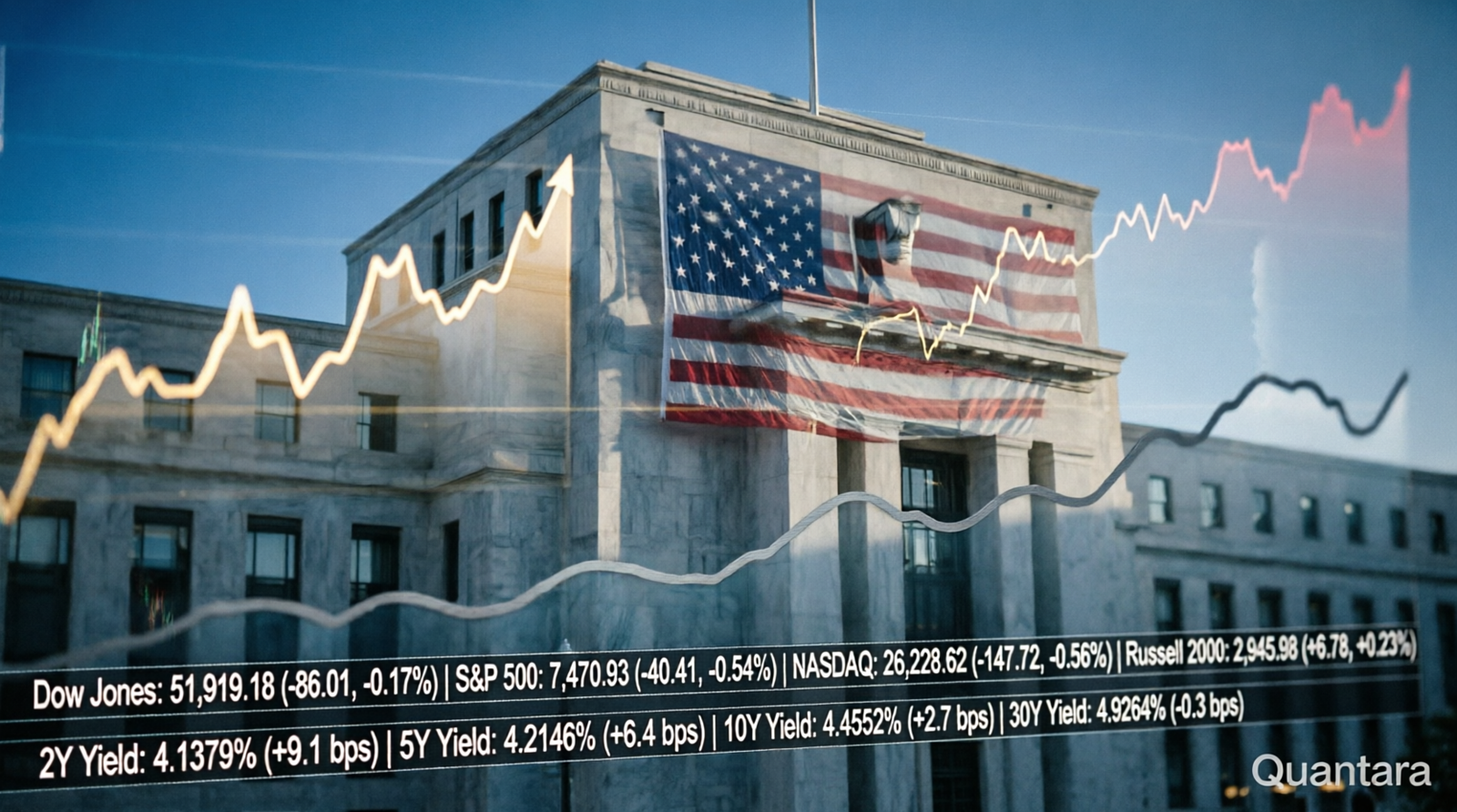
Following the FOMC announcement and Chair Warsh’s press conference:
- The S&P 500 fell 36 points to 7,476.
- Gold reversed sharply, falling $44 after previously trading approximately $30 higher on the session.
- U.S. 2-year Treasury yields climbed 8.6 basis points to 4.13%.
- EUR/USD declined roughly 60 pips to 1.1545 as the U.S. dollar strengthened broadly.
The immediate market reaction reflected a reassessment of future monetary policy expectations. Investors entered the meeting expecting the Federal Reserve to maintain interest rates, but many were positioned for a more accommodative tone regarding future policy easing. Instead, policymakers delivered a message centered on inflation persistence, policy discipline, and a continued commitment to achieving price stability.
Perhaps the most significant moment of the press conference came when Chair Warsh emphasized that inflation has been running “well ahead” of the Federal Reserve’s 2% objective. He followed by stating that committee members remain unanimous in their commitment to restoring price stability.
According to market participants, Warsh intentionally paused after saying, “This committee will deliver price stability,” underscoring the importance of the statement and reinforcing the Federal Reserve’s determination to keep inflation expectations anchored.
For investors, businesses, and consumers, the latest FOMC meeting provided a clear reminder that monetary policy remains focused on inflation first, even as economic growth continues and labor market conditions remain relatively stable.
Key Takeaways From the Latest FOMC Meeting
Several important themes emerged from the latest FOMC meeting.
First, policymakers remain confident that economic activity continues to expand at a solid pace. The Federal Reserve highlighted ongoing strength in productivity growth, capital investment, and labor market conditions. Employment gains continue to keep pace with workforce growth, while unemployment remains relatively stable.
Second, inflation remains the central concern. While progress has been made compared with the peak inflationary period experienced in previous years, policymakers acknowledged that inflation remains above target and continues to be influenced by supply-side pressures, including higher energy costs.
Third, the Federal Reserve’s updated projections show less confidence that inflation will quickly return to the 2% objective. Forecast revisions indicate that policymakers now expect inflation to remain elevated for longer than previously anticipated.
Finally, the projected path of the federal funds rate shifted higher, signaling that policymakers may need to maintain restrictive monetary policy for an extended period.
Taken together, these developments point to a Federal Reserve that remains patient, data dependent, and focused on achieving sustainable price stability rather than rushing toward rate reductions.

What Changed in the Federal Reserve’s Economic Outlook?
The most important information released alongside the FOMC statement came from the updated Summary of Economic Projections, commonly referred to as the SEP.
The SEP provides insight into how Federal Reserve officials view economic growth, inflation, unemployment, and the likely future path of interest rates.
Compared with previous projections, the latest forecast revealed three significant changes:
Slower Economic Growth
Federal Reserve officials revised economic growth expectations lower.
Real GDP growth is now expected to expand at a more moderate pace, reflecting the cumulative impact of restrictive monetary policy and ongoing uncertainty surrounding global economic conditions.
While growth remains positive and consistent with continued economic expansion, policymakers appear less optimistic about the pace of activity compared with earlier forecasts.
Importantly, the revised projections do not point toward recession. Instead, they suggest a gradual moderation in growth as the economy adjusts to higher borrowing costs and tighter financial conditions.
Higher Inflation Forecasts
Perhaps the most notable change involved inflation projections.
Both headline and core inflation forecasts were revised higher, indicating that policymakers believe inflationary pressures may prove more persistent than previously expected.
This revision reflects several factors:
- Elevated energy prices.
- Ongoing supply-side disruptions.
- Resilient consumer demand.
- Continued wage growth.
- Geopolitical uncertainty.
The higher inflation outlook helps explain why policymakers simultaneously raised their projected path for interest rates.
Higher Interest Rate Expectations
The projected federal funds rate moved higher across much of the forecast horizon.
This adjustment indicates that policymakers believe maintaining restrictive monetary policy may be necessary to ensure inflation returns sustainably to target.
For financial markets, this was arguably the most important takeaway from the entire meeting.
Interest rate expectations influence borrowing costs, equity valuations, corporate investment decisions, mortgage rates, and currency markets. Even modest changes in projected policy rates can have significant implications across asset classes.
Why Markets Reacted Immediately
Although the Federal Reserve did not raise interest rates, markets reacted as if financial conditions had effectively tightened.
The reason is straightforward.
Markets are forward-looking. Investors care less about today’s interest rate decision and more about the future path of monetary policy.
Prior to the meeting, expectations had gradually shifted toward the possibility of additional policy easing over time. However, the combination of higher inflation forecasts and a higher projected federal funds rate forced investors to reassess those assumptions.
Treasury yields moved higher because bond investors began pricing in a more restrictive policy outlook.
The U.S. dollar strengthened because higher interest rates generally increase the attractiveness of dollar-denominated assets.
Gold declined because rising real yields tend to reduce the appeal of non-income-producing assets.
Equity markets weakened because higher discount rates can place pressure on stock valuations, particularly within growth-oriented sectors.
While the market moves were not extreme, they represented a meaningful adjustment to expectations regarding the future direction of Federal Reserve policy.
Chair Warsh’s Message: Price Stability Remains the Priority
A key theme throughout Chair Warsh’s press conference was the Federal Reserve’s commitment to restoring price stability.
Unlike previous periods when policymakers focused heavily on providing forward guidance, Warsh emphasized that current conditions require flexibility and data dependence.
He noted that forward guidance is not particularly well suited to the current environment, reflecting the unusually high level of uncertainty surrounding inflation, global developments, and economic activity.
This comment is important because it signals that future policy decisions will remain highly dependent on incoming economic data rather than pre-committed policy paths.
Investors hoping for a clear roadmap regarding future interest rate adjustments received little additional guidance.
Instead, policymakers reinforced a framework centered on three principles:
- Data dependence.
- Price stability.
- Policy flexibility.
The message was straightforward: the Federal Reserve will respond to evolving economic conditions rather than predetermined expectations.
Inflation Forecasts Move Higher Across the Projection Period
The inflation outlook was the central story of this FOMC meeting and the primary reason markets interpreted the overall message as more restrictive than anticipated.
Federal Reserve policymakers increased their projections for both headline and core inflation, acknowledging that price pressures have proven more persistent than expected. While inflation has moderated significantly from the peaks experienced during the post-pandemic period, progress toward the Federal Reserve’s 2% target appears slower than previously forecast.
Updated projections now show Personal Consumption Expenditures (PCE) inflation remaining elevated before gradually moving toward target over the forecast horizon. Core PCE inflation, which excludes food and energy prices and is closely monitored by policymakers, also remains above the desired level for longer than expected.
This matters because inflation expectations play a critical role in monetary policy decisions. If businesses and consumers begin expecting higher inflation over longer periods, those expectations can become embedded in wage negotiations, pricing decisions, and investment planning.
The Federal Reserve wants to avoid that outcome.
Chair Warsh repeatedly emphasized that inflation remains “well ahead” of the Committee’s objective, reinforcing that policymakers view inflation control as their primary responsibility.
Several factors continue contributing to inflationary pressures:
Energy Prices
Energy markets remain vulnerable to geopolitical developments, particularly tensions in the Middle East. Higher energy costs often filter through the economy by increasing transportation, manufacturing, and production expenses.
Consumer Demand
Despite higher borrowing costs, consumer spending has remained relatively resilient. Strong household balance sheets and continued employment growth have helped support demand across many sectors.
Labor Market Tightness
Although labor market conditions have moderated from exceptionally tight levels, wage growth remains supportive of household income and spending. This dynamic can create ongoing inflationary pressures within service industries.
Supply-Side Constraints
Certain sectors continue experiencing supply disruptions that contribute to elevated prices. These supply-side influences are particularly challenging because monetary policy cannot directly resolve them.
The combination of these factors explains why Federal Reserve officials remain cautious about declaring victory over inflation.
Understanding the Federal Funds Rate Projections
One of the most closely watched components of every FOMC meeting is the projected path of the federal funds rate.
Although Chair Warsh confirmed that he did not personally submit dot plot projections, he encouraged participants to continue providing them as a valuable tool for understanding policymaker expectations.
The updated projections indicate a higher expected policy rate across much of the forecast horizon compared with previous estimates.
For investors, the significance extends beyond the specific numbers themselves.
A higher projected federal funds rate suggests several important conclusions:
- Policymakers expect inflation to remain elevated.
- Additional monetary restraint may still be required.
- Future rate reductions could occur more gradually than markets previously expected.
- Financial conditions may remain restrictive for an extended period.
The federal funds rate serves as the foundation for borrowing costs throughout the economy. Changes in policy expectations influence:
- Mortgage rates
- Corporate borrowing costs
- Treasury yields
- Bank lending rates
- Credit card interest rates
- Commercial real estate financing
- Equity valuations
Even when rates remain unchanged, adjustments to future expectations can significantly affect financial markets.
That dynamic was evident immediately following the FOMC announcement as Treasury yields moved higher and risk assets came under pressure.
Economic Growth Remains Resilient
Despite the focus on inflation, the Federal Reserve’s assessment of economic growth remained constructive.
The Committee noted that economic activity continues expanding at a solid pace. Productivity growth remains healthy, business investment is supportive, and labor market conditions continue to provide a foundation for ongoing expansion.
This combination presents a unique challenge for policymakers.
Historically, inflation often declines rapidly when economic growth weakens significantly. In the current environment, however, the economy continues demonstrating resilience despite elevated interest rates.
Several factors are supporting growth:
Strong Business Investment
Capital expenditures remain relatively healthy as companies continue investing in technology, automation, and productivity improvements.
Productivity Gains
Improving productivity can help offset inflationary pressures while supporting economic output. Policymakers specifically highlighted productivity growth as a positive development.
Stable Employment Conditions
Job creation continues broadly matching workforce growth, helping maintain labor market stability without generating excessive unemployment.
Consumer Spending
Consumers remain active participants in the economy despite higher financing costs.
The result is an economy that continues growing even as monetary policy remains restrictive.
While growth forecasts were revised modestly lower, policymakers do not appear concerned about an imminent recession.
Instead, the Federal Reserve’s baseline outlook remains consistent with slower but continued expansion.
Labor Market Conditions Remain Stable
Employment remains one of the strongest pillars supporting the U.S. economy.
The Federal Reserve noted that job gains continue to keep pace with labor force growth and that unemployment has changed little.
This assessment is important because the labor market plays a central role in the Federal Reserve’s dual mandate.
The central bank is responsible for promoting:
- Maximum employment
- Price stability
In many policy cycles, achieving one objective requires sacrificing progress on the other. Today, policymakers are attempting to bring inflation lower while maintaining labor market strength.
So far, that balance has largely been achieved.
Although hiring activity has moderated from exceptionally strong levels, employment conditions remain healthy by historical standards.
The latest projections suggest unemployment may drift modestly higher over time, but officials do not foresee a significant deterioration in labor market conditions.
This outlook supports the possibility of a soft landing, where inflation gradually declines without triggering a severe economic slowdown.
What the New Projections Mean for Investors
For investors, the updated projections provide several important signals.
First, the Federal Reserve remains committed to fighting inflation.
Second, interest rates may remain elevated for longer than many market participants anticipated earlier in the year.
Third, policymakers continue viewing the economy as fundamentally resilient despite tighter financial conditions.
These conclusions create both opportunities and risks across asset classes.
Equities
Higher interest rates generally place pressure on valuation multiples, particularly for growth-oriented sectors.
Companies with strong earnings growth, healthy balance sheets, and pricing power may continue outperforming in a higher-rate environment.
Fixed Income
Higher Treasury yields can create attractive opportunities for income-focused investors.
At the same time, expectations for fewer or slower rate cuts may limit near-term price appreciation in longer-duration bonds.
Commodities

Commodity markets remain sensitive to inflation expectations, global demand conditions, and geopolitical developments.
Gold’s post-FOMC decline reflected the influence of rising real yields and a stronger U.S. dollar.
Foreign Exchange
The dollar benefited from the perception that U.S. interest rates may remain higher for longer.
Currency markets will likely continue responding to relative differences in monetary policy expectations among major central banks.
Federal Reserve Task Forces Could Shape Future Policy
One of the more underappreciated developments from Chair Warsh’s remarks involved the creation of several new Federal Reserve task forces.
These groups will examine important aspects of policymaking and institutional operations.
The announced task forces include:
Productivity
A review of productivity trends and their implications for economic growth and inflation.
Inflation Framework
An assessment of how the Federal Reserve measures and responds to inflation dynamics.
Communications
A review of how policymakers communicate decisions and economic assessments to markets and the public.
Data Sources
An examination of the data used to support economic forecasting and policy decisions.
Jobs and Fed Framework
A review of employment-related metrics and broader labor market analysis.
Balance Sheet Policy
An evaluation of asset holdings, reserve management, and long-term balance sheet strategy.
These initiatives may eventually influence future policy frameworks, communication strategies, and even elements of the Summary of Economic Projections.
While changes are unlikely to occur immediately, the creation of these task forces signals a willingness to continuously improve the Federal Reserve’s analytical toolkit.
Key Risks to the Economic Outlook
Although the baseline outlook remains constructive, several risks could alter the path of monetary policy.
Persistent Inflation
If inflation remains elevated longer than projected, policymakers may need to maintain restrictive policy for an extended period.
Geopolitical Developments
Conflicts and geopolitical tensions can disrupt energy markets, supply chains, and global trade flows.
Economic Slowdown
Growth could weaken more rapidly than expected if consumers or businesses reduce spending.
Financial Market Volatility
Sharp adjustments in asset prices could tighten financial conditions and affect economic activity.
Labor Market Weakness
A meaningful deterioration in employment conditions could force policymakers to reassess the balance between inflation and growth risks.
The Federal Reserve remains highly data dependent because these risks remain difficult to forecast with precision.
What Could Change the FOMC Outlook?
Future policy decisions will depend on incoming data rather than predetermined commitments.
Several developments could influence future FOMC decisions:
- Sustained improvement in inflation data.
- Slower economic growth.
- Rising unemployment.
- Changes in financial conditions.
- Energy price developments.
- Global economic trends.
If inflation declines more rapidly than expected, policymakers may gain flexibility to adjust policy accordingly.
Conversely, if inflation remains stubbornly high, restrictive policy could remain in place longer than markets currently anticipate.
The Federal Reserve has made it clear that future decisions will be guided by evidence rather than assumptions.
Conclusion
The latest FOMC meeting did not deliver a change in interest rates, but it provided meaningful updates regarding the Federal Reserve’s outlook for inflation, economic growth, and monetary policy.
While economic activity continues expanding at a solid pace and labor market conditions remain stable, inflation remains above the Federal Reserve’s target and continues to represent the primary challenge facing policymakers.
The updated Summary of Economic Projections revealed higher inflation forecasts, slower growth expectations, and a higher projected path for the federal funds rate. Together, these revisions suggest that monetary policy may remain restrictive for longer than many investors anticipated.
Market reactions reflected this reality. Treasury yields moved higher, the U.S. dollar strengthened, equities weakened modestly, and gold reversed earlier gains as investors adjusted expectations for future policy easing.
Perhaps most importantly, Chair Warsh reinforced a message that has become increasingly clear throughout the policy cycle: the Federal Reserve remains committed to restoring price stability and will continue making decisions based on incoming economic data rather than market expectations.
As inflation, growth, and labor market conditions evolve, future FOMC meetings will remain central to understanding the direction of interest rates and the broader economic outlook.
Frequently Asked Questions
What did the FOMC decide regarding interest rates?
The FOMC maintained the target range for the federal funds rate at 3.50% to 3.75%, leaving policy unchanged while continuing to monitor economic conditions.
Why did markets react negatively if rates were unchanged?
Markets focused on the updated projections and policy outlook rather than the rate decision itself. Higher inflation forecasts and a higher projected rate path led investors to reassess expectations for future easing.

What is the federal funds rate?
The federal funds rate is the interest rate at which banks lend reserve balances to one another overnight. It serves as the Federal Reserve’s primary monetary policy tool.
Why is inflation still a concern?
Inflation remains above the Federal Reserve’s 2% objective. Policymakers believe ongoing supply-side pressures, energy costs, and resilient demand continue contributing to elevated price growth.
What does a higher projected rate path mean?
It suggests policymakers expect interest rates to remain elevated for longer, reflecting concerns that inflation could take additional time to return to target.
What should investors watch going forward?
Investors should monitor inflation reports, labor market data, economic growth indicators, Treasury yields, and future FOMC communications for clues regarding the direction of monetary policy.