




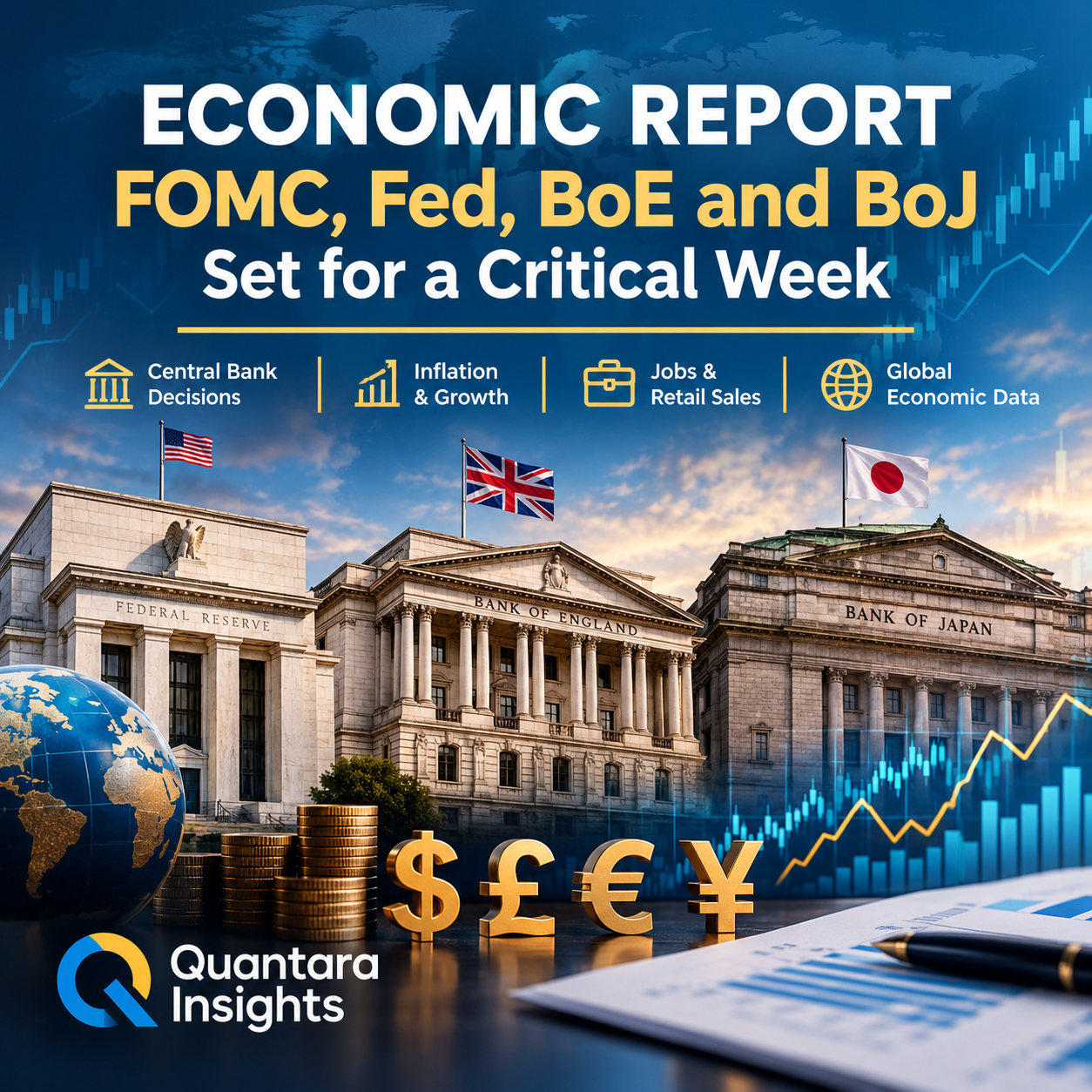

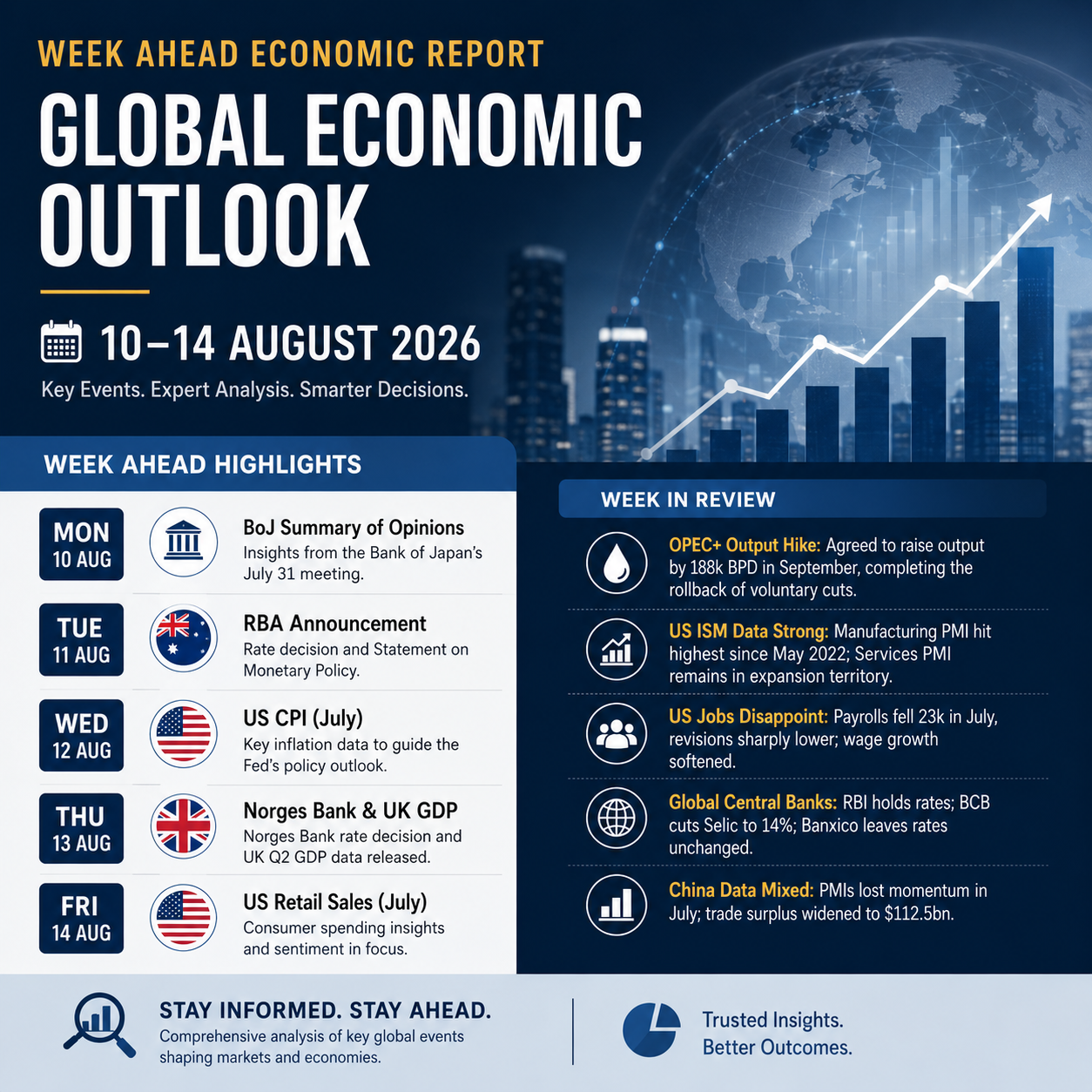
The Economic Report for 10–14 August 2026 focuses on a busy week of central-bank decisions, inflation data, growth figures and consumer activity across the major economies. The main events include US CPI, US Retail Sales, the Reserve Bank of Australia (RBA), the Bank of Japan’s Summary of Opinions, UK GDP, Norges Bank, US PPI and preliminary University of Michigan sentiment data.
Markets will be particularly focused on the latest CPI and Inflation figures because they could influence expectations for future interest-rate decisions. The RBA will also publish its latest Statement on Monetary Policy, while the US data calendar provides several important indicators for assessing the strength of economic activity.
The broader Economic Report also follows several important developments from the previous week, including US employment data, ISM manufacturing and services surveys, Chinese trade figures, OPEC production policy, Canadian employment, Brazilian monetary policy and inflation releases from Sweden and Mexico.
Week Ahead: Key Economic Events
The following calendar highlights the main events covered in this Economic Report:
| Day | Key Economic Events |
|---|---|
| Monday | BoJ Summary of Opinions |
| Tuesday | RBA Announcement and Statement on Monetary Policy |
| Wednesday | German Final Inflation, IEA OMR, OPEC MOMR, US CPI |
| Thursday | Norges Bank, UK GDP, US PPI |
| Friday | Eurozone Employment and GDP, US Retail Sales, University of Michigan Sentiment |
The week is likely to be dominated by CPI, Inflation, central-bank communication and consumer spending data. While each release provides a different view of the economy, the combination should offer a broader picture of growth, price pressures and monetary-policy conditions.
Week Ahead

BoJ Summary of Opinions: Focus on Future Rate Policy
The Bank of Japan will release its Summary of Opinions from the 31 July meeting, when policymakers kept the policy rate unchanged at 1.00%.
The decision was widely expected, although the vote contained an important point of disagreement. The decision passed by 8–1, with board member Takata dissenting and proposing a 25-basis-point increase.
Consequently, the key focus of this part of the Economic Report will be the degree of support for additional monetary tightening among other members of the Board.
Investors will be looking for evidence that Takata’s position was an isolated view or whether other policymakers also believe that a rate increase could become appropriate sooner rather than later.
Particular attention is likely to be paid to the BoJ’s assessment of the Inflation outlook and the economic conditions that could justify another rate increase.
The central bank has indicated that it intends to continue adjusting rates in response to economic and price developments and financial conditions. However, policymakers have also stressed that the timing and pace of future moves will depend on the risks surrounding the central bank’s baseline outlook.
The Summary of Opinions may therefore provide useful information about the internal debate surrounding the next stage of policy normalisation.
Governor Ueda has previously indicated that the BoJ does not necessarily need to wait until inflation has fully stabilised at the 2% target before making a policy decision. He has also highlighted the possibility of inflation overshooting previous expectations.
This makes the inflation discussion particularly relevant for this week’s Economic Report.
The BoJ’s latest Outlook Report slightly increased its real GDP forecasts for FY2026 and FY2027. At the same time, it lowered its core CPI forecast for FY2026 while raising its projection for FY2027.
The central bank continues to expect underlying inflation to reach a level consistent with its 2% target between the second half of FY2026 and FY2027.
Markets will therefore be watching for any additional comments on upside price risks, domestic demand and the potential impact of geopolitical developments on energy prices and economic activity.
RBA Announcement: Inflation Remains the Main Focus
The Reserve Bank of Australia is expected to leave its Cash Rate unchanged at 4.35% at its upcoming meeting.
The RBA will also publish its quarterly Statement on Monetary Policy, which will provide updated forecasts for economic growth, employment and inflation.
This will be one of the most important central-bank events in this week’s Economic Report because the RBA must balance persistent price pressures against signs that some parts of the economy are beginning to cool.
The RBA paused at its June meeting after three consecutive rate increases. Although policymakers kept rates unchanged, the accompanying communication retained a relatively firm tone.
The central bank warned that further rate increases could still be required if necessary, particularly because headline and underlying Inflation remained above the RBA’s medium-term target range.
The RBA also highlighted risks from oil supply disruptions and continued to emphasise that incoming economic data would determine the appropriate policy response.
Governor Michele Bullock maintained that message during the subsequent press conference, noting that inflation remained too high and that the Board continued to be concerned about price pressures.
At the same time, the latest Australian data provide reasons for the RBA to remain patient.
Australian CPI and Inflation Data
Australia’s latest quarterly CPI figures showed some cooling in price pressures.
Headline CPI increased by 0.6% quarter on quarter, below expectations of 0.7% and down from the previous 1.4% reading.
On an annual basis, headline CPI was 3.9%, compared with expectations of 4.1% and a previous reading of 4.1%.
The RBA’s preferred Trimmed Mean CPI measure was also slightly softer than expected. It increased 0.8% quarter on quarter compared with expectations of 0.9%, while the annual rate was 3.6% against expectations of 3.7%.
However, underlying inflation remained above the RBA’s 2–3% medium-term target range.
That means the latest Economic Report does not necessarily point to an immediate change in policy direction. Instead, the data provide the RBA with some additional room to assess whether inflation is moving sustainably lower.
Employment conditions have also remained relatively firm.
Australian employment increased by 76.3k in June, significantly above the expected 15k increase and the previous 40.3k gain. The unemployment rate remained at 4.4%.
The labour-market data suggest that the economy continues to have some resilience, potentially giving the RBA flexibility to maintain restrictive policy while it evaluates the inflation outlook.
The central bank has previously indicated that it sees value in using the room created by earlier rate increases to assess how the economy is performing.
The main issue for the RBA will therefore be whether the latest decline in Inflation is sufficient to justify a less restrictive policy stance or whether underlying price pressures remain too persistent.
US CPI: Key Inflation Test for the Federal Reserve
US CPI will be one of the most closely watched releases in the week ahead.
Consensus expectations point to a 0.1% month-on-month increase in headline CPI for July, following a previous decline of 0.4%.
Core CPI is expected to rise by 0.2% month on month after showing no change in the previous reading.
The US Economic Report will therefore provide another important test of whether inflationary pressures are stabilising or beginning to accelerate.
Pantheon Macroeconomics expects core goods prices to increase by approximately 0.18%, which would represent the strongest monthly gain since September.
The consultancy expects some of that pressure to come from higher prices for selected consumer goods.
At the same time, several services categories could provide an offset.
Airline fares are expected to decline, while accommodation prices and auto insurance premiums could also continue to ease.
Energy goods are expected to provide another significant downward influence on headline CPI.
Food-at-home prices are forecast to increase modestly.
The composition of the report will be just as important as the headline figure. A moderate headline CPI reading could still contain areas of persistent underlying price pressure, while a stronger headline figure could be partly driven by volatile components.
This makes the details of the July Inflation report important for assessing the Federal Reserve’s policy outlook.
The range of potential outcomes is considered unusually wide, while the August inflation report may ultimately have a greater influence on the Federal Reserve’s September decision.
For this reason, investors may treat the July CPI report as one part of a broader sequence of inflation data rather than as a standalone signal.
Norges Bank: Inflation Data and Rate Expectations
Norges Bank is expected to leave its policy rate unchanged at 4.25% at its 13 August meeting.
At its June meeting, the central bank indicated that another rate increase could be necessary at one of the forthcoming meetings.
Its policy-rate path had shown a potential peak of 4.50% by the end of 2026.
However, recent inflation data have complicated that outlook.
June core inflation was 2.7% year on year, significantly below Norges Bank’s projection of 3.3%.
The latest Economic Report will therefore pay close attention to the bank’s interpretation of inflation developments and the potential timing of another increase.
July CPI-ATE, the core inflation measure closely followed by Norges Bank, is expected to rise modestly to 2.8% year on year from 2.7%.
Even if the figure increases, it would remain below the central bank’s previous forecast.
Food inflation has also shown signs of slowing, which could provide additional evidence that some of the earlier price pressures are moderating.
Nevertheless, the central bank is unlikely to abandon its cautious approach.
The key question is whether recent weakness in underlying Inflation proves durable or whether price pressures begin to strengthen again later in the year.
UK GDP: Growth Momentum in Focus
UK GDP data will provide another important part of the week’s Economic Report.
The June and second-quarter figures are expected to show continued growth, although momentum is likely to have slowed compared with earlier periods.
Services were the primary contributor to growth in May, meaning the June figures will be watched closely for evidence that broader economic momentum is weakening.
Recent PMI commentary pointed to strong cost pressures, subdued demand and business uncertainty as factors affecting economic activity.
For the second quarter, quarterly GDP growth is expected at approximately 0.4%, down from 0.6% previously.
Annual growth is expected at around 1.2%, compared with 1.3%.
The Bank of England will naturally monitor the GDP data, although Inflation remains a major policy consideration.
The interaction between economic growth and price pressures will be important.
A softer growth reading could strengthen expectations for a more accommodative monetary-policy approach, particularly if inflationary pressures continue to moderate.
However, policymakers will remain attentive to second-round effects and any signs that inflation could become persistent.
US PPI: Another Test of Price Pressures
US Producer Price Index data will follow the CPI release and provide another perspective on inflationary pressures within the US economy.
PPI can be particularly relevant when markets are assessing whether cost pressures faced by businesses are likely to feed into consumer prices.
For the Economic Report, the combination of CPI and PPI will be more informative than either release viewed in isolation.
If consumer inflation remains contained while producer prices also show limited pressure, expectations for a gradual easing in inflation could strengthen.
Conversely, renewed increases in producer prices could reinforce concerns that price pressures may remain persistent.
The Federal Reserve’s policy outlook will therefore depend on the broader pattern of data rather than a single monthly figure.
US Retail Sales: Consumer Spending Takes Centre Stage
US Retail Sales will be one of the most important economic activity indicators of the week.
Consensus expectations point to a 0.2% month-on-month increase in headline retail sales.
Core retail sales are also expected to increase by 0.2%, following a previous decline of 0.2%.
The control group is expected to rise by 0.3%, although that would represent a slowdown from the previous 0.5% increase.
The US Economic Report will use the retail-sales figures as an important measure of consumer resilience.
Consumer spending remains central to the US economic outlook. Strong retail activity can indicate that households continue to support growth, while weaker spending could point to increased sensitivity to borrowing costs, inflation and employment conditions.
The Chicago Fed’s July advance retail trade summary expects retail and food-services sales excluding autos to increase by around 0.1% month on month on a seasonally adjusted basis.
When adjusted for inflation, the measure is expected to be unchanged.
This distinction is important.
Nominal retail sales can increase simply because prices are higher. Real spending provides a better indication of the quantity of goods and services consumers are purchasing.
Consequently, the US Retail Sales report should be considered alongside the latest CPI data.
If nominal sales rise while real spending remains weak, the result could suggest that higher prices are accounting for a significant portion of the increase.
If both nominal and inflation-adjusted activity strengthen, the evidence for resilient consumer demand would be stronger.
University of Michigan Sentiment
The preliminary University of Michigan consumer sentiment survey for August will provide another indication of household confidence.
Although sentiment data do not directly measure spending, they can provide useful information about consumers’ perceptions of income, employment, prices and the broader economic outlook.
The survey will also be relevant to the Economic Report because consumer expectations can influence spending behaviour.
Inflation expectations are especially important.
If households become more concerned about future price increases, this can affect purchasing decisions, wage negotiations and broader economic expectations.
For policymakers, a combination of resilient spending and elevated inflation expectations could make the policy environment more complicated.
Week in Review
OPEC JMMC Review
OPEC-7 agreed to increase production by a nominal 188k barrels per day in September, in line with expectations.
The decision completes the rollback of voluntary production cuts introduced in 2023.
The group maintained a cautious view of the supply outlook, citing concerns surrounding attacks on energy infrastructure and disruptions to international shipping routes.
Energy-market conditions remain relevant to the broader Economic Report because changes in oil prices can influence headline Inflation across major economies.
The group also maintained its focus on compliance and compensation cuts.
Members that have produced above agreed levels are expected to compensate through reductions by December 2026.
The broader layer of approximately 2 million barrels per day of OPEC+ cuts remains in place through the end of the year.
The next meeting of the seven producers is scheduled for 6 September, while the next JMMC meeting is scheduled for 4 October.
Chinese RatingDog PMI Review
Chinese RatingDog PMI data showed a notable loss of momentum in July.
Manufacturing PMI declined to 50.9 from 51.7, marking a four-month low, although it remained above the 50 threshold separating expansion from contraction.
New orders continued to rise, while new export orders returned to expansion.
The services sector was considerably weaker.
Services PMI fell to 50.4 from 54.1, marking the slowest expansion since September 2024.
Softer domestic demand weighed on new business, while 12-month business confidence fell to its lowest level since February 2020.
The Composite PMI declined to 50.8 from 53.6.
The RatingDog surveys were somewhat more resilient than official Chinese NBS surveys, which showed contraction in both manufacturing and non-manufacturing.
Nevertheless, the broader message from this part of the Economic Report is that Chinese economic momentum softened during July.
The data will keep attention focused on whether additional policy measures are required to support domestic demand during the second half of 2026.
US Treasury Quarterly Refunding Review
The US Treasury maintained coupon auction sizes for the next quarter, in line with expectations and previous guidance.
The Treasury continues to anticipate maintaining nominal coupon and floating-rate note auction sizes for at least the next several quarters.
According to the latest market assessment, dealers generally expect nominal coupon auction sizes to increase at some point in 2027.
The Treasury Advisory Committee also discussed the possibility that higher coupon issuance could become appropriate during fiscal year 2027.
Treasury Inflation-Protected Securities auction sizes were unchanged.
The August 30-year reopening is set at USD 8 billion, while the September 10-year reopening is set at USD 19 billion and the October new 5-year issue at USD 26 billion.
Next week, the Treasury is scheduled to offer USD 125 billion of coupon securities to refund approximately USD 96.3 billion of privately held notes and bonds maturing on 15 August.
The resulting new cash raised is expected to be approximately USD 28.7 billion.
The refunding schedule includes USD 58 billion of three-year notes on Tuesday, USD 42 billion of 10-year notes on Wednesday and USD 25 billion of 30-year bonds on Thursday.
The Treasury also expects to maintain benchmark bill auction sizes in the near term.
A short-dated Cash Management Bill may be issued around the end of August, followed by adjustments to bill issuance during September and October as fiscal cash-flow requirements change.

The Treasury continues to assume a USD 950 billion cash balance at the end of September and now expects the Treasury General Account to peak at approximately USD 1.05 trillion in late October.
RBI Review
The Reserve Bank of India kept its Repurchase Rate unchanged at 5.25% in a unanimous decision and maintained a neutral policy stance.
Governor Malhotra said economic growth continued to be supported by domestic demand, while greater clarity on inflation was needed before further policy action.
The RBI raised its FY2027 real GDP growth forecast to 6.7% from 6.6%.
Its FY2027 CPI forecast was revised to 5.0% from 5.1%.
The central bank also stated that it would ensure sufficient liquidity within the banking system while continuing to address excessive volatility and speculative activity in the foreign exchange market.
The RBI’s communication pointed to uncertainty and limited urgency to adjust interest rates immediately.
The next stage of policy will depend heavily on incoming growth and Inflation data.
Brazilian Central Bank Review
Brazil’s central bank reduced the Selic rate by 25 basis points to 14%, in line with expectations.
The decision was unanimous.
The central bank said economic indicators pointed toward a gradual moderation in activity, although economic conditions remained resilient.
The labour market remained tight, while inflation had slowed but remained above the upper limit of the target.
Underlying inflation measures had eased to slightly below the upper limit.
The central bank maintained a cautious assessment of the inflation outlook, noting that risks remained elevated and skewed to the upside.
Fiscal policy developments remain an important consideration for monetary policy and financial markets.
The bank also highlighted the risk of longer-term inflation expectations becoming less firmly anchored.
The overall message from this part of the Economic Report is that further easing may proceed cautiously, particularly while inflation expectations remain elevated.
US ISM Manufacturing PMI Review
US manufacturing activity accelerated strongly in July.
The ISM Manufacturing PMI increased to 55.6 from 53.3, exceeding expectations of 54.0.
The reading represented the strongest level since May 2022.
Production rose sharply to 58.5 from 52.2, while new orders increased to 56.7 from 56.0.
Employment returned to expansion at 52.8 from 49.7, marking its first expansionary reading in 33 months.
Order backlogs and export orders also strengthened.
However, price pressures remained elevated.
The Prices Paid Index stood at 71.1, above expectations of 70.3 but below the previous 73.0 reading.
The survey pointed to continued supply constraints, while respondents cited strong demand linked to semiconductors, data centres and defence spending.
At the same time, manufacturers continued to report concerns about steel, aluminium, tariffs, energy costs and geopolitical developments.
The manufacturing survey therefore provided a mixed signal for the Economic Report: growth momentum was strong, but elevated input costs could complicate the Inflation outlook.
US ISM Services PMI Review
The ISM Services PMI was little changed at 54.1 in July compared with 54.0 previously.
Although the reading was slightly below expectations of 54.5, it remained comfortably above the 50 level associated with expansion.
Business Activity increased to 59.1 from 55.4.
New Orders also strengthened, rising to 57.2 from 55.1.
The employment component was weaker, falling back into contraction at 47.4 from 51.2.
This suggests that service-sector activity remained resilient even as employment growth showed signs of softness.
The Prices Paid Index increased to 70.3 from 67.7, highlighting continued cost pressures.
The survey remained consistent with ongoing economic expansion, although the employment and price components point to a more complicated outlook.
For the Economic Report, the combination of strong business activity and elevated prices is significant.
It suggests that the Federal Reserve must continue balancing economic resilience against the need to bring Inflation back toward its target.
Swedish Inflation Review
Swedish inflation was somewhat stronger than expected.
CPIF stood at 0.7% year on year, compared with expectations of 0.6%.
The monthly decline was also less pronounced than expected at -0.3%.
The data were stronger than the Riksbank’s forecast but did not necessarily imply a major change to the broader policy outlook.
Markets continued to price the possibility of a 25-basis-point increase by year-end.
The Swedish data add another example to the wider Economic Report theme: central banks continue to monitor whether inflation is moving sustainably toward target before adjusting monetary policy.
Banxico Review
Mexico’s central bank left its policy rate unchanged at 6.50% in a unanimous decision.
Banxico maintained forward guidance suggesting that rates are likely to remain at their current level for the foreseeable future.
The central bank said the balance of risks surrounding the inflation outlook remained tilted to the upside.
Both headline and core CPI are expected to decline during the forecast period, although the decline is expected to be slower than previously anticipated.
Banxico now expects headline inflation to converge toward its target during Q4 2027, compared with its previous expectation of Q2 2027.
The decision reinforces the importance of inflation persistence in determining the pace of future monetary-policy changes.
Chinese Trade Data Review
Chinese trade data were stronger than expected in July.
The trade surplus widened to USD 112.5 billion, compared with expectations of USD 107.0 billion.
The figure was lower than the USD 125.62 billion surplus recorded in June.
Exports increased by 23.9% year on year, exceeding expectations of 22.2%.
Imports increased by 27.5%, slightly below expectations of 27.9% but remaining strong.
Export performance continued to benefit from technology demand and the front-loading of shipments ahead of potential tariffs and other trade restrictions.
The data provide a relatively positive element within the China section of the Economic Report, although the earlier PMI data indicate that domestic demand and services activity remain areas to monitor.
Canadian Jobs Review
Canadian employment increased by 75k in July, substantially above expectations of 12.5k.
The previous month showed an increase of 18.2k.
The composition of the report was also relatively strong, with full-time employment rising by 38.6k and part-time employment increasing by 36.6k.
The unemployment rate unexpectedly declined to 6.4% from 6.5%, even as the participation rate increased to 65.1%.
The strength of the labour-market data should allow the Bank of Canada to maintain a patient policy approach.
The central bank continues to assess competing risks, including inflationary pressures related to energy and geopolitical developments alongside downside risks associated with trade uncertainty.
The latest employment data reduce the immediate need for additional monetary support.
However, the sustainability of the employment gains remains an important question.
US Jobs Report Review
The US employment report was weaker than expected in July.
Headline payrolls fell by 23k compared with expectations for an increase of 91k.
Two-month net revisions totalled approximately -103k.
The scale of the revisions was particularly notable because the June payroll estimate had been based on a lower-than-usual proportion of survey responses.
The internal details of the report also showed weakness.
Government employment declined by 53k, while leisure and hospitality payrolls fell by 40k.
Private payrolls increased by only 30k compared with expectations for 78k.
The unemployment rate declined slightly to 4.1% from expectations of 4.2%, although the participation rate also decreased by 0.1 percentage point to 61.4%.
Wage growth was softer than expected.
Average hourly earnings increased by only 0.1% month on month compared with expectations of 0.3%.
The annual growth rate declined to 3.2% from expectations of 3.5%.
The weaker labour-market data shifted market expectations toward a more accommodative Federal Reserve outlook.
However, the Fed’s policy focus remains heavily influenced by Inflation.
This means the upcoming US CPI and PPI reports could have a greater influence on September policy expectations than the jobs report alone.
The Federal Reserve will also receive the next PCE inflation report on 26 August, which remains particularly important because PCE is the central bank’s preferred inflation measure.
What Matters Most in This Economic Report?
The central theme of this week’s Economic Report is the interaction between inflation, consumer demand, labour-market conditions and monetary policy.
The most important releases can be grouped into four categories.
1. US Inflation
US CPI is likely to be one of the most market-sensitive releases.
The composition of the report will matter alongside the headline number.
2. Australian Monetary Policy
The RBA decision and Statement on Monetary Policy will provide updated information about Australia’s inflation and growth outlook.
3. US Consumer Spending
US Retail Sales will provide an important indication of whether consumers continue to support economic growth.
4. Global Growth
UK GDP, Chinese data, euro-area activity and Norges Bank policy developments will help shape the broader international outlook.
Taken together, these indicators should provide a more complete picture of the global economy than any single data point.
Economic Report: Key Takeaways for the Week
The most important points from this Economic Report are:
- US CPI is the primary inflation release to watch.
- US Retail Sales will provide a key test of consumer demand.
- The RBA is expected to keep its Cash Rate unchanged at 4.35%.
- Australia’s latest inflation data have cooled but remain above the RBA’s target range.
- The BoJ Summary of Opinions may reveal the degree of support for another rate increase.
- Norges Bank is expected to keep rates unchanged at 4.25%.
- UK GDP is expected to show slower quarterly growth.
- US PPI will provide another indication of producer-level price pressures.
- Chinese PMI data point to weaker momentum in domestic activity.
- US manufacturing activity strengthened significantly in July.
- US services activity remained in expansion despite softer employment conditions.
- Canadian employment was stronger than expected.
- US employment data were weaker than anticipated, with substantial payroll revisions.
- Energy-market developments remain relevant to the global Inflation outlook.
- Central banks continue to balance slowing inflation against resilient or uneven economic growth.
What to Watch After the Economic Report
The importance of the week’s data will extend beyond the individual releases.
For the Federal Reserve, the key question is whether Inflation is moving sufficiently close to target to allow greater flexibility in monetary policy.
The answer will depend on the combined trend in CPI, PPI, PCE, wages and labour-market conditions.
For the RBA, the question is whether Australian inflation is declining sufficiently to reduce the need for additional tightening.
For the BoJ, policymakers must determine whether inflation and wage dynamics justify another move away from its current policy setting.
For Norges Bank, recent inflation data below the bank’s projections may reduce the urgency of an immediate rate increase.
For the UK, the combination of slower growth and persistent inflation will remain central to the Bank of England’s policy considerations.
The global picture is therefore not defined by a single direction.
Some economies are showing resilient demand, while others are experiencing slower activity. Inflation is declining in several areas but remains above central-bank targets in important economies.

This makes incoming data particularly important as policymakers assess whether current interest-rate settings remain appropriate.
Frequently Asked Questions
What is the main focus of this Economic Report?
The main focus is the combination of US CPI, Inflation, US Retail Sales, RBA policy, central-bank decisions and major global economic indicators scheduled for 10–14 August 2026.
Why is US CPI important this week?
US CPI provides an important measure of consumer price changes and will help markets assess the direction of US inflation. The details of core and headline CPI can influence expectations for Federal Reserve policy.
What is the RBA expected to do?
The RBA is expected to leave its Cash Rate unchanged at 4.35%. The accompanying Statement on Monetary Policy will be important because it will provide updated economic and inflation projections.
Why are US Retail Sales important?
US Retail Sales provide an indication of consumer spending activity. Stronger-than-expected sales can suggest resilient household demand, while weaker results may point to increased pressure on consumers.
What does CPI mean?
CPI stands for Consumer Price Index. It measures changes in the prices consumers pay for a basket of goods and services and is widely used as an indicator of consumer inflation.
How does Inflation affect interest rates?
Persistent inflation can encourage central banks to maintain higher interest rates for longer or consider additional tightening. Lower and more stable inflation can give central banks greater flexibility to reduce rates.
What is the BoJ watching?
The Bank of Japan is monitoring inflation, economic activity, wages and financial conditions while assessing the appropriate timing and pace of future policy normalisation.
Why is UK GDP important?
UK GDP provides a broad measure of economic activity. The Bank of England considers growth alongside inflation, employment and other indicators when assessing monetary policy.
What could US Retail Sales show about the economy?
The data could provide additional information about the strength of consumer demand. The distinction between nominal and inflation-adjusted spending will be particularly useful when assessing the underlying trend.
Why is US PPI relevant after CPI?
PPI measures producer-level price changes. It can provide additional information about business input costs and potential price pressures that could eventually affect consumer prices.
What did the latest US jobs report show?
The latest US jobs report was weaker than expected, with payrolls falling by 23k and substantial downward revisions to previous employment figures. Wage growth was also softer than expected.
What is the broader message from this Economic Report?
The broader message is that central banks remain focused on the balance between inflation and economic activity. Some economies show resilient demand while inflation remains uneven and policymakers continue to rely heavily on incoming data.
Conclusion
This Economic Report for 10–14 August 2026 brings together several of the week’s most important economic and monetary-policy developments.
US CPI will be central to the inflation discussion, particularly following the weaker US employment report. The next US Retail Sales release will provide another important indication of whether consumer demand remains resilient.
The RBA meeting will also attract significant attention. Australian inflation has moderated, but underlying price pressures remain above the central bank’s medium-term target range. The latest Statement on Monetary Policy should therefore be important for understanding the RBA’s assessment of growth, employment and inflation.
Elsewhere, the BoJ Summary of Opinions may provide further insight into the debate over future Japanese rate increases, while Norges Bank will assess recent inflation data that have been softer than its previous forecasts.
UK GDP, US PPI, Chinese activity indicators, European growth data and consumer sentiment will add further information about the global economic environment.
Overall, the week’s data should help clarify whether the recent combination of slower inflation, uneven growth and changing labour-market conditions is becoming sufficiently established to influence monetary-policy expectations.
The central theme remains straightforward: Inflation, economic growth, employment and consumer demand will continue to determine the path of monetary policy across major economies.