







Table of Contents
- Week Ahead: The Key Economic Events
- Japan: GDP and Inflation Put BoJ Policy Back in Focus
- China: Activity Data Test the Strength of Domestic Demand
- Canada Inflation: BoC Patience Faces Another Test
- UK Jobs: Labour-Market Stability Meets Wage Pressure
- UK Inflation: The BoE’s Balancing Act Continues
- FOMC Minutes: The Main Rates Event of the Week
- Why Markets May Look Beyond the FOMC Minutes
- Riksbank: Inflation Risks Keep the Door Open
- PBoC LPR: China Expected to Favour Targeted Support
- Japanese Trade Balance: Exports and Energy Costs in Focus
- Australian Jobs: Measuring the Amount of Labour-Market Slack
- Japanese CPI: Another Test for BoJ Normalisation
- UK Retail Sales: Consumer Momentum Under Pressure
- Friday PMIs: The Global Growth Checkpoint
- UK PMIs: Growth Remains Modest
- Eurozone PMIs: Manufacturing Versus Services
- US PMIs: Growth, Prices and the Fed
- Week in Review: What Changed the Macro Picture?
- US Inflation: A More Balanced Signal
- US Retail Sales: Consumer Momentum Shows Signs of Cooling
- Norges Bank: A Hold With a Hawkish Option
- UK GDP: Stronger Headline, Mixed Details
- The Main Themes for Traders
- What Could Move FX Markets?
- What Could Move Bond Markets?
- Economic Report: The Policy Divide
- Why the Sequence of Data Matters
- Economic Report Outlook: What Matters Most
- The Bottom Line for the Week Ahead
- Frequently Asked Questions
- What is the most important event in this week’s Economic Report?
- When are the FOMC Minutes released?
- Why are UK Jobs data important?
- Why are the PMIs important?
- Which inflation reports matter this week?
- Could the FOMC Minutes change September rate expectations?
- What should traders watch in UK inflation?
- What does the Economic Report mean for the US dollar?
- Why is Japanese CPI important for the yen?
- What will the Friday PMIs tell investors?
- Conclusion
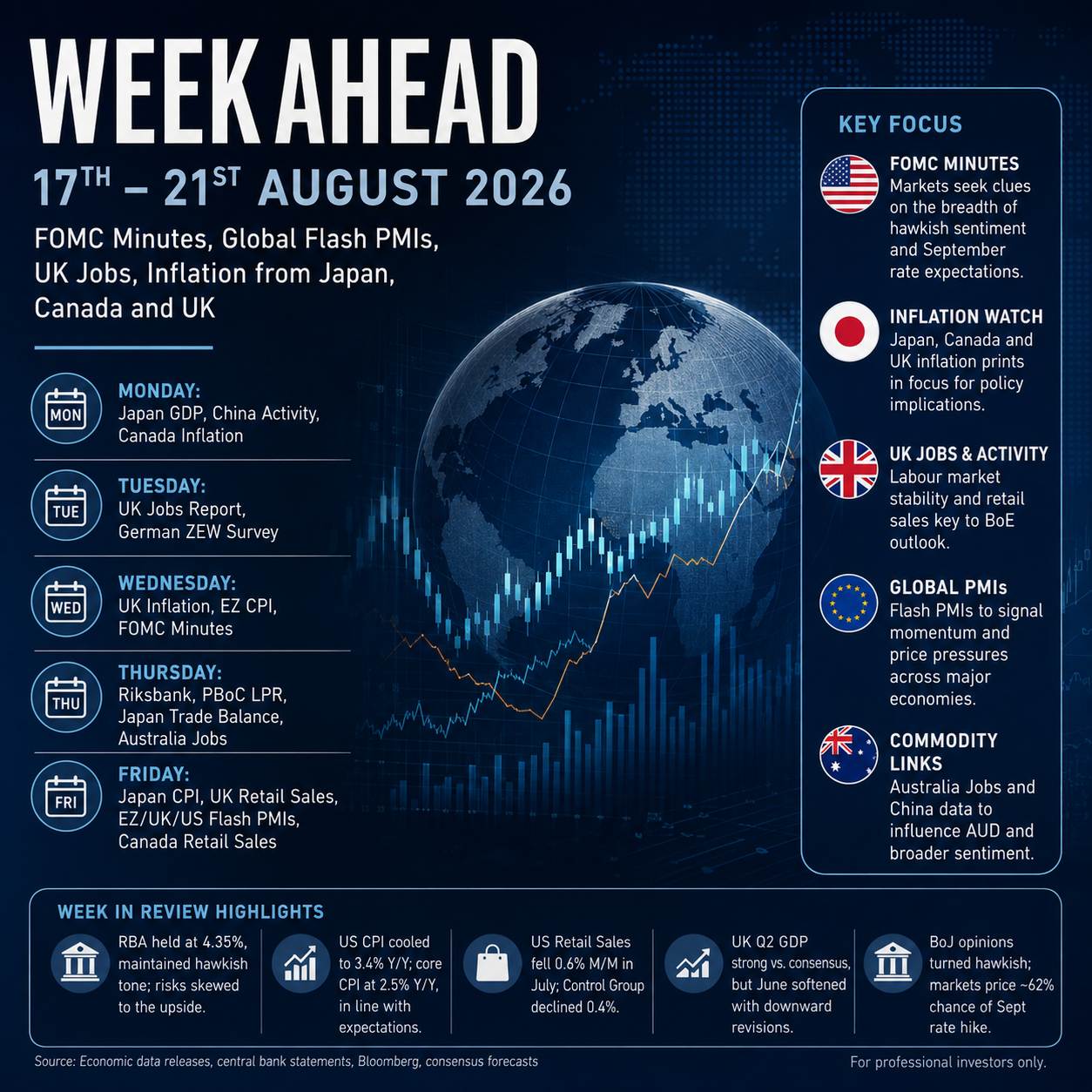
Economic Report — The week of August 17–21 brings a concentrated run of global economic data, with markets preparing for the July FOMC Minutes, flash PMIs, UK Jobs, inflation releases from Japan, Canada and the UK, and a series of central-bank decisions across the G10.
The calendar is unusually dense. Japan will open the week with preliminary second-quarter GDP and later publish trade and inflation data. China will release July activity figures, Canada will report July inflation, and the UK will provide labour-market and consumer-price updates. In Europe, traders will monitor German sentiment, the Riksbank and euro-area flash PMIs. Australia will publish employment data, while the US Federal Reserve will release the FOMC Minutes from its July meeting.
For markets, the central question is less about any single release and more about how the data alter the balance between inflation, growth and monetary policy.
The FOMC Minutes are likely to attract the greatest attention in the middle of the week, particularly because the July Federal Reserve meeting produced a three-way dissent in favour of a 25-basis-point rate increase. The minutes could therefore provide a clearer indication of how broad the hawkish argument was within the Committee.
The second major theme will be the global inflation picture. Canada and the UK will publish consumer-price data, while Japan’s CPI will help determine whether domestic price pressures are strengthening enough to keep the Bank of Japan on a normalisation path.
Friday then brings the PMIs for the US, UK and euro area, offering an early look at business activity and price pressures in August.
The result is a week in which rates, currencies and bond markets could respond to a series of competing signals rather than one dominant macroeconomic narrative.
Week Ahead: The Key Economic Events
The week’s main releases are spread across five trading sessions.
| Day | Key Economic Report Events |
|---|---|
| Monday | Japanese Q2 GDP, Chinese July activity data, Canadian July inflation |
| Tuesday | UK Jobs report, German ZEW survey |
| Wednesday | UK Inflation, euro-area final CPI, FOMC Minutes |
| Thursday | Riksbank decision, PBoC LPR, Japanese trade balance, Australian Jobs report |
| Friday | Japanese CPI, UK retail sales, UK/EZ/US PMIs, Canadian retail sales |
The sequencing matters.
Monday’s releases will establish the early-week growth and inflation tone. Tuesday shifts the focus toward the UK labour market. Wednesday is the key rates day, with UK inflation followed by the FOMC Minutes. Thursday brings several central-bank decisions and employment data, while Friday closes the week with the global PMI complex.
The broader Economic Report theme is therefore one of policy uncertainty. Some central banks are assessing whether inflation could require further tightening, while others are waiting for clearer evidence that price pressures are returning toward target.
Japan: GDP and Inflation Put BoJ Policy Back in Focus
Japan is one of the clearest examples of the interaction between growth and inflation in the week’s Economic Report.
Japanese GDP: Domestic Demand Remains Important
Preliminary second-quarter Japanese GDP is expected to show quarterly growth of around 0.5%, matching the previous quarter, with annualised growth forecast at approximately 2.0% compared with 1.8% previously.
Private consumption is expected to remain an important contributor, with household spending seen increasing by around 0.5%. Business investment is expected to moderate, while net exports are unlikely to provide a major contribution.
The composition of GDP will arguably matter more than the headline number.
A stronger domestic-demand performance would reinforce the argument that Japan’s economy is capable of absorbing a gradual withdrawal of monetary accommodation. A weaker consumption reading, by contrast, would provide the Bank of Japan with another reason to proceed cautiously.
The Japanese economy remains particularly sensitive to household purchasing power, import costs and the exchange rate. A weaker yen can support exporters but also raises the domestic cost of imported energy and other goods.
That makes the interaction between GDP and inflation particularly important.
A solid GDP result followed by another firm inflation reading would create a relatively straightforward policy signal: growth remains sufficiently resilient while price pressures remain relevant.
A weaker GDP result would complicate that interpretation.
Why Japanese GDP Matters for Markets
For currency markets, the main question is whether the data reinforce expectations for further BoJ normalisation.
A stronger-than-expected GDP release could increase expectations for another rate increase later in the year, particularly if accompanied by evidence of resilient domestic demand.
A softer figure would not necessarily remove the possibility of further tightening, but it could reduce the urgency attached to the timing.
The Economic Report therefore starts the week with Japan at the intersection of growth, inflation and monetary-policy expectations.
China: Activity Data Test the Strength of Domestic Demand
China will release July industrial production, retail sales and fixed-asset investment data on Monday.
Industrial production is expected to slow to around 4.8% year over year from 5.3%, while retail sales are expected to improve to approximately 1.6% from 1.0%. Fixed-asset investment is expected to remain weak.

The key issue is the divergence between industrial activity and domestic demand.
China’s manufacturing and industrial sectors have shown greater resilience than parts of the domestic economy. Consumer demand and investment remain more challenging areas, particularly where property-related weakness and cautious household behaviour continue to weigh on activity.
A stronger retail-sales number would help ease concerns about domestic demand.
A weaker release would reinforce expectations that policymakers may need to maintain or increase targeted support.
The likely policy response remains important for global markets. Broad-based monetary easing is not necessarily the default expectation. Policymakers have increasingly relied on targeted measures and fiscal support, while pressure on bank margins can limit the scope for aggressive reductions in lending rates.
For global investors, China’s data matter beyond the renminbi.
Weak Chinese activity can affect commodity demand, regional currencies, European exporters and broader global growth expectations.
Canada Inflation: BoC Patience Faces Another Test
Canadian inflation is one of the week’s most important releases because it will help determine whether the Bank of Canada can remain patient on interest rates.
The previous inflation report showed headline CPI easing to 2.8% year over year, while core measures also moderated. The preferred Common, Median and Trimmed measures averaged around 2.10%, down from approximately 2.27%.
That represented progress toward the Bank of Canada’s 2% inflation objective.
The question now is whether that improvement continues.
Energy Prices Add an Important Risk
Energy prices remain a key source of uncertainty.
Higher energy costs can feed directly into headline inflation and indirectly into transportation, production and household expenses. At the same time, uncertainty around international trade continues to pose risks to Canadian economic growth.
This creates a difficult policy balance.
If inflation continues to moderate, the BoC can afford to remain on hold while assessing the impact of previous policy tightening and trade uncertainty.
If inflation reaccelerates, particularly in the underlying measures, markets could begin assigning a greater probability to another rate increase.
The distinction between headline and underlying inflation will therefore be particularly important.
A temporary energy-driven increase would carry a different policy implication from a broad-based acceleration in core prices.
What the Canadian Inflation Report Could Mean
A soft Inflation report would support the case for patience.
A stronger report could push rate expectations higher, particularly if the increase extends beyond energy-related components.
The Canadian dollar could also respond to the report through changes in interest-rate expectations, although broader risk sentiment and oil prices remain important external variables.
UK Jobs: Labour-Market Stability Meets Wage Pressure
The UK Jobs report arrives Tuesday and will be closely watched by the Bank of England and sterling markets.
Recent labour-market data have pointed toward stabilisation rather than a sharp deterioration. Vacancy numbers have eased, while the broader labour market has lost some momentum.
The next release should therefore be judged against the trend rather than a single monthly movement.
The UK labour market has become especially important because wage growth remains one of the main variables in the Bank of England’s inflation assessment.
Wage Growth Is the Critical Component
For policymakers, the headline employment number is only part of the story.
Wage growth provides a potentially more timely indication of whether inflation could become embedded through second-round effects.
If wage growth continues to moderate, the BoE has more room to maintain its current policy stance while monitoring the economy.
If wage pressures remain unusually firm, the argument for caution becomes stronger.
The distinction is important because inflation can remain elevated even while economic growth slows. Policymakers must determine whether high inflation is temporary, externally driven or becoming entrenched through domestic wage and services-price pressures.
The UK Jobs report therefore has implications beyond employment.
It will feed directly into expectations for UK interest rates, gilt yields and sterling.
UK Inflation: The BoE’s Balancing Act Continues
UK inflation is the key domestic release on Wednesday.
The previous reading showed a mixed picture, with headline inflation slightly softer than expected while core inflation remained more persistent.
That combination left the Bank of England facing the same difficult policy trade-off: inflation is not sufficiently subdued to remove concern, but economic activity is not strong enough to make additional tightening an obvious choice.
Utility Prices Could Lift the Headline Rate
The July inflation figure is expected to be influenced by the latest Ofgem utility-price-cap adjustment.
That means a higher headline rate would not necessarily indicate a broad-based deterioration in domestic inflation.
Markets will therefore focus closely on core inflation and services-related measures.
The distinction between temporary administered-price effects and persistent domestic inflation is central to the Bank of England’s policy debate.
If underlying price pressures ease, the argument for an extended hold becomes stronger.
If core and services inflation remain sticky, the hawkish side of the debate will retain leverage.
UK Inflation and Sterling
Sterling is likely to respond primarily through interest-rate expectations.
A stronger-than-expected Inflation reading could push back expectations for policy easing or strengthen expectations that rates will need to remain restrictive for longer.
A softer report could have the opposite effect.
However, the market reaction should not be viewed in isolation. UK activity data, wage growth, energy prices and external geopolitical developments will continue to influence the broader policy outlook.
FOMC Minutes: The Main Rates Event of the Week
The FOMC Minutes are the centrepiece of the week’s Economic Report.
The Federal Reserve left the federal funds target range unchanged at 3.50%–3.75% at its July meeting. The decision was approved by a 9–3 vote, with Beth Hammack, Neel Kashkari and Lorie Logan preferring a 25-basis-point increase.
The dissent itself was significant.
The minutes will therefore be read for evidence of whether the hawkish position was confined to those three policymakers or whether a broader group considered a rate increase but ultimately preferred to wait.
Why the FOMC Minutes Matter
The July statement described economic activity as expanding at a solid pace, with strong productivity and capital investment. It also said job gains had kept pace with the workforce and acknowledged that inflation remained elevated relative to the Fed’s 2% objective.
The minutes can provide considerably more detail than the statement.
Markets will be looking for discussion around:
- Inflation persistence
- Supply-side price pressures
- Energy costs
- Labour-market conditions
- Productivity
- Capital investment
- Financial conditions
- The appropriate level of policy restriction
- The case for a September rate increase
The three dissenters argued for a hike.
The key question is how many other policymakers shared some of their concerns.
The September FOMC Question
The minutes arrive with an important limitation: they describe the July meeting, while markets are already incorporating subsequent economic data.
That creates the possibility of a relatively muted market reaction.
Since the July meeting, investors have received additional inflation and employment information.
If the newer data suggest inflation is moderating while labour-market conditions are softening, traders may be reluctant to assign too much weight to hawkish language from a meeting that occurred several weeks earlier.
The Federal Reserve’s official calendar confirms that the July 28–29 meeting is scheduled to be followed by the release of its minutes on August 19, with the next policy meeting scheduled for September 15–16.
That makes the September decision highly data dependent.
The Three Dissenters
The three dissenting votes deserve close attention.
A broader discussion supporting their position could suggest that the July decision was closer than the 9–3 vote alone implies.
Conversely, if the minutes show that most policymakers viewed the July decision as appropriate and saw little immediate need for tightening, markets could interpret the dissent as a relatively isolated position.
This distinction matters for Treasury yields and the US dollar.
A more hawkish set of FOMC Minutes could lift front-end yields and support the dollar.
A more balanced discussion could reduce expectations for near-term tightening.
Why Markets May Look Beyond the FOMC Minutes
The market could ultimately treat the FOMC Minutes as less important than usual because of their backward-looking nature.
The July meeting took place before several important economic releases.
That creates a familiar problem for investors: the minutes can reveal what policymakers thought at the time, but they cannot fully incorporate information that arrived afterward.
This is particularly important when the economic data are changing quickly.
If inflation continues to moderate and employment data weaken, traders may focus more heavily on the next round of releases than on the July discussion.
The minutes will still matter because they establish the range of views within the Committee.
But they are unlikely to settle the September policy question on their own.
Riksbank: Inflation Risks Keep the Door Open
The Riksbank is expected to leave its policy rate unchanged at 1.75% at the August meeting.
The central bank faces a familiar dilemma.
Inflation has been higher than some expectations, but it has not moved far enough from the target to force an immediate policy response.
The likely message is therefore one of caution.
Policymakers may acknowledge the upside risks while maintaining the current rate.
For Swedish markets, the most important signal may be whether the Riksbank changes its assessment of inflation persistence.
A stronger warning about upside risks could support expectations for a future hike.
A more balanced assessment would reinforce the expectation that rates remain unchanged for longer.
No new macroeconomic forecasts are expected at this meeting, increasing the importance of the wording surrounding the policy outlook.
PBoC LPR: China Expected to Favour Targeted Support
The People’s Bank of China is expected to maintain its one-year Loan Prime Rate at 3.00% and five-year LPR at 3.50%.
The decision would fit with a policy approach focused on targeted liquidity and fiscal measures rather than aggressive broad-based monetary easing.
Domestic demand remains a concern, but banks are also dealing with pressure on net interest margins.
That limits the attractiveness of substantial LPR reductions.
For global markets, the key question is therefore not simply whether the LPR changes.
It is whether policymakers signal a stronger commitment to supporting domestic demand.
A steady LPR accompanied by targeted measures could be interpreted as policy continuity.
A surprise rate cut would represent a more substantial signal about concern over economic momentum.
Japanese Trade Balance: Exports and Energy Costs in Focus
Japan’s trade data will provide another view of the economy’s external position.
Exports are expected to remain supported by automobiles, semiconductors and global technology demand.
At the same time, elevated energy costs continue to increase the import bill.
The trade balance therefore needs to be interpreted alongside the exchange rate.
A weaker yen can support export competitiveness but also increases the local-currency cost of imported energy.
That creates an important connection between trade, inflation and monetary policy.
The combination of resilient exports and stronger domestic inflation would be particularly relevant for the BoJ.
Australian Jobs: Measuring the Amount of Labour-Market Slack
Australia’s employment report is due Thursday.
Employment is expected to increase by roughly 20,000–25,000 in July after a much stronger previous reading.
The unemployment rate is expected around 4.4%–4.5%, while participation is expected to remain close to 67%.
The headline employment number may therefore look relatively soft compared with the previous month.
But that does not automatically imply a major deterioration.
Monthly employment data can be volatile, making the trend more important than an individual observation.
Underemployment Could Become More Important
Recent increases in underemployment deserve attention.
If employment growth slows while unemployment remains relatively stable, underemployment can provide an early indication that spare capacity is building in the labour market.
The employment-to-population ratio can also help analysts assess whether labour-market conditions are genuinely weakening.
For the Reserve Bank of Australia, the key issue is whether labour-market conditions are consistent with the inflation outlook.
A resilient labour market could keep inflation risks elevated.
A clear deterioration could reduce pressure for additional tightening.
Japanese CPI: Another Test for BoJ Normalisation
Japanese CPI closes the week on the inflation side.
Core CPI is expected to rise to around 1.8% year over year from 1.6%.
The market will focus on whether inflation is moving sustainably toward the Bank of Japan’s 2% target.
Recent Tokyo inflation data and higher energy costs have increased attention on the possibility of renewed price pressure.
Why Japanese Inflation Matters
Japan’s monetary-policy regime is still in a normalisation phase compared with other developed economies.
The BoJ therefore has to determine whether current inflation reflects temporary cost pressures or a broader improvement in underlying price dynamics.
A stronger-than-expected CPI report could increase expectations for another rate increase.
A weaker report would give policymakers more time.
The interaction with wages remains important as well.
For a durable inflation cycle, policymakers want evidence that price increases are becoming embedded in domestic demand rather than being driven only by imported costs.
UK Retail Sales: Consumer Momentum Under Pressure
UK retail sales will provide another indication of household demand.
The previous BRC reading moderated more than expected, with the organisation describing sales growth as modest.
The summer heatwave may have affected consumer behaviour, while some activity may have been distorted by major sporting events and changes in spending patterns.
That makes the July retail-sales release difficult to interpret in isolation.
Still, a sustained moderation in consumer activity would be significant.
The Bank of England needs to balance inflation against economic growth.
If household demand weakens while inflation pressures ease, the argument for maintaining or eventually reducing restrictive policy becomes stronger.
If consumers remain resilient, policymakers have more room to keep policy restrictive while monitoring inflation.
Friday PMIs: The Global Growth Checkpoint
The PMIs are the final major component of the week’s Economic Report.
Flash purchasing managers’ indices provide one of the earliest monthly indications of business conditions.
They are particularly useful because they cover both manufacturing and services and include qualitative information from businesses about orders, employment, costs and prices.
The August PMIs will therefore help determine whether the global economy is maintaining momentum during the second half of the year.
UK PMIs: Growth Remains Modest
The UK flash PMI series showed an improvement in market conditions during July, although the overall level of activity remained relatively subdued.
August data will help determine whether that improvement can continue.
The UK economy is facing several competing influences.
On one side, stronger business expectations and improved market conditions can support activity.
On the other, high temperatures, cautious consumers and elevated costs can restrain household demand.
For the Bank of England, the price components of the PMI are particularly important.
If input and output-price pressures continue to ease, policymakers receive more evidence that inflationary pressure may be fading.
If price pressures reaccelerate, the inflation debate becomes more difficult.
The PMIs therefore have a dual role: measuring growth and providing a timely inflation signal.
Eurozone PMIs: Manufacturing Versus Services
Eurozone manufacturing PMI is expected to edge up to approximately 52.0 from 51.9.
The services and composite readings were previously around 51.6 and 51.9 respectively.
The market will be watching whether improving manufacturing momentum can compensate for softer services activity.
Regional differences also matter.
Germany and France remain particularly important because of their size and influence on the euro-area economy.
A broad improvement across the region would support the view that the euro-area recovery is gaining traction.
A divergence in which manufacturing improves but services weaken would suggest that the recovery remains uneven.
PMI Prices Matter Too
Markets will also examine the price components.
If output prices and input costs rise, investors may reconsider the inflation outlook.
If price pressures continue to moderate, the European Central Bank has greater flexibility.
This is why the PMIs can have an impact on both growth expectations and rate markets.
US PMIs: Growth, Prices and the Fed
The US flash PMIs will arrive against the backdrop of the FOMC Minutes.
That makes their price and activity components particularly relevant.
A strong services reading would support the argument that the US economy remains resilient.
A weaker composite reading could reinforce concerns about slowing momentum.
But markets may be especially interested in employment and price indicators within the surveys.
The Federal Reserve is balancing two risks:
- Inflation remains above target.
- Labour-market and consumer momentum may be losing strength.
The PMIs can provide an early indication of which risk is becoming more important.
Week in Review: What Changed the Macro Picture?
The previous week also delivered several important signals that shape this Economic Report.
The Bank of Japan’s Summary of Opinions carried a relatively hawkish tone, with policymakers discussing risks from a weaker yen, higher oil prices and strong AI-related demand.
The Reserve Bank of Australia maintained its policy rate while keeping a cautious stance on inflation.
US CPI provided a more constructive inflation signal, with headline and core annual inflation easing.
Norges Bank kept rates unchanged while leaving the possibility of future tightening open.
UK GDP was stronger than expected in some respects, although the monthly breakdown and revisions provided a more mixed picture.
US retail sales, meanwhile, were significantly weaker than expected.
Taken together, the data point to a global economy where inflation is moderating unevenly while growth momentum is becoming less consistent.
US Inflation: A More Balanced Signal
US CPI was one of the most important recent releases for the Federal Reserve.
Headline CPI increased 0.1% month over month in July, while the annual rate eased to 3.4%.
Core CPI increased 0.2% month over month, while the annual rate declined to 2.5%.
The report did not provide the kind of upside inflation surprise that would immediately force markets to price a more aggressive Fed.
Energy prices declined during the month, while shelter remained an important contributor to the overall increase.
The result was broadly consistent with the view that inflation remains elevated but is not accelerating uncontrollably.
That matters for the September FOMC decision.
However, one inflation report is not enough to settle the policy debate.
The Federal Reserve’s own July statement continued to describe inflation as elevated relative to its 2% goal.
The next several inflation and labour-market reports will therefore remain important.
US Retail Sales: Consumer Momentum Shows Signs of Cooling
US retail sales fell 0.6% month over month in July, substantially weaker than expected.
Sales excluding autos declined 0.3%, while the Control Group also weakened.
The weakness was broad across several categories.
Nonstore retailers, motor vehicle and parts dealers, gasoline stations, and electronics and appliance stores all recorded declines.
Some categories did increase, including clothing and clothing accessories, health and personal care, miscellaneous retailers, and food services.
The key message was the loss of momentum at the start of the third quarter.
That matters because consumer spending remains central to the US growth outlook.
If the weakness proves temporary, the market may treat the report as a one-month correction.
If it continues, it could become increasingly relevant to Federal Reserve policy.
Norges Bank: A Hold With a Hawkish Option
Norges Bank maintained its policy rate at 4.25%.
The central bank acknowledged that slower inflation was welcome but stressed that inflation remained too high.
Core inflation had been below the Bank’s previous forecast, but policymakers were reluctant to conclude that the inflation outlook had fundamentally changed.
The message was therefore cautious.
The possibility of another rate increase remains open.
For markets, the lesson is similar to that of several other central banks: improving inflation data do not automatically produce an immediate policy shift.
Central banks increasingly want evidence that inflation is sustainably returning to target.
UK GDP: Stronger Headline, Mixed Details
UK second-quarter GDP was relatively firm against consensus expectations.
Services remained an important contributor, while manufacturing also received support from pharmaceuticals.
However, the monthly breakdown was less impressive, with June weaker than expected and earlier data revised down.
That distinction matters.

The overall quarterly number suggests that the economy is not collapsing.
The monthly details indicate that momentum may be less robust than the headline quarterly figure suggests.
For the Bank of England, this supports the argument for patience rather than an immediate change in policy direction.
The upcoming UK Jobs, Inflation, retail-sales and PMI releases will provide more information.
The Main Themes for Traders
The week’s Economic Report can be reduced to several central questions.
1. Is US Inflation Cooling Fast Enough?
The Federal Reserve does not need inflation to fall to 2% immediately.
It needs confidence that inflation is moving sustainably toward target.
The FOMC Minutes will reveal how policymakers viewed the balance of risks at the July meeting.
The next data releases will then determine whether those views remain relevant.
2. Is the UK Labour Market Losing Enough Heat?
The UK Jobs report will help determine whether wage pressures are likely to moderate further.
A softer labour market would help the BoE manage inflation without maintaining excessive policy restriction.
A resilient labour market could keep wage and services inflation elevated.
3. Are Global PMIs Confirming or Rejecting the Growth Slowdown?
The PMIs will offer a broad cross-check on economic activity.
If the US, UK and euro-area surveys all show improvement, recession concerns should remain limited.
If all three weaken simultaneously, the market could begin to reassess global growth expectations.
4. Is Inflation Becoming More Broad-Based?
The week’s Inflation data span several major economies.
Canada, the UK and Japan each face different domestic conditions.
Canada is balancing inflation against trade and growth risks.
The UK is dealing with sticky domestic price pressures.
Japan is assessing whether inflation can support continued monetary normalisation.
The common theme is persistence.
What Could Move FX Markets?
Foreign-exchange markets are likely to respond primarily through interest-rate expectations.
US Dollar
The dollar’s direction will depend heavily on the interpretation of the FOMC Minutes and subsequent US data.
A hawkish interpretation could support the dollar.
Evidence of softer growth and lower inflation could reduce expectations for additional tightening and weigh on the currency.
Sterling
Sterling faces a particularly busy week.
UK Jobs, UK Inflation, retail sales and the UK PMIs will all contribute to expectations for the Bank of England.
The most important combination would be wage moderation plus softer underlying inflation.
That would strengthen the case for patience or eventual easing.
Persistent wage and services inflation would support a more hawkish interpretation.
Japanese Yen
The yen will be sensitive to GDP and CPI.
Stronger domestic activity combined with firm inflation could increase expectations for BoJ tightening.
Weak GDP accompanied by softer inflation would reduce those expectations.
Canadian Dollar
The Canadian dollar will react to the inflation report, but oil prices remain an important secondary factor.
A stronger CPI release could support the currency through higher rate expectations.
What Could Move Bond Markets?
Bond markets will be watching the same themes through the lens of central-bank policy.
US Treasuries are likely to be most sensitive to the FOMC Minutes.
The front end of the curve should remain particularly responsive to expectations for the September meeting.
Longer maturities may also respond to changes in inflation expectations, term premium and broader growth concerns.
UK gilts face a more complex combination of inflation and labour-market signals.
A weaker UK Jobs report followed by softer inflation could reinforce expectations that policy can remain restrictive without further tightening.
European bonds will respond to the PMI growth and price data alongside ECB expectations.
Economic Report: The Policy Divide
One of the most important themes this week is the growing divergence between central banks.
Japan is considering further normalisation.
Canada is assessing whether inflation progress is sufficient to remain patient.
Australia remains concerned about inflation.
The Nordic central banks continue to acknowledge upside risks.
The Bank of England is weighing sticky inflation against modest growth.
The Federal Reserve is assessing whether inflation remains sufficiently persistent to justify restrictive policy despite signs of softer activity.
China, meanwhile, is dealing with weak domestic demand and is expected to favour targeted support.
This divergence means global markets cannot be analysed through a single “risk-on” or “risk-off” framework.
Different currencies and bond markets are increasingly being driven by different domestic policy cycles.
Why the Sequence of Data Matters
The order of releases is important.
Monday’s Japan, China and Canada data will establish the initial tone.
Tuesday’s UK Jobs report will provide a first major test of sterling and UK rate expectations.
Wednesday is likely to be the most important session, with UK Inflation followed by the FOMC Minutes.
Thursday brings several central-bank and employment events.
Friday’s PMIs will provide a final test of the week’s growth narrative.
This sequencing can create significant intraday shifts.
For example, a softer UK Jobs report could initially weaken sterling, only for a stronger UK Inflation report to reverse part of the move.
Similarly, hawkish FOMC Minutes could initially support the dollar, while weaker US PMIs on Friday could moderate that reaction.
The week’s data therefore need to be read as a sequence rather than as isolated events.
Economic Report Outlook: What Matters Most
The central message for August 17–21 is that markets are entering a period of greater policy differentiation.
The US Federal Reserve remains focused on the inflation-growth balance.
The Bank of England is assessing wage and services inflation against modest economic momentum.
The Bank of Japan is evaluating whether stronger domestic price pressures justify further normalisation.
The Bank of Canada is assessing whether recent inflation progress can continue.
The Riksbank and Norges Bank are watching upside inflation risks.
The PBoC is balancing weak domestic demand against banking-sector constraints.
This creates several potential market catalysts.
The first is the breadth of hawkish sentiment revealed in the FOMC Minutes.
The second is whether UK Jobs data show further labour-market cooling.
The third is whether UK and Canadian Inflation reports confirm continued progress or reveal renewed price pressure.
The fourth is whether Friday’s PMIs show stronger or weaker business activity in August.
The Bottom Line for the Week Ahead
This week’s Economic Report is unusually concentrated, but the market does not have to choose between a growth story and an inflation story.
Both are developing simultaneously.
Inflation is generally below its earlier peaks but remains above target in several major economies.
Growth is still positive in many regions, but recent data suggest momentum is uneven.
Labour markets are cooling in some economies without showing the kind of deterioration normally associated with a severe downturn.
That combination leaves central banks in a difficult position.
The FOMC Minutes will be the week’s central policy event, particularly because of the three dissenting votes at the July meeting. The minutes should help investors assess how widespread the argument for tighter policy was within the Committee.
The UK Jobs report and UK Inflation data will determine whether the Bank of England’s current balancing act is becoming easier or harder.
Japan’s GDP and CPI will provide another test of the BoJ’s normalisation path.
Canada’s inflation report will determine whether recent disinflation is continuing.
And Friday’s PMIs will offer the most timely assessment of business conditions across the US, UK and euro area.
The most important takeaway is therefore not a single forecast.
It is the interaction between the data.
If inflation continues to moderate while activity weakens, markets could increasingly price a less restrictive policy environment.
If inflation remains sticky while growth holds up, central banks will have greater justification for keeping rates restrictive.
If the data diverge by country, monetary-policy divergence could become an even stronger driver of currencies and bonds.
For traders and investors, the week ahead is therefore about reading the policy signal beneath the headline numbers.
Frequently Asked Questions
What is the most important event in this week’s Economic Report?
The FOMC Minutes are likely to be the central rates event because the July Federal Reserve meeting produced three dissenting votes for a 25-basis-point rate increase. Markets will look for evidence of how broadly the hawkish view was shared.
When are the FOMC Minutes released?
The Federal Reserve’s calendar lists August 19, 2026, as the release date for the minutes from the July 28–29 FOMC meeting.

Why are UK Jobs data important?
UK Jobs data are important because employment, unemployment and wage growth influence the Bank of England’s assessment of domestic inflation pressure. Wage growth is particularly relevant when policymakers are evaluating potential second-round effects.
Why are the PMIs important?
PMIs provide an early monthly indication of business activity across manufacturing and services. Their employment and price components can also provide useful signals about labour demand and inflation pressure.
Which inflation reports matter this week?
The major inflation releases include Canadian CPI on Monday, UK CPI on Wednesday and Japanese CPI on Friday. Each has different implications for its respective central bank.
Could the FOMC Minutes change September rate expectations?
They could influence expectations, particularly if they reveal broader support for the three dissenters’ preference for a rate increase. However, the minutes are backward-looking, so subsequent inflation and labour-market data will remain important.
What should traders watch in UK inflation?
Traders should focus on the headline rate as well as core and services-related measures. The composition of the increase matters because temporary utility-price effects have different policy implications from persistent domestic inflation.
What does the Economic Report mean for the US dollar?
The US dollar will likely respond to changes in Federal Reserve rate expectations, particularly following the FOMC Minutes and subsequent US economic data. A more hawkish policy interpretation could support the dollar, while evidence of weaker growth and moderating inflation could reduce that support.
Why is Japanese CPI important for the yen?
Japanese CPI helps determine whether domestic inflation is moving sustainably toward the Bank of Japan’s target. A stronger reading could reinforce expectations for further monetary-policy normalisation.
What will the Friday PMIs tell investors?
The Friday PMIs will provide an early look at August business conditions in the UK, euro area and US. Investors will be watching both activity and price indicators for confirmation of the broader growth and inflation trends.
Conclusion
The August 17–21 calendar brings one of the more closely watched combinations of monetary-policy and macroeconomic releases of the month.
The Economic Report is dominated by the FOMC Minutes, but the surrounding data may ultimately be just as important.
Japan’s GDP and CPI will shape expectations for the BoJ. Canada’s inflation report will test the case for policy patience. The UK’s UK Jobs and Inflation releases will influence expectations for the Bank of England. The Riksbank, PBoC and Australian employment report add further policy and growth signals.
The week then concludes with the PMIs, giving markets a timely view of August activity and price pressures.
The common thread is uncertainty over how quickly inflation will return to target while economic growth remains resilient enough to avoid a sharper slowdown.
For markets, that means the key question is not simply whether an individual number beats or misses expectations.
It is whether the combined evidence changes the path of monetary policy.
That will remain the central theme across rates, currencies and global risk assets as the second half of 2026 progresses.