








Economic Report coverage for the week of September 21–25, 2026 centres on a broad range of global economic and monetary-policy developments. China, the US, global PMIs, major central banks, Japanese and Australian data, and developments in international trade will all be important for financial markets.
The week also includes the scheduled meeting between Chinese President Xi Jinping and US President Donald Trump, making the China-US economic relationship one of the central international themes. Trade, tariffs, technology restrictions, critical minerals, agricultural purchases and broader geopolitical issues are expected to remain important considerations.
At the same time, the latest PMIs will provide an updated view of private-sector activity across several major economies. Manufacturing and services indicators will be closely watched for evidence of whether economic momentum is holding up as businesses continue to deal with elevated input costs, energy prices, labour expenses and uncertainty surrounding global trade.
Several central banks are also scheduled to announce policy decisions, including Norges Bank, the Swiss National Bank, Riksbank and Banxico. Japan and Australia will provide additional data on manufacturing, services and labour-market conditions.
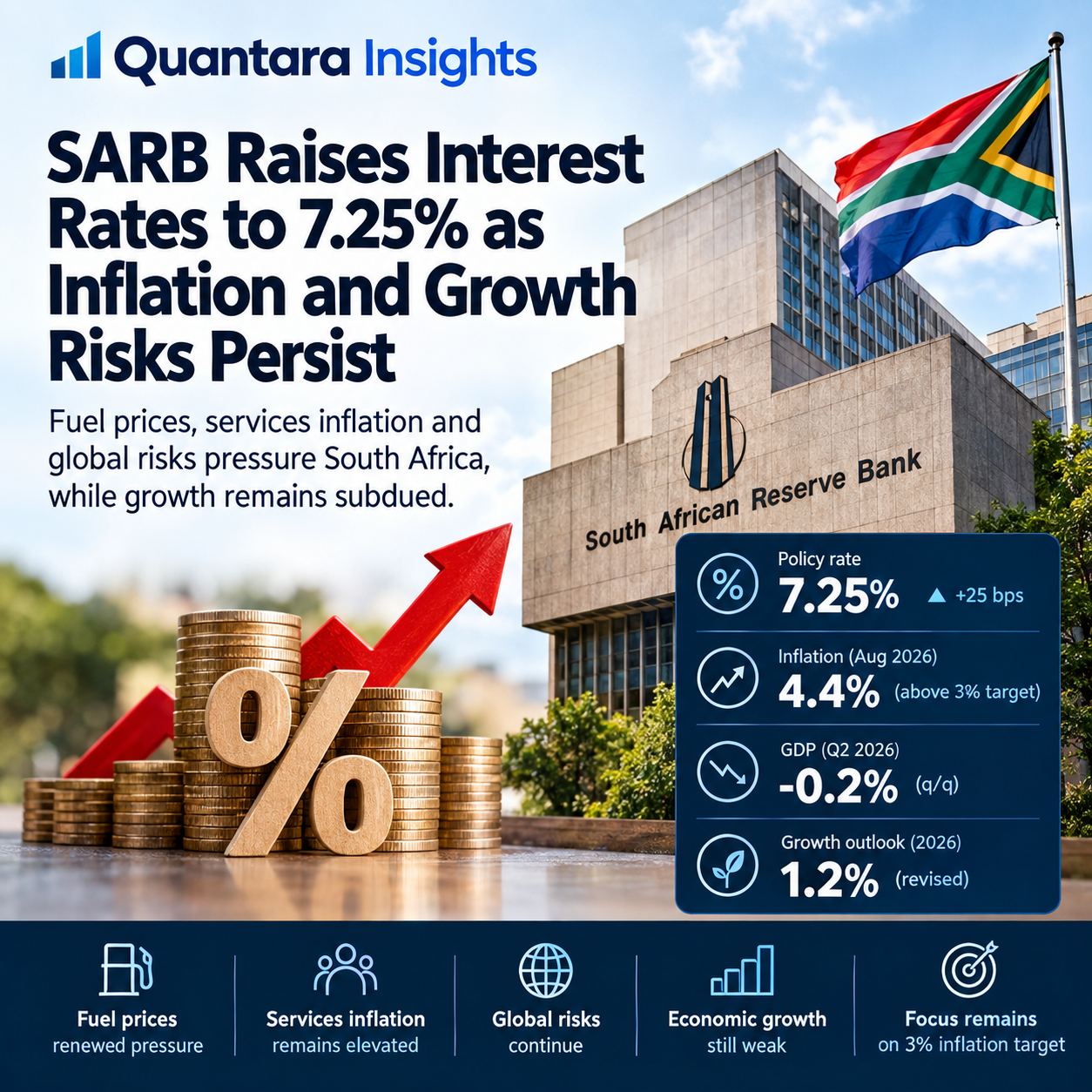
For South African markets, the SARB’s September monetary policy announcement will be an important domestic event. Inflation, inflation expectations and the latest growth data will all be relevant to the Monetary Policy Committee’s assessment of the balance between price stability and economic activity.
This Economic Report therefore focuses first on the major international developments before turning to the South African monetary-policy outlook and the factors that could influence the SARB decision.
Economic Report: Key Global Themes for the Week Ahead
The global calendar for September 21–25 contains several developments with the potential to influence expectations for growth, inflation and interest rates.
The main themes are:
- China’s September Loan Prime Rate decision
- The latest global Flash PMIs
- The Xi-Trump meeting in Washington
- US economic data and Federal Reserve expectations
- Policy decisions from several major central banks
- Japanese manufacturing and services activity
- Australian employment data
- Developments in global inflation and energy costs
- The latest Chinese economic activity indicators
- The South African Reserve Bank’s monetary policy decision
The interaction between these events will be particularly important. Markets are not assessing individual data releases in isolation. Instead, investors are looking at whether the latest information points towards stronger or weaker economic growth, persistent inflationary pressure or changing expectations for monetary policy.
The PMIs will therefore be important because they provide a relatively timely indication of business activity, while central-bank decisions will show how policymakers are responding to the latest inflation and growth environment.
China will remain another major focus. The country’s domestic demand picture has remained uneven, while the upcoming meeting between Xi Jinping and Donald Trump introduces another layer of uncertainty around trade, technology and critical supply chains.
The US will also remain central to the global outlook because American economic activity and monetary policy have significant implications for global financial conditions, currencies, bond yields and emerging markets.
China: LPR Decision and the Domestic Growth Picture
China’s Loan Prime Rate decision is scheduled for Monday and will provide an early indication of whether policymakers are prepared to adjust borrowing costs in response to the domestic economic environment.
Expectations are for the People’s Bank of China to maintain the one-year LPR at 3.00% and the five-year LPR at 3.50%.

A further decision to keep both rates unchanged would extend the period of stable benchmark lending rates. The lack of an LPR reduction would also reinforce the view that policymakers are currently relying on other forms of targeted support and liquidity management rather than broad-based reductions in benchmark lending rates.
Domestic demand remains an important consideration.
Chinese policymakers continue to face the challenge of supporting economic activity while managing pressure on financial institutions and maintaining an appropriate monetary-policy environment.
The latest activity data presented a mixed picture.
Industrial production accelerated to 5.2% year on year in August, above expectations of 4.8% and higher than the previous 4.5%. The performance reflected continued strength in several areas of manufacturing, particularly high-tech and digital production.
Retail sales, however, increased by only 0.4% year on year, below expectations of 0.8%. This points to a different dynamic on the consumer side, where household demand remains less convincing.
Fixed-asset investment also remained weak, while the unemployment rate unexpectedly increased to 5.3%.
The combination of relatively strong industrial output and weaker consumer demand highlights the uneven nature of the Chinese recovery.
For the global economy, this distinction matters. China is a major source of demand for commodities, manufactured goods and industrial inputs, while its position within global supply chains means that changes in Chinese production can have international effects.
The latest data also showed continued strength in emerging industries. High-tech manufacturing and digital product manufacturing output increased strongly, providing evidence that newer areas of the economy continue to contribute to industrial activity.
However, the weakness in retail sales remains an important issue.
A sustained improvement in domestic consumption would provide a broader foundation for growth, reducing reliance on industrial production and external demand. Conversely, continued weakness in household spending could increase pressure on policymakers to provide additional support.
The LPR decision will therefore be assessed alongside the broader policy response rather than viewed in isolation.
China-US Relations: Xi and Trump Set for Washington Meeting
One of the most closely watched events of the week will be the scheduled meeting between Chinese President Xi Jinping and US President Donald Trump on Thursday.
Trade will be a central issue.
The two sides are expected to discuss the future of the existing tariff arrangements, Chinese purchases of US agricultural products and Boeing aircraft, access to Chinese rare earths and critical minerals, and US restrictions on technology exports.
The meeting comes against the background of a broader effort to manage the economic relationship between the world’s two largest economies.
The trade relationship has implications well beyond the US and China. Tariffs and restrictions can influence production costs, supply chains, corporate investment decisions and the prices of goods and industrial inputs.
Critical minerals are particularly important because they are used across a wide range of industries, including advanced manufacturing and technology.
Technology restrictions will also remain an important part of the discussion.
Both countries have increasingly focused on the strategic implications of advanced technologies, including artificial intelligence. The economic relationship is therefore no longer limited to traditional trade in goods and services.
Technology access, semiconductor supply chains, AI development and strategic industrial capacity have become increasingly important components of the broader economic relationship.
Taiwan is another issue expected to feature in the wider discussions, alongside geopolitical developments involving Iran, Russia and the flow of dual-use goods.
From a market perspective, the key issue will be whether the meeting produces evidence of greater stability in the bilateral relationship or whether significant disagreements remain unresolved.
Any developments involving tariffs, technology restrictions or critical minerals could have implications for companies and industries exposed to international supply chains.
The broader significance for the global economy lies in whether the two countries can establish a more predictable framework for their economic relationship.
For investors, businesses and policymakers, predictability can be almost as important as the specific terms of individual trade agreements.
Global PMIs: A Timely Measure of Economic Activity
The latest Flash PMIs will be another major focus of the week.
Purchasing Managers’ Index data provide an important early indication of private-sector activity and are closely watched because they are released relatively quickly compared with many official economic statistics.
The key question for the September releases will be whether global private-sector activity continues to expand and whether the pace of expansion is strengthening or weakening.
The data will cover manufacturing, services and composite activity across several major economies.
Services remain an important source of economic activity in many developed markets, while manufacturing provides insight into global trade, industrial production and supply-chain conditions.
Input prices will also be important.

Energy costs, freight expenses, wages and raw-material prices continue to influence business margins. If firms face rising costs, the extent to which those costs are passed on to customers will be important for the inflation outlook.
The employment components of the PMIs will also be monitored.
A combination of slowing business activity and weaker employment would provide evidence of cooling economic conditions. Conversely, resilient employment and new orders would suggest that businesses continue to see sufficient demand to maintain activity.
UK Flash PMI
The UK Composite PMI is expected to remain around 52.5 in September, with services also expected around 52.5 and manufacturing around 51.7.
Readings above 50 generally indicate expansion, meaning the expected figures would continue to point towards modest private-sector growth.
Services are expected to remain the main contributor to overall activity.
Manufacturing, however, continues to face higher energy, freight and input costs. Labour costs are another consideration, particularly as companies attempt to manage margins while maintaining competitiveness.
Employment trends will therefore remain important.
A stronger-than-expected PMI would provide evidence of continued resilience in the UK economy. A weaker release, particularly if accompanied by softer employment and new-order components, would indicate that higher costs and tighter financial conditions may be having a greater impact on activity.
The data will also be considered in the context of the Bank of England’s approach to inflation and interest rates.
Eurozone Flash PMI
The Eurozone Flash PMI will provide another important indication of regional activity.
The previous Composite PMI increased to 52.0 from 51.9, highlighting continued expansion despite a challenging external environment.
The question for September is whether this resilience can continue while energy prices remain elevated.
Higher energy costs can affect businesses through several channels. Manufacturing companies may face increased production costs, while services businesses can experience higher transportation, utility and operating expenses.
The latest geopolitical developments could also affect business confidence.
If firms become more cautious about future demand, investment and hiring decisions could weaken. Conversely, stable new orders and employment could help sustain the current pace of expansion.
The PMI data will therefore provide an early indication of how businesses are responding to the combination of energy costs, geopolitical uncertainty and existing monetary conditions.
Japanese Flash PMI
Japan’s Flash PMI is expected to show continued expansion.
Manufacturing activity is forecast to remain relatively strong, supported by demand for semiconductors and AI-related equipment. Services are also expected to remain in expansion territory, supported by domestic activity and tourism.
The price components will be closely watched.
Japan has spent a prolonged period attempting to establish more durable inflation dynamics, and businesses’ ability to pass higher input costs on to customers is an important consideration for monetary policy.
A sustained increase in corporate pricing could reinforce expectations that inflation is becoming more established.
At the same time, weaker household demand or softer services activity could complicate the outlook.
The PMI therefore needs to be considered alongside Japanese inflation, wages and the Bank of Japan’s broader assessment of the economy.
US Economic Outlook and Market Focus
The US remains central to the global Economic Report because developments in American activity and monetary policy influence financial conditions worldwide.
The latest Federal Reserve decision and subsequent economic data will be important for determining expectations for the next stage of US monetary policy.
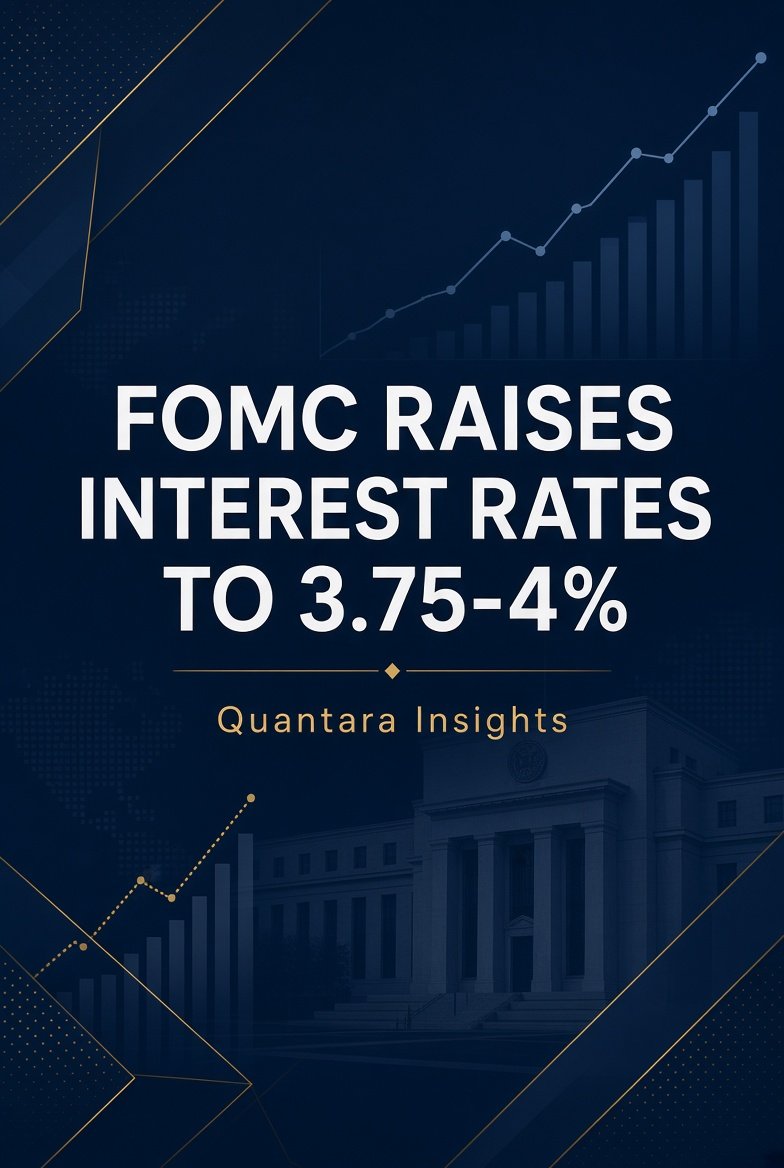
The Federal Open Market Committee raised the federal funds target range by 25 basis points to 3.75%–4.00% at its September meeting.
The decision reflected the Fed’s assessment that inflation remains elevated while economic activity and domestic spending have remained relatively resilient.
The updated projections also pointed towards the possibility of another rate increase during 2026.
The key issue for markets is therefore how incoming economic data affects the balance between inflation risks and economic growth.
A stronger economy can give policymakers greater scope to maintain restrictive monetary policy if inflation remains above target.
Conversely, a clear deterioration in activity or employment could increase the case for a less restrictive policy stance.
US Retail Sales and Consumer Spending
US retail sales provided a strong signal in the latest data.
Headline retail sales increased by 1.2% month on month in August, above expectations of 0.8% and significantly stronger than July’s revised decline.
Core retail sales also increased by 1.4%, while retail sales excluding gasoline and autos rose by 1.2%.
The retail control measure increased by 1.4%, well above the expected 0.4%.
Some of the strength was influenced by factors affecting the timing of non-store sales, including the timing of Amazon’s Prime Day shopping event.
Higher gasoline prices also supported nominal sales at service stations.
Nevertheless, the broader data indicated that consumer spending remained relatively resilient.
Spending in areas such as food services, electronics, sports and recreation contributed to the improvement.
The consumer remains an important part of the US economic outlook. Strong household spending can support economic growth, but it can also contribute to persistent demand-side inflation if supply is unable to keep pace.
Higher-income households have also benefited from stronger financial wealth, helping to offset some of the pressure created by higher gasoline prices.
The sustainability of consumer spending will therefore remain an important consideration in the coming months.
Global Central Banks in Focus
Several central banks will announce policy decisions during the week.
The common theme across many of these meetings is the tension between inflation that remains above preferred levels and economic activity that is showing varying degrees of resilience.
Policymakers are therefore attempting to determine whether current inflation pressures are temporary or whether they could become more persistent.
Norges Bank Policy Decision
Norges Bank faces a relatively close decision in September.
The latest inflation data were mixed, with headline inflation rising more than expected, while CPI-ATE increased but remained below the central bank’s forecast.
Economic growth indicators have also shown some softness.
The Regional Network Report pointed to a degree of weakness in the Norwegian economy, although the deterioration does not necessarily indicate a sharp slowdown.
The policy debate therefore centres on whether inflation remains sufficiently high to justify another rate increase or whether policymakers should maintain the existing rate while assessing incoming data.
Energy prices are another important factor.

Norway’s economic exposure to energy markets means that changes in global commodity prices can influence both domestic activity and inflation.
The September decision will consequently provide useful information about how Norges Bank assesses the balance between inflation risks and growth.
Swiss National Bank
The Swiss National Bank is expected to keep interest rates unchanged.
Inflation remains within the SNB’s 0%–2% price-stability range, although recent CPI data have moved somewhat higher.
Swiss CPI increased by 0.4% month on month in August, while annual inflation rose to 0.8%.
Currency movements and energy prices contributed to the increase.
The key question for the SNB is whether the recent rise represents a temporary development or the beginning of a more sustained increase in inflation.
For now, the expectation is that policy will remain stable.
However, a continued rise in inflation would become increasingly relevant for expectations about 2027.
Riksbank Policy Decision
Sweden’s Riksbank is also expected to keep rates unchanged.
Recent inflation data were softer than expected, suggesting that the upward trend seen earlier in the summer may be losing momentum.
Nevertheless, inflation remains above the central bank’s own forecast in some measures, meaning policymakers are unlikely to dismiss the possibility of renewed price pressure.
The Swedish krona and developments in global interest rates will also remain relevant.
A resurgence in inflation, persistent currency weakness or renewed tightening by other major central banks could alter the Swedish policy outlook.
For now, however, the focus remains on whether inflation continues to moderate without creating a significant deterioration in economic activity.
Banxico Policy Decision
Mexico’s central bank is expected to leave its policy rate at 6.50%.
Recent communication has emphasised that inflation has improved but that policymakers still need evidence that the progress is sustainable.
Services inflation remains a particular concern.
Banxico has also revised its growth forecasts, with 2026 GDP growth now seen at 1.5%, compared with 1.1% previously.
The 2027 growth forecast has been adjusted to 2.0%.
The central bank continues to expect headline inflation to converge towards its 3% target during 2027.
The policy outlook therefore remains dependent on the evolution of underlying inflation.
A further improvement in core inflation could eventually provide room for additional easing, but persistent services inflation and external price shocks could encourage a more cautious approach.
Australia: Employment Data in Focus
Australia’s August Labour Force Report is scheduled for Thursday.
Employment is expected to increase by around 20,000 following the previous decline of 15,800.
The unemployment rate is expected to remain at 4.5%.
The labour market remains particularly important for the Reserve Bank of Australia because employment conditions influence both household income and domestic demand.
Recent commentary from RBA Governor Michele Bullock has indicated that labour-market conditions remain close to full employment, while inflation risks have become more noticeable.
The employment report will therefore be assessed alongside the broader inflation picture.
A strong labour-market outcome could reinforce the view that economic activity remains resilient.
A weaker result could provide evidence that higher interest rates and other economic pressures are gradually affecting hiring.
The jobs report may not by itself determine the RBA’s policy path, but it will contribute to the broader assessment of demand and inflation.
Economic Report: China Activity Data Shows an Uneven Economy
The latest Chinese activity data provide an important backdrop to the week’s developments.
Industrial production was stronger than expected, increasing by 5.2% year on year in August.
High-tech manufacturing and digital product manufacturing were particularly strong.
However, retail sales increased by only 0.4%, while fixed-asset investment remained weak.
The unemployment rate also increased unexpectedly.
This combination illustrates the uneven nature of China’s economic performance.
Industrial activity is benefiting from investment in emerging sectors and technology-related manufacturing, but consumer demand remains comparatively weak.
For policymakers, the challenge is to encourage a broader improvement in domestic demand while maintaining financial stability.
The data also matter internationally.
China’s industrial sector has a significant influence on commodity demand, regional supply chains and global manufacturing.
If industrial production remains strong while domestic consumption improves, the outlook for Chinese growth would become more balanced.
If household demand remains weak, policymakers may face greater pressure to provide targeted support.
The LPR decision and the Xi-Trump meeting will therefore take place against a backdrop of mixed domestic economic signals.
UK Labour Market and Inflation
The UK’s labour market continued to show signs of cooling in the latest data.
The unemployment rate remained at 4.9%, while employment growth slowed.
Average earnings excluding bonuses remained at 3.5%, while total earnings growth including bonuses eased to 3.9%.
More timely indicators were weaker, with payrolls falling and the claimant count increasing.
The overall picture suggested that labour-market pressures were gradually easing.
However, UK inflation remained an important concern.
Consumer price inflation increased to 3.1% year on year in August, while monthly inflation was 0.5%.
Core inflation remained at 2.6%, while services inflation was 3.4%.
Producer price data also pointed to stronger upstream price pressures.
Higher petrol and diesel prices contributed to the increase in headline inflation.
The Bank of England therefore continues to face a difficult balance.
A cooling labour market provides some evidence that domestic demand pressures may be easing, but higher energy prices and persistent services inflation remain risks.
Bank of England Policy
The Bank of England kept Bank Rate at 3.75% in its latest decision.
The vote was 6–3, with three members supporting a 25-basis-point increase.
The Monetary Policy Committee continued to assess the risk of second-round effects in wages and prices.
The Bank indicated that inflation risks had become more tilted to the upside, particularly if higher energy prices remain in place.
At the same time, its quantitative-tightening programme contained a notable adjustment.
The Bank agreed on a multi-year plan to reduce its gilt holdings, while maintaining a significant stock of longer-dated government bonds.
The combination of monetary policy and quantitative tightening will remain important for UK financial markets.
For sterling and gilt yields, the key question is how markets interpret the balance between inflation risks and the pace of economic activity.
Brazil: Continued Gradual Easing
Brazil’s central bank reduced its policy rate by 25 basis points to 13.75%, marking another step in its easing cycle.
The decision reflected evidence of moderating economic activity and improving inflation conditions, although policymakers continued to describe inflation risks as unusually high.
The central bank’s updated forecasts still showed inflation above the 3% target at the relevant policy horizon.
Oil prices remain an important upside risk.
For Brazil, as for several emerging markets, higher energy prices can complicate the inflation outlook by increasing transportation, production and consumer costs.
The central bank therefore continues to face a balance between supporting activity and ensuring that inflation expectations remain anchored.
Bank of Japan and Japanese Inflation
The Bank of Japan raised its short-term policy rate to 1.25% in its latest decision.
The vote was 7–2.
The central bank continued to signal that future policy decisions would depend on economic and price developments as well as financial conditions.
However, the communication did not indicate an immediate intention to accelerate the pace of tightening.
Japanese inflation data subsequently showed some moderation.
Headline CPI was 1.9% year on year in August, while core CPI excluding fresh food declined to 1.7%.
The core measure remained below the Bank of Japan’s 2% target.
Government energy subsidies contributed to some of the moderation.
The inflation data therefore remain important for determining whether Japan is experiencing a durable shift in its underlying inflation environment or a temporary movement caused by specific price factors.
For the yen and Japanese bond markets, the relationship between inflation, wages and monetary policy will remain important.
UK Retail Sales Provide a Positive Surprise
UK retail sales increased by 0.5% month on month in August, significantly stronger than expectations for a 0.2% decline.
Annual growth increased to 2.4%.
Sales excluding fuel also increased.
The improvement was supported by stronger non-food and online spending.
Higher fuel prices continued to weigh on automotive fuel volumes.
The retail data suggest that consumers remained more resilient than some of the preceding labour-market data might have implied.
However, the durability of consumer spending will depend on employment, wage growth, inflation and household purchasing power.
This remains an important consideration for the Bank of England as it evaluates the balance between persistent inflation and slowing economic activity.
SARB: South African Monetary Policy Takes Centre Stage
The South African Reserve Bank’s monetary policy decision will provide the key domestic focus of the Economic Report and is scheduled for September 23.
While SARB is not a global economic driver in the same way as the US Federal Reserve, China or the world’s major economies, its decision is particularly important for South African financial markets, the rand, domestic borrowing costs and expectations for inflation and economic growth.
The Monetary Policy Committee must assess a combination of domestic and international factors.
The central issue is the balance between inflation and economic activity.
Inflation remains above the midpoint of the SARB’s target range, while recent economic growth data have highlighted the vulnerability of domestic demand.
At the same time, inflation expectations have become more stable.
This creates a complicated policy environment.
A higher policy rate could provide additional support for bringing inflation back towards target and maintaining confidence in the inflation framework, but tighter monetary conditions can also weigh on already subdued economic activity.
A decision to leave rates unchanged would allow policymakers to assess whether recent inflation pressures are temporary while avoiding additional pressure on household and business borrowing costs.
The latest inflation expectations survey is particularly relevant.
Average inflation expectations for 2026 remained unchanged at 4.4%.
Expectations for 2027 declined to 4.0%, from 4.2%, while expectations for 2028 fell to 3.8%, from 3.9%.
The downward movement in longer-term expectations provides some support for the argument that inflation expectations remain relatively contained.
However, headline inflation itself remains an important consideration.
The July inflation rate was 4.3% year on year, above the midpoint of the SARB’s target range.
The MPC therefore has to consider whether current price pressures are likely to fade or whether additional policy action may be required to ensure inflation returns sustainably towards target.
The growth outlook complicates the decision.
South Africa’s Q2 GDP contracted by 0.2%.
A contraction in economic activity increases the importance of the growth side of the monetary-policy mandate.
Higher interest rates can reduce household consumption, increase debt-servicing costs and discourage some forms of investment.
This is particularly relevant in an economy where growth remains constrained by structural factors and where domestic demand has not consistently generated strong momentum.
The July MPC meeting provides important context.
The committee voted 4–2 to leave the policy rate unchanged, while the two dissenting members supported a 25-basis-point increase.
The split vote demonstrated that policymakers had different assessments of the balance between inflation and growth.
The statement also highlighted downside risks to economic growth alongside upside risks to inflation.
That combination remains central to the September decision.
Market pricing has indicated a meaningful possibility of a 25-basis-point increase, reflecting concern about inflation and the credibility of the monetary-policy framework.
However, the moderation in inflation expectations and weakness in GDP growth provide arguments for caution.
The SARB must also consider external conditions.
Global interest rates influence capital flows and emerging-market currencies.
Changes in US monetary policy can affect the relative attractiveness of South African assets, while movements in global bond yields can influence domestic financial conditions.
Commodity prices are another important variable.
South Africa’s position as a major commodity exporter means that changes in global demand and commodity prices can influence the trade balance, fiscal conditions and the rand.
Energy prices are particularly important because higher oil prices can increase domestic inflation while simultaneously placing pressure on household purchasing power.
The rand also remains a significant transmission channel.
A weaker rand can raise the domestic cost of imported goods and energy, potentially adding to inflation pressure.
A more stable currency, by contrast, can reduce some of the imported inflation risks facing the economy.
The SARB therefore cannot assess domestic inflation independently of global financial conditions.
However, the Bank’s primary focus remains the domestic inflation outlook and the medium-term return of inflation towards its target.
The timing of monetary-policy transmission is also important.
Interest-rate changes do not affect the economy immediately. Borrowing costs, household spending, business investment and other financial conditions adjust over time.
This means the MPC has to make policy decisions based not only on current inflation but also on where inflation and growth are likely to be over the policy horizon.
The inflation-expectations data may therefore carry considerable weight.
If longer-term expectations remain anchored, policymakers have more room to assess whether current inflation pressures will fade without requiring an aggressive policy response.
If expectations were to move materially higher, the MPC could face greater pressure to act to prevent temporary price shocks from becoming embedded in wage and price-setting behaviour.
The growth data present the opposite consideration.
The Q2 contraction suggests that the economy has limited room for additional pressure on domestic demand.
A policy decision that increases borrowing costs could further restrain activity, particularly for highly indebted households and businesses.
This does not mean that higher rates would necessarily be inconsistent with economic growth objectives.
If inflation remains elevated and expectations become unanchored, allowing inflation to persist could ultimately create broader economic costs.
The policy challenge is therefore to determine the appropriate balance between maintaining price stability and avoiding unnecessary damage to economic activity.
The September meeting will also be watched for the wording of the statement.
The decision itself will be important, but the Bank’s assessment of inflation, growth, the rand, global monetary policy and risks will help shape expectations for future meetings.
A hold would not necessarily imply that the SARB has abandoned the possibility of future tightening.
Similarly, a 25-basis-point increase would not necessarily indicate the beginning of a prolonged tightening cycle.
The subsequent communication will be important for understanding how policymakers view the trajectory of inflation and the economy.
For financial markets, the rand will be one of the most immediate indicators of how the decision is interpreted.
South African government bonds will also respond to changes in interest-rate expectations.
Equities could be affected through the impact of borrowing costs on domestic companies, although individual sectors will respond differently.
Banks, retailers, property companies and highly leveraged businesses can be particularly sensitive to changes in interest rates, while exporters may respond differently because of their exposure to the rand and global commodity prices.
The broader South African economy will also remain influenced by developments outside the country.
The direction of US monetary policy, global bond yields, commodity prices, Chinese demand and international risk sentiment can all affect South African financial conditions.
This makes the SARB decision an important domestic event within a much broader global economic environment.
The key issue for the September meeting is therefore not simply whether the repo rate rises or remains unchanged.
The more important question is how the MPC assesses the durability of inflation pressures against the weakness in domestic growth.
Inflation at 4.3%, declining longer-term inflation expectations and a Q2 GDP contraction create competing signals.
The committee’s interpretation of those signals will determine the immediate policy decision and could provide important guidance about the direction of monetary policy into the final months of 2026.
Economic Report: What to Watch Across Global Markets
The week ahead brings several interconnected themes.
China’s LPR decision will provide information about the immediate direction of Chinese monetary policy, while the country’s latest activity data highlight the contrast between resilient industrial production and weaker consumer demand.
The Xi-Trump meeting will put China-US economic relations firmly in focus, particularly trade, tariffs, technology restrictions and critical minerals.
The global Flash PMIs will provide a timely assessment of business activity across manufacturing and services.
The US will remain central to global markets because monetary policy and consumer spending continue to influence global financial conditions.
European and Nordic central banks will provide additional insight into how policymakers are responding to the combination of inflation and uneven economic growth.
Japan’s PMI and inflation data will be important for assessing the sustainability of its changing monetary-policy environment.
Australia’s employment report will provide another indication of labour-market conditions and the potential persistence of domestic inflation pressures.
For South Africa, the SARB decision will be the main domestic event.
The policy debate will remain centred on whether inflation is sufficiently persistent to warrant additional tightening or whether weak economic activity and stable inflation expectations support a more cautious approach.
Economic Report: Key Takeaways for the Week Ahead
The international economic picture remains characterised by different growth and inflation dynamics across regions.
China continues to show strength in industrial production and technology-related manufacturing, but domestic consumption remains comparatively weak.
The US economy continues to show resilience in consumer spending, while inflation remains important for the Federal Reserve’s policy outlook.
Global PMIs will provide one of the clearest near-term indicators of whether business activity is maintaining momentum.
The Xi-Trump meeting adds another major international variable, with trade, tariffs, technology and critical minerals all carrying potential economic implications.
European and other central banks are similarly balancing inflation risks against the need to avoid unnecessarily restricting economic activity.
Japan’s monetary-policy transition remains dependent on the durability of inflation and broader domestic economic conditions.
Australia’s labour-market data will provide another important test of economic resilience.
In South Africa, the SARB decision will need to balance inflation above the midpoint of the target range against weak recent economic growth.
The most important feature of the week is therefore not any single data release.
Instead, the focus will be on how the various indicators collectively influence expectations for economic growth, inflation and monetary policy.
For global markets, China, the US and the PMIs will remain the principal international themes.
For South African markets, the SARB will provide the key domestic policy event and will be closely assessed against the latest inflation, inflation-expectations and growth data.
This Economic Report therefore points to a week in which economic data, central-bank decisions and international policy developments will all contribute to the market outlook for the final months of 2026.