






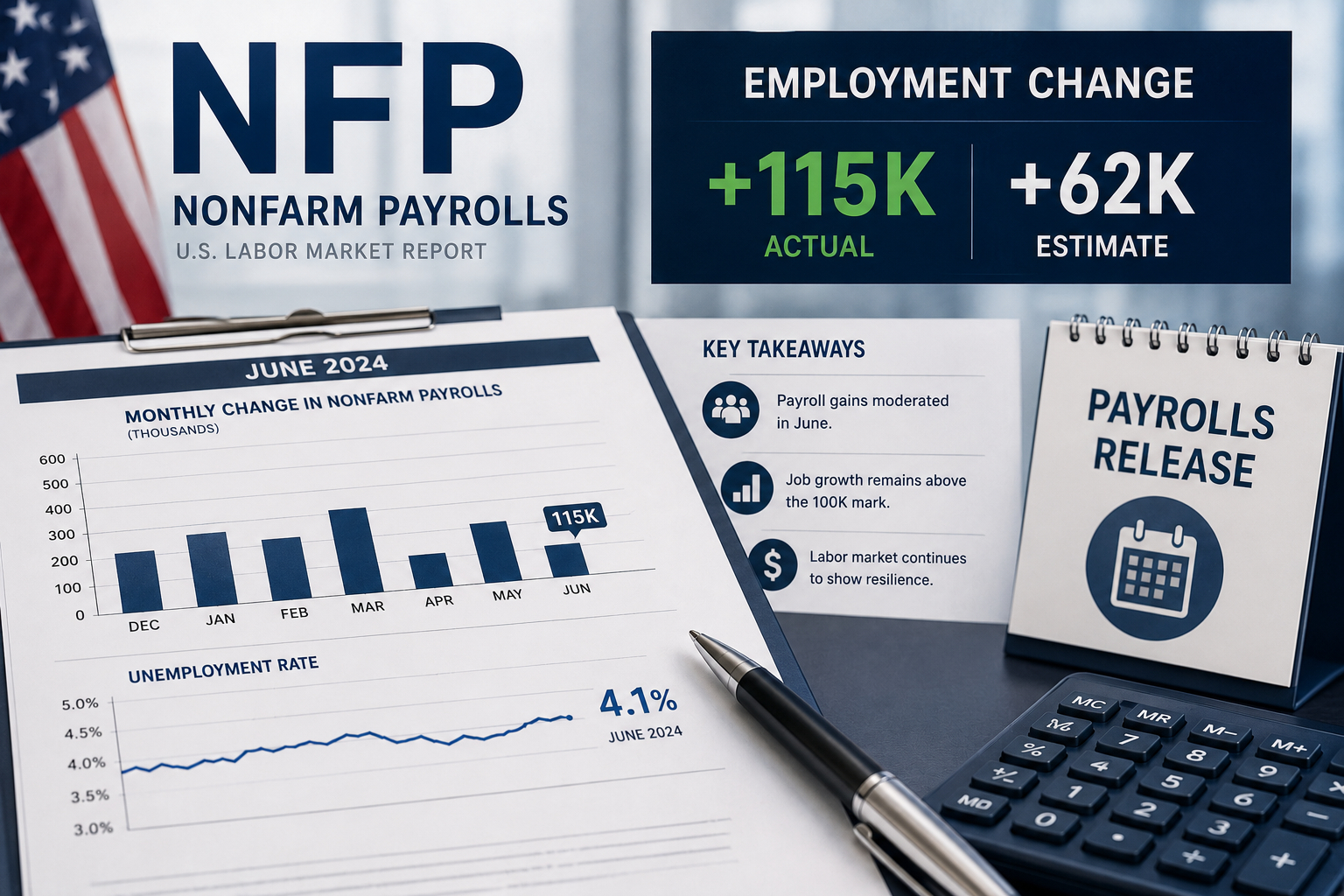
April Nonfarm Payrolls Show Stable Hiring Conditions Across the US Labor Market
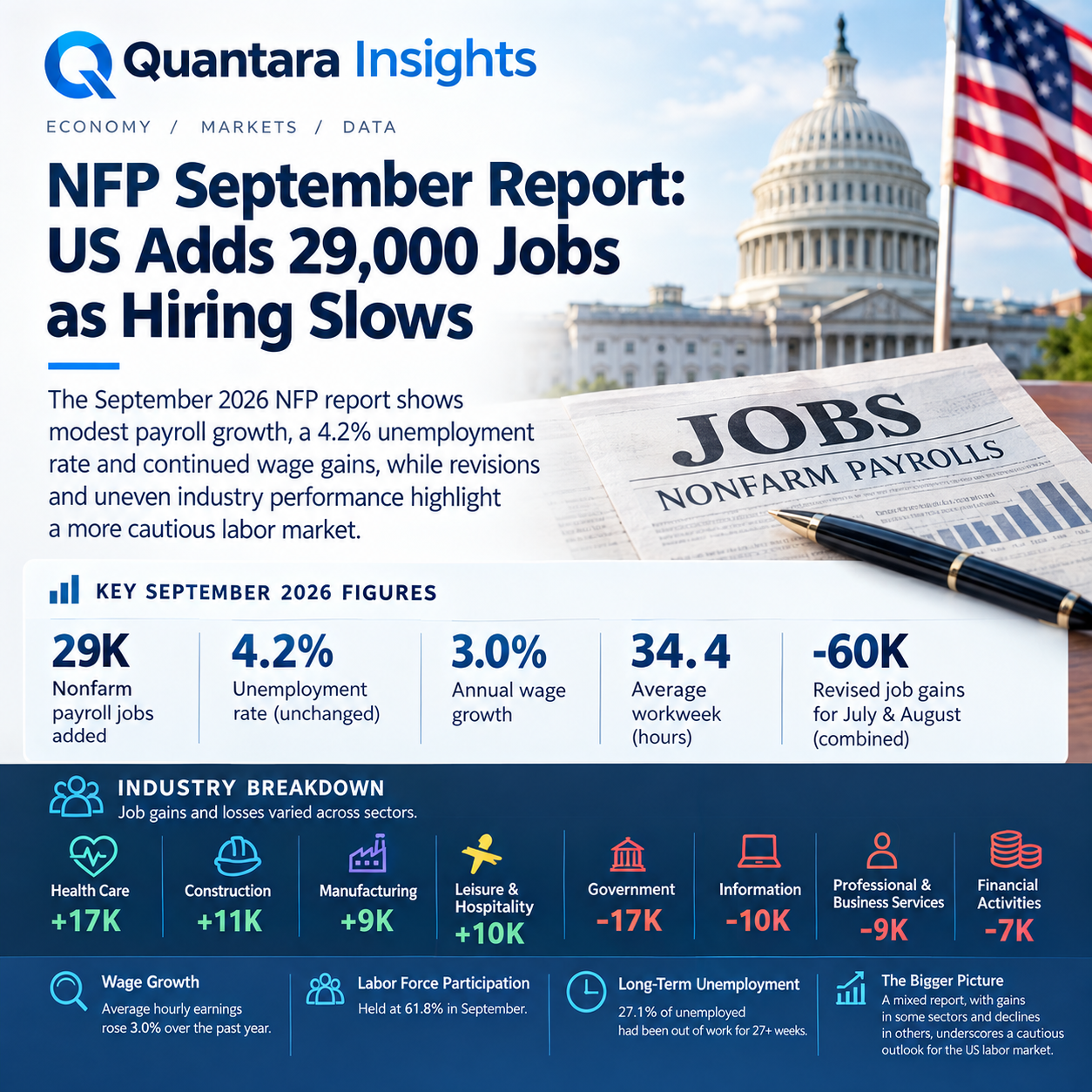
April Nonfarm Payrolls increased by 115,000 during the month, exceeding market expectations for a 65,000 increase and reinforcing signs of continued stability across the US labor market. The latest NFP report from the Bureau of Labor Statistics showed that the unemployment rate remained unchanged at 4.3%, while wage growth continued at a moderate pace. Despite concerns surrounding slowing economic activity and tighter financial conditions, the overall jobs environment continued to demonstrate resilience.
The April Nonfarm Payrolls report highlighted strength in healthcare, transportation and warehousing, retail trade, and social assistance. At the same time, federal government employment continued to decline, while information and technology-related sectors remained under pressure. Overall, the report reflected a labor market that is gradually moderating rather than sharply weakening.
For investors, economists, and policymakers, the latest NFP figures offered another important update on economic growth, inflation trends, and Federal Reserve policy expectations. While payroll growth slowed compared to stronger periods seen earlier in the economic cycle, the report still suggested that hiring demand remains present across several major sectors of the economy.
Overview of the April Nonfarm Payrolls Report
The April Nonfarm Payrolls report showed total nonfarm payroll employment increased by 115,000 jobs during the month. Consensus estimates had expected payroll growth closer to 65,000, meaning the report modestly exceeded expectations despite broader concerns about slowing economic momentum.
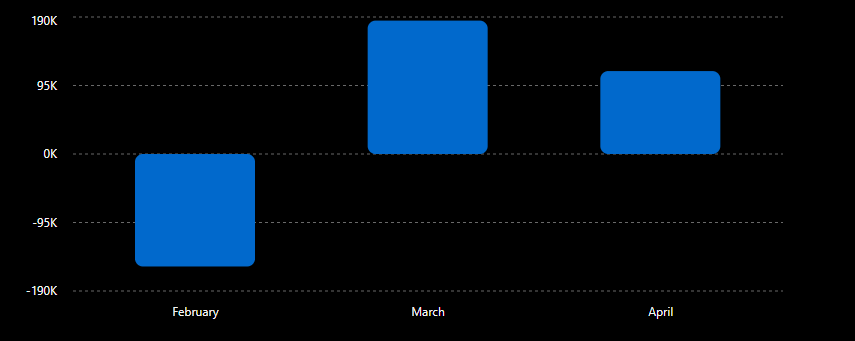
US Nonfarm Payrolls Monthly Change
Comparison of recent monthly payroll changes in thousands.
The unemployment rate remained unchanged at 4.3%, reflecting relatively stable labor market conditions. Average hourly earnings increased by 0.2% during the month and were up 3.6% over the previous year. The average workweek edged higher to 34.3 hours.
Several industries contributed positively to payroll growth:
- Healthcare added 37,000 jobs
- Transportation and warehousing added 30,000 jobs
- Retail trade added 22,000 jobs
- Social assistance added 17,000 jobs
At the same time, several sectors continued to experience weakness:
- Federal government employment declined by 9,000 jobs
- Information services lost 13,000 jobs
- Manufacturing declined by 2,000 jobs
The overall NFP report suggested that the US labor market remains balanced, with moderate jobs growth continuing despite tighter monetary conditions and slower economic expansion.
Healthcare Continues to Lead Jobs Growth
Healthcare remained one of the strongest contributors to April Nonfarm Payrolls growth. The sector added 37,000 jobs during the month, continuing a trend that has supported payroll expansion over the past year.
Employment gains were concentrated in:
- Nursing and residential care facilities
- Home healthcare services
- Ambulatory healthcare services
Healthcare employment has consistently provided support to overall payroll growth because demand for medical services remains relatively stable regardless of broader economic conditions. Demographic trends, including an aging population, continue to create long-term hiring demand across hospitals, outpatient centers, and long-term care facilities.
The healthcare sector has become increasingly important in sustaining overall NFP growth as cyclical industries such as manufacturing and technology experience slower hiring conditions.
The steady increase in healthcare jobs also reflects broader structural changes within the US labor market. Employers continue to compete for qualified healthcare workers, contributing to stable wage growth and relatively low unemployment levels across the industry.

Transportation and Warehousing Support Nonfarm Payrolls Expansion
Transportation and warehousing employment increased by 30,000 jobs in April, with much of the increase driven by gains in courier and messenger services.
The sector has remained highly sensitive to changes in consumer demand, e-commerce activity, and supply chain trends. While transportation employment remains below previous peaks reached in 2025, the April increase suggested that logistics demand continues to stabilize.
Several factors supported jobs growth in transportation:
- Continued strength in online retail activity
- Improvements in supply chain efficiency
- Seasonal increases in shipping demand
- Ongoing demand for warehouse operations
Despite the monthly improvement, transportation and warehousing employment has still declined significantly from prior highs, showing that the sector continues adjusting after rapid expansion during earlier periods of elevated consumer spending.
Nevertheless, transportation remains a key contributor to overall nonfarm payrolls because of its direct connection to retail demand and broader economic activity.
Retail Trade Employment Shows Moderate Improvement
Retail trade added 22,000 jobs during April, contributing positively to overall NFP growth.
The largest gains occurred in:
- Warehouse clubs
- Supercenters
- General merchandise retailers
- Building material suppliers
However, several retail segments continued to experience weakness:
- Department stores lost jobs
- Electronics retailers declined modestly
Retail employment trends often provide insight into consumer spending conditions. The April increase suggested that consumer demand remains relatively stable despite higher interest rates and inflation pressures.
The retail sector has undergone significant structural changes over recent years as e-commerce continues reshaping hiring patterns. Traditional department stores continue reducing employment while warehouse-based retail operations and logistics-focused retail businesses expand hiring activity.
The latest payroll figures showed that consumer-facing sectors remain relatively healthy even as economic growth moderates.
Federal Government Employment Continues to Decline
One of the weaker areas in the April Nonfarm Payrolls report remained federal government employment, which declined by 9,000 jobs during the month.
Since reaching a peak in October 2024, federal government employment has declined by approximately 348,000 jobs. Budget constraints, restructuring efforts, and government shutdown-related disruptions have contributed to ongoing declines.
Although federal government jobs represent only one portion of the overall labor market, persistent reductions can still influence broader payroll trends.
The decline in government employment partially offset stronger gains in private-sector industries, particularly healthcare and transportation.
Information Sector Remains Under Pressure
The information sector continued to experience weakness during April, losing 13,000 jobs.
Areas experiencing declines included:
- Telecommunications
- Motion picture and sound recording industries
- Data processing and web hosting services
The technology and information industries have faced ongoing adjustments following rapid hiring growth seen during previous years. Many companies continue focusing on cost controls, operational efficiency, and slower expansion strategies.
Higher interest rates and reduced investment activity have also weighed on hiring demand within technology-focused industries.
While layoffs and hiring slowdowns in technology have received significant media attention, the broader NFP report showed that weakness within information services has not yet spread aggressively across the wider US labor market.
Unemployment Rate Holds Steady at 4.3%
The unemployment rate remained unchanged at 4.3% during April, indicating continued stability across the labor market.
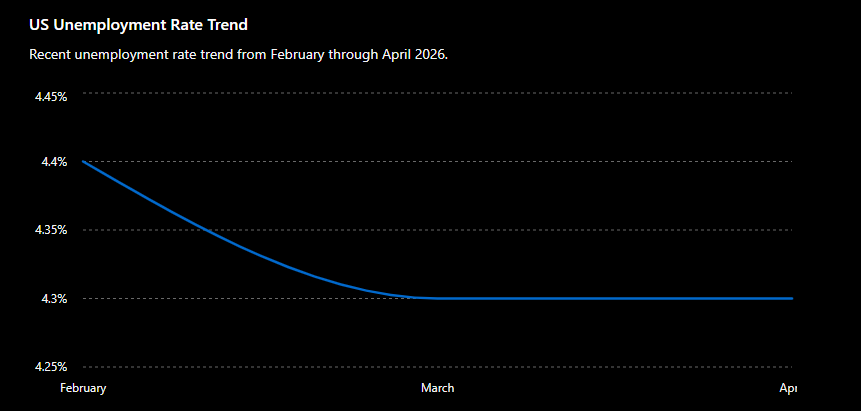
Key unemployment data included:
- Adult men unemployment: 4.0%
- Adult women unemployment: 3.9%
- Teen unemployment: 14.4%
- White unemployment: 3.7%
- Black unemployment: 7.3%
- Asian unemployment: 3.3%
- Hispanic unemployment: 5.0%
The stable unemployment rate suggested that layoffs remain relatively contained despite slower economic growth.
However, the report also showed that labor force participation edged lower to 61.8%, while the employment-population ratio declined slightly to 59.1%.
These participation figures indicate that some workers continue leaving the labor force or delaying reentry into employment.
Labor Force Participation Continues to Ease
One of the more closely watched components of the NFP report involved labor force participation, which declined modestly during April.
The labor force participation rate fell to 61.8%, continuing a gradual downward trend observed over recent months.
Several factors continue influencing participation rates:
- Demographic aging
- Retirements
- Reduced immigration growth
- Changing workforce preferences
- Childcare and caregiving challenges
Although unemployment remains relatively low by historical standards, participation trends suggest that the available labor supply remains constrained in several industries.
A lower participation rate can contribute to ongoing wage pressures because employers continue competing for a smaller pool of available workers.
Wage Growth Remains Moderate
Average hourly earnings increased by 0.2% during April and rose 3.6% on an annual basis.
Average Hourly Earnings Growth
Annual wage growth trend in the private sector.
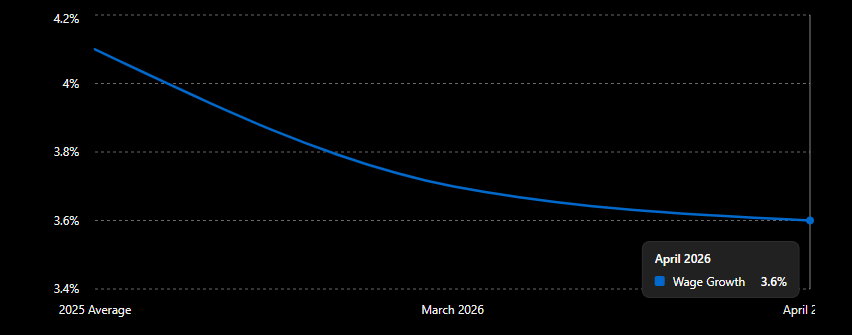
Moderating wage growth remains important for Federal Reserve policymakers because it influences inflation expectations and consumer spending conditions.
The latest wage data suggested:
- Labor market conditions remain healthy
- Wage inflation continues easing gradually
- Employers remain cautious on compensation growth
- Inflation pressures may continue moderating
Stable wage growth supports consumer spending while reducing concerns about accelerating inflationary pressures.
Part-Time Employment Increases
The April NFP report showed that the number of people working part-time for economic reasons increased by 445,000 to 4.9 million.
These workers generally prefer full-time employment but are unable to obtain full-time hours due to:
- Reduced employer demand
- Business conditions
- Limited hiring flexibility
The increase in involuntary part-time employment may suggest that some employers are becoming more cautious about labor costs while maintaining staffing flexibility.
Although overall payroll growth remained positive, rising part-time employment can sometimes indicate slowing momentum beneath headline jobs numbers.
Sector Performance Across the US Labor Market
The April Nonfarm Payrolls report showed mixed performance across major sectors of the economy.
Strongest Sectors
- Healthcare
- Transportation and warehousing
- Retail trade
- Social assistance
Weakest Sectors
- Information technology
- Federal government
- Manufacturing
April 2026 Payroll Changes by Sector
Monthly jobs gains and losses across major industries.
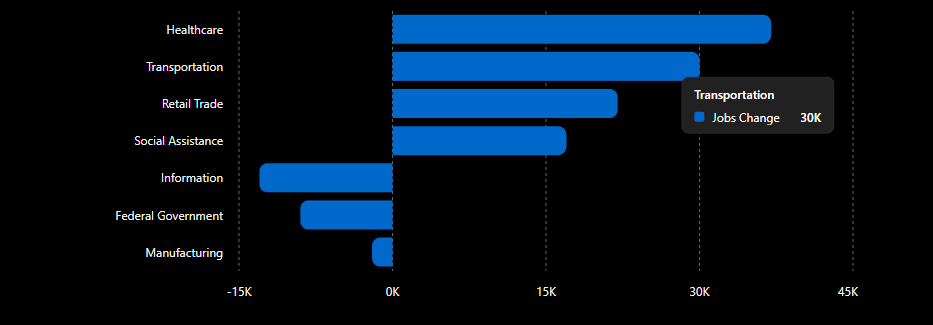
The broad sector distribution suggested that labor market weakness remains concentrated rather than widespread.
Consumer-oriented industries continue supporting payroll growth, while more cyclical and interest-rate-sensitive sectors experience slower hiring conditions.
Federal Reserve Implications of the NFP Report
The latest Nonfarm Payrolls report is likely to remain important for Federal Reserve policy discussions over the coming months.
Several elements of the report may influence interest rate expectations:
- Payroll growth exceeded forecasts
- Unemployment remained stable
- Wage growth moderated slightly
- Participation rates weakened modestly
The Federal Reserve continues balancing two primary objectives:
- Maintaining stable inflation
- Supporting maximum employment
The April NFP figures suggested that the labor market is cooling gradually rather than deteriorating rapidly. This type of moderation may support expectations for a cautious policy approach moving forward.
Markets will continue monitoring future jobs reports for signs of either stronger reacceleration or sharper labor market weakness.
Market Reaction to the April NFP Report
Financial markets closely monitor every NFP release because labor market data directly influences expectations for interest rates, inflation, and economic growth.
The April report likely reduced immediate concerns about a sharp labor market slowdown because payroll growth exceeded expectations.
Several asset classes typically respond strongly to NFP data:
- Treasury yields
- Equity markets
- Currency markets
- Gold prices
- Interest rate futures
A stronger-than-expected payroll number can sometimes reduce expectations for near-term Federal Reserve rate cuts because it signals continued economic resilience.
At the same time, stable unemployment and moderating wages help reduce fears of overheating inflation.
Comparing April Payroll Growth with Previous Months
Recent payroll data has reflected increasing volatility across monthly employment reports.
Recent monthly payroll changes included:
- February: -156,000
- March: +185,000
- April: +115,000
The April report suggested that payroll growth remains positive but uneven as the economy adjusts to slower growth conditions and tighter financial policy.
Monthly revisions also remain important when analyzing labor market trends. February payroll figures were revised lower while March payrolls received a modest upward revision.
These revisions demonstrate why economists often focus on multi-month averages rather than relying on a single NFP report.

Why Nonfarm Payrolls Matter for the Economy
Nonfarm Payrolls remain one of the most closely watched economic indicators because employment conditions influence nearly every part of the economy.
Strong payroll growth generally supports:
- Consumer spending
- Business investment
- Housing activity
- Tax revenue
- Financial market confidence
Weak payroll growth can signal:
- Slowing economic activity
- Reduced hiring demand
- Lower business confidence
- Slower consumer spending growth
The April NFP report suggested that the labor market continues expanding at a slower but still stable pace.
What the April NFP Report Signals Moving Forward
The April Nonfarm Payrolls report showed that the US labor market continues adjusting gradually rather than experiencing severe deterioration.
Key takeaways included:
- Payroll growth exceeded expectations
- Unemployment remained stable
- Wage growth moderated
- Participation rates softened slightly
- Sector performance remained mixed
The overall picture suggested that the labor market remains resilient despite tighter financial conditions and slowing economic growth.
Future payroll reports will remain critical in determining whether the economy continues achieving a soft landing or whether labor market conditions weaken more significantly later in the year.
Frequently Asked Questions
What are Nonfarm Payrolls?
Nonfarm Payrolls measure the number of paid workers in the US economy excluding farm workers, private household employees, and nonprofit workers.
How many jobs were added in April 2026?
The US economy added 115,000 jobs during April 2026 according to the latest NFP report.
What was the unemployment rate in April 2026?
The unemployment rate remained unchanged at 4.3%.
Which sectors added the most jobs?
Healthcare, transportation and warehousing, retail trade, and social assistance added the most jobs during April.
Why is the NFP report important?
The NFP report helps investors, economists, and policymakers evaluate economic growth, inflation trends, and labor market conditions.
Did wage growth increase in April?
Yes. Average hourly earnings increased by 0.2% during the month and 3.6% year over year.
Conclusion
April Nonfarm Payrolls increased by 115,000, exceeding expectations and reflecting continued stability across the US labor market. While hiring conditions have moderated compared to stronger periods seen earlier in the economic cycle, the latest NFP report showed that employment growth remains supported by healthcare, transportation, retail trade, and social assistance sectors.
The unemployment rate held steady at 4.3%, while wage growth continued moderating gradually. Although labor force participation softened and several industries remained under pressure, the overall report suggested that the labor market continues moving through a controlled slowdown rather than a sharp deterioration.
As investors and policymakers continue monitoring inflation, growth, and Federal Reserve policy expectations, future Nonfarm Payrolls reports will remain among the most important indicators shaping the outlook for the broader US economy.