






Table of Contents
- 1. September 2026 CPI Report: The Key Numbers
- 2. Energy Prices Drive the Increase in Inflation
- Why Gasoline Inflation Matters to Household Budgets
- Energy Costs and Business Margins
- 3. Food and Shelter Show Different Inflation Trends
- 4. Core CPI and the Underlying Inflation Picture
- 5. Real Earnings Decline as Inflation Outpaces Wage Growth
- 6. Production and Nonsupervisory Employees Face Similar Pressure
- 7. What the Inflation Data Could Mean for Interest Rates
- 8. Economic Growth, Consumer Spending and Business Costs
- 9. Implications for Corporate Earnings and Financial Markets
- 10. What Households, Businesses and Investors Should Monitor
- 11. The Economic Outlook: Balancing Inflation and Growth
- Conclusion: CPI, Earnings and Interest Rates Remain Closely Connected
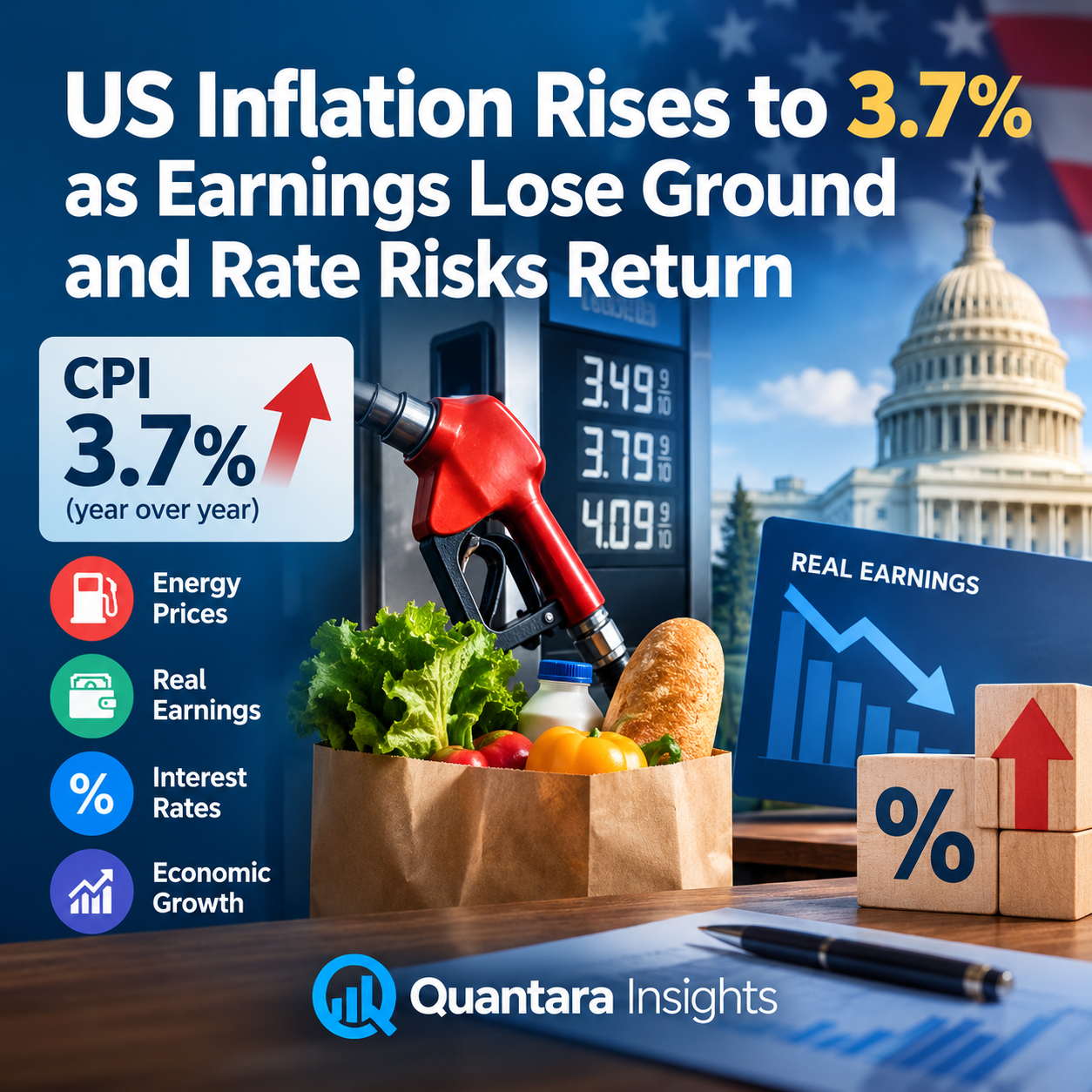
US Inflation Rises to 3.7% as Earnings Lose Ground and Rate Risks Return
The latest US Consumer Price Index (CPI) report points to renewed inflation pressure, while real-earnings data show that higher prices continue to weigh on workers’ purchasing power. Annual CPI inflation reached 3.7% in September 2026, up from 3.4% in August, as a sharp increase in energy costs contributed to a faster monthly rise in consumer prices. At the same time, real average hourly earnings declined, highlighting the continuing gap between nominal wage increases and the cost of living.
The September figures put inflation, interest rates, economic growth, and corporate earnings back at the centre of the US economic outlook. Although the headline CPI increase was heavily influenced by energy prices, the underlying picture is more complex. Core inflation also accelerated on an annual basis, shelter costs continued to rise, and wage growth did not fully offset the latest increase in consumer prices.
For households, this combination means that pay increases may not translate into greater purchasing power. For businesses, it creates a more difficult environment for managing labour expenses, energy costs, pricing decisions, and demand. For investors and policymakers, it reinforces the need to assess whether the latest increase in inflation represents a temporary energy-driven shock or a broader challenge to price stability.
The September data do not, by themselves, determine the next move in monetary policy or establish the future direction of economic growth. They do, however, provide important evidence about the relationship between prices, wages, spending, and financial conditions.
This article examines the latest CPI figures, the components driving inflation, the decline in real earnings, and the possible implications for interest rates, business performance, and the wider US economy.
1. September 2026 CPI Report: The Key Numbers
The September CPI report showed a faster increase in consumer prices than the previous month. The Consumer Price Index for All Urban Consumers rose 0.6% on a seasonally adjusted basis in September, following a 0.4% increase in August. Over the 12 months ending in September, the index increased 3.7%, compared with 3.4% over the year ending in August.
The acceleration in annual inflation is important because it indicates that the pace of consumer-price increases moved further away from the lower readings recorded in the previous month. However, understanding the change requires looking beyond the headline figure to the categories contributing most to the increase.
Energy prices were a major factor. The energy index rose 5.2% in September, following a 2.1% increase in August. Gasoline prices increased 9.1% during the month and were 34.2% higher than a year earlier. These movements helped push the overall CPI higher.
Core CPI, which excludes food and energy, increased 0.3% in September. Its annual increase reached 2.6%, up from 2.4% in August. Core inflation therefore also moved higher on a year-over-year basis, although its monthly increase was smaller than the headline CPI increase.
Shelter costs remained another important contributor to consumer inflation. The shelter index increased 0.4% in September and was 3.2% higher than a year earlier. This matters because housing-related expenses represent a substantial part of many household budgets and tend to influence how consumers experience inflation over time.
Food prices showed a more moderate monthly pattern. The overall food index was unchanged in September, while food at home declined 0.1% and food away from home rose 0.2%. Over 12 months, the food index increased 2.5%.
The real-earnings report adds a separate but closely related dimension. Real average hourly earnings for all employees declined 0.5% from August to September. The decline occurred because average hourly earnings increased by 0.1% while the CPI-U rose 0.6%.
Taken together, these figures show three important developments:
- Headline CPI inflation accelerated from August to September.
- Energy costs played a significant role in the monthly price increase.
- Real earnings declined as consumer prices rose faster than nominal hourly pay.
These results do not establish that every household faced the same increase in living costs or that every business experienced the same cost pressures. Inflation varies by spending pattern, location, energy use, housing arrangements, and other individual circumstances. Nevertheless, the data provide a useful national measure of the direction of prices and purchasing power.
2. Energy Prices Drive the Increase in Inflation
Energy was the clearest source of upward pressure in the September CPI report. The energy index increased 5.2% during the month, while gasoline rose 9.1%. On a 12-month basis, energy prices were 20.4% higher and gasoline prices were 34.2% higher.
These increases matter because energy is both a direct household expense and an input into a wide range of economic activities. Consumers pay for fuel and utilities, while businesses use energy to operate buildings, manufacture products, transport goods, and provide services.

When gasoline prices rise sharply, households can face an immediate increase in the cost of commuting and other essential travel. The impact may be particularly noticeable for people who rely on cars, have long commutes, or live in areas with limited public transport. A household may have little short-term flexibility to reduce fuel consumption if driving is necessary for work, education, or caregiving.
Businesses can experience a similar effect through transport and distribution costs. Delivery companies, logistics operators, contractors, and firms with vehicle fleets may find that fuel expenses rise faster than other operating costs. Businesses that cannot quickly pass those expenses on to customers may see pressure on margins.
The impact can extend beyond industries that purchase large quantities of fuel directly. Transportation is embedded in the supply chain for many consumer products. If higher energy expenses persist, some businesses may respond by renegotiating contracts, changing delivery schedules, seeking operational efficiencies, or adjusting prices.
However, a monthly increase in energy prices should not automatically be treated as evidence that all prices will accelerate at the same rate. Energy markets can move sharply in either direction, and the effect on broader inflation depends on the duration of the increase, how businesses respond, and whether higher costs feed into other categories.
The distinction between a temporary energy shock and persistent inflation is central to interpreting the September figures. If energy prices stabilise or reverse, the direct contribution to future monthly CPI increases could become smaller. If elevated energy costs persist, their influence on household budgets and business expenses may last longer.
Policymakers and analysts will therefore need to monitor both energy prices and the components of inflation that are less directly affected by fuel. A single month of higher gasoline prices provides important information, but it does not fully determine the medium-term inflation outlook.
Why Gasoline Inflation Matters to Household Budgets
Gasoline inflation can affect households differently depending on income, commuting distance, vehicle efficiency, and access to alternatives. A person who drives long distances may experience a more significant increase in monthly expenses than someone who works remotely or uses public transport.
The challenge is that fuel is often a necessary expense rather than a discretionary purchase. If a household must spend more on gasoline, it may have less money available for restaurants, entertainment, clothing, travel, savings, or debt repayment.
That shift in spending can influence economic growth. When consumers redirect more of their income toward essential expenses, discretionary businesses may face weaker demand. The effect will not be uniform, but sustained pressure on household budgets can change spending patterns across sectors.
Energy Costs and Business Margins
For companies, higher energy prices create a decision between absorbing the additional expense and passing some of it on to customers. The appropriate response depends on competition, demand, contract terms, operating efficiency, and the sensitivity of customers to price changes.
A company with strong pricing power may be able to protect its margins by raising prices. A business operating in a competitive market may have less flexibility and could instead accept lower margins, reduce other costs, or delay investment.
The September CPI figures do not quantify the impact on individual corporate earnings. They do, however, identify an economic pressure that investors and business leaders may need to consider when assessing operating costs and profit expectations.
3. Food and Shelter Show Different Inflation Trends
Energy dominated the monthly increase, but food and shelter provide a more detailed picture of the pressures facing consumers.
The overall food index was unchanged in September. Food at home declined 0.1%, while food away from home increased 0.2%. Over the year, food prices rose 2.5%, with food at home increasing 1.8% and food away from home rising 3.5%.
These figures illustrate why consumers may experience different price trends depending on where and how they purchase food. Grocery prices and restaurant prices do not necessarily move together because they are affected by different combinations of labour, ingredients, energy, rent, and other operating costs.
For households, a small monthly decline in grocery prices may offer limited relief, especially if other major expenses are rising more quickly. A household that cooks most meals at home may experience the food component differently from one that regularly purchases prepared meals. The national CPI captures an average pattern rather than every individual experience.
Shelter remains a particularly important component of the inflation picture. The shelter index increased 0.4% in September and 3.2% over the year. Rent of primary residence rose 0.2% during the month and 2.8% annually, while owners’ equivalent rent increased 0.3% monthly and 3.3% over 12 months.
Housing-related inflation matters because rent and housing services often account for a large share of household spending. Unlike some discretionary purchases, these costs can be difficult to reduce quickly. A renter may be unable to move immediately without facing deposits, moving expenses, changes in commuting costs, or limited housing availability. Homeowners also face a range of expenses, although the CPI’s owners’ equivalent rent measure is a statistical measure of the rental value of owner-occupied housing rather than a direct measure of mortgage payments.
The shelter figures suggest that housing-related price pressure remained present even as food inflation showed a more restrained monthly pattern. They also show that the September inflation increase was not exclusively an energy story.
A balanced reading of CPI requires looking at the composition of price changes. When energy rises sharply but other categories remain relatively moderate, the headline figure can overstate how broadly prices are accelerating. Conversely, if shelter and other services continue to increase, inflation may remain persistent even after energy prices stabilise.
For households, the practical issue is the combined cost of necessities. Fuel, housing, food, utilities, healthcare, and transport can each place pressure on budgets. A moderate increase in one category does not necessarily offset a large increase in another, particularly for people whose spending is concentrated in essential goods and services.
4. Core CPI and the Underlying Inflation Picture
Core CPI increased 0.3% in September and 2.6% over the year, compared with an annual increase of 2.4% in August. The measure excludes food and energy to help analysts assess price movements outside two categories that can be especially volatile.
Core CPI is useful because a sudden rise in gasoline prices can lift headline inflation without necessarily indicating that price pressures are accelerating across the entire economy. Looking at core inflation helps provide additional context.
However, core CPI should not be interpreted as a complete measure of the cost of living. Food and energy are essential expenses for many households, and excluding them does not make their price increases irrelevant. Rather, the core measure offers a different view of the underlying pattern of consumer prices.
The September figures contain signals in both directions. The monthly core CPI increase of 0.3% was below the 0.6% increase in headline CPI, indicating that energy contributed significantly to the overall monthly movement. At the same time, annual core inflation rose from 2.4% to 2.6%, suggesting that price increases outside food and energy also warrant attention.
Shelter continued to contribute to inflation, rising 3.2% annually. Other categories showed different trends: airline fares increased 1.2% during September and 22.4% over the year, while recreation prices rose 2.8% annually, medical care rose 1.5%, and education increased 3.8%.
These differences show why it is important to avoid describing inflation as if all prices were rising at the same rate. Some categories can increase quickly while others rise more slowly or decline. The aggregate CPI reflects the combined movement of a broad basket of consumer goods and services.
The next question is whether the latest figures represent a sustained change in the inflation trend. One report cannot answer that question definitively. Several subsequent readings would help establish whether monthly increases are broadening, narrowing, or returning to a more moderate pace.
Analysts will also want to assess whether increases in energy costs are affecting prices elsewhere. If businesses absorb higher fuel expenses, the impact may appear in margins rather than consumer prices. If they pass costs through to customers, the effect could become more visible in goods and services. The timing and extent of that pass-through will vary across industries.
For monetary policy, the distinction between headline and core inflation is important but not decisive on its own. Policymakers consider a wider range of information, including employment, economic activity, financial conditions, inflation expectations, and other price measures. The CPI report is a key input into that assessment, not an automatic instruction to change interest rates.
5. Real Earnings Decline as Inflation Outpaces Wage Growth
The real-earnings report provides an important counterpart to the CPI figures. In September, real average hourly earnings for all employees declined 0.5% from the previous month. Nominal average hourly earnings increased 0.1%, while the CPI-U rose 0.6%.
Nominal earnings describe pay in current dollars. Real earnings adjust that pay measure for changes in consumer prices, giving a clearer indication of how purchasing power is changing. If wages rise more slowly than the prices consumers pay, real earnings decline even when workers receive a nominal pay increase.
That distinction is central to the September data. Nominal hourly earnings did not fall; they increased slightly. But the increase was insufficient to offset the monthly rise in consumer prices, so the inflation-adjusted measure moved lower.
On a year-over-year basis, real average hourly earnings for all employees decreased 0.7% from September 2025 to September 2026. Nominal average hourly earnings were $37.81 in September 2026, up 3.0% over the year. The real-earnings figures indicate that these nominal gains did not keep pace with the overall increase in consumer prices over the same period.
Real weekly earnings also declined 0.5% from August to September. The average workweek was unchanged, meaning that the monthly fall in real weekly earnings was primarily associated with the decline in real hourly earnings.
Over the year, real weekly earnings decreased 0.1%, while the average workweek increased 0.6%. Nominal average weekly earnings reached $1,300.66 in September, an increase of 3.6% from a year earlier.
These figures highlight a key issue for household finances: higher nominal pay does not automatically mean workers can afford more. Purchasing power depends on the relationship between income and the cost of the goods and services people buy.
When real earnings decline, households may respond in several ways. They may reduce discretionary spending, use savings, seek additional work, change shopping habits, or rely more heavily on credit. The choices available depend on household income, existing savings, debt obligations, family circumstances, and access to cheaper alternatives.
It is important not to assume that every worker experienced the same outcome. The reported figures are averages across private nonfarm jobs, not a description of a single typical worker. Individual wage growth, working hours, occupation, location, household structure, and personal spending patterns can differ substantially.
Even with that limitation, the broad message is clear: the September increase in consumer prices was accompanied by a monthly decline in inflation-adjusted earnings. That combination can put pressure on consumption if it persists.
The Difference Between Nominal and Real Wage Growth
Nominal wage growth tells workers how their pay has changed in dollar terms. Real wage growth adjusts that change for inflation.
For example, if a worker’s hourly pay increases by 3% over a year but the prices of the goods and services represented by the relevant inflation measure rise by 4%, the worker’s purchasing power generally declines. The exact result depends on the measures and periods being compared, but the principle remains the same.
The September data show this relationship at the aggregate level. Average hourly earnings increased 3.0% year over year in nominal terms, while real hourly earnings fell 0.7%. The figures demonstrate why wage growth alone is not enough to determine whether workers are financially better off.
This distinction is also relevant to businesses. Nominal wage increases can raise labour costs, but the effect on household demand depends partly on whether pay increases outpace the prices consumers face. Strong nominal wage growth can coexist with pressure on purchasing power when inflation is elevated.
6. Production and Nonsupervisory Employees Face Similar Pressure
The real-earnings report also examined production and nonsupervisory employees, providing a separate view of wage trends for this group.
Their real average hourly earnings declined 0.6% from August to September. Nominal average hourly earnings increased 0.2%, while the Consumer Price Index for Urban Wage Earners and Clerical Workers (CPI-W) rose 0.7%.
Over the year, real average hourly earnings for production and nonsupervisory employees fell 0.6%. Nominal average hourly earnings reached $32.60 in September, an increase of 3.3% from September 2025. Nominal average weekly earnings were $1,101.88, up 3.6% year over year, while the average workweek was 33.8 hours.
Real weekly earnings for this group declined 0.5% during September and 0.3% over the year. The average workweek increased 0.3% over the year, offering some support to weekly pay but not enough to prevent the annual decline in real weekly earnings.
The CPI-W increased 3.9% over the 12 months ending in September. This index differs from the CPI-U and represents a different population and weighting approach. As a result, the real-earnings calculation for production and nonsupervisory employees should be interpreted using the corresponding CPI-W measure rather than directly substituting the CPI-U rate.
The figures suggest that inflation-adjusted earnings pressure was not limited to the all-employee measure. However, they should not be used to conclude that every production or nonsupervisory worker experienced an identical decline. Individual outcomes depend on actual pay changes, hours, occupation, and personal circumstances.
For businesses, the data also illustrate why labour-market analysis should consider both pay and purchasing power. Nominal wages affect employer costs, while real wages help describe how workers’ earning power changes after inflation. These are related but distinct economic questions.
7. What the Inflation Data Could Mean for Interest Rates
The September CPI report adds complexity to the outlook for US interest rates. When inflation rises, policymakers must evaluate whether the increase is temporary, whether price pressures are becoming more persistent, and how monetary policy is affecting economic activity.
Higher interest rates are commonly used to restrain demand by making borrowing more expensive and encouraging saving relative to spending. This can help reduce inflationary pressure over time. However, monetary policy works with delays, and its effects differ across households, businesses, and financial markets.
The September figures present a mixed picture. Headline CPI rose 3.7% over the year, energy prices increased sharply, and annual core inflation moved higher to 2.6%. Real earnings declined during the month. These figures may increase the importance of carefully assessing the relationship between inflation, wages, demand, and financial conditions.

They do not establish that the Federal Reserve must raise rates at its next meeting. Nor do they guarantee that rates will remain unchanged or decline. The policy decision depends on the full range of available evidence and policymakers’ assessment of the risks to price stability and economic activity.
A critical consideration is the source of inflation. If energy prices are the principal driver of a temporary increase, a rate change may have limited ability to address the initial supply-side shock. Monetary policy cannot directly produce more fuel or reverse a sudden increase in energy prices. Policymakers must instead consider whether the shock is likely to persist and whether it risks influencing broader prices and inflation expectations.
If core inflation also remains firm, or if higher energy costs spread into other goods and services, policymakers may be more concerned about the persistence of inflation. The September increase in annual core CPI therefore deserves attention alongside the headline number.
Interest-rate decisions also involve risks to growth and employment. Tighter financial conditions can weigh on household borrowing, business investment, housing activity, and demand for interest-sensitive goods. If inflation moderates, maintaining restrictive policy for too long could unnecessarily weaken economic activity. If inflation remains persistent, easing policy too early could make the return to price stability more difficult.
The appropriate response depends on the evidence available over time rather than a single data release.
Why One CPI Report Does Not Determine the Next Rate Decision
Monthly CPI figures can be volatile, particularly when energy prices move sharply. Policymakers generally assess trends across multiple releases and consider other indicators before drawing conclusions about the medium-term outlook.
The September report contains several signals worth tracking: a 0.6% monthly increase in headline CPI, a 0.3% monthly increase in core CPI, annual headline inflation of 3.7%, and annual core inflation of 2.6%. Real earnings declined over the month, while nominal wages continued to increase.
Future reports will help show whether these developments persist. If headline inflation slows as energy prices stabilise, policymakers may interpret the September increase differently than if monthly core inflation also accelerates and price increases broaden.
Employment, consumer spending, business activity, inflation expectations, and financial conditions will also matter. Interest rates reflect the broader economic outlook, not simply the direction of one index.
For households and businesses, this means it is unwise to make major financial decisions based solely on assumptions about the next Federal Reserve move. Borrowers should evaluate their own cash flow and financing terms, while businesses should test plans against several interest-rate scenarios.
8. Economic Growth, Consumer Spending and Business Costs
Inflation and economic growth are closely connected, but their relationship is not always straightforward. Rising prices can reflect strong demand, supply constraints, changes in global commodity markets, or a combination of factors. The September CPI data identify price pressure but do not, by themselves, establish the current growth rate of the US economy.
The decline in real earnings is relevant because household consumption depends partly on purchasing power. If wages do not keep pace with prices, some consumers may have less room to increase spending after covering essential expenses. That can affect businesses that depend on discretionary purchases.
The extent of the effect depends on several factors. Households with savings or faster-growing incomes may be better positioned to absorb higher expenses. Others may reduce nonessential spending or delay larger purchases. Credit access, debt payments, job security, and consumer confidence can also influence the response.
For businesses, the combination of higher energy prices and pressure on real household income creates a challenging planning environment. Companies may face higher operating costs at the same time that some customers become more price-sensitive. Whether this leads to lower profits, higher prices, or slower sales will vary by industry and company.
Energy-intensive businesses may experience direct pressure on production and distribution expenses. Retailers may need to manage transport costs while protecting customer demand. Service businesses may be more exposed to labour, rent, utilities, or other operating costs. The September CPI data do not quantify each sector’s exposure, but they help identify categories that deserve closer examination.
Business investment may also be affected by interest-rate uncertainty. If financing costs remain elevated, some projects may become less attractive or take longer to deliver an expected return. Firms could delay investment, prioritise efficiency, or focus on projects with clearer near-term benefits. Other businesses may continue to invest where demand and expected returns justify the expense.
These are possible responses, not outcomes established by the CPI report. Actual investment decisions depend on company finances, industry conditions, expected sales, credit availability, and management strategy.
Economic growth can also influence inflation in the other direction. If demand weakens substantially, businesses may have less scope to increase prices, potentially reducing some inflationary pressure. But weaker demand can also put pressure on employment, revenues, and investment. Policymakers must therefore balance the objective of controlling inflation with the risk of unnecessarily slowing economic activity.
The September figures underline the importance of monitoring both prices and real incomes. Inflation is not just a headline rate: it affects the resources households have available to spend and the costs businesses face when producing goods and services.
9. Implications for Corporate Earnings and Financial Markets
The relationship between inflation, interest rates, and corporate earnings is important for investors because each can affect company valuations and expected cash flows.
Higher energy prices can raise operating costs for businesses that rely on fuel, transport, heating, electricity, or energy-intensive production. If a company cannot pass these costs to customers, its margins may narrow. If it can raise prices without significantly reducing demand, it may protect some of its profitability.
However, pricing power is not unlimited. Customers may switch to competitors, reduce purchase volumes, delay purchases, or seek cheaper alternatives. A business’s ability to pass on higher costs depends on the strength of demand, competitive conditions, product differentiation, and the share of the customer’s budget devoted to the product.
The September inflation data also have potential implications for companies that sell discretionary goods and services. If real earnings remain under pressure, some consumers may become more selective. Businesses exposed to nonessential spending may need to pay closer attention to sales volumes, promotional activity, customer retention, and inventory management.
Interest rates introduce another channel. Higher borrowing costs can increase financing expenses for companies with floating-rate debt or upcoming refinancing needs. They can also influence the valuation of future earnings by changing the rate investors use to discount expected cash flows. The actual effect varies considerably by company, capital structure, cash reserves, and growth prospects.
A more uncertain inflation outlook may also increase volatility in financial markets as investors reassess expectations for interest rates, profits, and economic activity. Yet the CPI report alone does not determine the direction of stock prices, bond yields, currency markets, or any particular asset. Market prices reflect a wide range of information, including what investors expected before the release.
The same caution applies to corporate earnings forecasts. The CPI and real-earnings reports are not company financial statements and do not establish that earnings across the market will rise or fall. They provide macroeconomic context that can inform analysis of costs, demand, margins, and financing conditions.
Investors assessing individual companies may want to examine several questions:
- How sensitive are operating expenses to fuel and energy prices?
- Can the company pass higher costs to customers without materially weakening demand?
- What proportion of revenue depends on discretionary consumer spending?
- Does the business face significant refinancing needs or variable-rate debt?
- Are wage and other input costs rising faster than productivity or revenue?
- Does management have flexibility to adjust pricing, sourcing, or capital expenditure?
These questions help translate broad inflation data into company-level analysis. They also reduce the risk of treating a national economic indicator as a direct forecast for every sector or investment.
A useful approach is to distinguish the immediate market reaction from longer-term fundamentals. Short-term price movements can be driven by positioning and expectations, while the effect on earnings depends on how the economic environment develops and how individual companies respond.
10. What Households, Businesses and Investors Should Monitor
The September figures point to several indicators worth following over the coming months. Monitoring these measures together can provide a more balanced view than focusing only on the headline CPI rate.
Future CPI Reports
The next CPI releases will help establish whether September’s acceleration persists. Monthly changes are particularly useful for tracking momentum, while annual comparisons show how prices have changed over a longer period. Both measures need context, especially when volatile categories such as gasoline experience large movements.
Core Inflation
Core CPI can help show whether price pressure is extending beyond food and energy. A sustained increase in core inflation would suggest that the underlying trend needs careful attention. Moderating core inflation could provide a different signal even if headline inflation remains temporarily elevated because of energy.
Energy and Gasoline Prices
Energy contributed significantly to September’s monthly increase. Future movements in gasoline, electricity, and natural gas prices will therefore be important to the headline inflation outlook. Businesses should also assess their own energy exposure rather than assuming that the national index perfectly reflects their costs.
Real Earnings and Working Hours
Nominal wage growth alone cannot show whether purchasing power is improving. Real hourly and weekly earnings provide additional context by accounting for consumer-price changes and working hours. If real earnings remain weak, households may face continuing pressure on discretionary spending.
Working hours also matter. Weekly earnings can change because of hourly pay, hours worked, or both. Looking at these factors together helps explain changes in income more clearly than examining hourly wages alone.

Consumer Spending and Confidence
Spending data can help show whether households are maintaining consumption despite higher costs or adjusting their behaviour. Retail activity, service spending, and consumer confidence may offer clues about the extent to which price increases are influencing demand. Different groups may respond differently depending on income, savings, debt, and spending needs.
Employment and Business Activity
Labour-market conditions influence household income and the broader growth outlook. Employment, wage trends, job openings, and business activity can help indicate whether the economy is maintaining momentum or slowing. These measures are also relevant to policymakers assessing the trade-off between inflation and economic activity.
Federal Reserve Communications and Interest Rates
Policy statements and decisions will provide insight into how policymakers interpret the latest data. Businesses and households should avoid assuming that one CPI release guarantees a particular interest-rate outcome. Instead, they can consider a range of possible rate paths when evaluating borrowing, saving, and investment decisions.
Corporate Guidance and Profit Margins
Company earnings reports and management commentary can help reveal how inflation is affecting actual operating results. Investors may want to compare revenue growth with changes in labour, energy, transport, and financing costs. Margin performance can show whether companies are absorbing higher expenses or passing them on to customers.
Tracking these indicators together provides a more complete view of the economic environment. CPI measures consumer prices, real-earnings data estimate changes in purchasing power, and company reports show how businesses are responding to conditions. No single measure can fully explain the outlook on its own.
11. The Economic Outlook: Balancing Inflation and Growth
The September 2026 data leave the US economy facing a familiar but difficult policy and business challenge: inflation remains elevated, while purchasing power is under pressure.
Annual CPI inflation increased to 3.7%, up from 3.4% in August. Energy prices were a major contributor to the monthly increase, with gasoline rising 9.1% during September. At the same time, core CPI rose 2.6% over the year, compared with 2.4% in August, indicating that the inflation picture cannot be understood solely through energy prices.
Real average hourly earnings declined 0.5% during September and 0.7% over the year. Nominal wages continued to rise, but those increases did not fully offset changes in consumer prices. Real weekly earnings also fell over the month.
These trends have implications for households, companies, and policymakers, but the precise consequences will depend on how the data evolve. If energy prices stabilise and core inflation moderates, the latest headline increase may prove less persistent. If price increases remain broad or inflation expectations rise, the pressure on monetary policy could last longer.
Growth is another essential part of the outlook. Higher prices can squeeze household budgets, while higher financing costs can affect borrowing and investment. However, the CPI and real-earnings reports alone do not establish whether the economy is expanding or contracting. Growth must be assessed using additional evidence, including output, employment, spending, and business activity.
For businesses, the prudent response is to review costs, pricing flexibility, financing exposure, and demand assumptions. For households, it is useful to assess the difference between nominal income increases and actual purchasing power. For investors, the data reinforce the importance of distinguishing broad economic trends from the financial position and prospects of individual companies.
The most useful outlook is therefore one based on scenarios rather than certainty. A more favourable scenario would involve easing energy pressure, moderating core inflation, and real earnings stabilising. A more difficult scenario would involve persistent price increases, continued pressure on purchasing power, and interest rates remaining restrictive for longer than borrowers or investors expect.
Neither scenario is guaranteed by the September report. The coming inflation releases, earnings data, labour-market indicators, and policy decisions will provide further evidence.
Conclusion: CPI, Earnings and Interest Rates Remain Closely Connected
The September 2026 CPI report shows that US inflation accelerated, with annual consumer-price growth reaching 3.7% and the monthly index increasing 0.6%. Energy prices, particularly gasoline, played a substantial role in the increase. Core CPI also rose on an annual basis, while shelter costs continued to advance.
At the same time, the real-earnings report showed that inflation-adjusted hourly and weekly earnings declined during September. Nominal wages continued to increase, but not quickly enough to prevent a monthly loss in purchasing power. Real hourly earnings were also lower than a year earlier.
Together, the reports illustrate why inflation cannot be assessed in isolation. Consumer prices affect household purchasing power, wage trends influence spending capacity, and these developments can shape the environment in which businesses set prices, manage costs, and plan investment. Interest-rate expectations depend on the wider economic picture, including whether inflation proves persistent and how growth and employment evolve.
The September data do not guarantee a specific Federal Reserve decision, a particular rate path, or a defined outcome for corporate earnings and economic growth. They provide evidence that inflation risks remain relevant and that real-income pressure deserves continued attention.
The next stage will be to determine whether the energy-driven increase fades, whether core inflation moderates, and whether wage growth begins to recover relative to consumer prices. For households, businesses, and investors, following these trends together will provide a more reliable basis for understanding the US economic outlook than relying on a single headline number.