



Table of Contents
- SARB October 2026: What the Latest Review Means for Interest Rates, Inflation and Growth
- What Is the SARB Saying in October 2026?
- SARB Interest Rates Reach 7.25%
- Why Interest Rates Matter for South Africa
- Inflation Is the Central SARB Concern
- What Are Second-Round Inflation Effects?
- Fuel Prices and Refinery Margins Add to the Inflation Risk
- The Rand Provides Some Protection Against Imported Inflation
- The 3% Inflation Target Is Now Central to Policy
- South Africa’s Growth Outlook Remains Modest
- Why Growth Could Improve Over the Medium Term
- Electricity Prices Could Have a Major Impact on Growth
- Why Energy Reform Matters for Interest Rates
- What Does The MPR Mean for Businesses?
- What Does the SARB Outlook Mean for Households?
- The Food Inflation Risk Cannot Be Ignored
- Global Interest Rates Still Matter
- What Could Happen to Interest Rates Next?
- Why the 2026 Growth Forecast Matters
- The Policy Trade-Off: Inflation Versus Growth
- What the October 2026 SARB Review Says About the Longer-Term Outlook
- Key Risks to Watch Through 2026 and 2027
- SARB October 2026: The Numbers That Matter Most
- What Should Businesses and Investors Watch Next?
- SARB and the Outlook for 2027
- The Bigger Economic Picture
- What SARB October 2026 Means in Practical Terms
- Conclusion: Where the SARB Stands in October 2026
SARB October 2026: What the Latest Review Means for Interest Rates, Inflation and Growth
The SARB enters the final part of 2026 facing a difficult policy balance: inflation has moved higher, interest rates have risen, and economic growth remains modest.
The October 2026 Monetary Policy Review provides a detailed assessment of these pressures and explains why monetary policy has become more cautious as fuel prices, energy costs, food risks and inflation expectations have changed.
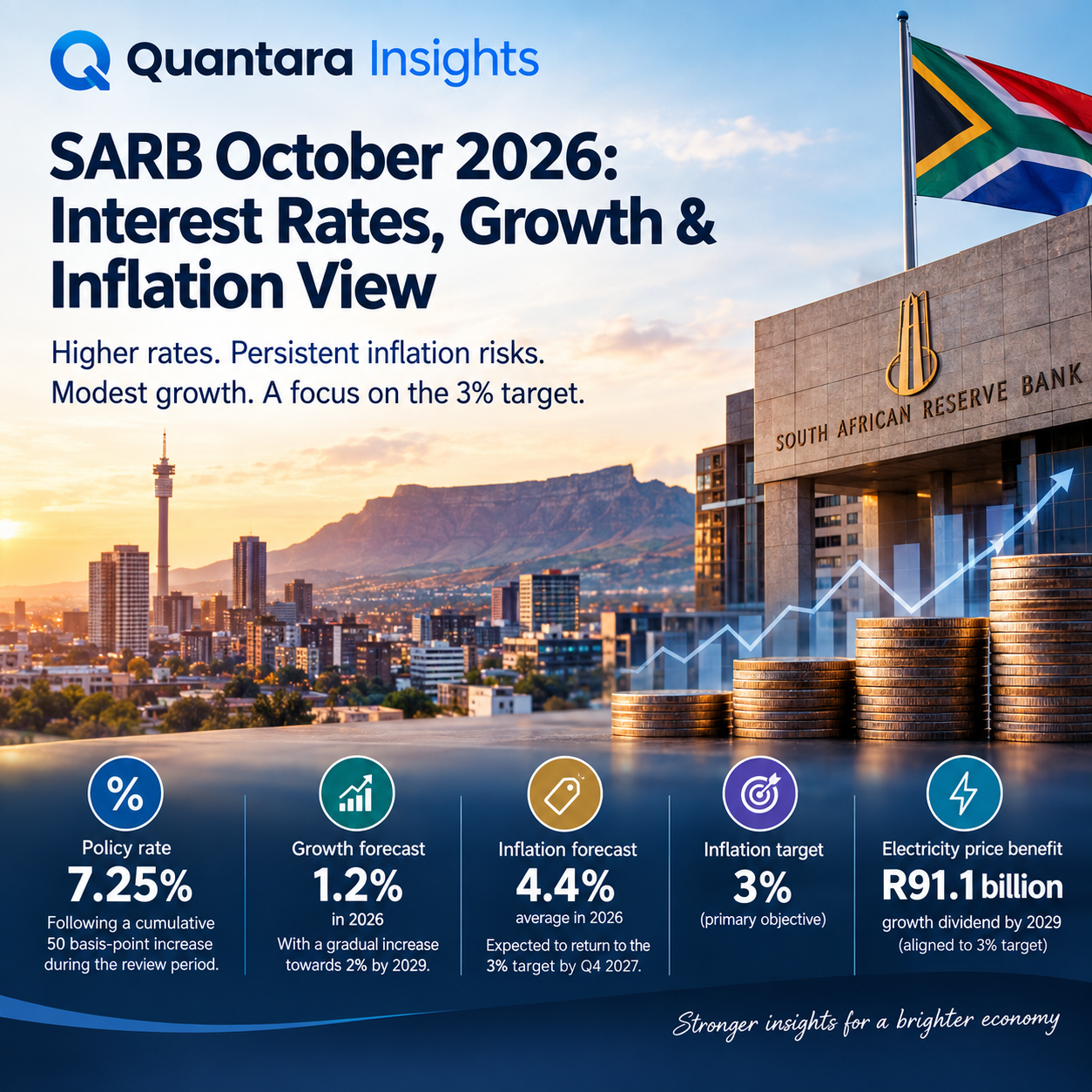
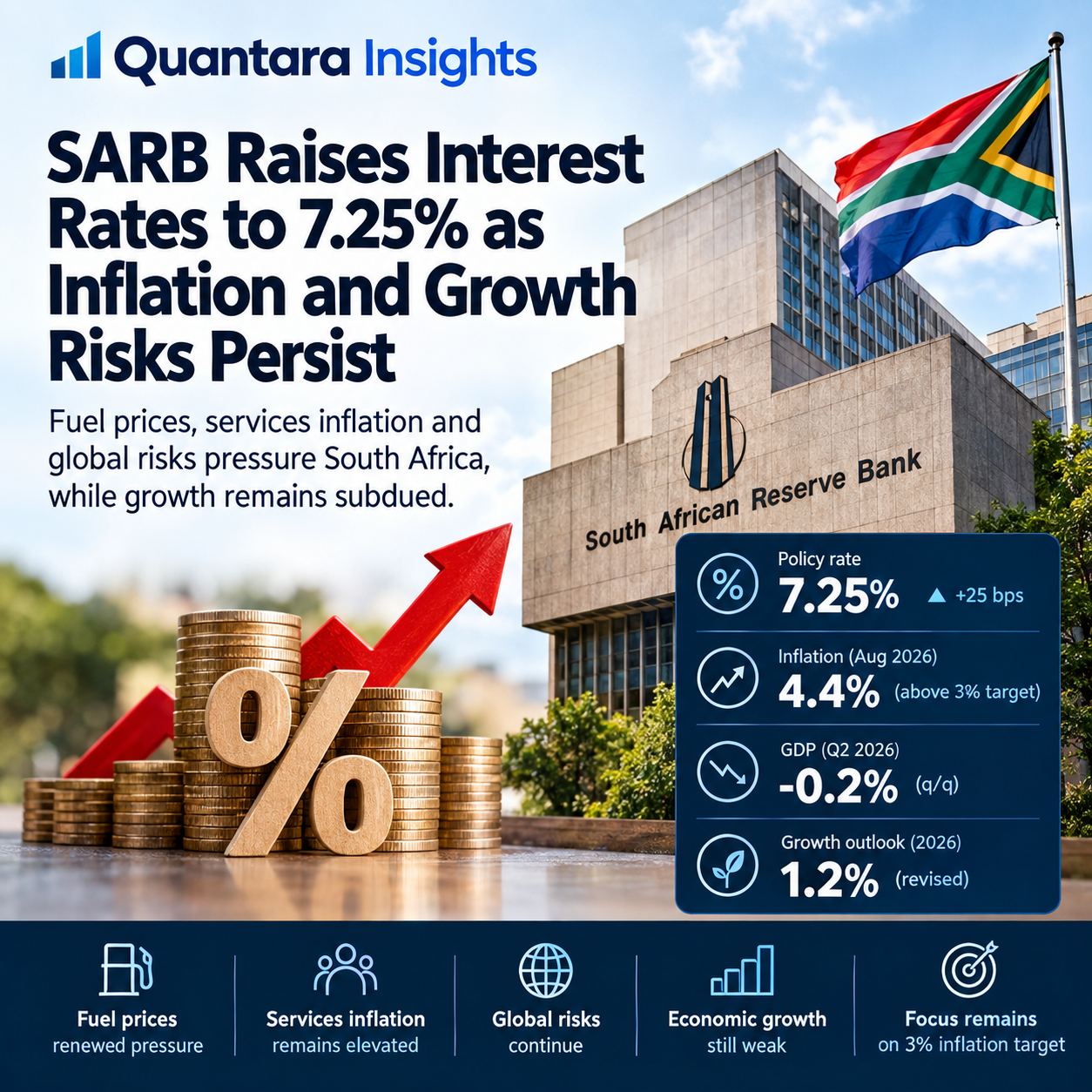
The most important headline is clear. The SARB policy rate is now 7.25%, following a cumulative 50-basis-point increase over the April-to-October review period. The increases came through two 25-basis-point moves, while the July meeting left rates unchanged.
At the same time, the growth outlook remains restrained. The SARB forecasts South African economic growth of approximately 1.2% in 2026, down from the 1.4% forecast in the April review. The longer-term outlook is more constructive, with growth expected to move gradually towards 2% by 2029 as structural reforms improve confidence, investment and economic capacity.
Inflation is the more immediate concern.
The October review shows how the energy shock has changed the inflation environment. Headline inflation increased from 3.2% in the first quarter of 2026 to 4.5% in the second quarter, with the SARB expecting inflation to remain elevated before returning towards the 3% target later in the forecast period.
This creates an important policy challenge.
Higher interest rates can help prevent temporary price increases from becoming embedded in wages and broader pricing behaviour. However, higher rates can also place pressure on households, businesses, investment and economic activity.
That trade-off is at the centre of the MPR outlook.
The October review is therefore not simply a story about whether rates will rise or fall next. It is about whether inflation pressures can be contained without unnecessarily weakening the recovery in economic growth.
What Is the SARB Saying in October 2026?
The October 2026 review presents a monetary policy environment that is considerably more complicated than the relatively benign inflation conditions seen before the latest energy shock.
The SARB says the international environment has been affected by disruptions to energy supplies, higher oil prices, wider refinery margins and increased transport and production costs.
These pressures have increasingly moved beyond headline fuel prices.
The concern is that an initial supply shock can eventually influence a much wider range of prices.
Fuel affects transportation. Transportation affects distribution. Distribution affects production and retail costs. Energy costs affect businesses. Businesses may eventually pass some of those costs through to consumers.
That process is what makes second-round inflation effects important.
The October MPR review specifically examines the risk that the energy shock could become more persistent through wages, prices and inflation expectations.
For the SARB, preventing this process from becoming entrenched is a central policy priority.
The Bank therefore raised the policy rate by a cumulative 50 basis points during the review period, taking the rate to 7.25%.
The decision reflects the fact that monetary policy operates with a lag. By the time inflation becomes fully visible in official data, some of the underlying pressure may already have spread through the economy.
That makes the policy response forward-looking rather than simply reactive.
SARB Interest Rates Reach 7.25%
The most important number for borrowers and financial markets is the current 7.25% policy rate.
The SARB increased rates by 25 basis points at the May meeting and another 25 basis points at the September meeting. The July meeting resulted in no change. Together, those decisions produced the cumulative 50-basis-point increase during the review period.
The increase needs to be understood within the broader inflation environment.
The objective was not simply to respond to one month of higher prices. Instead, policymakers were assessing whether the fuel and energy shock could become persistent enough to influence inflation expectations and wage-setting behaviour.
The distinction is important.
A temporary increase in petrol prices does not necessarily require a large monetary policy response if policymakers believe inflation will quickly return to target.
A persistent shock is different.
If households and companies begin to expect higher inflation for longer, businesses may increase prices more aggressively, employees may seek larger wage increases and consumers may adjust their behaviour.
That can make inflation more difficult to reverse.
The SARB describes the current policy stance as moderately restrictive. At the same time, the review notes that higher inflation has limited the increase in real interest rates because the inflation rate itself has risen.
This is one reason the interest-rate outlook cannot be judged by the nominal policy rate alone.
Why Interest Rates Matter for South Africa
Interest rates influence the economy through several channels.
For households, higher rates can increase the cost of servicing variable-rate debt and reduce disposable income.
For businesses, higher financing costs can affect investment decisions, expansion plans and working capital.
For consumers, tighter financial conditions can reduce discretionary spending.
For investors, interest-rate changes influence the relative attractiveness of different asset classes and can affect exchange-rate expectations and capital flows.
For the wider economy, the impact depends on the strength of the transmission mechanism and the reasons behind the rate increase.
This is particularly relevant in the current environment.
The SARB is dealing with an inflation shock that originates significantly from supply-side pressures. Monetary policy cannot produce more oil, repair global refineries or directly increase agricultural supply.
Higher rates therefore cannot eliminate the original source of the shock.
Their role is different.
The objective is to prevent the initial shock from spreading into broader inflation.
The October review explains that supply shocks create a difficult trade-off because they can increase inflation while simultaneously weakening economic activity.
That is why the current interest rates debate is more nuanced than simply asking whether higher rates are good or bad for the economy.
The key question is whether the policy stance is sufficiently restrictive to prevent inflation expectations from becoming entrenched while remaining appropriate for an economy where growth is still relatively weak.
Inflation Is the Central SARB Concern
Inflation has become the most important factor shaping the current SARB policy outlook.
According to the October review, headline inflation increased from 3.2% in the first quarter of 2026 to 4.5% in the second quarter. The review projects headline inflation to average approximately 4.4% for 2026.
The inflation picture is being influenced heavily by fuel and energy-related developments.
The report notes that inflation is expected to remain elevated before returning towards the 3% target in the fourth quarter of 2027.
That means the current inflation episode is not being treated as a short-lived monthly fluctuation.
The SARB is concerned about persistence.
This matters because the longer inflation remains elevated, the greater the risk that expectations change.
If households believe prices will continue rising rapidly, they may alter spending behaviour. If businesses expect higher input costs, they may adjust prices. If workers expect higher living costs, wage negotiations may reflect those expectations.
The result can be a feedback loop.
That is the second-round effect that the October review examines in considerable detail.
What Are Second-Round Inflation Effects?
Second-round effects occur when an initial price shock begins influencing other prices and wages across the economy.
A useful example is fuel.
Suppose the price of fuel rises sharply.
The immediate effect is visible at petrol stations.
But fuel is also an important input into transportation, logistics, agriculture, manufacturing and distribution.
Higher transport costs can increase the cost of moving goods.
Higher distribution costs can increase retail prices.
Higher operating costs can reduce business margins.
Businesses may then pass some of those costs on to customers.
Workers may also face higher living expenses and seek higher wages.
If wage increases then raise business costs, companies may respond with further price increases.
This is why the SARB is watching the current fuel shock closely.
The October review states that the risk of second-round effects has increased as the shock has persisted, particularly through inflation expectations and wage-setting.
The policy challenge is timing.
Waiting until second-round effects are obvious could mean that inflation has already become entrenched.
But tightening monetary policy too aggressively in response to a supply shock could unnecessarily weaken growth.
The SARB therefore has to make decisions using forecasts, expectations and evidence about how the shock is moving through the economy.
Fuel Prices and Refinery Margins Add to the Inflation Risk
The October MPR review highlights an important issue beyond the crude oil price itself: refinery margins.
This distinction is important because consumers may assume that falling crude oil prices automatically mean fuel prices will fall by a similar amount.
The relationship is not always that simple.
The review explains that global refinery margins increased sharply during 2026 as disruptions reduced the availability of refined products. South Africa’s reliance on imported refined fuel means global refining conditions can have a meaningful impact on domestic fuel prices.
This creates an additional risk for the inflation outlook.
Even if crude oil prices were to moderate, elevated refinery margins could keep fuel inflation higher than expected.
That creates uncertainty for both consumers and policymakers.
For households, fuel costs affect transport budgets.
For businesses, fuel affects logistics and operating expenses.
For agriculture, diesel costs can influence production and distribution.
For manufacturers and retailers, transportation costs can feed into pricing.
The SARB therefore cannot focus only on the crude oil price.
It also needs to consider refining capacity, margins, exchange-rate movements and the duration of the energy shock.
The Rand Provides Some Protection Against Imported Inflation
The exchange rate is another important part of the inflation equation.
A stronger rand can help reduce the local-currency cost of imported goods and commodities.
The October review notes that the rand has remained relatively resilient during the review period and has helped cushion some of the impact of higher crude oil prices and imported goods.
That resilience matters.
If the rand were to weaken sharply while global energy prices remained elevated, imported inflation could become more pronounced.
A weaker currency increases the rand cost of imported products.

For an economy exposed to imported fuel, machinery, intermediate goods and other commodities, this can add to domestic price pressures.
The SARB therefore continues to monitor global interest rates, capital flows, risk sentiment and commodity markets.
These external factors can influence domestic financial conditions even when the underlying South African economy has not changed significantly.
The 3% Inflation Target Is Now Central to Policy
Another major development is South Africa’s move to a 3% point inflation target.
The October review explains that the 3% point target was adopted in 2025, replacing the previous 3% to 6% target band.
This change has implications for the way inflation is assessed.
The objective is now more clearly centred on bringing inflation back to 3% and keeping it there over time.
The SARB describes price stability as essential for protecting purchasing power and supporting balanced and sustainable economic growth.
The target therefore has implications beyond monetary policy.
Stable and predictable inflation can improve the environment for investment, business planning and household financial decisions.
However, moving inflation back to target after a supply shock can take time.
The October review indicates that inflation is expected to return to target during the latter part of 2027.
This means the SARB is effectively navigating a period in which inflation remains above target while interest rates are already elevated.
South Africa’s Growth Outlook Remains Modest
The second major theme of the October review is growth.
The SARB expects South African economic growth to average 1.2% in 2026, compared with 1.1% in 2025.
However, the forecast is lower than the 1.4% projection contained in the April review.
The economy experienced a contraction in the second quarter after growing by 0.4% in the first quarter.
The slowdown was associated with the fuel-price shock, weaker confidence and a reversal in net exports.
This illustrates the difficulty facing monetary policymakers.
The same factors contributing to higher inflation can also weaken economic activity.
Higher fuel prices increase inflation, but they also reduce the purchasing power of households and increase costs for businesses.
Higher interest rates can help contain inflation, but they can also reduce spending and investment.
That creates a difficult policy environment.
The SARB therefore needs to distinguish between temporary weakness and deeper structural constraints.
Why Growth Could Improve Over the Medium Term
Despite the weak near-term environment, the October review contains a more positive medium-term outlook.
The SARB expects economic activity to strengthen gradually as global growth improves and confidence and investment recover.
Structural reforms are an important part of this outlook.
The review points to progress under Operation Vulindlela and continued improvements in energy and logistics as factors that could support economic capacity.
Real GDP and potential output are projected to reach approximately 2% by 2029.
That is significant because monetary policy alone cannot deliver sustainable long-term growth.
Lower interest rates can support demand when inflation conditions allow, but sustainable economic expansion requires stronger productivity, infrastructure, investment and business conditions.
This is one of the most important messages in the October SARBMPROct26 review.
Monetary policy can create conditions for stability, but structural reforms remain critical to improving the economy’s long-term growth potential.
Electricity Prices Could Have a Major Impact on Growth
One of the more notable findings in the October review concerns electricity prices.
The report examines what could happen if electricity-price increases were aligned with the 3% inflation target.
The modelling indicates that lower electricity-price inflation could support both economic growth and household purchasing power.
Under the scenarios examined by the SARB, aligning electricity-price increases with the 3% inflation target could produce cumulative output gains of approximately 1.3 percentage points by 2029 compared with the high-tariff scenario.
The report calculates the associated growth dividend at approximately R91.1 billion.
This is an important economic finding.
Electricity is a fundamental input for households and businesses.
When electricity prices rise rapidly, households have less disposable income available for other spending.
Businesses face higher production costs.
Companies may reduce investment or pass higher costs through to customers.
Higher electricity inflation can also create additional pressure for monetary policy.
The result can be a cycle in which higher administered prices contribute to inflation, tighter policy increases borrowing costs and weaker demand reduces growth.
The SARB therefore identifies energy reform as an important part of improving the country’s long-term economic performance.
Why Energy Reform Matters for Interest Rates
Energy reform is often discussed as an infrastructure issue, but the October review demonstrates why it is also relevant to monetary policy.
If electricity prices rise significantly, the immediate effect is higher household and business costs.
Those increases can contribute to inflation.
If inflation becomes persistent, monetary policy may need to remain tighter.
That means higher interest rates could persist for longer than otherwise necessary.
Conversely, if energy reforms reduce costs and improve reliability, the economy can benefit through several channels.
Businesses can operate with greater certainty.
Households can face more predictable costs.
Investment decisions can become easier.
Production capacity can improve.
Inflationary pressure can moderate.
Economic growth can strengthen.
The electricity scenario in the October review therefore reinforces a broader point: monetary policy and structural economic reform are interconnected.
What Does The MPR Mean for Businesses?
For businesses, the October MPR outlook points to a period in which cost management and pricing decisions remain important.
Higher fuel prices, electricity costs and financing expenses can put pressure on margins.
Companies may need to balance the need to recover higher costs with the risk that consumers are increasingly price-sensitive.
The SARB’s industry intelligence also provides useful context.
The review reports that businesses have experienced a challenging environment, with value-conscious consumers and extensive promotional activity among retailers. Manufacturers have also reported limited incentives to increase production where demand conditions remain weak.
This helps explain why inflation and growth cannot be considered separately.
Businesses may face higher input costs at the same time as customers become more cautious.
That can make it difficult to pass the entire increase through to final prices.
The result can be weaker margins, lower investment or reduced production.
For companies with significant debt exposure, the 7.25% policy rate also remains relevant because financing conditions are likely to remain more restrictive than they would under a low-inflation environment.
What Does the SARB Outlook Mean for Households?
For households, the most visible effects of the current environment are likely to come through borrowing costs, fuel, food, electricity and general living expenses.
The SARB has a mandate focused on price stability because persistent inflation reduces purchasing power.
Inflation effectively means that the same amount of money buys fewer goods and services over time.
This is particularly important for households with limited flexibility in their budgets.
The October review describes inflation as a regressive burden because higher prices tend to have a disproportionate effect on lower-income households.
At the same time, higher interest rates can create pressure for households with variable-rate debt.
This creates a difficult situation.
The policy response designed to prevent persistent inflation can itself create financial pressure in the short term.
The longer-term objective is therefore to restore price stability so that households and businesses can make financial decisions in a more predictable environment.
The Food Inflation Risk Cannot Be Ignored
Fuel is not the only inflation risk identified by the SARB.
The October review also highlights potential food-price risks associated with El Niño conditions, fertiliser availability and global agricultural commodity prices.
Although the baseline outlook does not assume a severe El Niño event, the report identifies it as an upside risk.
Higher agricultural input costs can affect domestic food prices.
Weather conditions can influence harvests.
Global commodity prices can affect imported food and agricultural inputs.
These factors could add to inflation at a time when the SARB is already monitoring elevated fuel and services inflation.

Food prices are particularly important because they have a direct effect on household budgets.
A renewed food-price shock could therefore complicate the inflation outlook even if fuel prices begin to moderate.
Global Interest Rates Still Matter
South Africa does not operate in isolation.
Global interest rates, particularly US monetary policy, can influence emerging-market currencies, capital flows and domestic financial conditions.
The October review notes that changes in US interest rates can affect emerging markets through borrowing costs, capital flows and exchange rates.
For South Africa, the exchange-rate channel is particularly relevant.
If global interest rates remain high, investors may favour assets offering attractive returns in developed markets.
That can place pressure on emerging-market currencies.
A weaker rand can increase the local cost of imported goods and fuel.
The SARB therefore has to consider both domestic inflation and the external financial environment.
However, the Bank’s policy decisions remain primarily focused on domestic inflation and economic activity.
Global developments matter because they can change the domestic environment through financial and exchange-rate channels.
What Could Happen to Interest Rates Next?
The October review does not provide a simple answer to the question of whether interest rates will rise or fall at the next meeting.
That is because monetary policy decisions depend on incoming data and the balance of risks.
The important factors to monitor include:
- Inflation outcomes
- Fuel prices
- Refinery margins
- Inflation expectations
- Wage developments
- The rand exchange rate
- Food prices
- Electricity-price developments
- Global interest rates
- Economic growth
- Business confidence
- Investment activity
The SARB has made clear that the policy priority is to prevent temporary supply shocks from becoming persistent inflation.
That means the path for interest rates will depend heavily on whether inflation pressures begin to moderate in a sustained way.
If inflation falls towards target and expectations remain anchored, pressure for further tightening could diminish.
If inflation remains elevated and second-round effects become more visible, monetary policy may need to remain restrictive for longer.
The timing of future rate changes therefore depends on the data rather than a predetermined schedule.
Why the 2026 Growth Forecast Matters
A 1.2% growth forecast may appear modest, but it needs to be considered in context.
South Africa has faced structural constraints for several years, including infrastructure limitations, weak investment, logistics challenges and energy costs.
The October SARB review suggests that progress in reforms can gradually improve the outlook.
The medium-term goal is not simply to achieve a temporary increase in GDP.
It is to raise potential output.
Potential output refers to the economy’s capacity to produce goods and services sustainably without generating excessive inflationary pressure.
That distinction matters.
If an economy grows only because demand rises temporarily while productive capacity remains constrained, inflation pressures can emerge.
If productivity, infrastructure, investment and competitiveness improve, the economy can potentially grow faster without creating the same inflation pressures.
This is why structural reforms feature prominently in the MPR outlook.
The Policy Trade-Off: Inflation Versus Growth
The central economic challenge facing the SARB can be summarised as a policy trade-off.
On one side is inflation.
Persistent inflation reduces purchasing power and can undermine confidence in the inflation target.
On the other side is growth.
Excessively restrictive monetary policy can weaken demand, investment and economic activity.
The current environment makes the trade-off particularly difficult because the initial inflation shock is largely supply-driven.
If fuel prices rise because global refining capacity has been disrupted, higher South African interest rates cannot directly increase global fuel supply.
But policymakers can influence what happens next.
They can seek to prevent the shock from spreading into wages, expectations and broader price-setting behaviour.
That is the reasoning behind the current policy stance.
The SARB is effectively trying to contain the secondary effects of the shock while allowing the original supply pressures to eventually fade.
What the October 2026 SARB Review Says About the Longer-Term Outlook
The longer-term outlook is more constructive than the immediate inflation and growth picture might suggest.
The October review identifies domestic reforms as a cornerstone of macroeconomic resilience.
Energy and logistics improvements can support productivity.
Better infrastructure can reduce business costs.
Improved confidence can encourage investment.
Greater investment can expand productive capacity.
Higher productive capacity can support stronger growth without creating the same inflation pressures associated with supply constraints.
This is particularly important for South Africa because the country needs more than a short-term recovery.
It needs sustained improvements in productivity and investment.
The SARB therefore places monetary policy within a broader economic framework.
Stable inflation creates an environment in which businesses and households can plan.
Structural reform improves the economy’s ability to grow.
Fiscal consolidation can support confidence and reduce sovereign risk.
Together, these factors can strengthen macroeconomic resilience.
Key Risks to Watch Through 2026 and 2027
Several risks could materially change the economic outlook.
1. A prolonged energy shock
If global energy disruptions continue, fuel prices could remain elevated.
That could delay the decline in inflation.
2. Higher refinery margins
Even if crude oil prices moderate, refinery constraints could keep refined fuel prices higher than expected.
3. Inflation expectations
If households, businesses and workers begin to expect persistently higher inflation, second-round effects could become stronger.
4. Food prices
El Niño conditions, fertiliser costs and global agricultural prices could increase food inflation.
5. Rand weakness
A significant depreciation of the rand could increase imported inflation.
6. Global monetary policy
Higher-for-longer global interest rates could place pressure on emerging markets.
7. Weak domestic demand
Consumers facing higher costs and borrowing expenses may reduce discretionary spending.
8. Investment weakness
Businesses may delay capital spending if demand remains uncertain and financing costs remain high.
9. Structural reform delays
Slower progress in energy, logistics and local government reform could limit the improvement in potential growth.
These risks do not all point in the same direction.
Some are inflationary.
Others are growth-negative.
That is why the SARB needs to continually reassess the balance of risks.
SARB October 2026: The Numbers That Matter Most
For readers wanting the key information at a glance, the October review highlights several numbers that define the current economic environment.
Policy rate: 7.25%
Cumulative rate increase during the review period: 50 basis points
2026 growth forecast: 1.2%
2026 inflation forecast: 4.4% average
Inflation target: 3%
Expected return towards the inflation target: Fourth quarter of 2027
Medium-term growth direction: Towards approximately 2% by 2029
Potential growth benefit from aligning electricity-price increases with the 3% inflation target: Approximately R91.1 billion in cumulative output terms by 2029 compared with the high-tariff scenario.
These figures illustrate the basic policy challenge.
Inflation is above target.
Interest rates are elevated.
Growth is modest.
And structural reforms remain critical to improving the longer-term outlook.
What Should Businesses and Investors Watch Next?
The next phase of the SARB story will be determined by whether the inflation shock begins to fade and whether the economy shows signs of stabilising.
Several indicators will be particularly important.
Inflation data
A sustained decline would reduce pressure on monetary policy.
Fuel prices
Changes in oil prices and refinery margins will remain important.
Inflation expectations
The behaviour of expectations will help determine whether second-round effects are becoming more significant.
Wage growth
Wage settlements will provide another indication of whether the inflation shock is spreading.
Economic activity
GDP, retail sales, business confidence and investment data will help determine whether the economy is gaining momentum.
The rand
Currency stability can help contain imported inflation.
Electricity costs
Energy prices remain important for both inflation and growth.
Global rates
Changes in major central-bank policy can affect capital flows and emerging-market financial conditions.
Taken together, these indicators will help determine how long the current restrictive monetary policy stance remains appropriate.
SARB and the Outlook for 2027
The 2027 outlook will depend heavily on whether the current inflation shock begins to unwind.
The SARB expects inflation to remain elevated before gradually moving back towards the 3% target.
That creates the possibility of a period in which interest rates remain relatively restrictive even as inflation begins to moderate.
This is an important point for anyone following the interest rates outlook.
The policy rate does not necessarily fall immediately when inflation starts to decline.
Policymakers also need confidence that the decline is sustainable.
If inflation expectations remain elevated or second-round effects continue, the Bank may need to maintain a restrictive stance for longer.
Conversely, if inflation falls consistently and economic weakness becomes more pronounced, the balance of risks could eventually change.
The policy path will therefore depend on the interaction between inflation and growth, rather than either indicator alone.
The Bigger Economic Picture
The October 2026 SARB review provides a useful reminder that monetary policy is only one part of the economic equation.
Interest rates can influence demand and expectations.
They cannot directly repair electricity infrastructure.
They cannot expand port capacity overnight.
They cannot solve global refinery shortages.
They cannot create agricultural supply.
They cannot independently generate higher productivity.
Those challenges require structural and institutional responses.
The role of monetary policy is to maintain price stability and protect the purchasing power of the currency while supporting conditions for sustainable economic activity.
That is why the current SARB approach focuses heavily on preventing temporary supply shocks from becoming persistent inflation.
The broader objective is to restore price stability without unnecessarily damaging the economy’s productive capacity.
What SARB October 2026 Means in Practical Terms
For households, the message is that borrowing costs remain elevated while inflation continues to affect living expenses.
For businesses, the environment remains challenging because input costs and financing costs are higher while consumer demand remains sensitive to prices.
For policymakers, the challenge is to contain inflation without unnecessarily weakening economic activity.
For investors, the outlook depends on the interaction between domestic inflation, global financial conditions, the rand, commodity markets and structural reform.
For the broader economy, the medium-term opportunity lies in improving energy, logistics, investment and productivity conditions.
The October MPR review therefore provides a balanced picture.
The near-term environment remains difficult.
But the medium-term outlook has room for improvement if reforms continue and inflation returns sustainably towards target.
Conclusion: Where the SARB Stands in October 2026
The October 2026 SARB review shows that South Africa’s monetary policy environment has changed significantly during the year.
The policy rate has risen by a cumulative 50 basis points to 7.25% as policymakers respond to stronger and more persistent inflation risks.
Inflation has moved higher because of fuel and energy pressures, while the possibility of second-round effects has become more important.
At the same time, economic growth remains modest, with the 2026 forecast at 1.2%.
This combination creates a difficult environment for monetary policy.
The SARB cannot directly eliminate global energy shortages or refinery constraints. Its role is to prevent those shocks from becoming embedded in domestic inflation expectations, wages and broader price-setting behaviour.
The 3% inflation target is therefore central to the policy outlook.
Returning inflation sustainably to target should help restore purchasing power and create a more predictable environment for businesses, households and investors.
The medium-term outlook is more encouraging.
The SARB expects growth to improve gradually towards approximately 2% by 2029 as reforms support investment, confidence, energy availability and economic capacity.
The electricity-price analysis in the October review is particularly significant, showing how structural reforms can complement monetary policy. Aligning electricity-price increases with the 3% inflation target could deliver meaningful output benefits, with the review estimating a cumulative growth dividend of approximately R91.1 billion by 2029 compared with the high-tariff scenario.
Ultimately, the next stage of the SARB story will depend on whether inflation pressures begin to moderate, whether expectations remain anchored and whether structural reforms translate into stronger economic activity.
For now, the central message is straightforward: interest rates are higher because inflation risks have increased, but the longer-term objective remains stable prices combined with stronger and more sustainable growth.