








Table of Contents
- Economic Report: Key Events From September 1 to September 4
- Economic Report: Tuesday Focuses on Eurozone Inflation and ISM Manufacturing
- US ISM Manufacturing: A Key Test of Industrial Activity
- Economic Report: Wednesday Brings RBNZ, BoC and Australian GDP
- RBNZ Policy Decision: Inflation Keeps Pressure on Policymakers
- Bank of Canada: Policy Hold Expected
- Australian GDP: Growth Versus Inflation
- US ADP Employment: A Preliminary Jobs Signal
- Economic Report: Thursday Centres on ISM Services
- Swiss CPI: Low Inflation Keeps the SNB in Focus
- Friday Economic Report: NFP and Jobs Take Centre Stage
- Wage Growth Could Shape the Fed Reaction
- Payroll Revisions Could Be Critical
- Barclays’ Lower Jobs Forecast Highlights Uncertainty
- Federal Reserve Policy and the Jobs Report
- Canadian Jobs Report
- Economic Report: Week in Review
- RBA Minutes: Inflation Risks Remain Relevant
- Australian CPI Review
- US PCE Review
- Nvidia Earnings: AI Investment Remains a Major Growth Theme
- Bank of Korea Policy Review
- ECB Minutes Review
- Tokyo CPI Review
- Fed Chair Warsh: Inflation Remains the Central Concern
- What the Economic Report Means for Markets
- Why ISM Manufacturing and ISM Services Matter Together
- Jobs Remain the Key Market Variable
- Economic Report: Key Market Indicators to Watch
- Economic Report: What Matters Most This Week
- Economic Report: A Week Defined by Policy Trade-Offs
- Conclusion: Data Will Define the Next Stage of Market Expectations
- Frequently Asked Questions About the Economic Report
- What is the most important economic release this week?
- What is NFP?
- Why is ISM Manufacturing important?
- Why is ISM Services important?
- What does the Jobs Report tell investors?
- Why do wage numbers matter for interest rates?
- Why are payroll revisions important?
- How can NFP affect the US dollar?
- How can ISM data affect markets?
- What should investors watch besides NFP?
- Why is eurozone CPI important?
- What is the main issue facing the Federal Reserve?
- Economic Report: Final Takeaways
The first trading week of September brings a concentrated set of economic releases that could influence expectations for interest rates, currencies, bonds and equities. The Economic Report calendar for September 1-4 includes the US NFP report, ISM Manufacturing, ISM Services, eurozone inflation, central-bank decisions in New Zealand and Canada, Australian GDP, Swiss inflation and Canadian Jobs data.
The timing is important because markets are entering a period in which monetary-policy expectations remain sensitive to the balance between inflation and labour-market conditions. Investors are therefore likely to examine not only the headline numbers but also the underlying components of each release.
For the United States, the combination of ISM Manufacturing, ISM Services, ADP employment data and the August Jobs Report provides several different views of economic activity. The NFP release on Friday will receive the greatest attention because it provides a broader assessment of employment, unemployment and wage growth.
The Economic Report also extends beyond the United States. Eurozone CPI could provide another indication of how higher energy costs are feeding into consumer prices, while the Reserve Bank of New Zealand and Bank of Canada are scheduled to announce monetary-policy decisions. Australia and Switzerland will also release important data during the week.
The result is a calendar where several seemingly separate releases are connected by the same underlying questions: How strong is economic activity? How persistent is inflation? How resilient are labour markets? And how much room do central banks have to adjust policy?
Economic Report: Key Events From September 1 to September 4
The week begins on Tuesday with a broad collection of manufacturing and inflation data. The main events include eurozone preliminary CPI and US ISM Manufacturing.
Wednesday shifts attention toward central banks and growth, with the RBNZ and Bank of Canada decisions alongside Australian GDP and US ADP employment.
Thursday brings the US ISM Services report, Swiss economic data and final services and composite PMI readings across major economies.
Friday is dominated by the US Jobs Report and Canadian employment data.
Tuesday
- US midterm primary elections
- Chinese manufacturing PMI
- German retail sales
- Eurozone, UK and US final manufacturing PMIs
- Eurozone preliminary CPI
- US ISM Manufacturing PMI
Wednesday
- RBNZ monetary-policy announcement
- Bank of Canada monetary-policy announcement
- Australian Q2 GDP
- South Korean CPI
- US factory orders and durable goods
- US ADP employment
Thursday
- Swiss CPI
- Swiss GDP
- Eurozone, UK and US final services and composite PMIs
- US ISM Services PMI
Friday
- German factory orders
- Eurozone retail sales
- US Jobs Report
- Canadian Jobs Report
The Economic Report calendar therefore moves from inflation and manufacturing through monetary policy and services before ending with the most closely watched labour-market releases.
Economic Report: Tuesday Focuses on Eurozone Inflation and ISM Manufacturing
Tuesday’s data will provide an early indication of how inflation and industrial activity are developing as September begins.
The eurozone CPI report will be closely monitored because energy prices have become a more important component of the inflation outlook. At the same time, the US ISM Manufacturing report will offer insight into production, new orders, inventories, prices and factory employment.
These two releases address different parts of the economy, but together they can help establish the tone for the week.
Eurozone Preliminary CPI: Inflation Remains the Main Question
The preliminary August eurozone CPI reading is expected to show a renewed increase in headline inflation. The working expectation is for monthly inflation to accelerate to approximately 0.4%, from 0.2% previously, while annual headline inflation could rise to around 3.2%, compared with 2.9%.

Core annual inflation is expected to remain around 2.5%.
The composition of the report will be particularly important.
Recent inflation developments in France and Spain have already pointed toward stronger price pressures. Energy is also becoming a significant consideration because oil prices have remained elevated and European natural-gas prices have moved toward three-month highs amid concerns surrounding storage levels.
Energy inflation could therefore provide a significant contribution to the headline number.
The Economic Report focus should nevertheless remain on whether higher energy costs are feeding into broader price categories.
That distinction matters for monetary policy.
A temporary increase in energy prices does not necessarily imply persistent inflation. However, if higher energy costs begin to influence wages, services and other prices, central banks face a more difficult policy environment.
Services inflation is expected to remain around 3.3%. That will keep the underlying inflation picture important for the European Central Bank.
ECB Policy Expectations
The ECB has increasingly had to assess the possibility that supply-side price pressures could generate broader inflation effects.
The concern is not simply the immediate increase in energy prices. Policymakers must consider whether businesses pass higher input costs to consumers, whether employees seek compensation for higher living costs and whether those developments become embedded in inflation expectations.
That is the second-round effect that policymakers are watching.
The August inflation data may not fundamentally change the immediate policy outlook, particularly if markets already expect further tightening. However, the report could influence expectations for the later stages of the year.
The Economic Report takeaway for Europe is therefore straightforward: headline inflation matters, but the persistence of services and underlying inflation will be more important for assessing the policy path.
US ISM Manufacturing: A Key Test of Industrial Activity
The US ISM Manufacturing PMI will be one of Tuesday’s most important releases.
The headline index is expected to ease modestly to around 55.3 in August from 55.6 in July.
A reading above 50 indicates expansion, meaning that a result around the mid-50s would still point to growth in manufacturing activity. The question is whether the pace of expansion is becoming less pronounced.
Recent S&P Global manufacturing indicators have pointed toward some moderation in output and new orders.
The flash manufacturing PMI declined to 53.2 in August from 53.9, while the output index fell to 51.9 from 53.9.
Those figures suggest that manufacturing remains in expansion territory but that momentum has weakened.
Production and New Orders
Production growth has reportedly slowed for a third consecutive month, while new orders have weakened.
That combination is important.
Manufacturing companies typically respond to changes in demand through production schedules, inventories, hiring and purchasing activity. When new orders slow, businesses can become more cautious about adding capacity or increasing employment.
Inventories are also relevant.
Earlier precautionary stock-building had provided support to manufacturing activity as companies attempted to protect themselves against supply disruptions. If that stock-building fades, the underlying pace of demand becomes easier to assess.
The Economic Report will therefore pay particular attention to new orders and production rather than relying solely on the headline PMI.
Supply Chains and Input Prices
Supply-chain conditions remain another important component.
Longer supplier delivery times can sometimes signal stronger demand, but they can also reflect transportation problems, tariffs, geopolitical disruptions or shortages of available goods.
That makes the supplier-delivery component especially relevant during a period of elevated geopolitical and trade uncertainty.
At the same time, input-cost inflation has moderated in recent months. Selling-price inflation has also eased.
That would provide some relief on the inflation side if the trend continues.
For markets, the ideal outcome would be continued manufacturing expansion accompanied by softer price pressures.
That combination would suggest that economic activity can remain resilient without creating an immediate acceleration in inflation.
Manufacturing Jobs
Employment within manufacturing will also be watched.
Factory payrolls have increased modestly, with the recent gain representing the strongest improvement since May.
Although manufacturing employment is only one component of the wider US labour market, it can provide a useful signal ahead of the broader NFP report.
The Economic Report therefore treats ISM Manufacturing as more than a simple PMI release. The details can help establish expectations for the wider economic picture later in the week.
Economic Report: Wednesday Brings RBNZ, BoC and Australian GDP
Wednesday is dominated by central-bank decisions and economic growth data.
The Reserve Bank of New Zealand and Bank of Canada will both announce monetary-policy decisions, while Australian GDP will provide a fresh assessment of growth.
US ADP employment will also help shape expectations ahead of Friday’s NFP report.
RBNZ Policy Decision: Inflation Keeps Pressure on Policymakers
The Reserve Bank of New Zealand is expected to continue tightening policy, with market expectations centred on another 25-basis-point increase.
The previous decision marked the first rate increase in more than three years. The central bank indicated that additional reductions in monetary stimulus could be required to return inflation to the midpoint of its target range.
The inflation data since then has strengthened the case for further action.
New Zealand CPI for the second quarter increased 1.5% quarter-on-quarter, compared with expectations of 1.4%, while annual inflation accelerated to 4.1% from 3.1%.
That places inflation clearly above the RBNZ’s medium-term 1-3% target range.
The labour market has provided a more mixed signal.
Employment increased 0.5% in the second quarter, stronger than the 0.1% expectation. However, unemployment unexpectedly increased to 5.6% from 5.4%.
Participation also increased to 70.7% from 70.4%.
This combination is significant because stronger participation can allow unemployment to rise even when employment itself is increasing.
The Economic Report interpretation is therefore not simply that the New Zealand economy is weakening or strengthening. Instead, policymakers face a combination of elevated inflation and a labour market that is showing some signs of softer conditions.
That balance will be important for the future policy path.
What the RBNZ Decision Means for Markets
A 25-basis-point increase is already widely anticipated.
As a result, the immediate market reaction may depend more heavily on the accompanying statement and guidance.
If the RBNZ signals that additional increases are likely, the New Zealand dollar could receive support as markets adjust expectations for future rates.
If policymakers indicate that the latest increase provides sufficient restraint, the reaction could be more limited.
The Economic Report focus should therefore be on the forward policy signal rather than the rate decision alone.
Bank of Canada: Policy Hold Expected
The Bank of Canada is expected to leave its policy rate unchanged at 2.25%.
The Canadian economy is dealing with a different combination of challenges.
Trade tensions with the United States remain a significant source of uncertainty, particularly following the deterioration in bilateral trade negotiations.
Potential retaliatory tariffs could weaken economic growth while simultaneously increasing some consumer prices.
That creates a difficult environment for monetary policy.
If tariffs reduce demand, the central bank could face pressure to provide additional monetary support. But if tariffs also increase the cost of imported goods, policymakers may be reluctant to cut rates aggressively.
The Economic Report therefore places considerable emphasis on the interaction between trade policy, growth and inflation.
Canada-US Trade Risks
The key issue for Canada is how prolonged trade uncertainty affects business confidence.
Companies may delay investment, hiring and expansion if they cannot determine future tariff costs or market access.
At the same time, businesses may attempt to pass higher costs onto consumers.
That creates the possibility of slower growth alongside higher inflation.
The Bank of Canada will therefore need to assess whether the trade shock is temporary or likely to become a longer-lasting drag on economic activity.
Australian GDP: Growth Versus Inflation
Australian Q2 GDP is expected to increase approximately 0.4% quarter-on-quarter, following 0.3% growth previously.
Westpac has projected a softer 0.2% increase and annual growth around 1.7%.
Higher interest rates and geopolitical uncertainty are expected to have weighed on activity.
However, investment in data centres, renewable energy and housing construction could provide support.
The key question is whether Australian growth remains sufficiently resilient to coexist with renewed inflation pressure.
Recent inflation data has already surprised on the upside.
If GDP also proves stronger than expected, markets could increase expectations for further Reserve Bank of Australia tightening.
The Economic Report therefore places Australian GDP within the wider inflation-policy framework rather than treating the growth number in isolation.
US ADP Employment: A Preliminary Jobs Signal
US ADP employment data will arrive on Wednesday ahead of Friday’s official Jobs Report.
ADP is not a direct substitute for NFP, and the two measures can diverge significantly. Nevertheless, investors often use ADP as one of several indicators when assessing the labour market.
The important question will be whether private-sector employment appears to be accelerating or slowing.
The result can influence expectations for Friday, but it should not be treated as a precise forecast of NFP.
Other indicators, including job openings, weekly claims, continuing claims and business surveys, provide additional context.
Economic Report: Thursday Centres on ISM Services
Thursday’s main US economic event is the ISM Services PMI.
The services sector is particularly important because it represents a large share of US economic activity.
The latest ISM Services reading was 54.1, indicating continued expansion.
The upcoming August report will therefore be assessed primarily for evidence of acceleration or moderation.
Services Activity and New Business
Recent flash services data showed stronger business activity in August.
The S&P Global services business-activity index rose to 56.8 from 54.6, reaching its strongest level in 20 months.
New business also remained robust.
This creates an interesting contrast with manufacturing.
Manufacturing indicators have shown some moderation, while services activity appears to have strengthened.
That divergence matters because it can tell investors whether the broader economy is slowing or simply changing its composition.
The Economic Report will therefore treat ISM Services as one of the most important indicators of domestic demand.
Services Employment
Employment is another critical component.
Service providers reported a stronger increase in hiring, with the latest survey showing the largest rise since the beginning of 2025.
If that trend is reflected in the ISM Services employment component, it could provide a constructive signal ahead of NFP.
However, markets will need to distinguish between employment intentions and actual payroll growth.
The official Jobs Report remains the more comprehensive measure.
Prices and Inflation
Services prices will also be closely monitored.
Recent data indicated that input-cost inflation had eased from its previous high, while prices charged for services increased at a slower rate.
This is potentially constructive for monetary policy.
A strong services sector accompanied by moderating price pressures would suggest that growth does not necessarily require renewed inflation acceleration.
The opposite combination — stronger activity with rising prices — would present a more challenging environment for the Federal Reserve.
Swiss CPI: Low Inflation Keeps the SNB in Focus
Swiss annual inflation is expected to remain around the 0.4-0.5% range.
The previous report showed headline inflation at 0.4% year-on-year, with core inflation at 0.3%.
That remains close to the lower end of the Swiss National Bank’s target framework.
Swiss inflation has been relatively subdued compared with many other developed economies.
One reason is the composition of the Swiss consumption basket, where energy has a relatively small weight compared with some other economies.
The Economic Report implication is that another benign inflation reading would support expectations for a cautious SNB policy approach.
However, the SNB has repeatedly indicated that it retains flexibility if inflation conditions deteriorate.
Friday Economic Report: NFP and Jobs Take Centre Stage
Friday is the most important day of the week for US markets.
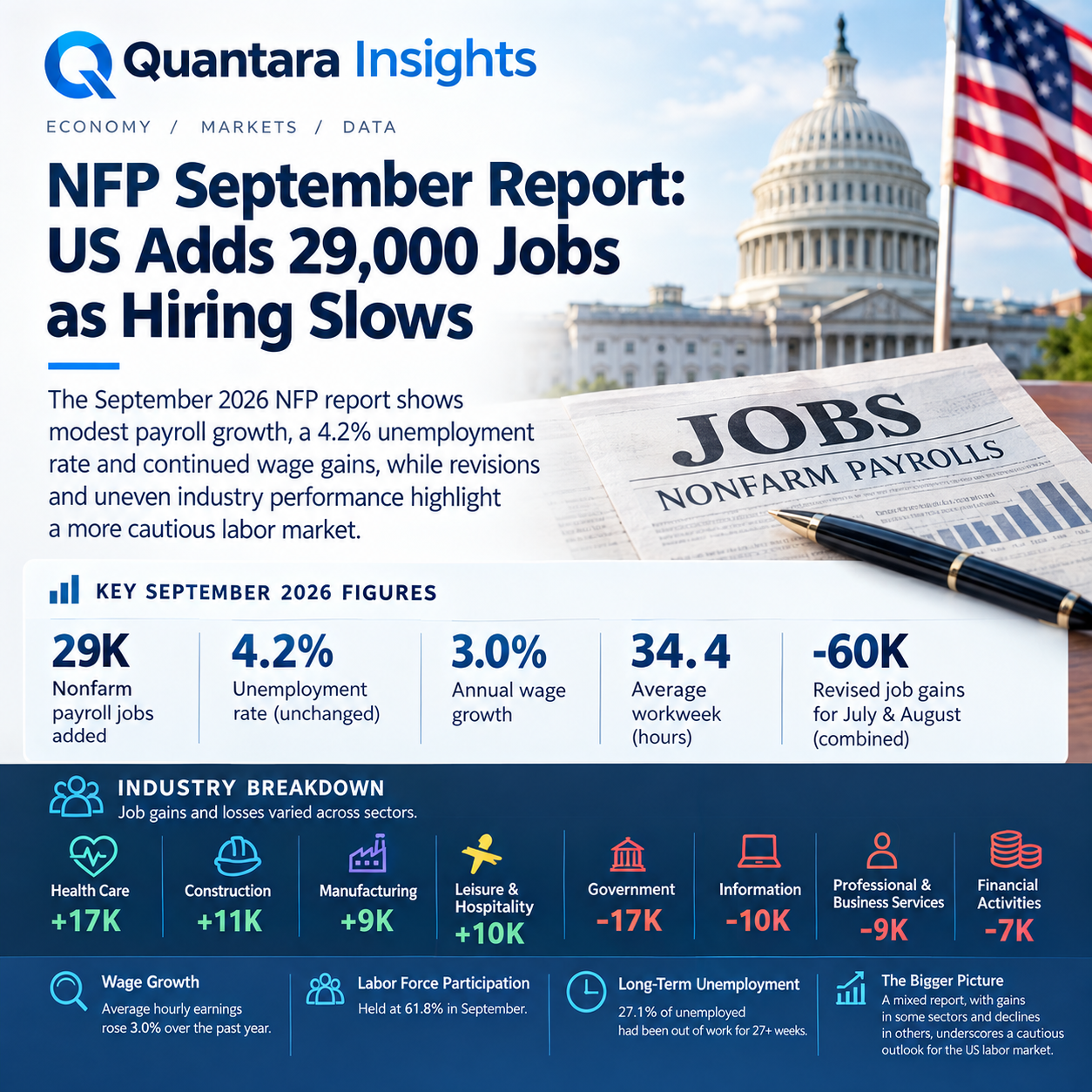
The August US Jobs Report will provide the latest information on nonfarm payrolls, unemployment and wage growth.
The release comes at a particularly sensitive point for monetary-policy expectations.
The labour market has weakened, but inflation remains elevated.
That leaves the Federal Reserve facing a difficult balance between its employment and price-stability objectives.
NFP Expectations
Forecasts for August payroll growth are modest.
The market is broadly positioned for a relatively small increase in nonfarm payrolls, with estimates varying across analysts.
One widely cited expectation is for approximately 45,000 new jobs, while other estimates are somewhat higher.
The July report showed an unexpected decline in payrolls, making the August number especially important.
If August payroll growth remains weak, attention will quickly shift to whether the deterioration represents a temporary distortion or a more persistent weakening in employment.
The Unemployment Rate
The unemployment rate is expected to remain around 4.1-4.2%.
That is still historically low, but the direction matters.
A rise in unemployment alongside weak payroll growth would provide stronger evidence of labour-market deterioration.
By contrast, stable unemployment accompanied by weak payroll growth could suggest that labour supply and participation are influencing the headline picture.
The Economic Report therefore considers the unemployment rate just as important as the payroll number.
Wage Growth Could Shape the Fed Reaction
Average hourly earnings are expected to rise around 0.2% month-on-month.
Wage growth matters because it can influence services inflation and household spending.
If wages accelerate unexpectedly, the Federal Reserve could become more cautious about easing or more concerned about persistent inflation.
If wage growth slows while employment also weakens, markets could interpret the report as evidence that labour-market conditions are becoming less restrictive.
The key is the combination.
A weak NFP number with strong wages would produce a different policy signal from weak payrolls accompanied by subdued wages.
The Economic Report therefore needs to evaluate the employment report as a collection of indicators rather than focusing exclusively on the headline payroll figure.
Payroll Revisions Could Be Critical
Another important feature of the US Jobs Report is revisions.
The previous month’s payroll estimate can be revised significantly.
That means a headline August gain could appear stronger or weaker depending on revisions to July and earlier months.
Investors should therefore compare:
- August payroll growth
- July revised payroll growth
- Three-month average
- Six-month average
- Private payrolls
- Government payrolls
- Unemployment
- Participation
- Average hourly earnings
A low headline number accompanied by positive revisions could be less concerning than a modest headline gain accompanied by downward revisions.
Barclays’ Lower Jobs Forecast Highlights Uncertainty
Some analysts have taken a more cautious approach.
Barclays has projected approximately 25,000 payroll gains, substantially below some broader consensus estimates.
Its reasoning includes the unusually uncertain labour-market backdrop and differences between claims-based models and alternative employment indicators.
The bank has also considered the effect of changes involving Temporary Protected Status and the potential impact on payroll counts.
That illustrates why the August NFP report could be unusually difficult to interpret.
The Economic Report should therefore avoid treating any single forecast as definitive.
Federal Reserve Policy and the Jobs Report
The Federal Reserve is currently dealing with an unusual combination of signals.
Inflation remains above target.
The labour market has weakened.
Economic growth remains relatively resilient.
Financial conditions are not obviously restrictive across every measure.
That creates competing arguments for monetary policy.

A weak Jobs Report could increase pressure for policy support.
But if inflation remains elevated, the Fed may still prefer patience.
This is why the interaction between NFP and inflation data matters so much.
The Economic Report theme is ultimately one of policy trade-offs.
Canadian Jobs Report
Canada’s August employment report will follow the US data on Friday.
The Canadian labour market had a particularly strong July, when employment increased by approximately 75,100 jobs.
The unemployment rate declined to 6.4% from 6.5%.
Over the preceding three months, Canada added roughly 181,000 jobs.
The August report will therefore be examined to determine whether July represented the beginning of a sustained improvement or a temporary jump.
Trade uncertainty could become an important factor in the months ahead.
If businesses become more cautious because of higher trade costs and uncertainty surrounding US-Canada relations, employment growth could weaken.
The Economic Report will therefore treat Canadian Jobs as an important indicator of how trade conditions are affecting domestic demand.
Economic Report: Week in Review
The forward-looking calendar is only part of the market picture.
Several important developments from the previous week have already shaped expectations for central banks and financial markets.
These include RBA minutes, Australian inflation, US PCE inflation, Nvidia earnings, the Bank of Korea decision, ECB minutes, Tokyo CPI and Federal Reserve commentary.
RBA Minutes: Inflation Risks Remain Relevant
The Reserve Bank of Australia minutes showed that policymakers remain alert to upside inflation risks.
Several members believed that inflation risks could materialise and that higher rates might eventually be necessary.
Other members saw offsetting downside risks and preferred additional time to assess incoming data.
The discussion highlighted an important issue: monetary policy can be restrictive while the economy remains vulnerable to supply-side shocks.
The RBA also considered whether another 25-basis-point increase would be appropriate or whether rates should remain unchanged.
The Economic Report interpretation is that the RBA is not committed to a predetermined path.
Future decisions will depend heavily on inflation, labour-market conditions and evidence of domestic demand.
Australian CPI Review
Australian CPI increased 1.0% month-on-month in July, above expectations of 0.8%.
Annual inflation eased to 3.5% from 3.8%, largely reflecting base effects, but remained above the expected 3.3%.
Trimmed-mean inflation also surprised on the upside, increasing 0.5% month-on-month and 3.6% year-on-year.
Domestic services inflation remained elevated.
Fuel, domestic travel and household services contributed to the upward pressure.
The data complicates the outlook for the RBA.
Although annual inflation has eased from its earlier peak, underlying price pressure remains significant.
The Economic Report therefore treats Australia as another example of the central-bank dilemma facing policymakers globally: growth is not necessarily strong, but inflation is not yet sufficiently subdued.
US PCE Review
US core PCE increased 0.2% month-on-month in July, matching expectations.
Headline PCE also rose 0.2%, above the 0.1% forecast.
Annual core PCE remained at 3.3%, while headline PCE was 3.7%.
The data reinforced concerns that inflation remains above the Federal Reserve’s target.
However, the report did not completely alter the policy outlook.
The labour market has weakened enough to provide the Fed with some reason to remain patient rather than immediately tightening policy.
Personal spending increased 0.2%, exceeding expectations, while personal income increased 0.4%.
That suggests households remain relatively resilient.
For policymakers, this creates another complication.
Consumer demand is strong enough to support economic activity, but persistent demand can also make it harder for inflation to return rapidly to target.
The Economic Report therefore views PCE as an important part of the wider inflation picture that will interact with Friday’s Jobs data.
Nvidia Earnings: AI Investment Remains a Major Growth Theme
Nvidia’s latest earnings provided another reminder of the importance of artificial-intelligence investment to the broader US economic outlook.
Shares initially fell following the earnings release as investors considered higher memory-procurement commitments and pressure on near-term margins.
However, the underlying earnings performance was strong.
Data-centre revenue remained a major strength, while the forward revenue outlook exceeded expectations.
Management also provided longer-term guidance that pointed toward continued growth in AI infrastructure demand.
The importance of Nvidia extends beyond one company.
Large technology companies continue to invest heavily in data centres, computing capacity and AI infrastructure.
That spending has broader implications for capital expenditure, productivity expectations and economic growth.
The Economic Report therefore includes AI investment as an important structural theme when assessing US growth.
Bank of Korea Policy Review
The Bank of Korea increased its base rate by 25 basis points to 3.00%.
The decision was not unanimous, with one board member dissenting.
The central bank indicated that inflation could remain above target for an extended period.
Governor Shin argued that the consecutive increase was necessary to address inflationary pressure before it became more persistent.
The distribution of policymakers’ future rate projections also suggested that some members see further tightening as appropriate.
The Economic Report takeaway is that inflation remains sufficiently persistent in South Korea to keep monetary policy restrictive.
ECB Minutes Review
ECB minutes from the July meeting carried a hawkish tone.
The decision to leave rates unchanged was unanimous, but policymakers remained concerned about inflation risks.
Some members favoured an increase.
The discussion highlighted uncertainty surrounding energy prices and the potential impact of gas prices on future inflation.
This is particularly relevant because Europe remains vulnerable to energy-related supply shocks.
The ECB must distinguish between temporary price increases and persistent inflation.
The Economic Report therefore continues to monitor European inflation through both headline and services measures.
Tokyo CPI Review
Tokyo CPI increased 1.9% year-on-year in August.
Core CPI accelerated to 1.8%, while the so-called super-core measure increased to 2.0%.
The data suggested that underlying price pressures remain relatively broad.
For the Bank of Japan, stronger core inflation can reinforce expectations that monetary normalisation will continue.
Tokyo inflation is closely monitored because it often provides an early indication of national inflation trends.
The Economic Report therefore includes Tokyo CPI as an important Asian inflation indicator.
Fed Chair Warsh: Inflation Remains the Central Concern
Fed Chair Kevin Warsh’s Jackson Hole speech placed considerable emphasis on inflation.
He highlighted elevated PCE inflation and argued that underlying inflation trends had not improved sufficiently.
His comments suggested that the Federal Reserve still has more work to do before inflation can be considered fully under control.
Warsh also pointed to resilient economic activity and AI-related capital expenditure.
Financial conditions were described as relatively supportive, with credit spreads, bank lending standards and equity-market conditions providing little indication of severe financial restraint.
Importantly, the speech did not provide explicit forward guidance for the September meeting.
That leaves incoming data as the primary driver of expectations.
The Economic Report therefore places particular importance on the sequence of releases arriving before the Fed’s next major decision.
What the Economic Report Means for Markets
The key question for markets is not whether individual economic releases are strong or weak.
The more important question is what the combined data means for monetary policy.
There are several possible scenarios.
Scenario One: Strong Jobs and Strong Services
If NFP exceeds expectations and ISM Services remains strong, markets could interpret the economy as more resilient than previously assumed.
If inflation also remains elevated, expectations for tighter monetary policy could strengthen.
That could support the US dollar and Treasury yields while creating a more complicated environment for rate-sensitive equities.
Scenario Two: Weak Jobs and Weak Services
If NFP disappoints and ISM Services also weakens, the market could become more concerned about economic momentum.

A weaker labour market would strengthen arguments for monetary support.
If inflation were simultaneously moderating, expectations for easier policy could increase significantly.
Scenario Three: Weak Jobs but Persistent Inflation
This is arguably the most difficult scenario.
A weak NFP number would normally increase expectations for rate cuts.
However, if inflation remains stubbornly high, the Federal Reserve could still resist aggressive easing.
Markets could become more volatile because the two halves of the Fed’s mandate would be sending conflicting signals.
Scenario Four: Strong Jobs and Higher Inflation
This would represent the clearest hawkish combination.
Strong employment, firm wages and persistent inflation could reinforce expectations that monetary policy needs to remain restrictive.
That could place upward pressure on yields and the US dollar.
Why ISM Manufacturing and ISM Services Matter Together
The two ISM reports should not be viewed independently.
Manufacturing provides information about industrial demand, production, inventories, supplier conditions, employment and prices.
Services provide insight into business activity, new orders, employment, input costs and consumer-facing demand.
If manufacturing weakens while services remain strong, the economy may simply be shifting toward services-led growth.
If both weaken, the signal becomes much more concerning.
If both strengthen while prices accelerate, inflation risks become more significant.
The relationship between the two reports is therefore more valuable than either headline number alone.
The Economic Report uses this relationship to assess the broader direction of US economic activity.
Jobs Remain the Key Market Variable
The labour market has become particularly important because employment conditions can influence both consumer spending and monetary policy.
Strong Jobs data supports household income and spending.
Weak Jobs data can reduce demand and eventually place downward pressure on inflation.
However, the relationship is not immediate.
The labour market can weaken gradually while consumer spending remains resilient.
That is why Friday’s report needs to be considered alongside retail sales, personal income, spending, inflation and business surveys.
The Economic Report should therefore be read as a complete macroeconomic picture rather than a single-event forecast.
Economic Report: Key Market Indicators to Watch
Investors and traders will likely monitor several markets closely as the data arrives.
US Dollar
The dollar is particularly sensitive to changes in interest-rate expectations.
Stronger-than-expected employment and inflation data can support the currency by increasing expected rates.
Weaker data can have the opposite effect.
Treasury Yields
Bond yields will provide another important signal.
If markets expect the Federal Reserve to maintain or increase rates, short-term yields may rise.
If expectations shift toward easier policy, yields could decline.
Equities
Equity markets face a more complicated relationship with economic data.
Strong growth can support earnings expectations, but stronger inflation and higher rates can weigh on valuations.
Weak economic data can increase expectations for monetary support, but severe deterioration can damage corporate earnings expectations.
Gold
Gold remains sensitive to real yields, the dollar, inflation expectations and geopolitical uncertainty.
A weaker labour market accompanied by expectations for easier monetary policy could support gold.
However, a stronger dollar and higher real yields could create pressure.
Commodities
Energy prices remain particularly important for the inflation outlook.
Higher oil and gas prices can increase headline inflation and influence central-bank expectations.
Economic Report: What Matters Most This Week
The sheer number of releases can make the calendar appear overwhelming.
In reality, several reports deserve particular attention.
1. US NFP
The August Jobs Report is likely to be the week’s most important release.
The combination of payrolls, unemployment, wage growth and revisions will determine how markets assess the US labour market.
2. ISM Services
Services represent a large part of the US economy.
A stronger or weaker services reading could influence expectations for overall growth.
3. ISM Manufacturing
Manufacturing will provide information about industrial momentum, prices and employment.
The underlying components may matter more than the headline index.
4. Eurozone CPI
European inflation could influence expectations for ECB policy, particularly if energy prices continue to push headline inflation higher.
5. RBNZ Decision
New Zealand’s inflation picture remains elevated, keeping the central bank under pressure.
6. Bank of Canada
The BoC must balance trade-related growth risks against inflation concerns.
7. Canadian Jobs
The Canadian labour market has shown renewed strength, making the August report important for assessing whether that momentum can continue.
Economic Report: A Week Defined by Policy Trade-Offs
The common theme running through this week’s data is the difficulty facing central banks.
The global economy is not presenting policymakers with one clear direction.
In some economies, inflation is still too high.
In others, growth is losing momentum.
In several countries, employment remains relatively resilient even as hiring slows.
Energy prices and geopolitical developments add another layer of uncertainty.
Trade policy creates additional complications for Canada, the United States and other economies exposed to global supply chains.
This means that central banks cannot rely exclusively on backward-looking inflation data or employment numbers.
They need to assess how individual shocks are likely to evolve.
The Economic Report therefore highlights the importance of the details beneath each headline.
Conclusion: Data Will Define the Next Stage of Market Expectations
The first week of September is set to be one of the more important macroeconomic weeks of the month.
The calendar combines US NFP, ISM Manufacturing, ISM Services, ADP employment, eurozone CPI, RBNZ and Bank of Canada policy decisions, Australian GDP, Swiss inflation and Canadian Jobs data.
For US markets, the most important question will be whether the labour market is slowing enough to change Federal Reserve expectations while inflation remains elevated.
The answer will not come from NFP alone.
Investors will need to assess payroll growth alongside unemployment, wages, revisions, private-sector employment and other labour-market indicators.
ISM Manufacturing and ISM Services will provide another important perspective.
Manufacturing has shown signs of moderation, while services activity has remained comparatively resilient. Whether that divergence continues could provide useful information about the underlying direction of the US economy.
Europe faces a different issue.
The eurozone inflation report will provide another indication of how energy prices are affecting headline inflation and whether broader price pressures remain persistent.
New Zealand and Canada will provide important examples of how central banks are responding to different combinations of inflation, growth and trade risks.
The broader Economic Report conclusion is that monetary policy remains highly data dependent.
Markets are likely to respond not simply to whether a number beats or misses expectations, but to what the number means for the future path of interest rates.
That makes the week ahead important for currencies, bonds, equities and commodities alike.
The central question is straightforward:
Are economic conditions strong enough to keep inflation elevated, or are weakening Jobs and demand beginning to provide central banks with more room to adjust policy?
The answer will emerge through the interaction between the week’s major economic releases.
Frequently Asked Questions About the Economic Report
What is the most important economic release this week?
The US August NFP and Jobs Report is likely to attract the greatest market attention. Payroll growth, unemployment, wage growth and revisions will all be important for assessing the US labour market and Federal Reserve policy expectations.
What is NFP?
NFP stands for nonfarm payrolls. It is a major component of the US monthly Employment Situation report and measures changes in employment across nonfarm sectors. The report also contains information on unemployment and wages.
Why is ISM Manufacturing important?
ISM Manufacturing provides information about conditions in the US manufacturing sector, including production, new orders, inventories, employment, supplier deliveries and prices. A reading above 50 generally indicates expansion.
Why is ISM Services important?
ISM Services measures activity across the US services economy. Because services account for a large share of economic activity, the report can provide an important indication of domestic demand, employment and inflation pressures.
What does the Jobs Report tell investors?
The Jobs Report provides information about employment growth, unemployment, wages and labour-market conditions. Investors use these indicators to assess economic momentum and potential Federal Reserve policy changes.
Why do wage numbers matter for interest rates?
Strong wage growth can support consumer spending and may contribute to persistent services inflation. Slower wage growth can reduce inflation pressure. Central banks therefore monitor wage trends when evaluating monetary policy.
Why are payroll revisions important?
Previous payroll estimates can be revised significantly. A weak current reading accompanied by positive revisions may send a different economic signal from a weak reading accompanied by downward revisions.
How can NFP affect the US dollar?
A stronger-than-expected Jobs Report can increase expectations for higher interest rates and potentially support the US dollar. A weaker report can increase expectations for monetary easing and potentially weigh on the currency.
How can ISM data affect markets?
ISM data can influence expectations for economic growth, inflation and interest rates. Strong activity with rising prices can be interpreted as a more hawkish signal, while weaker activity with moderating prices can support expectations for easier monetary policy.
What should investors watch besides NFP?
Investors should watch ISM Manufacturing, ISM Services, ADP employment, unemployment, wage growth, payroll revisions, eurozone CPI, central-bank decisions and other inflation and growth indicators.
Why is eurozone CPI important?
Eurozone CPI provides information about inflation across the currency bloc. The data can influence expectations for ECB policy, especially when energy prices are creating additional inflation pressure.
What is the main issue facing the Federal Reserve?
The Federal Reserve must balance inflation that remains above target with signs that the labour market is becoming less robust. The direction of both variables will influence future policy decisions.
Economic Report: Final Takeaways
- NFP will be the week’s most closely watched US release.
- Jobs data will be important for assessing the health of the US labour market.
- ISM Services will provide insight into the strength of the services economy.
- ISM Manufacturing will offer information on industrial activity, orders, employment and prices.
- Eurozone CPI could provide another signal about European inflation.
- The RBNZ is dealing with inflation that remains above its target range.
- The Bank of Canada must balance trade risks against inflation and growth.
- Australian GDP will help determine whether growth remains resilient.
- Swiss inflation remains relatively subdued.
- Canadian Jobs data will indicate whether recent labour-market strength has continued.
- US PCE inflation remains above the Federal Reserve’s target.
- AI-related investment remains an important structural support for US capital expenditure and growth.
- Central-bank decisions remain highly dependent on incoming economic data.
The central message of this Economic Report is that the September 1-4 calendar is less about one isolated number and more about how several data points fit together.
Inflation, Jobs, growth and monetary policy remain interconnected.
For markets, the most important developments will be the ones that materially change expectations for interest rates.
That makes the combination of NFP, ISM Manufacturing, ISM Services, inflation and central-bank decisions the central focus for the week ahead.