









Table of Contents
- US NFP Payrolls Increase by 165,000 in October
- Unemployment Rate Falls to 4.1%
- Which Industries Drove October Job Growth?
- Average Hourly Earnings Rise to $38.00
- Why Wage Growth Matters for Inflation and the Federal Reserve
- Labour Force Participation and the Employment-Population Ratio
- Long-Term Unemployment and Underemployment Remain Challenges
- Previous Payroll Figures Revised Higher by 84,000
- Understanding the Two Employment Surveys
- What the October NFP Report Means for the US Economy
- The Federal Reserve Faces a More Complicated Rate Decision
- Overall Assessment: A Stronger Labour Market, but Not Without Risks
- Conclusion: October NFP Delivers a Beat from Bottom to Top
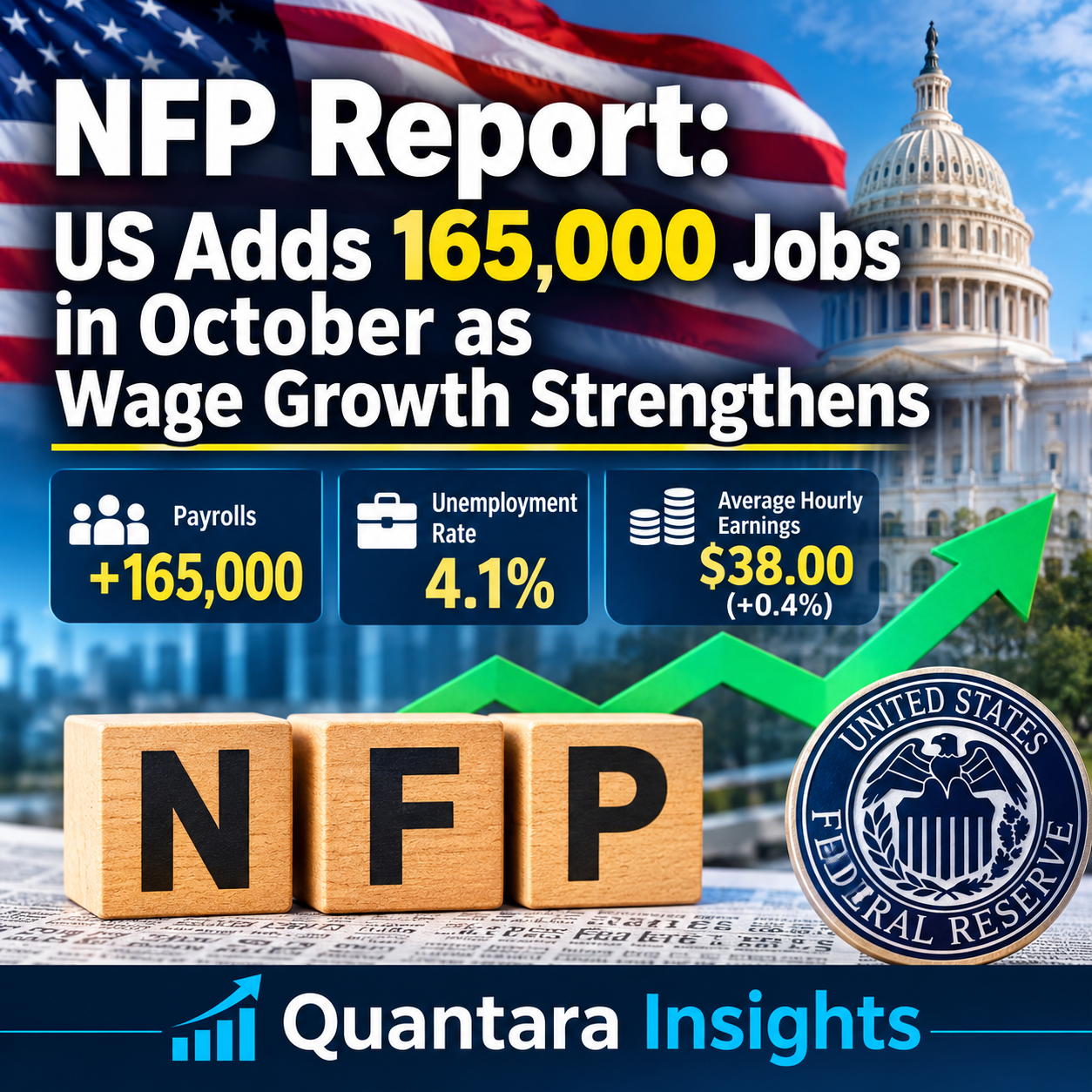
The October NFP report delivered a stronger-than-expected performance from the US labour market, with nonfarm payroll employment increasing by 165,000 and the unemployment rate edging down to 4.1%. Average hourly earnings also accelerated, rising by 0.4% over the month to $38.00, adding another important dimension to a report that points to renewed strength in employment and wages.
The headline payroll increase represents a notable improvement on the relatively subdued pace of hiring recorded in recent months. Before October, nonfarm payroll employment had averaged approximately 48,000 additional jobs per month over the preceding 12 months. October’s increase therefore stands out as a substantial improvement on that recent trend.
The unemployment rate also moved in a favourable direction, declining from 4.2% to 4.1%. Meanwhile, average hourly earnings increased by 14 cents during the month, taking annual wage growth to 3.1%. The combination of stronger hiring, a lower unemployment rate and firmer wage growth makes this NFP release particularly important for investors, economists, employers and Federal Reserve policymakers.
However, the report should not be interpreted as evidence that every part of the labour market has strengthened equally. The employment gains were concentrated in several industries, while measures of underemployment and long-term unemployment continue to highlight challenges for some workers. The distinction between stronger payroll growth and broader labour-market conditions remains important.
The October figures also need to be considered alongside revisions to previous months. Employment growth for August and September was revised higher by a combined 84,000 jobs, improving the picture of recent hiring activity. These revisions suggest that the labour market entered October with more momentum than the previously published figures indicated.
Wage growth is arguably one of the most consequential elements of this release. A 0.4% monthly increase in average hourly earnings is a meaningful acceleration, particularly when considered alongside the stronger payroll result. While higher wages are positive for workers and household incomes, sustained wage acceleration can also attract the attention of policymakers concerned about inflation.
For the Federal Reserve, the October NFP report presents a more complicated policy picture. Stronger employment and wage growth may reduce concerns about an abrupt deterioration in the labour market, but they could also make it harder to conclude that inflationary pressures are easing sufficiently. The next employment report will provide another important data point before the Federal Open Market Committee’s December 8–9 meeting.
Overall, October delivered a stronger employment result than the recent trend suggested. The headline figures point to improved hiring, lower unemployment and stronger wages. Beneath those numbers, however, the composition of job creation, the level of underemployment and the pace of wage growth will determine how sustainable this improvement proves to be.
US NFP Payrolls Increase by 165,000 in October
The central finding of the October NFP report is the increase of 165,000 in total nonfarm payroll employment. This was a substantial improvement on the average monthly gain of approximately 48,000 recorded over the preceding 12 months.
The increase also represents a significant improvement on September’s previously reported gain of 29,000. The October figure suggests that hiring activity strengthened after a period in which monthly employment growth had been relatively modest.
Private-sector employers accounted for the majority of the increase, adding 159,000 jobs. Government employment contributed a further 6,000 jobs. The private-sector result is particularly important because it indicates that the improvement was not primarily driven by government hiring.
The distinction matters when assessing the underlying strength of the economy. Private employers make hiring decisions in response to demand, business conditions, investment plans and expectations about future activity. A stronger private payroll figure can therefore provide useful evidence that businesses are willing to expand their workforces.
October’s result also needs to be viewed against the broader employment trend. A monthly increase of 165,000 is not necessarily enough to establish a sustained acceleration in hiring, but it is clearly stronger than the recent average. If similar gains continue in subsequent reports, the evidence for a more durable improvement would become stronger.
One month of employment data should never be treated as a complete picture of the economy. Payroll estimates are subject to revisions, and monthly results can be affected by seasonal patterns, survey responses and other statistical factors. Nevertheless, October’s increase is large enough to warrant attention.
The report also shows why looking beyond the headline number is essential. Employment growth was concentrated in professional and business services, healthcare, transportation and warehousing, and manufacturing. These industries accounted for much of the monthly improvement.
This concentration does not invalidate the headline gain. It does, however, raise questions about how broadly the improvement is being shared across the economy. A labour market in which several large sectors are hiring strongly can produce a positive national payroll figure even while other industries experience slower growth or little change.
The private-sector increase of 159,000 is therefore encouraging, but the sustainability of the improvement will depend on whether hiring broadens across more industries in the months ahead.
Unemployment Rate Falls to 4.1%
The unemployment rate declined to 4.1% in October, down from 4.2% in September. The decrease provides a second positive signal alongside the stronger payroll result.
The household survey estimated that approximately 7.1 million people were unemployed during October. Although that remains a substantial number of people looking for work, the lower unemployment rate suggests that the proportion of the labour force without a job and actively seeking employment declined.
The unemployment rate is one of the most closely watched indicators in the US labour market because it provides a broad measure of the availability of work relative to the labour force. A declining rate can indicate that more people are finding employment, although changes in labour-force participation can also influence the result.
The October decline is particularly notable because it occurred alongside an increase in the civilian labour force. The labour force expanded by approximately 421,000, while household-survey employment increased by around 463,000.
That combination is more encouraging than a decline in unemployment caused solely by people leaving the labour force. When employment rises and the labour force also expands, it suggests that more people are participating in the job market while the number of people reporting employment is increasing.
However, the unemployment rate does not capture every form of labour-market weakness. It excludes people who are not actively looking for work, and it does not fully describe the circumstances of workers who have jobs but would prefer more hours.
For this reason, the headline rate should be considered alongside broader indicators, including labour-force participation, the employment-population ratio, long-term unemployment and underemployment.
The October unemployment rate of 4.1% is a positive development, but it does not mean that every job seeker is finding work easily. The number of people experiencing prolonged unemployment and the increase in part-time employment for economic reasons show that challenges remain.
The decline is nevertheless consistent with the stronger payroll result. Taken together, the two headline indicators suggest that the US labour market performed better in October than it had in the preceding month.
Which Industries Drove October Job Growth?
The industry breakdown provides important context for the 165,000 increase in nonfarm payrolls. Four sectors accounted for much of the reported employment growth: professional and business services, healthcare, transportation and warehousing, and manufacturing.
Professional and business services recorded the largest increase, adding 70,000 jobs. Healthcare added 42,000, transportation and warehousing increased by 25,000, and manufacturing gained 19,000.
These figures show that October’s improvement was supported by a combination of business services, healthcare demand, logistics activity and manufacturing employment.
The gains were not evenly distributed across the economy. This is important because the strength of a labour market cannot be assessed solely by adding together the jobs created in its strongest sectors. The breadth of hiring also matters.
A broad-based improvement would ideally involve sustained employment growth across a larger number of industries. When a relatively small group of sectors accounts for much of the increase, the headline figure may be more vulnerable to changes in those industries.
Nevertheless, the October sector figures provide evidence of meaningful hiring activity in several important parts of the US economy.
Professional and Business Services Add 70,000 Jobs
Professional and business services recorded the largest employment increase in October, adding 70,000 jobs.
The result was particularly notable because the sector had averaged an increase of approximately 15,000 jobs per month over the preceding 12 months. October’s gain was therefore considerably stronger than its recent monthly trend.
Within the broader category, professional, scientific and technical services added 33,000 jobs. Administrative and support services contributed 28,000, while management of companies and enterprises added 9,000.
The distribution of these gains suggests that the improvement was not confined to one part of the sector. Professional and technical services, administrative support and management-related employment all contributed to the increase.

Professional and business services are important because they provide a wide range of functions to companies across the economy. These include consulting, technical services, staffing, administrative support and management activities.
Employment growth in this sector can reflect demand for business services, changes in corporate operating requirements and companies’ willingness to expand or maintain their workforces.
The sector has also added approximately 269,000 jobs since reaching a low point in October 2025. That longer-term increase provides additional context for October’s result and suggests that the sector has experienced a meaningful recovery from its earlier weakness.
However, the monthly increase should still be assessed cautiously. A particularly strong month does not guarantee that the sector will continue creating jobs at the same pace. Future reports will help establish whether October represents the beginning of a stronger trend or a temporary acceleration.
Even so, professional and business services were the largest contributor to October’s employment growth and played a central role in lifting the overall NFP figure.
Healthcare Employment Increases by 42,000
Healthcare added 42,000 jobs in October, continuing its role as an important source of employment growth.
The sector’s average monthly increase over the preceding 12 months was approximately 31,000. October’s gain therefore exceeded its recent average, although the difference was less pronounced than the acceleration recorded in professional and business services.
Hospitals accounted for 16,000 of the additional jobs. Home healthcare services added 11,000, while outpatient care services contributed another 5,000.
These figures indicate that employment growth was spread across several healthcare activities rather than being concentrated entirely in hospitals.
Healthcare employment is influenced by a range of structural and operational factors, including demand for medical services, staffing requirements, patient volumes and the availability of qualified workers.
The sector can also behave differently from more cyclical industries. While some employers may quickly reduce hiring when economic conditions weaken, healthcare providers must continue meeting ongoing service requirements.
That does not make healthcare employment immune to economic pressures. Providers still face operating costs, funding constraints and staffing challenges. Nevertheless, healthcare has remained an important contributor to overall employment growth.
The addition of 42,000 jobs in October reinforces that pattern. It also highlights the importance of healthcare when assessing the composition of the national payroll increase.
Transportation and Warehousing Add 25,000 Jobs
Transportation and warehousing employment increased by 25,000 in October.
Within the sector, couriers and messengers accounted for 17,000 additional jobs. Air transportation added 4,000.
The sector has gained approximately 104,000 jobs since reaching a low point in February. Couriers and messengers accounted for around 71,000 of that increase.
The figures point to a recovery in employment across parts of the transportation and logistics industry. Couriers and messengers were particularly important to October’s result, representing the largest component of the sector’s monthly increase.
Transportation and warehousing employment can provide insight into activity across the wider economy. Logistics companies support the movement of goods between manufacturers, distributors, retailers and consumers. Changes in hiring can therefore reflect adjustments in shipping volumes, distribution requirements and business activity.
Air transportation employment also contributes to the sector’s performance, although its drivers can differ from those affecting freight and courier services.
The 25,000 increase is a positive contribution to October’s overall payroll result. However, the sector’s longer-term performance will depend on whether the recent recovery can continue and whether demand remains strong enough to support additional staffing.
Manufacturing Employment Rises by 19,000
Manufacturing added 19,000 jobs in October, providing another positive contribution to the employment report.
The sector has gained approximately 101,000 jobs since reaching a low point in December 2025. Within October’s increase, computer and electronic product manufacturing added 7,000 jobs, while machinery and primary metals each contributed 4,000.
The manufacturing result is significant because the sector is often sensitive to changes in business investment, industrial demand, production requirements and economic confidence.
A rise in manufacturing employment can indicate that some producers are increasing staffing levels to meet production needs. However, hiring decisions in manufacturing can also reflect changes in inventories, supply chains, technology investment and expectations about future orders.
The gains in computer and electronic products, machinery and primary metals suggest that several distinct areas of manufacturing contributed to the monthly increase.
The sector’s 101,000-job increase since December’s low point provides a broader indication of improvement beyond the October result. It suggests that the monthly gain forms part of a longer recovery in manufacturing employment.
Still, the sector’s performance should be monitored in subsequent reports. One month of hiring does not establish a sustained industrial expansion, and manufacturing can be particularly sensitive to changes in domestic and international demand.
For October, however, the addition of 19,000 manufacturing jobs strengthened the overall payroll result and broadened the list of industries contributing to employment growth.
Average Hourly Earnings Rise to $38.00
Average hourly earnings were one of the most important elements of the October NFP report.
Wages increased by 14 cents, or 0.4%, during the month, taking average hourly earnings for all employees on private nonfarm payrolls to $38.00.
Over the 12 months ending in October, average hourly earnings increased by 3.1%.
The monthly increase is particularly noteworthy because it represents a stronger pace of wage growth than the 0.1% increase recorded in September. It also moves annual wage growth higher, from 3.0% in September to 3.1% in October.
Wage growth matters for two main reasons. First, it affects household income and consumers’ ability to meet everyday expenses. Second, it can influence inflation, particularly if labour costs rise persistently and businesses pass those costs on through higher prices.
For workers, higher average hourly earnings can improve purchasing power, although the actual effect depends on how wages compare with the cost of living.
A nominal wage increase does not automatically translate into a real improvement in living standards. If consumer prices rise faster than wages, workers may still experience a decline in purchasing power. If wages rise faster than prices, their real income can improve.
The October figures therefore need to be considered alongside inflation data rather than interpreted in isolation.
The increase to $38.00 also provides a useful benchmark for assessing the broader direction of compensation. A 0.4% monthly increase is a meaningful acceleration, especially when combined with a stronger employment result.
For the Federal Reserve, the wage figures may be just as important as the headline payroll gain. Stronger hiring can reduce concerns about labour-market weakness, while stronger wage growth may raise questions about whether labour costs could contribute to persistent inflation.
Production and Nonsupervisory Employee Earnings
Average hourly earnings for private-sector production and nonsupervisory employees also increased in October.
This group recorded an increase of 12 cents, or 0.4%, taking average hourly earnings to $32.75.
The figures are useful because they provide another view of wage developments among a broad group of private-sector workers.
The increase is consistent with the broader acceleration in average hourly earnings. It suggests that the monthly improvement was not limited to the headline average for all private-sector employees.
However, wage data are averages. They do not mean that every worker received a 0.4% increase in October. Individual pay outcomes vary according to industry, occupation, hours worked, experience and employer decisions.
The figures should therefore be understood as an aggregate measure of compensation rather than a direct representation of every worker’s pay rise.
Even with that qualification, the increase is important. Stronger wage growth can support consumer spending, but it may also complicate the inflation outlook if it persists.
Why Wage Growth Matters for Inflation and the Federal Reserve
The relationship between wage growth and inflation is one of the most important issues facing monetary policymakers.
Wages are a major source of income for households and a significant operating cost for many businesses. When workers receive higher pay, they may have more capacity to spend. That can support demand across the economy.
At the same time, businesses facing higher labour costs may attempt to protect profit margins by increasing prices, improving productivity or accepting lower margins.
The effect on inflation depends on several factors. Productivity growth, profit margins, competition, consumer demand and the broader cost environment all influence whether higher wages translate into higher prices.
This is why wage growth should not be treated as an automatic signal of rising inflation. Stronger wages can be consistent with a healthy economy, particularly when productivity improves and price pressures remain contained.
Nevertheless, the October increase deserves attention.
Average hourly earnings rose by 0.4% in October, while annual wage growth reached 3.1%. That is a firmer result than the previous month and could influence how policymakers assess the balance between employment and inflation risks.
The Federal Reserve has a dual mandate centred on price stability and maximum employment. A labour market that is weakening sharply can create pressure to support economic activity. A labour market that is strengthening while wage growth accelerates can make policymakers more cautious about easing financial conditions.
October’s figures may therefore complicate the policy discussion.
The payroll increase of 165,000 and the decline in unemployment to 4.1% suggest that employment conditions were stronger than the recent trend implied. The acceleration in wages adds another reason for policymakers to examine whether demand and labour costs could remain firm.
However, the Fed will not make a policy decision based on one employment report alone. Inflation measures, consumer spending, economic growth, financial conditions and subsequent labour-market data will also matter.
The distinction between a stronger labour market and an inflation problem is important. The October figures show stronger employment and wages. They do not, by themselves, establish that inflation is accelerating or that a rate increase is inevitable.
What they do provide is a reason for policymakers to reassess the risks.
Labour Force Participation and the Employment-Population Ratio
The October report also provides important information about the number of people participating in the labour market.
The labour-force participation rate stood at 61.9%, while the employment-population ratio was 59.3%.
The labour-force participation rate measures the share of the civilian noninstitutional population that is either employed or actively looking for work. It therefore captures more than the unemployment rate alone.
The employment-population ratio measures the share of the population that is employed. It offers another perspective on how much of the population is currently working.
Both indicators are useful because the unemployment rate can decline for different reasons. A lower unemployment rate may reflect stronger hiring, but it can also occur when people stop looking for work and leave the labour force.
In October, the civilian labour force increased by approximately 421,000, while household-survey employment rose by around 463,000.
These changes provide a more constructive context for the decline in unemployment. The labour force expanded rather than contracting, and the number of people reporting employment increased.
Nevertheless, participation remains an important consideration. The participation rate and employment-population ratio have changed relatively little since January, indicating that the improvement in October has not necessarily resolved longer-running questions about the share of the population engaged in work.
A strong payroll result is encouraging, but the broader labour-market picture also depends on how many people are participating and whether those who want jobs can find suitable employment.
The October figures therefore provide a mixed but generally positive message. More people were employed, the labour force expanded and the unemployment rate declined. At the same time, participation and employment-population measures remain important indicators to monitor in future releases.
Long-Term Unemployment and Underemployment Remain Challenges
Despite the stronger headline figures, the October report contains signs that some workers continue to face difficult employment conditions.
Approximately 2.0 million people had been unemployed for 27 weeks or longer. This group represented 27.6% of all unemployed people.
Long-term unemployment is important because the consequences of being without work can become more severe as the period of unemployment increases.
Extended periods without employment can make it harder for people to maintain professional networks, develop experience and compete for new opportunities. Household savings can also become depleted, while financial pressure may increase.
The long-term unemployment figure therefore provides a different perspective from the headline unemployment rate.
A rate of 4.1% may indicate that the overall labour market is relatively stable, but it does not show how long unemployed people have been searching for work or how difficult their job searches have become.
Underemployment is another important issue.
The number of people working part-time for economic reasons increased by approximately 339,000 to 4.8 million in October.
These workers have jobs but are working part-time because of economic conditions or because they cannot obtain full-time employment. Their circumstances differ from those of people who are fully unemployed, but they may still indicate that the labour market is not providing enough hours of work for everyone who wants them.
The broader U-6 measure of unemployment, which includes unemployed people, workers marginally attached to the labour force and people working part-time for economic reasons, stood at 7.9%.
This measure provides a wider view of labour-market underutilisation than the headline unemployment rate.
The report also indicated that approximately 6.0 million people outside the labour force wanted a job. Of these, around 1.6 million were classified as marginally attached to the labour force, including approximately 448,000 discouraged workers.
Marginally attached workers are people who want and are available for work and have looked for a job during the previous 12 months, but have not searched in the most recent four weeks.
Discouraged workers are a subset of this group who are not currently looking because they believe no jobs are available for them or that they would not be able to find work.
These measures matter because the headline unemployment rate does not include people who are outside the labour force and are not actively searching for employment.
The October report therefore presents two realities. The headline labour market improved, but a significant number of people remain unemployed for extended periods, are working fewer hours than they want or are outside the labour force despite wanting employment.
This does not erase the strength of the payroll result. It does, however, show why a complete assessment of employment conditions requires more than one statistic.
Previous Payroll Figures Revised Higher by 84,000
Revisions to earlier employment estimates provided another positive element in the October report.
The August payroll increase was revised from 133,000 to 186,000, an upward adjustment of 53,000 jobs.
September’s increase was revised from 29,000 to 60,000, adding another 31,000 jobs to the previously published estimate.
Together, the revisions added 84,000 jobs to the combined August and September employment figures.
These revisions are important because the first estimate of monthly payroll growth is not final. The Bureau of Labor Statistics receives additional reports from businesses and government agencies after the initial release. It then incorporates those reports into revised estimates.
Seasonal adjustment calculations can also contribute to changes in previously published figures.
An upward revision means that employment growth in the earlier month was stronger than initially reported. A downward revision would indicate that the initial estimate overstated the increase.
The October revisions therefore improve the picture of recent hiring activity.
They also reinforce the strength of the current release. October’s 165,000 increase was not accompanied by downward revisions to the two preceding months. Instead, August and September were both adjusted higher.
This matters when assessing momentum. If October had been strong but the previous two months had been revised sharply lower, the overall picture would have been more mixed.
Instead, the combined upward revisions suggest that the labour market performed better over the late-summer period than the earlier estimates indicated.
Even so, revisions are a normal part of employment reporting. They should be considered alongside the full sequence of monthly results rather than treated as a guarantee that future estimates will also be revised higher.
The key takeaway is that the latest data show stronger hiring in October and a better assessment of employment growth in August and September.
Understanding the Two Employment Surveys
A useful assessment of the NFP report requires understanding that the monthly Employment Situation release draws on two separate surveys.
The establishment survey measures nonfarm payroll employment, hours worked and earnings by industry. It is the source of the headline 165,000 payroll increase and the average hourly earnings figures.
The household survey measures the labour-force status of individuals. It provides the unemployment rate, labour-force participation rate and employment-population ratio.
These surveys measure different aspects of the labour market and should not be treated as interchangeable.
The establishment survey counts jobs. A person holding more than one nonfarm payroll job can be counted more than once in the establishment data.
The household survey counts people according to their employment status. It can include self-employed workers and other categories that are not captured in the same way by the establishment survey.
Because the surveys use different methods and populations, their monthly estimates do not always move in the same direction.
This distinction is especially important when interpreting the October report. The increase of 165,000 refers to payroll employment, while the decline in unemployment to 4.1% comes from the household survey.
Both measures provide useful information, but they answer different questions.
The establishment survey helps explain where jobs are being added, how many payroll positions are increasing and how wages are changing. The household survey helps explain how many people are employed, how many are unemployed and how many are participating in the labour force.
Considering both surveys provides a more complete view of employment conditions than relying on the payroll figure alone.
What the October NFP Report Means for the US Economy
The October NFP report provides evidence that the US labour market strengthened after a period of relatively modest employment growth.
The 165,000 increase in payrolls is substantially above the recent 12-month average of approximately 48,000. The decline in unemployment to 4.1% adds to the positive headline picture, while the increase in average hourly earnings suggests that wage growth also accelerated.
The upward revisions to August and September provide further support for the view that employment growth was stronger than initially estimated.
For the broader economy, employment is important because household income supports consumer spending. Workers who receive wages are able to spend on housing, transport, food, healthcare, services and other goods.
When employment rises, more households may have access to income from work. Stronger wages can also support spending, although the effect depends on inflation and the distribution of income.
October’s figures are therefore positive for the income side of the economy.

However, the report does not establish that every household is experiencing an improvement. Long-term unemployment remains significant, part-time employment for economic reasons increased and millions of people outside the labour force still want work.
The concentration of hiring in a handful of sectors is another consideration. Professional and business services accounted for the largest increase, followed by healthcare, transportation and warehousing, and manufacturing.
A more broadly distributed improvement would provide stronger evidence that hiring momentum is spreading across the economy.
For businesses, the report may suggest that labour demand remains more resilient than the preceding months indicated. Employers in the strongest-performing sectors may continue to compete for workers, while companies in slower-growing industries may remain more cautious.
For workers, stronger hiring and wage growth are encouraging, but the figures do not guarantee that job opportunities will improve equally across occupations or regions.
For investors, the report is particularly relevant because employment and wages can influence expectations about Federal Reserve policy. Stronger economic data can support confidence in the economy, but stronger wage growth may also affect expectations for interest rates.
The overall message is therefore positive but not uncomplicated. The US labour market produced a stronger headline result in October, while several underlying measures continue to point to uneven conditions.
The Federal Reserve Faces a More Complicated Rate Decision
The October NFP report could have implications for the Federal Reserve’s approach to monetary policy.
Before the release, the recent pace of hiring had been relatively subdued. October’s 165,000 increase, combined with the decline in unemployment and stronger wage growth, presents a firmer labour-market picture.
The Federal Reserve must consider both sides of its mandate. It seeks to maintain price stability while supporting maximum employment.
When employment weakens significantly, policymakers may be more concerned about the risk of a deteriorating labour market. When employment strengthens and wage growth accelerates, the discussion can shift towards whether demand and labour costs are consistent with the Fed’s inflation objectives.
October’s report could make policymakers more cautious.
The increase in average hourly earnings to $38.00, together with monthly wage growth of 0.4%, is particularly relevant. If stronger wage growth continues, it may raise questions about the pace at which inflation can return to the Federal Reserve’s objective.
However, the report should not be interpreted as a guarantee of a rate increase. The Fed will consider additional inflation data, consumer spending, economic activity, financial conditions and the next employment release before making its December decision.
The next jobs report will be available before the December 8–9 FOMC meeting, giving policymakers another opportunity to assess whether October’s stronger employment and wage figures represent a sustained change in momentum.
If the next report also shows resilient hiring and firm wage growth, the case for a more cautious policy stance could strengthen. If employment growth moderates or inflation data show further progress, policymakers may reach a different conclusion.
The October report has therefore increased the importance of the remaining economic data before the December meeting.
Overall Assessment: A Stronger Labour Market, but Not Without Risks
October’s employment figures represent a clear improvement on the recent trend.
Nonfarm payroll employment increased by 165,000, well above the preceding 12-month monthly average of approximately 48,000. The unemployment rate declined to 4.1%, while average hourly earnings rose by 0.4% to $38.00.
The improvement was supported by professional and business services, healthcare, transportation and warehousing, and manufacturing. Upward revisions to August and September also strengthened the assessment of recent employment growth.
These are meaningful positives.
The report nevertheless contains important qualifications. Long-term unemployment remains elevated, the number of people working part-time for economic reasons increased, and millions of people outside the labour force continue to want a job.
The industry breakdown also shows that hiring was concentrated in a relatively small number of sectors. The coming months will help determine whether the improvement spreads more broadly.
Wage growth is the most important issue for the Federal Reserve. The 0.4% monthly increase in average hourly earnings is a notable acceleration and could influence the central bank’s assessment of inflation risks.
The report does not prove that inflation will rise or that interest rates must increase. It does, however, make the next set of economic releases more consequential.
Conclusion: October NFP Delivers a Beat from Bottom to Top
The October NFP report delivered a strong result across several of the labour market’s most important indicators. Employers added 165,000 jobs, unemployment declined to 4.1%, average hourly earnings increased by 0.4% and previous payroll estimates were revised higher by a combined 84,000.
This is a beat from bottom to top. The improvement was visible in the headline payroll number, the unemployment rate, wage growth and revisions to previous employment data. The figures collectively suggest that the US labour market entered October with more strength than the recent trend had indicated.
The wage component, in particular, will certainly make the Federal Reserve look twice. Average hourly earnings rising by 0.4% in a single month, with annual growth reaching 3.1%, is a development policymakers will need to consider carefully. Stronger wages are positive for workers and household income, but sustained acceleration could make the inflation outlook more complicated.
The Fed will receive another jobs report before the December 9 FOMC decision. That release will be important in determining whether October’s improvement represents a one-month rebound or the beginning of a more durable strengthening in employment and wage conditions.
Nevertheless, this October report is likely to make a December rate hike more plausible than it appeared under the weaker hiring trend of recent months. A stronger labour market, falling unemployment and accelerating wages give policymakers less reason to assume that employment conditions are deteriorating and more reason to remain alert to inflation risks.

That does not mean a rate increase is certain. The Federal Reserve will still need to assess the next employment report, inflation figures and wider economic conditions before deciding its next move. But October has clearly shifted the discussion.
For now, the central takeaway is that the US labour market has delivered a stronger-than-expected performance, and wage growth has emerged as a key factor for the Fed to consider. The next jobs report will help determine whether this momentum is sustained and whether the central bank needs to respond with a more restrictive policy stance.
Editorial note and disclaimer: This article is an independent analysis of the October 2026 US Employment Situation data. Employment estimates are subject to revision, and individual labour-market indicators may provide different perspectives on economic conditions. The information is provided for general news and educational purposes only. It does not constitute financial, investment, trading or economic advice, nor should it be relied upon as a recommendation to buy, sell or hold any financial instrument. Readers should conduct their own research and consult a qualified professional before making financial or investment decisions.