









AI spending frenzy market outlook is now the defining narrative for global markets as Wall Street celebrates the Dow Jones Industrial Average crossing the historic 50,000 mark—while quietly confronting rising economic anxiety beneath the surface. The milestone, though symbolically powerful, obscures a market increasingly fractured between AI beneficiaries and AI spenders, optimism and caution, growth ambition and balance-sheet reality.
What once looked like a unified AI-driven rally has evolved into a selective, volatile environment where capital discipline matters as much as technological leadership. As investors turn their attention to labor data, inflation prints, and earnings guidance, the central question has shifted from who will win the AI race to who can afford it.
📊 MARKET RECAP: Dow 50,000 Reached as Market Divergence Widens
Wall Street closed the week with headlines blazing as the Dow Jones Industrial Average surged to 50,115.67, posting a powerful 2.47% single-day gain. The achievement marks the first time in history the index has breached the 50,000 threshold—a psychological milestone that reinforces the long-term resilience of U.S. equities.
Yet beneath the celebratory surface, market internals tell a more complicated story.
- S&P 500: 6,932.30 (+1.97%)
- Nasdaq Composite: 23,031.21 (+2.18%)
Despite Friday’s surge, weekly performance painted a far more cautious picture:
- S&P 500 slipped 0.1% on the week
- Nasdaq fell 1.84%
This divergence highlights a market torn between confidence in AI’s transformative power and growing discomfort with its immense cost structure.

🧠 AI Trade Evolves: From Broad Rally to Selective Leadership
The rally was once again powered by semiconductor leaders, with Nvidia at the forefront as demand for AI-processing chips continues to exceed supply. These firms represent the “picks-and-shovels” of the AI gold rush—earning revenue without shouldering the full burden of infrastructure investment.
However, the other side of the AI equation delivered a stark warning.
Amazon shares dropped 5.55% after the company revealed plans for approximately $200 billion in capital expenditures, largely aimed at expanding AI and cloud infrastructure. While the long-term strategy remains intact, investors reacted swiftly to the near-term implications for margins, free cash flow, and return on invested capital.
This reaction underscores a new reality:
Markets are no longer rewarding AI ambition blindly.
📉 BONDS, DOLLAR & CRYPTO: Markets Pause Ahead of Key Data
Treasury markets reflected investor hesitation ahead of critical economic releases.
- 10-Year Treasury Yield: 4.206% (slightly higher)
- 2-Year Treasury Yield: 3.4955% (lower)
The mixed movement suggests uncertainty around the Federal Reserve’s next steps, with traders awaiting confirmation on whether inflation continues to cool without destabilizing employment.
The U.S. dollar index slipped 0.21%, losing some of its safe-haven appeal as equities and bitcoin rebounded. The euro strengthened to $1.1823, while the dollar remained steady against the yen near 157.08.
🪙 COMMODITIES: Gold Shines as Oil Ticks Higher
Gold staged a sharp rebound, rising 3.85% to $4,953.76 per ounce, driven by:
- Bargain hunting after recent pullbacks
- A softer U.S. dollar
- Renewed geopolitical uncertainty, particularly around stalled U.S.–Iran negotiations
Oil prices also edged higher, with Brent crude climbing to $67.91 per barrel, reflecting concerns that diplomatic setbacks could threaten Middle Eastern supply flows.
🗓️ THE WEEK AHEAD: A Macroeconomic Stress Test
The coming week represents a macroeconomic crucible for markets already on edge.
🔔 Federal Reserve Spotlight
Fed officials will dominate early-week commentary, with particular attention on:
- Governor Christopher Waller’s digital assets discussion
- Governor Stephen Miran’s remarks on business dynamics
- San Francisco Fed President Mary Daly, who recently flagged “vulnerabilities” in the labor market and suggested room for one or two additional rate cuts if conditions soften
Any shift in tone could materially alter market expectations.
📊 DATA WATCH: Jobs, Inflation, and Consumer Strength
Employment Report (Wednesday)
- Nonfarm Payrolls: +70,000 expected
- Unemployment Rate: 4.4%
- Wage Growth: 3.6% year-over-year (down from 3.8%)
A moderation in wage growth would support the disinflation narrative the Fed is hoping to validate.
Consumer Price Index (Friday)
- Headline CPI: 2.5% expected
- Core CPI: 2.5% expected
A confirmation of easing inflation could reinforce expectations of policy flexibility later in the year.
Additional reports include Retail Sales, Jobless Claims, and Housing Data, each contributing to a clearer picture of whether the economy is cooling smoothly—or sliding faster than anticipated.
🌍 GLOBAL SNAPSHOT: Canada & International Markets
Canada’s economy delivered mixed signals:
- 24,800 jobs lost in January
- Unemployment rate fell to 6.5%, a 16-month low
The paradox reflects a shrinking labor force rather than robust job creation, with manufacturing particularly affected by tariff pressures.
Meanwhile, Canadian equities surged alongside global markets, powered by strength in materials and precious metals.
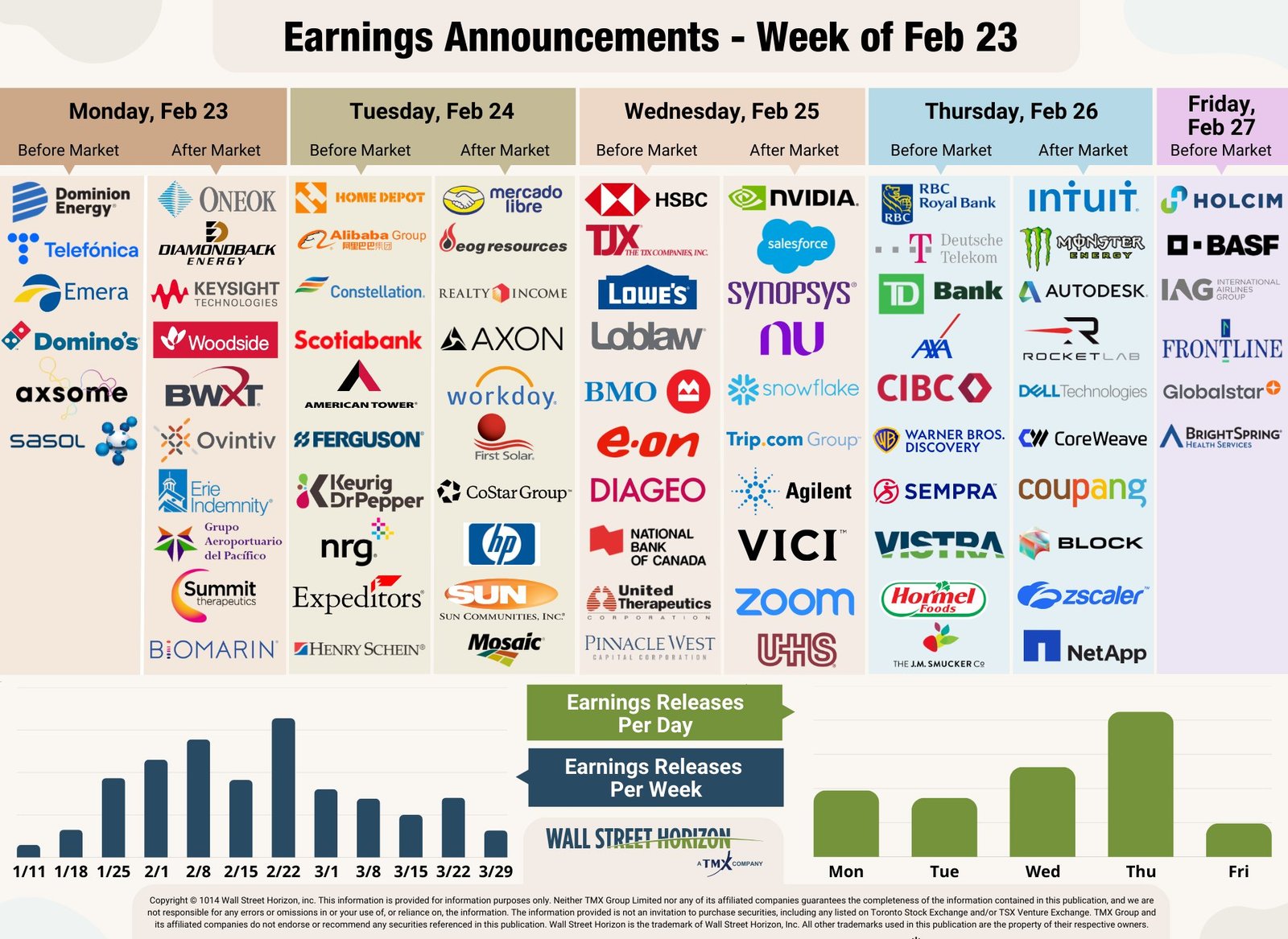
💼 EARNINGS PREVIEW: AI ROI Meets Consumer Reality
Earnings season enters a decisive phase, testing two major themes:
- Can AI spending generate acceptable returns?
- How resilient is the consumer?
🔧 Big Tech & Infrastructure
- Cisco Systems: Expected revenue growth of ~8%, benefiting from AI infrastructure demand
- Rivian: Forecast 26.5% revenue decline as EV subsidies fade
🛍️ Consumer Health
- Hasbro & Mattel: Modest holiday-driven gains expected
- Spotify: Potentially slowest revenue growth on record
- Masco & IFF: Weak demand tied to inflation fatigue
🏥 Healthcare Focus
- CVS Health & Humana: Scrutiny on medical cost trends following industry-wide margin pressure

🧨 TOP THEMES SHAPING 2026 MARKETS
1. The $600 Billion AI Spending Question
Big Tech is projected to spend $600 billion on AI-related capital expenditures in 2026, intensifying investor concern around market concentration, balance-sheet strain, and narrowing leadership.
2. Regulation & Geopolitics
- Antitrust scrutiny intensifies in media and tech
- Semiconductor supply bottlenecks stretch global lead times
- Arctic geopolitics heat up as nations reposition strategically
3. Disruption Accelerates
- Low-cost pharmaceutical alternatives challenge incumbents
- Private equity remains active in infrastructure assets
🇨🇦 CANADA MARKET MONITOR: Resources vs Reality
Canada’s equity rally contrasts with labor softness, highlighting the country’s exposure to global commodity trends and international capital flows. Wage growth slowed to 3.3%, offering some inflation relief but raising concerns about domestic demand.
🔍 INSIGHT: The Great Market Fracture
The AI spending frenzy market outlook reveals a market no longer unified by enthusiasm alone.
The New Divide:
- AI Enablers: Semiconductor and infrastructure suppliers with pricing power
- AI Spenders: Mega-cap platforms facing years of elevated capex
The Macro Overlay:
- Consumers are selectively pulling back
- Labor markets are cooling
- The Fed is constrained by data dependence
🧭 CONCLUSION: Dow 50,000 Is a Milestone—Not a Destination
The Dow’s breach of 50,000 represents a historic achievement, but not a declaration of economic invincibility. Instead, it marks a turning point—the transition from AI promise to AI accountability.
Markets are entering a phase defined by selectivity, discipline, and macro sensitivity. The winners will not simply be those investing the most in artificial intelligence, but those converting investment into sustainable returns.
As new data and earnings roll in, investors will learn whether 50,000 is a foundation—or a summit before renewed volatility.