


Global Financial System at a Crossroads is no longer a theoretical concept—it is the defining condition of modern markets. Capital flows, monetary authority, corporate power, and geopolitical influence are being reshaped simultaneously, creating a financial environment where stability and disruption coexist in uneasy balance.
What once moved in cycles now shifts in ruptures. Technology accelerates faster than regulation. Politics intrudes more directly into markets. And global integration, once assumed irreversible, is giving way to fragmentation and strategic realignment.
This is not merely a period of volatility. It is a systemic transition.
I. A World in Flux: Markets, Power, and the AI Inflection Point
As markets closed another turbulent week, financial behavior reflected deeper structural tensions rather than short-term catalysts. Equity indexes moved unevenly, not because of a single macro signal, but due to competing forces pulling capital in opposite directions.
Artificial intelligence remains a powerful narrative driver, yet markets are increasingly discriminating between technological potential and institutional readiness. The sharp repricing of a major semiconductor firm demonstrated how quickly confidence can evaporate when operational reality collides with strategic ambition.
This moment illustrates a broader truth: technological revolutions do not eliminate economic friction—they redistribute it.
Supply chains, energy availability, skilled labor, and geopolitical access now determine whether innovation translates into durable advantage. Markets are no longer rewarding vision alone; they are rewarding execution within constraint.
II. Currency Volatility and the Return of Sovereign Influence
Away from equity headlines, currency markets revealed the renewed power of sovereign intervention. Sudden volatility in the Japanese yen served as a reminder that central banks remain active participants, not passive observers.
Interest rate divergence, once a technical consideration, has become a geopolitical lever. Currency stability now intersects with national competitiveness, debt sustainability, and political legitimacy.
This environment has consequences:
- Currency moves increasingly reflect policy signaling, not just market forces
- Capital mobility is becoming conditional
- Investors must now price intervention risk alongside traditional macro indicators
The era of predictable foreign exchange regimes is fading, replaced by tactical flexibility and strategic ambiguity.
III. Safe Havens, Tangible Assets, and the Psychology of Risk
In periods of systemic uncertainty, investor psychology often reveals more than economic data. The persistent rise in precious metals underscores a collective reassessment of risk, trust, and permanence.
Gold and silver are not merely reacting to inflation expectations; they are responding to institutional uncertainty—questions about fiscal discipline, geopolitical stability, and technological displacement.
The renewed appeal of tangible assets signals:
- Skepticism toward purely digital value
- Concern over geopolitical escalation
- A desire for assets outside policy control
This is not fear-driven behavior—it is strategic hedging in an era of layered risk.
IV. Corporate Strategy in an Age of Constraint
Corporate decision-making has entered a new phase defined less by expansion and more by positioning. Large technology firms, industrial leaders, and consumer giants are reassessing their strategic assumptions.
AI adoption highlights this shift. For some companies, it represents operational leverage. For others, it exposes structural weaknesses—aging infrastructure, regulatory exposure, or talent shortages.
Meanwhile, platform-based business models face increased scrutiny. Regulatory frameworks are tightening, labor definitions are evolving, and data governance is no longer optional.
Corporate success now depends on:
- Political awareness
- Regulatory adaptability
- Supply-chain resilience
- Social legitimacy
Markets are no longer separate from society—they are embedded within it.
V. Central Banks and the Limits of Monetary Authority
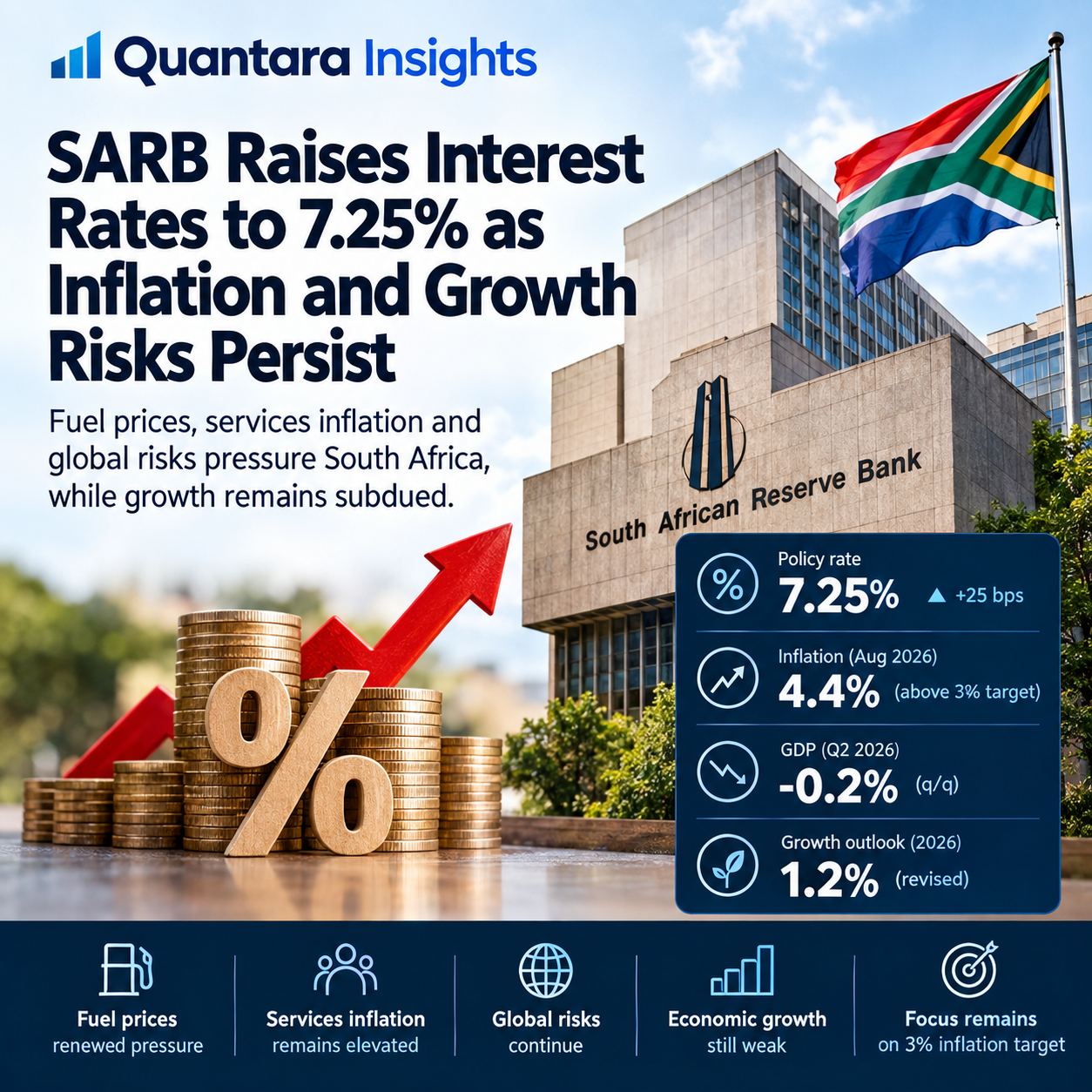
Central banking has entered a more constrained era. Policy tools remain powerful, but their effectiveness is increasingly shaped by external forces: geopolitics, fiscal expansion, and public expectation.
Holding rates steady is no longer a neutral act—it is a signal laden with interpretation. Each statement, pause, or adjustment now carries political and economic weight beyond traditional mandates.
Globally, monetary authorities face a shared dilemma:
- Act too aggressively and risk destabilization
- Act too cautiously and risk loss of credibility
The post-crisis monetary consensus has fractured, replaced by region-specific strategies and heightened communication sensitivity.

VI. Geopolitics as a Core Market Variable
Geopolitical analysis has moved from the periphery to the center of financial strategy. Trade policy, territorial disputes, sanctions, and alliance shifts now influence asset pricing directly.
Markets are adjusting to a world where:
- Economic efficiency competes with national security
- Supply chains are evaluated through political lenses
- Strategic autonomy matters as much as cost
This reality demands a new analytical framework—one that treats geopolitics as endogenous to markets, not external noise.
VII. Canada as a Reflection of Global Forces
Canada’s market dynamics offer a microcosm of global transformation. Resource sectors benefit from geopolitical demand and technological inputs, while financial institutions remain sensitive to cross-border policy alignment.
Consumer data reflects resilience alongside caution. Corporate restructuring highlights interdependence. Strategic partnerships increasingly cross national lines, reinforcing both opportunity and vulnerability.
Canada’s experience mirrors a broader truth: mid-sized economies feel global shifts faster and more acutely.
VIII. Regulation, Society, and the Corporate Social Contract
Legal challenges, labor rulings, and platform restrictions illustrate a redefinition of corporate responsibility. Governments are asserting greater influence over how innovation unfolds.
This regulatory recalibration reflects societal pressure:
- Transparency over opacity
- Accountability over scale
- Stability over unchecked disruption
Technology firms, energy producers, and gig-economy platforms now operate under heightened expectations—not just to generate value, but to justify it.
IX. Synthesis in an Age of Fragmentation
The global financial system is being reshaped by overlapping syntheses:
Innovation and Constraint
Progress accelerates even as boundaries tighten.
Integration and Fragmentation
Global networks persist, but trust is selective.
Markets and Power
Capital flows increasingly reflect political alignment.
Growth and Legitimacy
Economic success now requires social acceptance.
These forces do not resolve neatly—they coexist, collide, and evolve.

Conclusion: Navigating the Whirlwind
The global financial system stands at a crossroads defined not by a single crisis, but by continuous transformation. Markets, institutions, and policymakers must now operate in a world where certainty is scarce and adaptability is paramount.
Success belongs to those who understand systems, not silos—who recognize that technology, policy, geopolitics, and markets no longer move independently.
In this environment, the future is not forecasted.
It is negotiated—day by day, decision by decision—within a world where everything is connected.